Pull the engine revs up near the power peak as you feed the clutch in.
Remember, off idle this thing has about enough power to blow you a kiss from two
paces. Rev, then slide the clutch through most of first gear to keep the engine
pulling strong. For a Bonnie and Clyde blast-off, be careful. Don't let those
revs fall too far, or else the engine's power will go out like a light, delaying
your launch. Unacceptable! Keep that tach needle flashing above 5000.
On a straight piece of road, you're almost violating the 9000-redline in
fifth gear. A tight, 90-degree left-hander pops up on the horizon. Full
attention, please. Apply binders. You get the brakes on hard as
the turn closes in on the Gamma. You can't be clumsy with the rear brake; it
rewards the heavy-footed by locking up. The superb front brakes, sticky tires
and forward-mounted engine set the Gamma's behaviour terms under forceful
braking. Since weight seems to transfer to a point under the front axle, you
just touch the rear brake pedal. Elevating the rear tire under
hard braking is neither unthinkable nor impossible. Watch for mono-wheeling,
front-end style.
Here's the corner, now. Ease off the brakes slightly just as
you toss the Gamma in to the left. Pitch decisively, but be smooth. Too much
front brake during the turn-in and the light rear end will momentarily feel as
if it's on a side excursion. Ragged riding at this crucial moment will have you
cultivating in the roadside ditch.
This Gamma game room has a ceiling about 2000 rpm above its floor. Levitate
in this space by dancing with the gear shift lever. Be in the right gear at the
right time, and you'll be okay. Screw up - and you're on the floor.
Don't forget where this arcade game is going, either, right through the apex
of a corner.
Get back on the power when positive messages come up from the tires, and let
the bike arc toward the outside of the pavement as you reach full throttle. Now
snick/snick, third/fourth, before you nick the close-ratio six-speed back for an
instant to enter the second turn, an 80-mph right-hand sweeper, a corner where
momentum is the key. It exits onto a lengthy sixth-gear straight.
After you swoop through the right, tuck in while the tach needle waivers at
redline in top gear. Be alert. It's time to dive back through the gears and
brake for a left-right-left multi-speed combination. Don't be too aggressive;
the rear wheel has to stay on the surface. The first left is a fourth-gear
sweeper which dumps into a third-gear right. Quick, cooperative steering is
mandatory on this left-right combo: because the brakes are on all the way
from the entrance to the left until you peel off for the right. The 16-inch
front wheel eases the effort to get the hard-worked front tire to do what it
must - turn-brake-stick.
The Gamma does the left-right flip with a touch of "top-side." For a fleeting
instant the bike gets feathery when it's un-weighted during the transition, a
trait shared by all lightweight, race-bred machines. Nothing to get excited
about. It just registers in the pit of your stomach. Concentrate. Exit the
third-gear left. Hey, nice combination. Nice bike. Oops. Stay to the right for
the approaching second-gear left-hand hairpin; set up for a late apex, because
you'll get the maximum drive down the following long straight. Brakes. Careful.
Pitch. In and out. Neat! Getting through these corners like a beam of light
reflected from mirror to mirror is the key to finishing first at the end of the,
at the end of the, well, road.
Road? The hell you say. Yes, that's right, road, and on a street bike
no less. One complete with lights, turn indicators, battery, horn and license
plate. The messages sent up from the bike, the feedback from its aggressive,
surefooted, responsive manner speaks racetrack. But you're out there
laughing at those other poor fools who are yanking on lumbering, everyman
motorcycles. What an embarrassment you are for them with this 250. If they only
knew. They've been working with cannons. You've had a ray gun.
It's doubly embarrassing to them when they realize the bike you're riding is
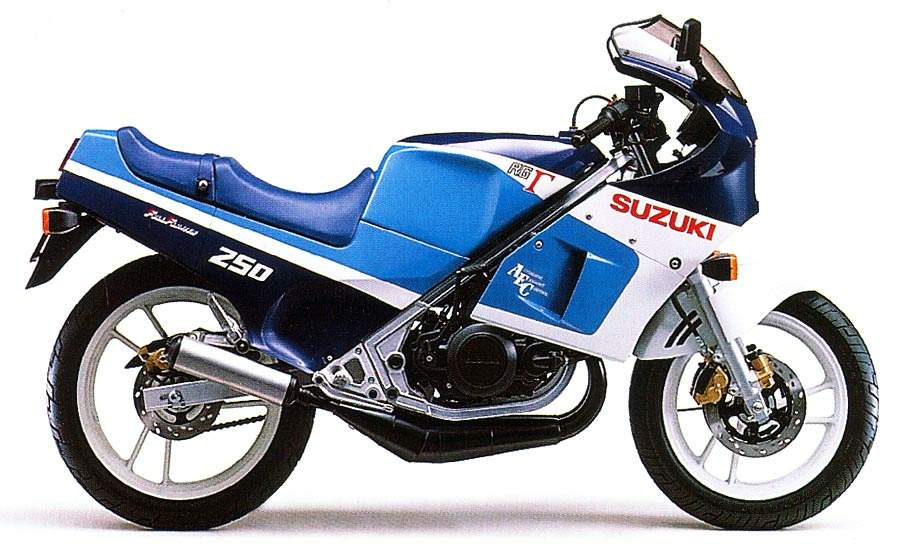
only a 250. Suzuki's RG-Gamma does more than share a name; it carries the repli-racer
connection beyond that of any other street-runner ever tried by Cycle. It
doesn't merely look like the World Championship-winning model; it is, in
many respects, the same. Never mind-that it only displaces 250cc or makes a
modest 30 horsepower at the rear wheel. This 250 is Gamma-like because as it
goes down the highway it responds to rider commands with the same kind of
directness that its namesake, the RG500 Gamma, would on the racetrack. Never
before has a motorcycle been so successful echoing the latest war whoop from the
Grand Prix circuits.
Look at this pint-sized Gamma. You've seen it before at places like Imola,
Nurburgring and Silverstone. Lots of today's sport bikes have square-section
frames, but they're mild steel stuff. Now ask yourself what factory ever raced
one made of steel. Exactly none. And how many street bikes have you seen with
aluminum frames? None, unless you take the time to look at the RG250 Gamma.
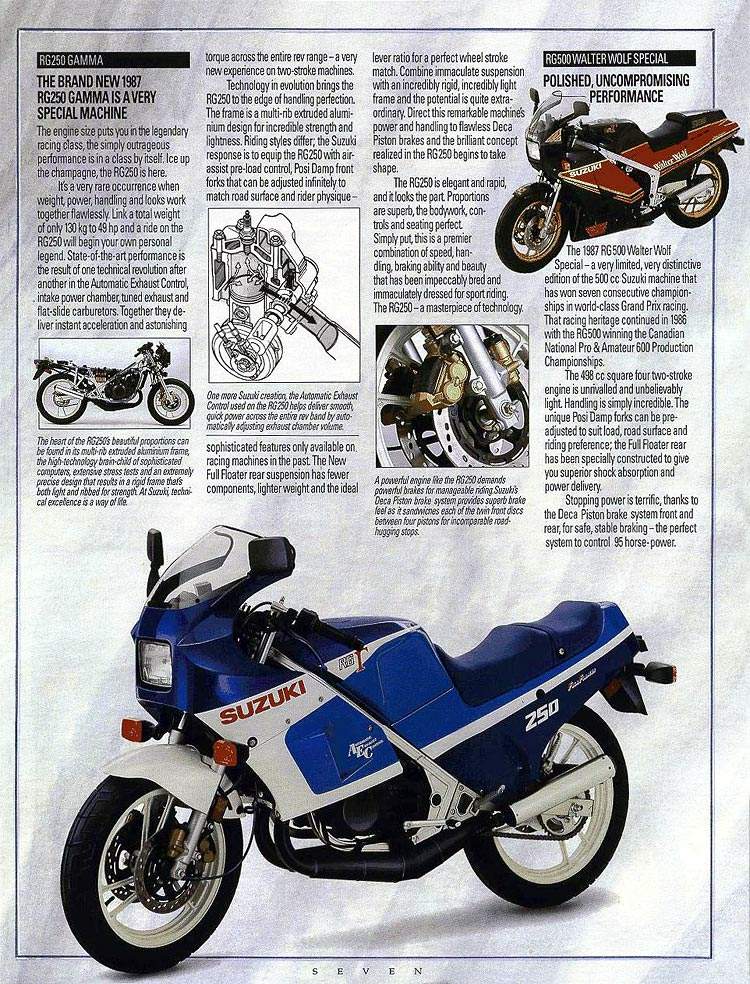
Suzuki has made the Gamma's entire chassis from aluminum, from the fairing
mounting tabs welded to the steering head to the seat brackets at the rear. All
the welds on the RG, whether easily visible or not, look like the work of a
Michelangelo of torch and rod. These Suzuki guys actually mass-produce these
things. Though its construction bears many similarities with its
championship-winning brother, concessions to production-line practicalities do
exist.
In those areas where the swing arm and Full Floater suspension anchor, the
RG500 race-bike frame is built up from aluminum plate and hollow extrusions
welded together; the 250 Gamma uses die-cast aluminum plates welded in place.
The die-castings, which also serve as the mounting points for the
footpeg/muffler carrier, are not solid, inch-thick plates as they appear. Their
backsides are hollow with stress-carrying ribs. Light and strong, these castings
are labor saving devices for the chassis builders. They're also gorgeous. Any
extras for ashtrays?
The RG's steering-head angle is a steep 24.7 degrees, the four inches of
trail middle of the road. The steep rake follows current racing design practice.
On the racetrack, where a rider must be able to change the motorcycle's
direction at the speed of thought (or faster), steep rake angles are mandatory.
The four inches of trail is more than an engineer might use on a racer, but on a
street bike it's necessary because normal riders should have a lot of
self-contained, built-in high-speed stability. Race riders learn to cope.
On the 250 Gamma, front and rear suspension are well balanced, though both
seem a trifle light on rebound damping near suspension top-out. Suzuki has
already adapted the GP-Gamma's Full Floater system on many new models, street
and off-road. The company has the single-shock rear system down pat on the Gamma
250, and it matches up to the fork, a 36-millimeter, 5.1-inch travel unit with
Suzuki's ANDF (Anti Nose Dive Fork) system. A steel fork brace, concealed
beneath the front fender, adds more rigidity. On the 250, braided stainless
steel lines connect the brake calipers to the ANDF activating pistons. These
lines don't flex, and as a result, the front brake lever vagueness, so
characteristic of many ANDF Suzukis, has been reduced.
With the exception of the shock, the superb Full Floater uses almost entirely
aluminum sheet and forgings. The effective suspension suits perfectly the abuse
the RG250 invites—busting down backroads as fast as the rider and motorcycle can
go, GP style. A remote preload adjustment knob located below the side-cover aids
preload tuning, but the engineering department left no provision for adjusting
either compression or rebound damping. Rear suspension travel measures a
moderate 4.8 inches, but in light of the rather quick front-end geometry, that's
probably a good thing. Were road surfaces bad enough and speeds sufficient,
great deflections with long-travel suspension might upset the bike's geometry,
and the rider would receive a wobble-message telegraphed to the handlebar.
The gold-finished dual-piston brake calipers are the same excellent units
fitted to the 1983 GS550ES series. The front brake system, apparently a direct
carry-over (minus a little black paint), ranks among the best of the Japanese
OEM stoppers. Your imagination probably can't do the stopping force of these
brakes justice when they're cinched on the Gamma. Five-fifty owners, put this in
your files—the Gamma weighs 140 pounds less than a GS550. The rear caliper-rotor
combination is a .250-Gamma exclusive. Considering the front brake's phenomenal
power, the rear brake has a light work load, not that you'd want a highly
excitable brake on a wheel that can get airborne under heavy-duty braking
anyway. The small brake rotor saves considerable weight in a place where it
really counts. Comparatively, front/rear brake size is yet another similarity
between the deadly-serious 500 GP and the all-for-fun 250. Those product
planners in Hamamatsu knew what the world's street demons would be doing with
the little Gamma.
Down in the engine bay, the similarities between the real and the road Gammas
end. Building a 250cc version of the disc-valve 500 square-four would have been
outrageously expensive and stupid. Suzuki would have had to mortgage their
General Motors stock to have done it, and were it done, the engine would be a
500. There's nothing too fancy in the RG250 Gamma's parallel twin. The 54 x 54
Gamma has bore and stroke dimensions identical to the latest production 125cc
motocross engine, and the RG utilizes Suzuki's Power Reed (case reed) intake
system. A pair of equalized 28-millimeter flat-slide Mikuni carburetors feed the
cylinders and draw air from a huge airbox fitted with an oiled foam element.
Since the Gamma is a small bike with a single-shock rear suspension,
components like the airbox and battery must be herded carefully into existing
space. We'll bet the engineers who managed to get 10 pounds of components into a
five-pound hole ride up and down 10-man elevators in packs of 15.
The one-piece cylinder head with its integrated thermostat housing has
squish-band combustion chambers.
Compression ratio is 7.1:1. Below the head, the individual iron-lined
cylinder assemblies flow coolant in the most efficient way possible. From the
water pump, coolant goes through the upper half of the horizontally split
crankcase and directly to the bottoms of the cylinders below the exhaust port,
the hottest point of the engine.
That's right. The crankcases are in part liquid-cooled, but more important,
the coolant, having been drawn out of the radiator by the pump, goes pretty
directly to the area in greatest need of cooling. That makes more sense than
running the coolest water into the cylinder heads preheating it before it
reaches the exhaust area. Coolant then passes up through the cylinder, through
the head and to the top of the single-core radiator. No auxiliary cooling fan
clutters the RG; it is, after all, built to be in motion.
The six-speed transmission operates through a seven-plate wet clutch driven
via a helical gear off the right side of the crank. The upper five ratios,
grouped fairly close together, help the rider to cope with the narrow 2000-rpm
powerband. In practice, first gear is a starting gear; it takes some over
revving to keep the engine pulling strong on the first/second break. A quick
note here to you road ruffians make sure your Gamma is far ahead of the pack if
your personal road has a first-gear hairpin. Otherwise, some pursuing rider
latched to you like a bad odor will snake past on the exit when it's time to
shift.
You kick to start the Gamma. That's okay; when was the last time a serious
racer pushed a button on the line? Our Gamma had the usual warning lights with a
cute extra, the You Are Exceeding The National Speed Limit In Japan light. Our
RG was a domestic (Japan only) model, and it conformed to Japanese Vehicle Code
regulations. Motor vehicles in Japan must have little lights that flare up and
stay lit any time offenders exceed 80 kph (50 mph) with their vehicles.
By our reckoning, we had the Too Fast (Too Fun) light operating on the same
schedule as, oh well, the spark plugs.
This is the motorcycle for the few, the proud, the crazy. Which means that
Suzuki could sell a handful of these bikes in the United States—if they were EPA
legal, and they're not. Yes, we know about catalytic converters for these
things, and yes, it would be wonderful as, say, a 400. We love it as a 250,
heaven knows, but still, folks, even as a 400 the Gamma would be an expensive
toy, misunderstood and unwanted in Peoria. The narrow handlebars and
high-mounted footpegs conspire with the firm seat to have you planning for your
second stop almost before you finish your first one. Size for size, the Gamma
makes a Phantom jet seem parsimonious. The RG swills at 35 mpg, so your sore
butt will be out of the saddle in 120 miles. You'll either be pumping gas or
walking. We recommend a hip flask for extra CCI oil because the RG empties its
two-stroke oil tank every other gas stop.
Forget touring considerations. The 250 Gamma is too direct, too connected
with the pavement for that. Like a race bike, it gives its rider access to every
capability in the motorcycle book of operations. The bike/rider communication is
instantaneous, without the filtering and deadening qualities produced by
excessive weight, slow steering, spongy suspension and soft braking. The Gamma
turns, stops, responds; no delays, no questions. And you better be good without
question, too. The RG-Gamma prefers smooth, sure guidance from its rider. If you
get sloppy and don't know where you're going, not only will your cornering lines
become haphazard, you'll have a hell of a time keeping the engine operating in
its 2000-rpm window.
Sure, the Gamma will work as a Saturday-cruise-to-the-beach special, and be
wasted doing so. In the month we've spent with the RG, it's happier threatening
life, limb and license. No, it's not unsafe; quite to the contrary, it'll get
you out of trouble as fast as you get yourself into it. Some motorcycles are fun
to ride fast, others—better yet—are willing accomplices to misbehavior, and
still others—best of all— are almost bonafide perpetrators themselves.
Suzuki has done the responsible thing, Law and Order wise, mind you. They've
kept the Gamma and its little EPA problem out of the United States. Yeah, and
succeeded in making the few and the proud even crazier.
Source Cycle 1984