NS 125F vs RG 125
I can still remember that first burst of acceleration as though it happened
yesterday. I'd handed over a wad of hard-saved fivers with a handshake, fired up
the bike, my bike, and ridden cautiously down the ex-owner's
farmhouse drive and on to a near-deserted road. Round a few bends, over a
humpbacked bridge and with a long straight beckoning I'd taken a deep breath and
wound back the throttle.
The Honda had surged forward like nothing I'd ever known. Panic set in as the
exhaust roared, my pulse rate soared, the bars seemed to go all light and I
backed off and struggled to keep the beast between the hedges. When you've
ridden nothing more powerful than a moped, even a battered old 125cc trail bike
is one formidable motorcycle. I'd almost reached home before I dared open the
thing up again.
Until recalling that little incident — and no doubt everyone has a similar
story of their own — I was about to feel sorry for present-day learners saddled
with the 12bhp 125cc limit. But after being reminded of my youthful fumblings on
a less-than-12-horse SL125 I'm sure few learners would feel too hard done by at
having to ride around on Honda's latest 12bhp race-replica, the NS125F, even if
it does feel a shade flat at the top-end when you've just stepped off a Kawasaki
GPX750. (A lack of power below 4000rpm was common to both, by the way...)
The single-cylinder NS is an interesting oddball in the Honda range, being
built a long way west of Hammamatsu, at Atessa in Italy. The Japanese supply the
spec sheets and a few parts, like the barrel, piston and electrics (you don't
thing they'd let the Eyties make the electrics, now do you?) but the majority of
the watercooled two-stroke's components originate, are constructed and are
bolted together in the land of the falling lira instead of that of the
rapidly-rising yen. Just as well Honda have saved some money on it, too, because
at £1249 the NS is not exactly cheap.
What it is, is undeniably cheerful. The bike looks very much the part,
resembling the NS400 triple and Honda's smaller vee-four-strokes with its
silver-painted square-section frame, its handlebar fairing and matching
belly-pan. Rear sidepanels bulge out as though hiding crackling expansion
chambers; there's a seat hump available as an extra; famous Italian names like
Marzocchi and Grimeca adorn the cycle parts. The unrestricted 125 makes 22bhp
and I'm quite sure this chassis can cope.
Those 22 horses need a 10,500rpm redline but with only half that number to
play with on the restricted bike the tacho's last few segments are left unused.
The needle rarely climbs above nine grand and the NS's 70mph top whack comes at
8000rpm in top gear. Unless you've a slope or tail wind to help you're better
off in fifth, as the Honda is geared too high to pull top more than
occasionally. The reed-valve engine is very smooth and has a good, manageable
spread of power, with no real steps once the motor has started working properly
at four thou. But come across a slope in the wrong direction and the resultant
fourth gear, 50mph crawl shows the NS up for the emasculated fraud it is. Being
overtaken by the Metro-driving old biddy you've just passed in full
chin-on-the-tank mode is embarrassing as well as frustrating.
The great thing about small bikes, on the other hand, is that you can have
some outrageous thrashes without even breaking the speed limit. We went all the
way to MIRA to discover that the NS and RG are near-identical on performance,
and just to prove it we adopted Angel Nieto pose all the way back down the Ml in
an attempt to see who could get home first. The sight of art assistant Tom
coming past me with his helmet somehow behind the Honda's tiny screen, his left
hand round the fork stanchion and his long legs folded double almost had me
falling off the Suzuki with laughter.
The bikes were as evenly matched as they could have been, the only advantage
seeming to go to whoeverjhad scored the better tow from a passing car or who had
found the longer clear run. I was reminded of another highlight on my old SL125
— the one and only time it made 60mph, in a frantic M23 dice with a friend's
similar but newer bike which most unfairly turned out to be a good 5mph faster
than mine. But he drew away with his handlebars flapping rhythmically from side
to side as his chassis decided that, like my bike, it couldn't keep up with his
engine.
With a good tail wind to help, this pair of two-strokes indicated 80mph-plus
on occasions but their chassis were mure than equal to the speed. We arrived
home slightly stiff-legged, although the Honda's big for a 125 and fairly
comfortable, still grinning and having taken not much longer than I had on the
GPX750 a few days earlier. (Much of the bigger bike's cruising speed advantage
having been nullified by an expensive hard-shoulder lecture on the new speeding
fines system.)
The Honda's forks and single rear shock are made by Marzocchi and work well
to give quick steering and a firm ride. Both ends are unadjustable —
surprisingly in the case of the Pro-Link shock, which handled my 14 stone well
but which lighter riders might find too hard. Like almost any light bike the NS
is a bit skittish when attacked by bumps or sudden winds but it generally goes
where it's pointed.
The powerful front disc brake is made by Grimeca, as are the elegant wheels
(16in front; 18 rear). Tyres are redoubtable Metzelers which, as that firm is
now owned by Pirelli, almost qualify as being Italian (quiet, Hans). The rear
brake is a drum and should allow some control even to the most lead-footed of
learners. Clocks, switchgear and bar-mounted choke are typically competent Honda
items which the spaghetti expert at Atessa had apparently plugged in correctly,
as everything worked. This could be the best-finished Italian bike ever, though
a worryingly long sidestand made me wonder about its chances of staying that
way.
Less radical than the tingly Suzuki with its full fairing and footpegs near
the rear wheel spindle, the NS is certainly one of the best bikes a learner
could hope to own. But, nice as it is, this Honda is extremely expensive when
you consider that, for all its handling advantages and pose value, a restricted
NS is hardly faster than any much cheaper 12-horse machine. If you see one with
L-plates you can bet there's a rich boy riding it. He won't get much sympathy
from me.
Since Roland seems to be in confession mode, I suppose I'd better join in .My
first venture in charge of two motorised wheels was aboard a ratty 600 Norton I
was thinking of buying. It was called a Dominator and I soon discovered
why. An elaborate starting ritual was followed by a brief interlude of youthful
complacency, then an abrupt transition to abject fear, with a short but deadly
bout of paralysis in between. Needless to say I bought the bike and eventually
grew to hate its gutless idiosyncracies as much as I loved its excess of
handling overpower.
Today's brigade of restricted 125s are a bit like that, without the
idiosyncracies. (I could never bring myself to regard as 'character' something
which fell over or retired hurt on a dark, rain-lashed fellside in the middle of
winter.) Carving-up city traffic or tearing around with a bunch of
similarly-equipped fellow bandits aside, none of these emasculated poseurs could
possibly be considered exciting after the first flush of ownership has faded; no
wonder the manufacturers have taken to tarting them up as pseudo-racers.
Unfortunately no amount of flashy paint and plastic can put back what the
learner law's taken out.
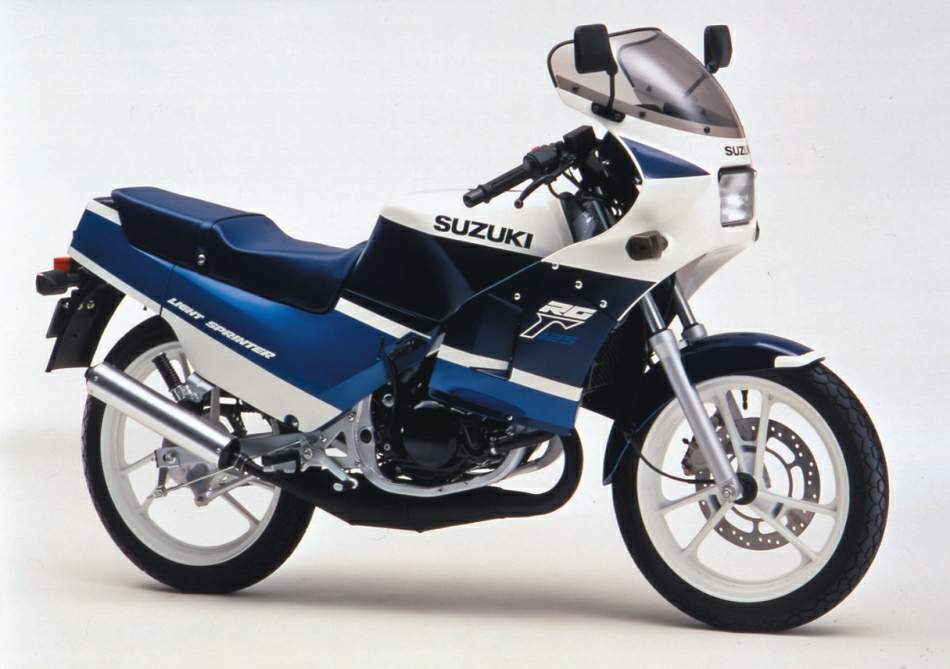
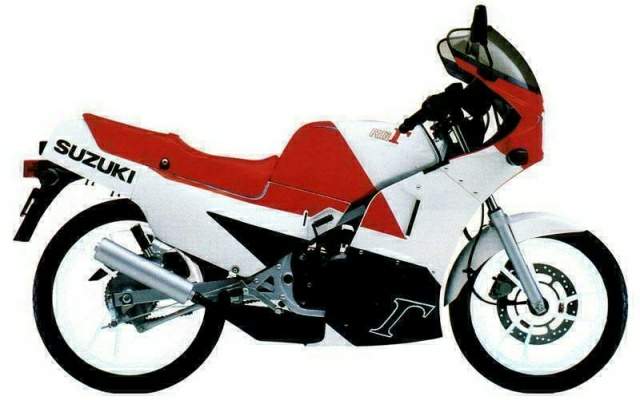
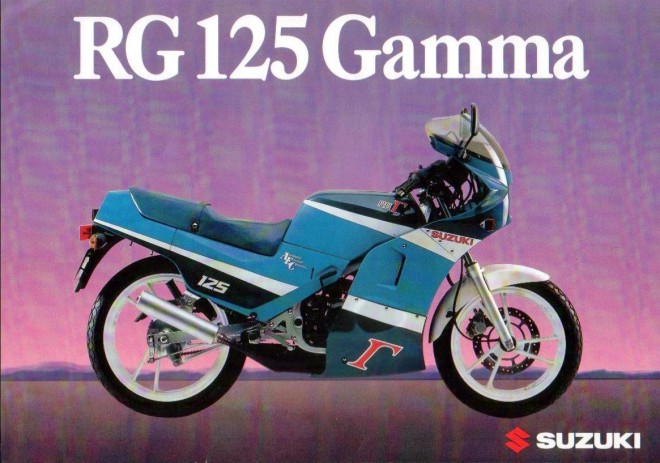
This time last year Suzuki's RG was the latest of the sports 125s, and the
flashiest. It speaks volumes that the newer NS is an improvement in cosmetic
terms only, and that's only a matter of taste; assuming we're riding bikes at
all in ten years' time, can we expect developments in this class to be confined
to designer bodywork? Maybe that's the intention in Whitehall, at least until
one of the big four start building bikes in Blighty. If so it's half-assed.
The Gamma, far from being the safest thing Concerned of Cheltenham could put
her cherished brat on, is actually not that easy to ride. In common with the
rest of the class it makes next to no power below 5000rpm and either completely
bogs down on takeoff or screeches away like a stuck soprano. Now, with only 12
horses on tap that's not likely to faze the razor reflexes of you lot, but mere
mortals are likely to find themselves wrapped around one bumper or another of an
adjacent twelve-wheeler. The other side of the same coin is that the peaky power
curves go into reverse on hills or if a headwind's even forecast, leaving that
theoretical 70-ish top whack firmly back home in the manual.
We're saddled with the only market to require such horsepower limitations for
125s, so with the relatively small numbers of bikes involved no-one has gone
overboard to design the engines to suit; all the 125s save Kawasaki's AR employ
cheapo restrictors and/or just leave bits out, slicing the top off the power
curve and giving very little in return. So why restrict tol2bhpandl25cc?A
restricted 200, say, would be a far more agreeable proposition, not to mention
even more fun to derestrict. (A certain LC of our acquaintance, bored out to
200cc and then breathed on, pumps out no less than 36bhp.)
Not that the RG and its ilk are all bad news. The Gamma is the lightest and
possibly the best-handling of the lot with a knees-round-your-elbows riding
position which dares you to make up in aggression what the motor lacks.
Sixpences are obsolete but the opposed-piston brakes are anything but and the
Suzuki would stop on one if you could find one; it's about as wide, too. So
everywhere is ten-tenths throttle, every gap a game of chicken and every braking
distance sufficient and sod Newton.
Now I know why despatch riders on 125s are such a bloody torment to other
bikes, let alone cars: it's to do with a little-known concept called the
Survival Quotient, in which a high number suggests long life.
Put crudely, the SQ is in direct proportion to the number of horsepower
available and the street credibility of the bike, not inversely as some seem to
think. Of course other factors like the proximity of closing time come into
play, but after two weeks on the Suzuki my SQ shrank to the point where I
stopped making appointments more than 20 minutes in advance.
In a chance conversation with Stan Stephens, a man who understands the
delinquent urge better than most, I happened to mention the Gamma's stunted
power characteristics. He reckoned he could resurrect the poor waif in about ten
minutes flat, so the little Suzuki found itself in deepest Kent in not much
longer. Stan duly kissed the sleeping beauty which six minutes later became the
proud recipient both of the mods described elsewhere and about 120 per cent more
power. What a transformation! Below 5000rpm there's slightly
less power—none as opposed to merely naff all—then there's a further 2000rpm
of fairly docile activity before the little kettle shrieks to the boil,
10,000rpm and the next gear change. For the first time since I'd picked up the
RG, I took the long way home, storm clouds and showers be blowed.
Even with wet roads, some fairly manic braking and brutal handfuls of
throttle, the Suzuki's chassis was completely underwhelmed by its new-found
speed and my new-found enthusiasm. As Roland observed on his somewhat slower
version, tiddlers like this permit—or should that be encourage — all sorts of
riotous behaviour and liberties. The frame is well up to demand in a lively sort
of way, if all else fails the brakes are up to the extra kinetic energy you
throw at them and even the suspension coped heroically with my 13 stones and
Maggie's neglected roads.
Which leaves the question of who's going to buy the Gamma. It's certainly the
raciest and most compact of the sports 125s so if you're over six foot you'd
probably look a bit silly on it. My 6'2" felt uncomfortably wallyish until Stan
found what was missing, after which I stopped caring. Under 5'8" and minus the
go-slower bits you'll probably have a ball pretending you're Paul Lewis. If you
have in mind to derestrict the RG it's probably the easiest and most productive
of the eighth-litre herd to fettle. On the other hand if you're planning on
sticking to 12bhp, you'd likely have more fun buying the extra option of going
green-laning with a trail bike; dual-purpose tyres can only transmit about 12
horses through mud anyway. ■