Google


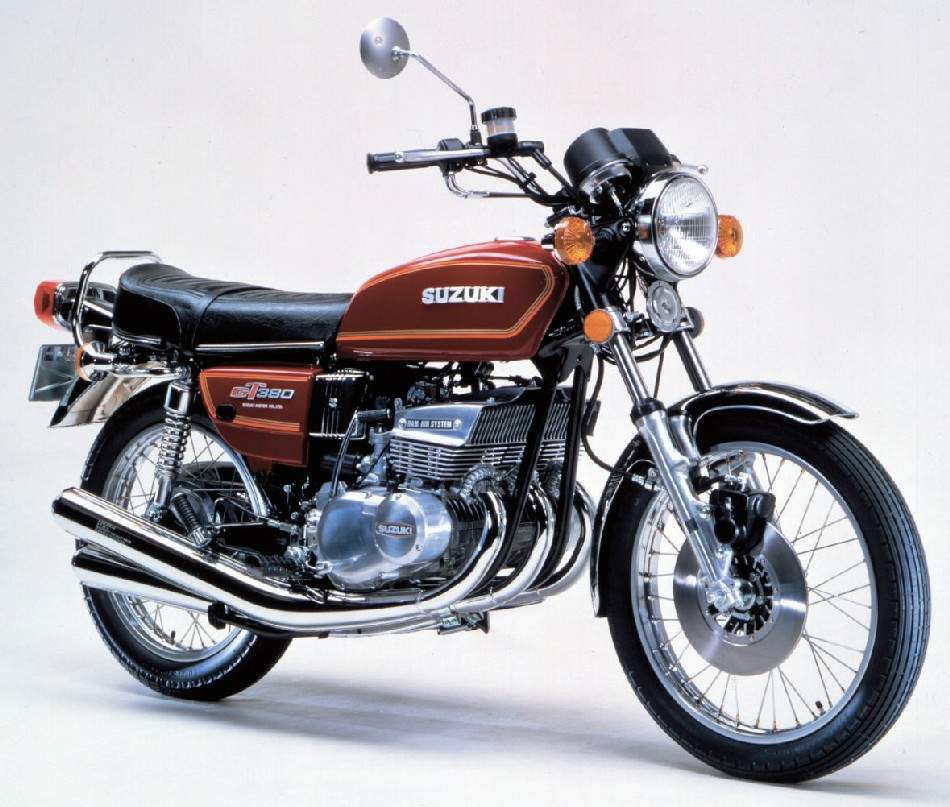
Suzuki GT 380B


Make Model

Suzuki GT 380B

Year

1977

Engine

Air cooled, two stroke, transverse three cyclinder,

Capacity

371
Bore x Stroke 54 x 54 mm
Compression Ratio 7.2:1

Induction

Ignition  /  Starting

Max Power

38 hp 27.7 kW @ 7500 rpm

Max Torque

38 Nm @ 6000 rpm

Transmission  /  Drive

6 Speed  /  chain
Frame Double tubular steel cradle

Front Suspension

Telescopic hydraulic forks, 100 mm wheel travel.

Rear Suspension

Dual chocks, 60 mm wheel travel.

Front Brakes

Single 275mm disc

Rear Brakes

180mm drum

Front Tyre

3.00-19

Rear Tyre

3.50-18

Wet-Weight

171 kg

Fuel Capacity 

15 Litres

Suzuki launched its air-cooled two-stroke triples GT380 and GT550 in 1972. An water-cooled three-cylinder GT750 had already been presented a year earlier and the 380 and 550 followed the design of the flagship model.

The GT380 and GT550 were predicatable and sporty motorcycles, but up to a point. At touring speeds they were comfortable and smooth, but twisting the grip farther brought a wobble and cornering at higher speeds showed the limitations of the suspension, swinging arm and the tube frame.

The GT engines were less highly tuned than for example the Kawasaki triples. It was tuned for the long run. Porting, timing, compression, carburetor size etc. were all chosen to deliver smooth power at the expence of maximum power. It made the Suzuki GTs more reliable than fast. The odd 3 to 4 exhaust system and rigid foot pegs also limited the leaning angle and the sporting nature of the bike. The GT triples were simply made for touring and not for sport-styled riding.

The Ram Air System (introduced in all of the air-cooled GT models) that forced the cool air to pass through the cylinders and behind the block was a new developement, tested earlier on Suzuki's TR500 racers. It is an simply an air scoop that ducts cold air directly onto the cylinder head the help the cooling on the engine. It was a known problem that two-stroke engines lost power when the cylinder head temperature rose too much. Cooling problem plagued other two-stroke triples but the Ram Air System made the Suzuki GT triples less suspective to the charasteric two-stroke power loss caused by too high a cylinder head temperature after a long, hard run. Nevertheless the GT triples still had a reputation for the middle piston seizing.

Suzuki's automatic system mixing fuel and oil had been refined for the GT models, providing less exhaust smoke, now called CCI. A clever new item in the early seventies was the vacuum-operated petcock was first used on the GTs and later used on all Suzuki mototrcycle models.

Both triples saw some minor improvements every year of their production but after only few of years production the two-stroke engined street bikes were terribly out of fashion. Although the GT380 was as strong and reliable as a four-stroke of equal displacement the rather high fuel comsuption of the two-strokers was suddenly an issue, when the gasoline prizes rose in the seventies. Even Suzuki itself dug a grave to its two-stroke models by launching its highly popular GS series with four-stroke angines. It was actually forced to change their minds and start making four-stroke engines. The tighter emission regulations in America sounded the death knell for most two-strokes.

Source suzukicycles.org

NOTE: Some of the photos on Motorcycle Specs are owned by somebody. If you see any of your photos,  you can let me know so that I can acknowledge it, or if you object to it, I can remove it altogether.  If any copyright holder objects to their articles being placed on Motorcycle Specs, it will be removed upon request.   Any correction or more info on these bikes will kindly be appreciated.        Aprilia    /   Benelli     /   Bimota   /   BMW   /   BSA   /   Buell   /   Cagiva   /   Custom Bikes  /   Derbi   /  Ducati   Ghezzi Brian   /   Gilera   /   Harley    /   Highland    /   Honda    /  Husqvarna    /  Husaberg    /   Indian    /    Kawasaki     /  KTM    /    Laverda    /   Magni    /   Moto Guzzi    /   Moto Morini    /   MZ   /  MV   /  Norton  /  OCC  Suzuki  Triumph  Victory  /    Voxan  Vyrus    /  Yamaha              Privacy Policy       Contact Me      Website Stats