|
|

|
|
|
|
Classic Bikes
Custom Bikes
Individual
Racing Bikes AJP
AJS
Aprilia
Ariel
Avinton / Wakan
Bajaj
Benelli
Beta
Bimota
BMW
Brough Superior
BRP Cam-Am
BSA
Buell / EBR
Bultaco
Cagiva
Campagna
CCM
CF Moto
Combat Motors
Derbi
Deus
Ducati
Excelsior
GASGAS
Ghezzi Brian
Gilera
GIMA
Harley Davidson
Hero
Highland
Honda
Horex
Husaberg
Husqvarna
Hyosung
Indian
Jawa
Kawasaki
KTM
KYMCO
Laverda
Lazareth
Magni
Maico
Mash
Matchless
Mondial
Moto Guzzi
Moto Morini
MV Agusta
MZ / MuZ
NCR
Norton
NSU
Paton
Peugeot
Piaggio
Revival Cycles
Roland Sands
Royal Enfield
Sachs
Sherco
Sunbeam
Suzuki
SWM
SYM
Triumph
TVS
Ural
Velocette
Vespa
Victory
Vincent
VOR
Voxan
Vyrus
Walt Siegl
Walz
Wrenchmonkees
Wunderlich
XTR / Radical
Yamaha
Zero
Video
Technical
Complete Manufacturer List
|
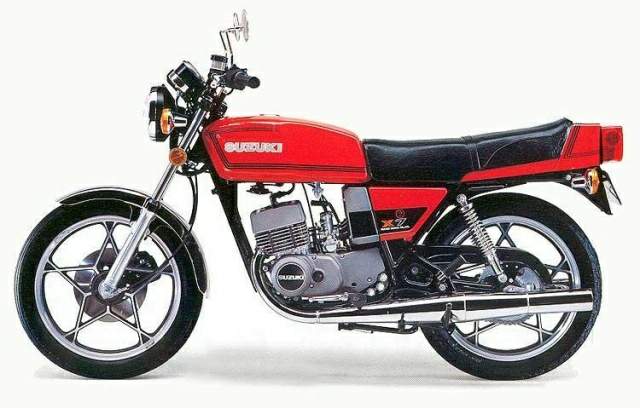
Suzuki GT 250
Inside Suzuki's X7 Suzuki's 'ton-up 2-stroke', the GT250X7, was hailed on its introduction in mid-1978 for its startling acceleration and mid-rpm pulling power. But would its performance figures hold up after, say, a full year's riding? And how does it rate for ease of servicing? Road Bike tested two X7s to find out. TheX7 is not a revamp of theGT250 C, its predecessor, but a completely new design from the wheels up. The overall approach to the X7 has been aimed at lightness and acceleration for the sports market. The new engine is very compactabout 7.2 kg (16 Ibs) lighter than the previous model. It features Suzuki's Power Reed valve dual induction system which increases engine breathing for better response through the rev range. This new dual induction system is the key to the X7's better pulling power over the GT250-C. The older models relied only on the conventional piston controlled fuel induction port, whereas the X7 utilizes both the piston port and a reed valve which is operated by crankcase pressure. The X7's piston-controlled port is designed to provide ihe fuel induction in the mid-rev range (3.000-6,000rpm). and this is what gives this 2-stroke its mid-rev pulling power. At the top-rev range (6,000-9.000rpm), the crankcase suction pressure causes the reed valves to open, drawing in more fuel, giving extra power in the lop rev band. The gearbox ratios have also been altered from the GT250 C to give the X7 a more even ratio between each gear. The firsi gear ratio has been The X7 sports design of alloy wheels, new exhausts and streamlined seat tank unit gives it style to match its speed lowered so that the change between first and second gear is less abrupt than was noticeable on the GT250-C. The rest of the gear ratios have been increased slightly making use of the X7's greater engine pulling power. The kickstart lever has been moved to the righthand side on the X7, compared to the left on the GT250 C and can now be used while still in gear as long as the clutch is disengaged. The frame has been redesigned and the twin downtubes found on previous models have now given way to a large diameter single downtube. This increases frame rigidity and decreases overall bike weight On the road Once under way. the bike had a definite Jekyll and Hyde character. For between 3,000-6,000rpm the bike would pull easily away in any gear without dropping down a gear—quite encouraging for a lightweight 2-stroke. This was useful in heavy traffic. However. above 6,000rpm and up to 9,000rpm the power up to 128 km/h (80mph) is breathtaking. When accelerating hard in first or second gear, it is very difficult to keepthe front wheel on the ground and care must be taken not to over-rev. Gear changing The six-speed gearbox is slick and smooth to use, but sixth gear is really useful only as an overdrive gear above 112 km/h (70mph). Neutral was sometimes difficult to find. Accelerating was very smooth as the gear ratios were spaced to make maximum use of the mid-range pulling power. If extra acceleration was required, it was instantly available by dropping down a gear to bring the revs up into the 6.000-9.000 power-band.
The clutch coped with the power and Ihere were no slipping problems. However, when the clutch was disengaged, the clutch noise was very loud. Road holding 'Two-up' travelling When travelling two-up. the bike's characteristics were very different. On smooth roads and motorways the bike was much slower and required constant gear changing to maintain speed. The extra weight with a passenger stabilized the bike at higher speeds, overcoming the light steering problem noticed when driving solo. Over bumps two-up, the bike developed a lurching feeling. As the forks hit a bump, the front disc brake seemed to snatch on, compounding the effect of the suspension. Even with the rear damper settings altered the problem persisted. Braking The front headlight was good for night driving up to about 96 km/h (60mph) and the dip switch was easily operated by the left thumb. No bulbs blew during the test but with the vibration which occurred around 5.000 rpm, we half expected one to go. The vibrations were noticeable through the footrests and handlebars. The vibration did not make riding uncomfortable and had no adverse effects on long distant touring, save a slight tingle in the fingers after 100 miles. The riding position was very comfortable with the rider inclined slightly forward. This tends to put more weight on to the wrists when riding and can cause some stiffness while getting used to the position. The seat absorbs all bumps and vibrations, and all journeys were accomplished without soreness. Economy The X7 250 definitely leads the 250 cc class in nearly all departments—acceleration, top speed, road holding, braking and manoeuvrability. The X7's performance easily matches larger class machines and represents good value for money if this is what you are looking for. To ride the bike at its maximum performance requires concentration and skill and this is not a bike for In the workshop Routine servicing of the Suzuki X7 is straightforward and, being a 2-stroke. it is relatively simple compared with a 4-stroke. The toolkit is adequate for simple service procedures. Specialized equipment you will need is an impact screwdriver and strobe timing light. The air filter is easily removed and the two bolts at the front of the lefthand side panel. The spark plugs should be cleaned every 1,000 miles as 2-strokes tend to oil up. The best method is to use your fingers to insert and tighten the plug, using the plug spanner for the final turn. As this bike has capacitor discharge electronic ignition, it is unlikely that the ignition timing will slip, but as an extra precaution, it is a aood idea to check the ignition timing regularly. If system does break down, the whole unit will have to be replaced, and this is an expensive business. Timing The engine should be revved to 6,000rpm and the middle notch on the alternator should coincide with the crankcase While the cover is off, the oil pump adjustment can be checked. This entails removing the plate behind the gearbox sprocket. You do this by loosening the three cross-head screws which hold The throttle valve dent mark is on the left-hand carburettor and can be seen by removing the brass hexagonal nut. You position the dent at the 12 o'clock setting, by turning the twistgrip, coincide with the aligning mark positioned to the right of the cam. Clutch adjustment The chain is tensioned by screwing in the adjuster bolts, until the centre play on the chain is 15-20 mm. Check that the adjuster marks arc the same on ment. On the test machine, the chain needed adjustment after every 500 miles. At the same time as adjusting the chain we also lubricated it by spraying The transmission oil has to be changed every 3,000 km (1,900 miles) and this was an easy procedure. The drain plug is the 14mm bolt underneath the right-hand side of the gearbox. Refill it with 800ml (1.4 pints) of a reputable make of SAE 20W.40.
|
|
|
Any corrections or more information on these motorcycles will be kindly appreciated. |