|
|
|
|
Classic Bikes
Custom Bikes
Individual
Racing Bikes AJP
AJS
Aprilia
Ariel
Avinton / Wakan
Bajaj
Benelli
Beta
Bimota
BMW
Brough Superior
BRP Cam-Am
BSA
Buell / EBR
Bultaco
Cagiva
Campagna
CCM
CF Moto
Combat Motors
Derbi
Deus
Ducati
Excelsior
GASGAS
Ghezzi Brian
Gilera
GIMA
Harley Davidson
Hero
Highland
Honda
Horex
Husaberg
Husqvarna
Hyosung
Indian
Jawa
Kawasaki
KTM
KYMCO
Laverda
Lazareth
Magni
Maico
Mash
Matchless
Mondial
Moto Guzzi
Moto Morini
MV Agusta
MZ / MuZ
NCR
Norton
NSU
Paton
Peugeot
Piaggio
Revival Cycles
Roland Sands
Royal Enfield
Sachs
Sherco
Sunbeam
Suzuki
SWM
SYM
Triumph
TVS
Ural
Velocette
Vespa
Victory
Vincent
VOR
Voxan
Vyrus
Walt Siegl
Walz
Wrenchmonkees
Wunderlich
XTR / Radical
Yamaha
Zero
Video
Technical
Complete Manufacturer List
|
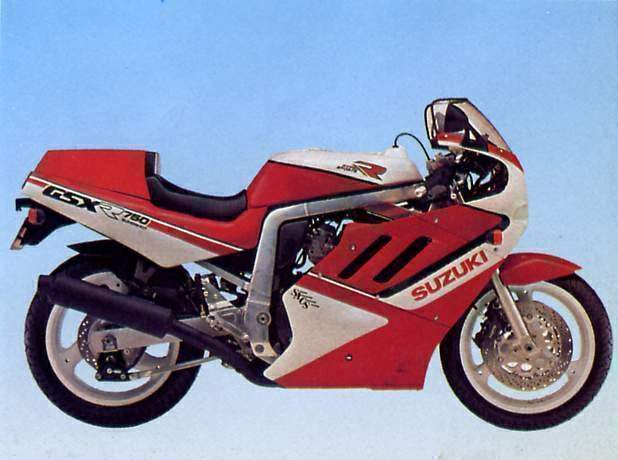
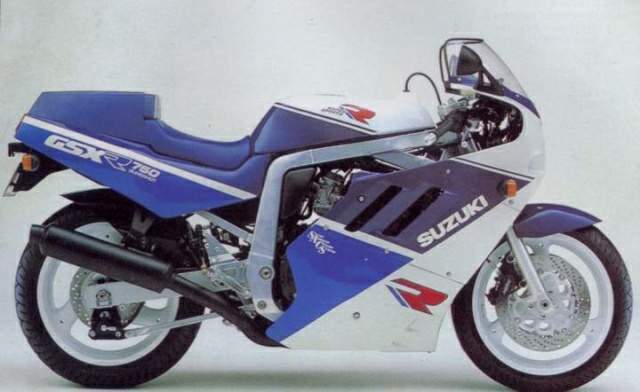
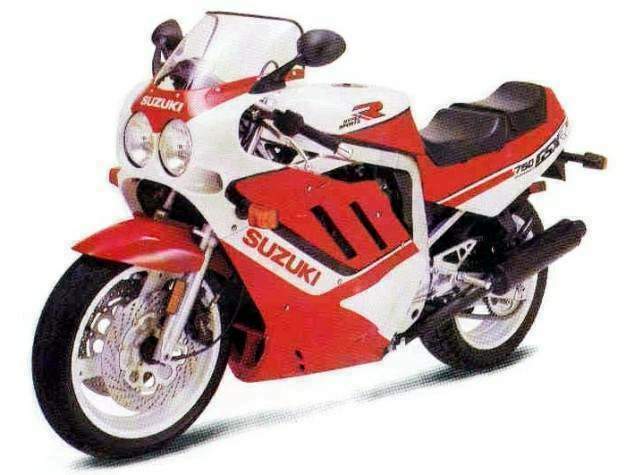
Suzuki GSX-R 750J
The styling went smooth and curvaceous with this model with
almost everything being new - 73.0 x 44.7mm short-stroke motor, thinner
piston rings, bigger main bearings, bigger valves, new high-lift camshaft,
36 mm contant-velocity semi-flatslide carbs and up rated suspension, wheels
and tyres. All this produced 112 hp at 11,000 rpm to propel a dry weight of
195 kg. Unfortunately, it lost significant ground clearance (via the
exhaust) and the adoption of 17" wheels which offered only a slim margin of
error. The distinctive air-cooled with SACS engine received larger diameter oil hose and less restrictive joints for 20% increase in the coolant flow and the large 15 row cooler improved the cooling efficiency by 48%. The red zone started at 13,000 rpm. Engine bore and stroke changed from the previous 70 x 48.7mm to shorter stroke 73 x 44.7mm to reduce reciprocating motion mechanical loss. The new Slingshot carburetors were equipped with lightweight throttle valves for increased throttle responsiveness. Another important addition was the incorporation of SACI (Suzuki Condensed Air Intake) system bringing fresh air from ducts on the front of the fairing to the carburetor intake for maximizing cylinder charging efficiency.
Lighter and simpler than the 34mm flat-slide units they replace, the 36ers use a slide, round in front and flat in back, which, like the "cartridge" fork, was pulled from Suzuki's RM motocrosser trick bag. Racers in search of the perfect mixture will appreciate the ease with which the Mikunis can be rejetted. With a one-piece plastic float and needle assembly, changes can be made quickly, with no tiny parts to drop out on the ground and disappear. A metal tang sets float height with similar ease. Spark comes from a new computer-controlled electronic ignition, similar to the 1988 Katana and Intruder systems. Analog rpm signals from the crankshaft are digitized by the computer, which pulls the optimal ignition advance from a selection of ignition curves developed through dyno research, and programmed into a random-access memory chip. Up to 5000 rpm, the curve is tracked and adjusted through 125-rpm increments up or down the rev band. Above that, the computer takes a reading with every 1000-rpm change in engine speed. To better withstand the violence of lower-volume, higher-compression (10.9:1) combustion chambers, the GSX-R gets fire from dual-electrode NGK JR9C spark plugs. When engine speed ventures past the 13,000-rpm redline, an electronic rev limiter cuts power. The 748cc engine packs one cubic centimeter less than before; bore and stroke shift from 70 x 48.7 to 73 x 44.7 mm this is the most oversquare Suzuki street four yet. With a shorter stroke, the new configuration drops piston speed accordingly; at 10,000 rpm, J-model slugs travel 2993 feet in the same minute 1987 H-models move 3195. Despite extensive drilling around the edges and undersides of the wrist-pin bosses, the J's larger-bore slipper pistons are each 12 grams heavier than the old 750 slugs. Larger bores mean a new and slightly larger cylinder casting to maintain liner thickness, overbore capacity and heat transfer characteristics. There's a new crankshaft spinning down below, with journal diameters bumped two millimeters to withstand the greater loads of higher rpm. The crank gains 10 ounces in the process, despite lighter flywheel weights. Connecting rods measure 106mm, 3.5 shorter than those in the '87 engine. Though general layout is unchanged, tuning in this engine is Early American Hot Rod; that is, hotter cams and larger valves. The 28.5mm intakes and 25.0mm exhausts are both GSX-R1100 spec. Intakes stay open 16 degrees longer than the old 750's did; exhaust poppets 24 degrees longer. Overlap jumps almost 32 percent to 75 degrees. The valve adjustment interval is every 4000 miles after the initial 600; lash is taken up by a standard screw-and-locknut layout. In order to get a free-breathing engine quiet enough to be legal, Suzuki resorted to a four-into-two exhaust system. The dual mufflers and additional piping add seven pounds and subtract ground clearance, but they deliver tuning latitude that Suzuki pushed to the maximum. Here is the first mass-produced 750 delivered with an 11,000-rpm, 90.75-horsepower peak, actually a horsepower more than the GSX-R1100. Formerly the 750-class dyno king (85.33 hp at 11,500 rpm), Yamaha's FZ750 loses by better than five ponies. The race-replica FZR fares no better with 83.76 at 10,500. Anyone else? Making a tick under 83 horsepower at 10,500, the Kawasaki 750 Ninja can't compete. Without a sporting 750 in the lineup for 1988, Honda's 1986 Interceptor gets summarily snuffed on the dyno as well, its 82.55 horsepower best buried under the J-model's stratospheric power curve.
With superimposed dyno charts, the new 750's curve lies at a steeper angle than its predecessor's. Though the old engine posts a two- to four-horsepower advantage between 3500 and 4000 rpm, the J pulls even at 5500, three horsepower beyond at 6000. Both curves angle near 62 horsepower between 8000 and 8500, but they part company at 9000 where the J wakes up, flying higher above the '87 bike as revs climb. Peak to peak, the J really gives its stepsister's dancing shoes a trampling—this engine is 11.5 horsepower stronger than the old 750. Suzuki's air/oil SACS cooling system moves 6.1 quarts of oil (15 percent more than before) from a deeper sump, through a higher-capacity, two-stage trochoidal pump and a large-capacity oil cooler, which Suzuki claims disposes of 48 percent more heat. New lines and fittings are said to be good for a 20-percent jump in oil flow, and a dished baffle improves cylinder-head cooling by keeping the flow pumping so hot oil doesn't sit around getting hotter. Oil descends to the sump via two large return passages cast into the front of the head and hollow front/center cylinder studs. Does the new GSX-R's more conventional strategy of high power beat last year's low-mass approach? Yes and no. Weighing in at 493 pounds soaking wet, the 1988 GSX-R750 pushes the scale 27.5 pounds further than the '87 bike, yet the J remains the lightest Japanese 750 currently available. Where does the weight come from? The engine is 11 pounds heavier; tack on 15 for the frame; then add heavier wheels, tires and exhaust system. Even pulling 5.4 pounds for every peak horsepower, the 750J still carries about a half pound less per horsepower than last year's GSX-R. It's the old big-motor Superbike formula, and it works in the quarter mile: Our test bike's best run down the drag strip took 11.04 seconds. More important, it blistered through the traps traveling 122.41 miles per hour, a single mile per hour slower than the GSX-R 1100. That's a tick quicker but 7.6 mph faster than our last GSX-R750's best 11.33/ 114.79-mile-per-hour run.
This huge difference explains why Suzuki went for a pumped-up engine and let the low-mass ride. Top speed on the order of the J's takes horsepower, lots of horsepower, and this bike, with just a touch more traction, could certainly get into the 10s. Surprisingly, roll-on numbers were almost identical to those from our 1986 test unit. The J took 122 feet to stop from 60. That's surprising, considering that the GSX-R's stopping hardware appears as if it was lifted from Kevin Schwantz's Superbike and feels supremely powerful. But the Michelin A59 front tire, with a somewhat triangular profile, lays down a narrow contact patch under straight-up braking, and the J, without an anti-dive fork, suffers nosedive under hard braking. Also, as in drag-strip tests of acceleration, very small factors the feel of a particular bike, traction feedback, even a rider's daily bravery index can account for such differences. Despite the middling numbers, the GSX-R brakes are excellent stoppers powerful and predictable.
Suzuki held the GSX-R750's coming-out party at Laguna Seca Raceway, a track whose high-speed, gravity-bowl turns and knotty pavement surface place ground clearance and correct line choice at a premium. At Laguna the new bike did everything more quickly and easily than the old: stop, go, turn—and drag the ground. Since six of Laguna's nine turns are left-handers, the clearance problem was concentrated on the bike's left side, where pipes and fairing threw sparks and plastic shavings—the sidestand, before, it was removed, smacked the pavement violently. Time to dial some ground clearance into the 750's suspension. The truth that this Suzuki is as sensitive as it is keenly focused—became apparent with only a few turns of the 750's myriad suspension adjusters. A dozen click stops at the top (rebound) and bottom (compression) of each fork leg alter damping rates. Fifteen millimeters of spring preload—in 2.5mm increments— are available via a 14mm bolt atop the fork. The shock is simpler—preload adjusts via a threaded collar, rebound damping with a four-position wheel. From a standard setting—with compression set six clicks from bottom; rebound out seven—we increased compression damping two positions, rebound one more click in, and dialed in all 15 millimeters of preload. Getting more ground clearance out of the GSX meant more shock preload as well. Two turns proved too stiff; 1.5 was a workable compromise. Shock rebound damping went full stiff. Without an independent ride-height adjuster, the GSX-R really forces a compromise between optimum suspension settings and maximum ground clearance. With the Suzuki you take—are forced to accept—the lesser of two undesirables: quirky handling and better ground clearance, or correct handling and little daylight left under the bike. Stiffening the GSX-R's shock exaggerated the already steep steering angle, making the bike's front end less trustworthy through Laguna's tricky downhill turn eight. Stripped of its sidestand, the J-model continues to drag pipes and fairing solidly on the ground. Handling/suspension trade-offs aside, the GSX, with strong acceleration, powerful brakes and adjustable suspension, is still a machine most at home on the track. The Michelin 59-series radials fitted, however, are better suited to the street. With the recommended 36 psi pumped in front and rear, the Michelins easily carry traction to the limits of the GSX-R's ground clearance, but the rear is a little hard—the bike's back wheel spinning under acceleration out of slow corners. The Suzuki, with its wide-gauge wheels, suffers from a shortage of tire choices. Real racing slicks, or perhaps taller radials, might well ease the GSX's ground-clearance problems. At the moment, the Michelins are the only tires designed to fit the Suzuki's 17-inch super-hoops. When the GSX returned to the Cycle shop, it was instantly evident that the racetrack setup was too stiff for street riding. We softened the fork's rebound damping to eight clicks out; compression to seven, with preload chopped in half—to 7.5mm. The shock lost two turns of preload, and damping was set midway at two. With these adjustments, the fork's bump response improved, but the Suzuki stood up in corners under braking and, thrown hard into a fast downhill corner in a nose-down attitude, pushed its front end. Suspension setup—especially in a motorcycle as sensitive and complex as the GSX-R—is a matter of subjective choice, dependent to a large degree on variations in rider size, weight, expertise level, etc. To balance the chassis and get more ground clearance, two of Cycle's staffers—with wet weights ranging from 155 to 190 pounds—lowered the fork tubes one quarter inch in the triple clamps from their standard setting with tubes protruding up one-half inch. Steering neutrality returned and the tuck disappeared, along with the bike's tendency to stand up under hard braking. Our 140-pounder had different, priorities: Without suspension compliance to keep the tires planted, he reasoned, what good is ground clearance? He dialed up the fork's softest compression setting, screwed in a single click of rebound, left preload at 50 percent and sunk the fork tubes still further flush with the top of the triple clamps. Shock preload was backed off half a turn and rebound damping set at three. Pulling the Suzuki's nose up though it did slow steering response a bit was one compromise everyone agreed on: Fork tubes stayed put at flush while our 187-pound man dialed three millimeters of spring preload (one more than stock) into the fork and set compression and rebound damping at seven and six clicks out respectively (both stock). Out back, the shock was stiffened a half turn past standard and rear rebound was left at three. Setup on the GSX-R is an arduous, exacting process. Stock settings are probably the best compromise for most riders, and altering them without a trail of notes to get back to normal is pure folly. But on the right road, the results are magic. As long as the stock pipes, fairing and sidestand remain where they are, though—which is mostly on the ground—clearance will continue to be the limiting factor with this motorcycle. But let's get one thing straight: Serious, complex and demanding as the GSX-R is, it's best understood as a road-legal racer—a "street bike" that's as far removed from the street as Laguna's corkscrew is from Sunset Boulevard. On this 750, straight pavement becomes almost a perversity. The old GSX-R suffered from racetrack ergonomics; the new bike's seating is more severe— higher pegs, harder seat and lower bars, ^ut while the old GSX-R was otherwise an excellent street machine, fast and forgiving, the J-bike is pure edge. It'll daunt most duffer racers. Complex as the GSX-R's suspension is for a street bike, the hundreds of choices its suspension offers—with more opportunities for error than delight—are only average for a track-competitive machine. There are some niceties, though, some civilities to the beast: It warms quickly and runs more smoothly and quietly than the old GSX. Reined in between 70 and 75 miles per hour in top gear, its solid-mount engine is vibration free, easing freeway flights between the twisties. But the GSX cooks your kneecaps in heat from the fairing; the mirrors match size with effectiveness—very little. A full tank lasts about 190 miles; 50 more than most riders will. That's because the GSX-R750 is a motorcycle for true believers. Counting yourself among them means you couldn't care less that, for the Suzuki's list price, you might easily buy more street bike. But your dollars could never capture this much street-legal Superbike racer, and—at $5199—you can bet they never will again. Source Cycle World 1988
|
|
|
Any corrections or more information on these motorcycles will be kindly appreciated. |