All compact & lightweight 4-stroke, 4-cylinder,
liquid-cooled engine designed for overall weight reduction, optimum
combustion efficiency and power delivery
Re-designed cylinder head with narrower valve angles creating a more compact
combustion chamber design, higher 12.5:1 compression ratio, large intake and
exhaust ports for improved intake and exhaust efficiency and high power
output
Valve bucket diameters are increased to work with more aggressive camshafts
Lightweight titanium valves with steel alloy springs and aluminum spring
retainers operated by thin-wall hollow camshafts to reduce weight and
inertia
Lightweight forged aluminum alloy pistons with short skirts, cut away sides
and an anti-friction surface finish along with shotpeened chrome-moly steel
connecting rods for improved strength
One-piece cylinder block and upper crankcase section is equipped with larger
39mm ventilation holes between cylinders to reduce crankcase pressure and
mechanical loss
Tapered, larger 50mm double-barrel throttle body design features Suzuki's
SDTV throttle valve system, plus twin multi-hole-type injectors per cylinder
for optimum performance and throttle response
Crankshaft features forged steel construction and a new secondary balancer
shaft for reduced vibration at high rpm.
Crankshaft and transmission shaft positions are revised to create a more
compact engine design and the engine itself is rotated slightly forward in
the chassis allowing for straighter and shorter intake and exhaust ports
New back torque limiting clutch allows smoother downshifts and works in
conjunction with an updated six speed transmission with revised internal
gear ratios and updated shift forks
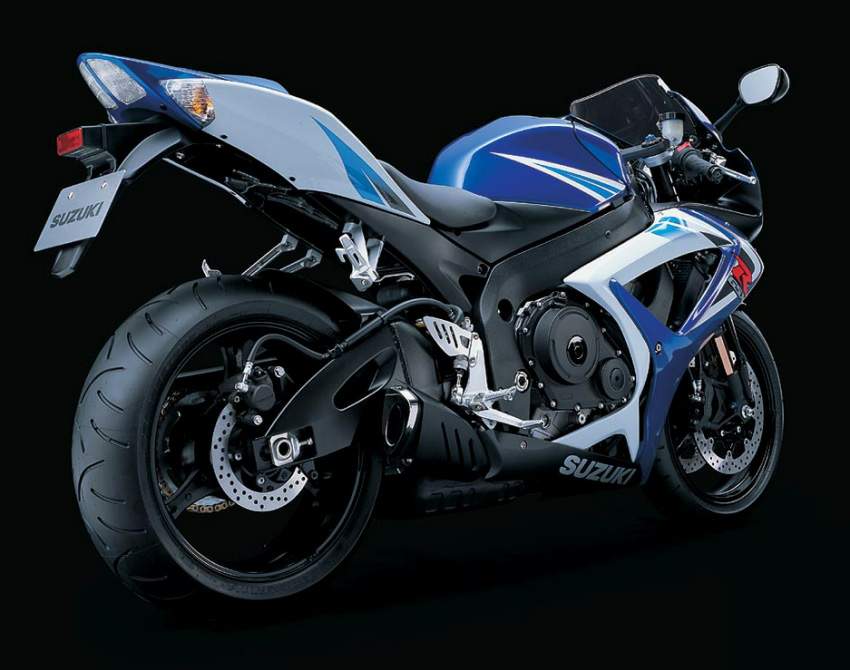
Innovative new Suzuki Advanced Exhaust System (SAES) with new under engine
muffler layout and Suzuki Exhaust Tuning (SET) system for improved mass
centralization, superior aerodynamics, and improved low-to-mid range
performance
High capacity large trapezoidal-shaped radiator provide efficient engine
cooling - includes compact cooling fan assembly designed for improved air
flow
A new Idle Speed Control (ISC) system improves cold starting and stabilizes
engine idle speed in a variety of conditions
SRAD ( Suzuki Ram Air Direct) force feeds cool, pressurized air into the
airbox at highway speeds, improving engine efficiency and throttle response
New Chassis
All new ultra-lightweight frame is built entirely of aluminum alloy castings
and is engineered to deliver optimum rigidity, unmatched accuracy and
maximum cornering performance
New aluminum alloy braced swingarm features increased rigidity, a larger
25mm swingarm pivot and is now 38mm longer for improved rider feel and
better rear wheel traction
RM-Z450 inspired new rear suspension linkage utilizes a forged aluminum
alloy link and a forged aluminum link rod that reduces side loads and helps
the rear shock absorber move in a smooth arc
New inverted 41mm Showa cartridge front forks are fully adjustable for
spring preload, compression damping, and rebound damping
Showa rear shock absorber with a 46mm piston and larger 16mm rod moves the
same amount of oil despite a shorter stroke and provides adjustable rebound
damping, compression damping and preload settings
New larger 310mm brake discs work with radial mount calipers and radial
front brake master cylinder. A new rear brake caliper is 100 grams lighter
Bridgestone radial tires are mounted on new cast aluminum wheels featuring
redesigned, thinner spokes with optimized wall thickness to reduce unsprung
weight
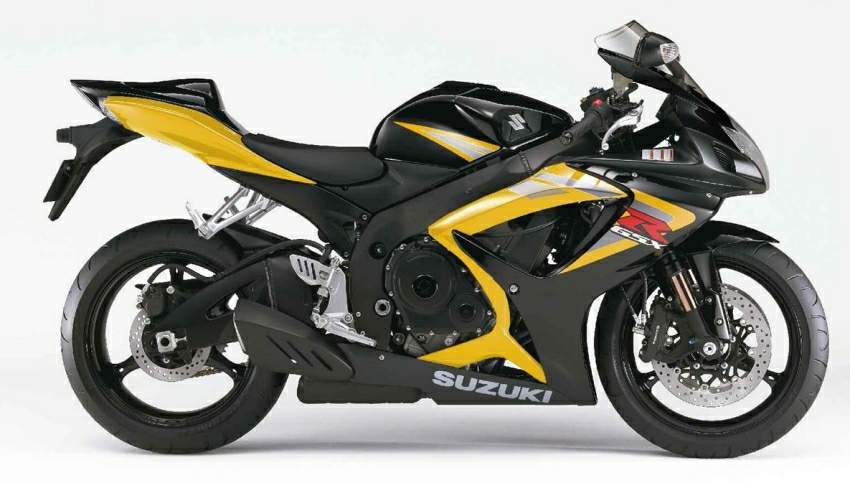
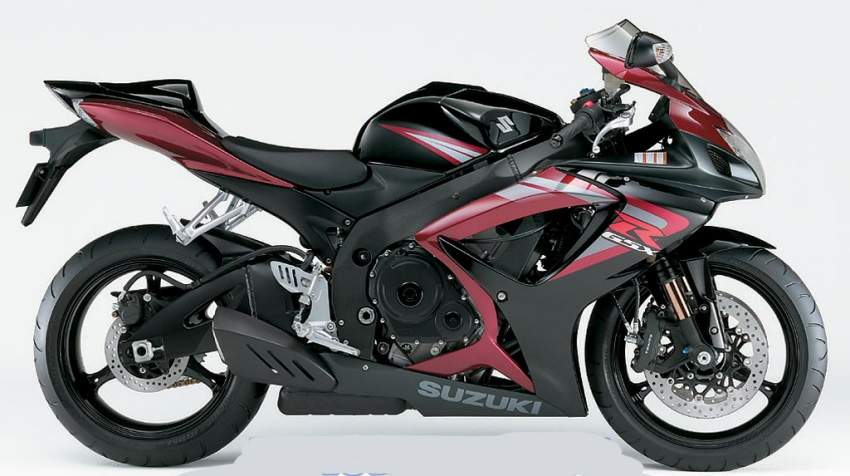
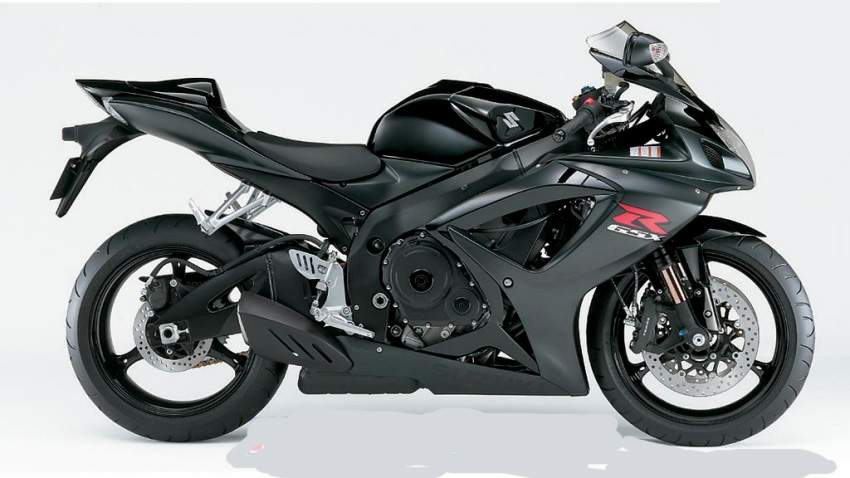
All new aggressive and aerodynamic bodywork gives the GSX-R750 an all new
look and when combined with integrated turn signals and smaller frontal area
provide a 5% increase in aerodynamic efficiency
Compact, lightweight instrument cluster features a step motor controlled
analog tachometer, LCD speedometer, dual trip meters, clock and convenient
new gear position indicator
Riding position is revised with a shorter fuel tank, lower seat height, and
adjustable rider footpegs for improved rider control and mobility
Road Test
Despite the less oversquare
dimensions (the '06 motor is 70mm x 48.7mm vs. 72mm x 46mm for the '05) the
engine revs quickly, but has enough flywheel effect to keep itself from being
too sensitive to throttle inputs. Larger crankcase holes between cylinders (39mm
vs. 35mm) further reduce pumping losses of the rising and falling pistons. The
cylinder head was redesigned as well. The exhaust valves are 1mm smaller and
included valve angle is now 22.5 degrees, versus the 05's 25 degrees. This has
boosted compression slightly, up to 12.5:1 from 12.3:1. Overall dimensions of
the engine illustrate how much the powerplant has shrunk. Height is 34mm
shorter, 57mm shorter front to back and 16mm narrower. Redline is 600 rpm higher
in spite of the longer stroke.
The new engine is a really well performing piece. It has just the right amount
of power when you want it. It is all things to all people; you can putt around
town below 5000 rpm to maintain stealth, both in terms of speed and sound.
There's enough torque available there to keep you from feverishly toeing the
shift lever.
When you want more acceleration, just hold the gear a little longer and open the
throttle a little more to get into the 6k - 9k range. If you're really in a
hurry, or on the track, then move the tach needle past the 10k mark. Once past
that, another level of acceleration takes over. It's not a major jump in power,
but it is definitely noticeable, and it will make the liter bikes take notice.
If you don't shift your weight over the gas tank in the first two gears, the
front wheel loses touch with the asphalt.
Although, the engine is strong, and provides fierce acceleration, I can't help
but feel it is working through some excessively tall gearing. First gear takes
you to 85 mph, and sixth is good for a theoretical 195 mph, although the engine
does not have the power to push the bike through the air at that speed. Adding
three or so teeth to the rear sprocket would raise rpm by about 500 for a given
speed in sixth gear, giving better acceleration without making the engine buzzy
at street speeds, and may even work better at some tracks. Going down one tooth
on the front sprocket is a more cost effective route, but is actually harder on
the chain, as it has to go around a smaller diameter.
The transmission shifts very well, but hasn't quite reached typical Suzuki
gearbox proficiency yet, as only 1500 miles have been clocked. Daily mileage
brings improved performance, however. The slipper clutch has not yet been
sampled, as only street miles have been accumulated to date. The clutch itself
performed transparently - that is, it did nothing to call attention to itself.
Reversing the shift pattern to race spec requires placing the adjustable
footpegs and shift lever in the upper / rear position - otherwise, the shift rod
fouls a water pump bolt.
A counter-balancer keeps vibes in check, and the engine is quite smooth, with
only a little vibration creeping in around 5k, and that's only on deceleration.
Fueling is pretty good, but there are three noticeably different behaviors.
Below 4k rpm, it feels a little 'fluffy' (rich). From 4k - 7k, it feels really
snappy, like it's a bit too lean. Above 8k, fueling feels spot-on. A power
commander from Dynojet or EMS from Yoshimura, along with some dyno tuning, would
smooth things out nicely. The throttle bodies are the same size as last year's
bike, but now feature a second set of injectors which are used in the higher rpm
range. Suzuki's dual throttle valves also remain. The throttle return spring
seems a bit stiffer than those sampled on previous GSX-Rs. Fuel economy has so
far ranged from 33 mpg to 48 mpg, depending on the rider's enthusiasm and
urgency.
One part of the engine hardware that seems to catch everyone's eye is the size
of the radiator. The size and trapezoid shape of the radiator never fails to
elicit envious comments.
The other piece that commands attention is the exhaust. Whether MotoGP inspired
or not, it is different, and effective. Small and centrally located, it moves
heft much closer to the bike's center of gravity than traditional systems, and
certainly more than the now fashionable underseat exhaust systems adorning some
other late model sport bikes. The catalytic converter also resides in the
muffler box, so it gets quite warm, necessitating the heat shields. It is
mounted aft of the servo controlled exhaust valve, so mounting a 'slip-on' will
not eliminate the valve, which could be considered good or bad, depending on
your preferences and tuning goals.
Side benefits of this design include no risk of "heated" seats for the rider or
passenger, and a small space for storage under the passenger seat area. The
exhaust is quite throaty, guttural even, and it combines its tones well with the
trademark Suzuki induction howl, which makes a wonderful sound all its own and
can cause an almost compulsive desire to repeatedly slow down and then
accelerate again, just to hear the engine sing its sweet song.
Suspension this year has been thoroughly revamped. Out back, the linkage has
been engineered to clear the muffler box. The Showa shock is shorter overall and
features high and low-speed compression damping adjustment, as well as rebound
and preload. Shock shaft and piston both have shrunk in their respective
diameters, the shock stroke is 10mm shorter and overall compression damping has
been increased to address complaints of being too soft on the previous model. Up
front, Showa forks are 41mm in diameter, vs. the 05's 43mm, but increased wall
thickness maintains rigidity. A 'carbonized titanium' coating is found on the
750's lower tubes.
The chassis also got a complete makeover to take advantage of the engine's
compact dimensions. A frame made entirely of castings is 44mm shorter, while the
shorter engine measurement allows a 35mm longer swingarm. Longer axle slots are
for greater range of axle (hence, wheelbase) adjustment. Rake/trail is identical
to the 600, at 23.8 degrees / 97mm. Wheelbase is 1400mm (55.1 inches). Claimed
dry weight is 359 lbs.
Overall, the suspension is definitely stiffer, and works well on smooth surfaces
and at higher speeds. However, during typical street riding, it dishes out a
rather harsh ride that no amount of adjusting from me could tune out. Only when
I was riding aggressively did the overabundant compression damping begin to make
sense. That's okay for the track or committed canyon rides, but not for the rest
of the riding situations I find myself in the majority of the time.
Additionally, I found that the damping adjusters only proved effective inside of
their last one half turn (out from full hard) of the roughly four-turn
adjustment range available. In that last little bit of adjustment, very small
adjustments have a substantial effect, making finding the ideal adjustment or
suitable compromise very difficult to achieve.
Handling manners of the 750 are exemplary, providing both stability and quick
turning characteristics. Transitions from side to side happen without much
effort, but could stand to be sped up a little, which I did with various
thickness shims placed between the shock and its top mounting point. Doing this
raised rear ride height, placing more weight on the front end, which increased
turn-in speed and provided more and better feedback from the front end. With the
standard exhaust in place, you have roughly an 8mm range of height adjustment
available before the linkage contacts the muffler box, which translates into
17.76mm at the axle.
Brakes are updated as well. Rotor diameter has grown from 300mm to 310mm, and
the new rotors are gripped by radial mounted calipers. A radial master cylinder
delivers the hydraulic pressure. Braking action is sublime, providing not as
much initial bite as some setups, but giving great feel and overall power. This
means that when you squeeze the brake lever during a spirited ride, track day,
or in an emergency situation, overpowering initial bite or a lack of feel will
not be what puts you on your head (hopefully you won't end up on your head at
all!). I came to this realization after overcooking a couple of corners on a
downhill section of a road local to me. Coming into the corner too hot, I was
forced to use the front brake aggressively while the bike was leaned over fairly
far. I gave the lever a pretty good squeeze, and the 750 scrubbed speed without
locking the front wheel or causing me to lowside. Part of the credit for that
outcome must go to the excellent Bridgestone BT-014 tires fitted as standard
equipment. They give excellent traction, feedback and seem to wear very well.
Despite the braking system's already excellent performance, I do plan to
experiment with other brake pad compounds.
Ergonomics proved very comfortable, with a range of footpeg adjustment of 14mm
in the vertical and horizontal axis, giving the rider some flexibility to choose
according to riding environment and/or rider dimensions. This new adjustability
eliminates my primary complaint with previous GSX-R750s, that being the cramped
seat-to-peg relationship. It's a simple solution, and very effective in aiding
rider comfort and control.
Suzuki's seats have traditionally been very comfortable. The seat on the 750
continues this trend, but seems to be a little thinner than before, feeling as
though it is nearly bottomed out after longer rides. The reach to the handlebar
is fairly short, and the bars are well angled.
Instrumentation is clear and informative, with an added gear indicator which is
more useful than you might first believe. A programmable shift light is reduced
to novelty status because of its location at the bottom of the instrument
cluster, rather than being placed at the top. A reserve fuel trip meter
activates automatically, to track how many miles you have traveled since the
fuel light came on (after using 3.4 gal.), although you must manually change the
display mode to see it. After filling up (4.4 gal capacity), the trip meter
rights itself.
At night, the instruments are lit up in a very "eighties" orange. It looks cool,
but I'd prefer a light to medium blue, which is a less intense color contrast,
and would make the instruments more easily readable. Headlight performance is
better than the pseudo-endurance racer one-headlight look of some other sport
bikes.
Wind protection is very good by sportbike standards, with the windscreen
actually deflecting wind to above chest-level, which I find somewhat surprising,
given the mostly ineffective examples found on many other current sportbikes.
The front half of the gas tank, which is plastic and appears to be detachable
for air cleaner access independent of the fuel tank, created some false hope.
The fuel tank still must be raised to remove the airbox cover for air filter
servicing.
The bottom line is, after living with the new GSX-R750 for about a month, it is
hard to fault its compromise between a liter bike and a 600, at least for street
riding. Suzuki seems to have combined the best characteristics of both classes,
while eliminating many of the drawbacks. Not to be satisfied with merely
creating the perfect middleweight, they even threw in some innovative extras
(like the cool-looking exhaust, and the adjustable footrest positioning) to
further entice prospective buyers. If you're looking for a machine that combines
the handling prowess of a 600 with the 'who cares what gear you're in' usable
midrange power of a 1000 (and who isn't?), the GSX-R750 is the bike for you.
The GSX-R750 is already on sale at your local Suzuki dealership, and carries a
U.S. MSRP of $9,999. For more info and specifications, check out Suzuki's web
site.
NOTE: Some of the photos on
Motorcycle Specs are owned by somebody. If you see any of your
photos, you can let me know so that I can acknowledge it, or if
you object to it, I can remove it altogether. If any copyright
holder objects to their articles being placed on Motorcycle
Specs, it will be removed upon request. Any correction or more
info on these bikes will kindly beappreciated
Contact MePrivacy
Policy
Website Stats