
|
Make Model |
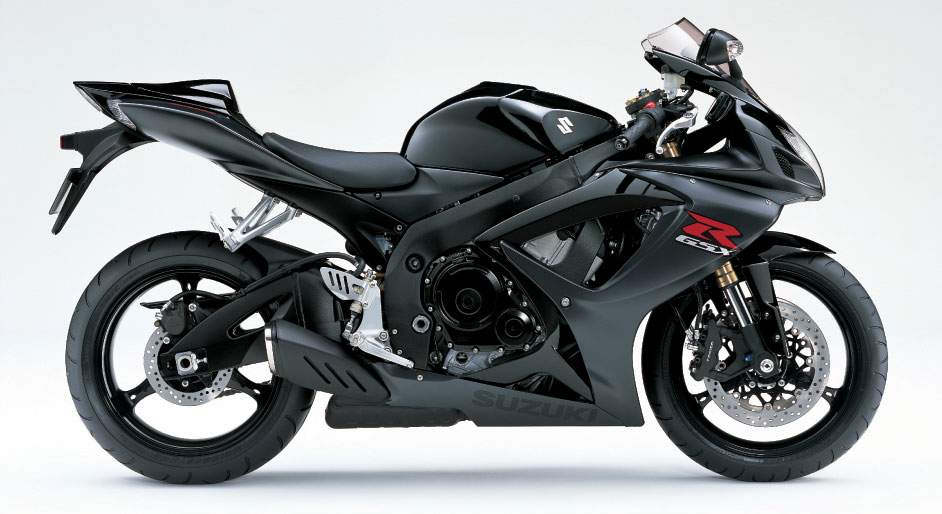
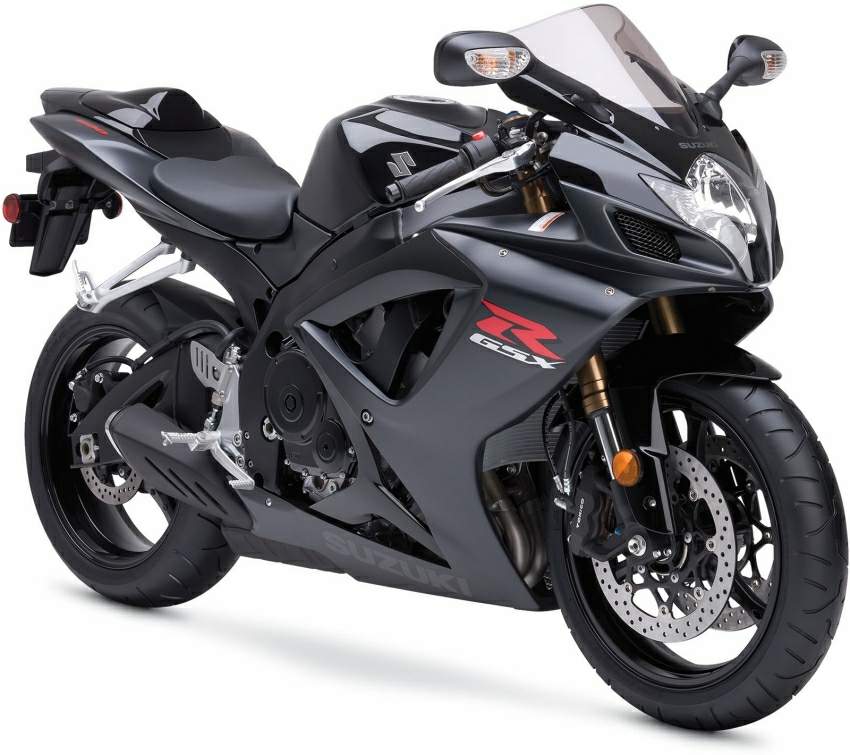
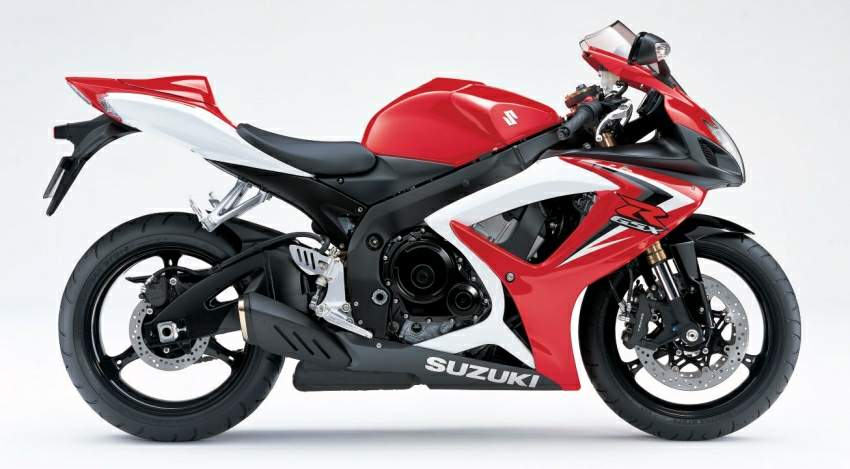
Suzuki GSX-R 600 K7 |
|
Year |
2007 |
|
Engine |
Liquid cooled four stroke, transverse four cylinder, DOHC, 4 valves per cylinder. |
|
Capacity |
599 |
| Bore x Stroke | 67 x 42.5 mm |
| Compression Ratio | 12.5;1 |
|
Induction |
EFI - 40mm throttle bodies |
|
Ignition / Starting |
Digital / electric |
|
Max Power |
125 hp @ 13500 rpm |
|
Max Torque |
67.7 Nm @ 11500 rpm |
|
Transmission / Drive |
6 Speed / chain |
| Frame | Twin-spar aluminum alloy |
|
Front Suspension |
Inverted telescopic, coil spring, spring pre-load fully adjustable, rebound and compression damping force fully adjustable |
|
Rear Suspension |
Link type, oil damped, coil spring, spring pre-load fully adjustable, rebound and compression damping force fully adjustable |
|
Front Brakes |
2x 310mm discs 4 piston calipers |
|
Rear Brakes |
Single 220mm disc 1 piston caliper |
|
Front Tyre |
120/70 -ZR17 |
|
Rear Tyre |
180/55 -ZR17 |
| Seat Height | 830 mm |
|
Dry-Weight |
161 kg |
|
Fuel Capacity |
17 Litres |
|
Standing ¼ Mile |
11.1 sec |
|
Top Speed |
263 km/h |
|
Reviews Supersport Shootout / Motorcycle-USA / MCNews.COM / Motorcycle-USA Supersport Shootout / MD 2006 Supersport Shootout / Motocorse / Mototest / Supersport Shootout / MCNews / 1000ps |
|
It took four tries but I finally
got a clear run down our six-kilometre test straight with no
wind, no birds (you have no idea how much damage a guinea-fowl
can do at 250km/h) and no distractions – and the Suzuki GSX-R600
K7 rewarded me with a one-way best of 271km/h, making it
officially the fastest 600 motoring.co.za has yet reviewed.
It was also only one km/h slower than the 272km/h I got on the
bike's
GSX-R750 sibling.
What's more important, it was rock steady at that speed; in fact
it's extraordinarily stable at any speed, given its 161kg weight
(or lack thereof) and cobby 1400mm wheelbase
That's partly due to a conventional but perfectly weighted
steering damper and partly thanks to a low, 810mm seat heat –
but mostly it's because the designers of Suzuki's latest
midweight screamer concentrated on getting all the major masses,
including the rider and the exhaust system, concentrated as
close as possible to the bike's centre of effort.
Hence the low seat heat and the big collector box under the
transmission that's also the silencer; the little triangular
tailpipe under the rider's right foot is mostly for show.
Restacking the gearbox shafts has made the engine more compact
and allowed Suzuki to lengthen the swing-arm by 37mm without
increasing the wheelbase or overall length.
The chassis has been set up for slower, slightly lazier handling
than some of its competitors (which grown-up riders will find
reassuring) and the factory suspension settings are biased
towards street comfort rather than race-track precision – which
doesn't help much as the seat is a genuine 1980's plastic plank
reminiscent of Yamaha at its worst
Suzuki
quotes 92kW at 13 500rpm and 67.6Nm at 11 500rpm;
unsurprisingly, it's distinctly lazy below 8000rpm, with an
occasional stumble in the fuel-injection mapping just below that
figure.
The flat, angry howl from the air box starts at about 5000rpm,
however, and the bigger the handful you give it the more
hard-edged it sounds; it sounds like a MotoGP bike at full chat
and it makes you want to rev the bike harder just to hear it.
Above 10 000rpm things get really manic; the bike accelerates
like a scrambler on steroids, you feel a strong secondary
tingling through the handlebars and footpegs and the howl of the
engine is perfectly in tune with the rush of adrenalin
throughout your body.
Suddenly you're overtaking three cars at a time between corners
on your favourite twisties instead of the usual one - just
because you can!
The power tails off sharply after 14 000rpm, however, so there's
not much sense in chasing the rev-limiter, which comes in at 16
500rpm; rather short-shift (if you can call it that!) at 13 500
and use the engine's torque curve to make things happen.
The downside of five-figure rev-counters, of course, is thirst;
the Gixer is typical in this regard, recording a fairly
extravagant 6.9 litres/100km over a week of commuting and a
couple of long, fast rides.
That's when I found out just how good the brakes are; the 310mm
floating discs and Tokico radial mount, four-piston callipers
are controlled by a Nissin radial master cylinder and the
combination is a masterpiece.
It combines enormous power with ultra-sensitive control and
highlights why similar set-ups are regarded as essential on GP
race bikes.
Most disc brake systems just help you slow the wheels down – the
very best allow you to vary the rate of deceleration by varying
lever pressure. On the GSX-R600 you can use the brakes to
tighten or widen your line in the middle of a corner; the
feedback is that accurate, the control that precise.
The seating position is a little cramped for riders taller than
1.8m, in an attempt to centralise the rider's mass as well as
that of the machine, while the little sports screen is upright
enough to enable the rider to see the instruments properly even
when sitting up in traffic – which is sufficiently unusual to be
noteworthy.
The instruments themselves consist of an analogue rev-counter
with an inset gear position indicator and a multifunction LCD
screen for speed distance, range, temperature and all sorts of
other trivia.
The GSX-R600, like its predecessor, is an honest-to-goodness
hooligan tool, but an extraordinarily well-mannered one; Suzuki
has combined screaming performance and hair-trigger handling
with unusual stability for this type of machine – and that alone
makes it worth a second look.
Source
Motoring.co.za


