|
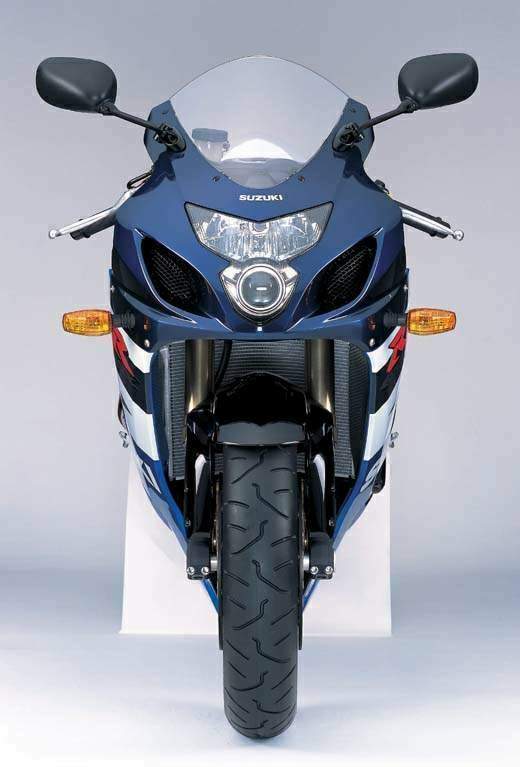
Suzuki GSX-R 600

|
Make Model |
Suzuki GSX-R 600 |
|
Year |
2004 |
|
Engine |
Liquid
cooled four stroke, transverse four cylinder, DOHC, 4 valves per cylinder. |
|
Capacity |
599 |
|
Bore x Stroke |
67 x 42.5 mm |
|
Compression Ratio |
12.5:1 |
|
Induction |
EFI - 38mm throttle bodies |
|
Ignition /
Starting |
Digital / electric |
|
Max Power |
120 hp 88.3 kW @ 13000 rpm |
|
Max Torque |
69.6 Nm 7.1 ft-lb @ 10800 rpm |
|
Transmission /
Drive |
6 Speed / chain |
|
Front Suspension |
Telescopic, fully adjustable spring preload,
rebound and compression damping. |
|
Rear Suspension |
Gas/oil monoshock, fully adjustable spring preload,
rebound and compression damping |
|
Front Brakes |
2x 300mm discs 4 piston calipers |
|
Rear Brakes |
Single 220mm disc 2 piston caliper |
|
Front Tyre |
120/70 ZR17 |
|
Rear Tyre |
180/55 ZR17 |
|
Seat Height |
830 mm |
|
Dry-Weight |
161 kg |
|
Fuel Capacity |
17 Litres / 4.5 gal |
|
Consumption average |
18.0 km/lit |
|
Standing
¼ Mile |
11. 2 sec |
|
Top Speed |
254.7 km/h |
|
Overview |
Motorcycle-USA
|

The 2004 GSX-R600 has been totally redesigned in
an attempt to reclaim the 600 Supersport throne.A lightning-quick glance shows
150 mph on the digital speedometer with the tachometer needle hitting redline at
15,500 rpm in fifth. It's a not-so-balmy 37 degrees, and I am working overtime
at hiding as much of my vented leathers behind the GSX-R's narrow fairing as
possible. Willing some blood into my frozen fingers, I roll off the throttle and
onto the brakes, sliding rearward to keep the rear wheel on the floor.
Downshifting, I dive left for the horseshoe and rail round on a steadily
increasing throttle, before nailing it back up to the redline. Briefly hitting
the rev limiter it is time to get hard on the brakes and drop a gear for the
tight uphill right-hander that leads to the first of Misano's two chicanes.
Hanging way off to keep the tires as upright as possible, I feed in the power
and hold the same gear up the hill, before sending brake fluid to the eight
pistons down at the front wheel. Clipping the curb into the chicane, I
effortlessly flick the bike left for the run up to the top horseshoe. Third gear
ends a tad bit short of the corner, but to save two shifts I hold it on the
limiter before arcing through the corner. Accelerating to the redline up the
short straight brings the approach to the second chicane. As with the first, it
is possible to take this a lot quicker than the brain will at first allow. A
good drive has the bike screaming onto the front straight, knee puck skimming
the tarmac as I attempt to use the entire racetrack and ignore the concrete way
three feet to my right.
The Guts
Taking the big bird to Italy for the launch of the 2004 GSX-R600, I have plenty
of time to think about the new bike. Lighter and more powerful this year, it
comes with titanium valves, an inverted fork and radial brakes, to mention just
some of the changes meant to vault it ahead of four contenders that debuted
all-new last year, demoting the old Gixxer to also-ran status.
Starting with the chassis, the Gixxer gets an all-new, thinner aluminum
twin-spar extrusion frame. Rake, at 23.25 degrees, is a bit steeper than the
24-degree figure of the '03 model; trail is down slightly from 96mm to 93mm and
the 1400mm wheelbase remains the same. Finished in satin black, the frame also
differs from last year's bike with the removable aluminum subframe attaching
directly to the frame. The seat rails are now made of cast aluminum, as is the
cast bridge that runs between them, and the whole plot is said to be more crash
resistant.
With the suspension dialed in the GSX-R was a carving machine on the curvy
Misano track.The new swingarm looks like last year's swingarm with braces welded
on top, and it shares the same length, height and width, so maybe it is? The
welds are actually very smooth, and the unit looks extremely butch holding the
chunky 180-series tire in place. Up front, Suzuki has chosen a Showa 43mm
inverted fork for increased rigidity and overlap. Fully adjustable for all the
usual stuff, I only made a few changes on the second day as my speeds began to
increase. The overall suspension settings were actually remarkably close to
showroom stock, with the exception of a little extra preload up front to deal
with the high-speed braking at Misano. The rear shock itself is a 46mm Showa
unit, and differs from last year's with a thicker diameter internal rod, as well
as being slightly shorter. Adjustable for the big three, it performed flawlessly
over the two-day test.

At the bottom of the inverted fork, the GSX-R600
rolls on the same 17-inch three-spoke alloy wheels as last year's model running
the same 120/70 and 180/55 front and rear sizes. The bikes we rode came equipped
with Bridgestone BT014SFs, but Dunlop D218s will be fitted for us here in
America. Full marks to the Bridgestone tires. With cold winds blowing across the
Santa Monica raceway, they gave a whole lot more grip than I had originally
thought possible.
This year's front brake discs are 20mm smaller at 300mm and 0.5mm thicker,
losing 20 grams in the process. Suzuki uses Tokico radial-mount 4-piston
calipers that allow for more rigidity and improved braking. Lightly squeezing on
the six-way adjustable lever at over 150 mph scrubbed off the required speed to
enter the horseshoe with absolutely no drama - the brakes just progressively
getting stronger the more I pulled. Riding the same bike for both days, the
brake action was just as strong during the last session as it had been during my
first. Partly responsible for this incredible setup is the radial-piston front
master cylinder. Unlike a conventional piston that works horizontally against
the lever, the radial piston is positioned vertically, allowing a more direct
force from the lever to the piston. This gets more fluid to the brake calipers
and is said to improve feel and feedback.
Responsible for all the high-speed forward motion, the fuel-injected GSX-R
engine has undergone a total redesign in the quest for more power and less
weight. Suzuki claims 4% more power, and says it has 124 horsepower with the
assistance of its ram-air system working at its max. Peak torque is now listed
as 3% stronger. Reciprocating weight inside the motor is reduced by 5% thanks to
titanium valves, lighter pistons, camshafts, valve buckets and more.
Displacement, bore and stroke are unchanged, but compression ratio has increased
to 12.5:1 from 12.2:1 with the use of flat top pistons and a more compact
combustion chamber.
Street hooligans and track junkies alike will be pleased with the radial-mounted
Tokico brakes.Providing the titanium valves a home, the new cylinder head has
been through the total re-design process, now weighing in 80 grams lighter. As
part of this diet, the cylinder-head bolts have been reduced 3.5 grams in weight
for a total saving of 35 grams, and the cam housing bolts 1.4 grams for a
further 28-gram loss. This weight loss program continues into the camshafts,
valve springs, and valve buckets. Connecting rods 3mm shorter attach to a new
crankshaft that features slimmer journal diameters, 30mm instead of 32mm. This
is to optimize crankshaft balance and to reduce mechanical friction loss.
Looking into the gearbox shows closer gear ratios and a totally redesigned shift
fork. I have no complaints about the shifting on the bike using only the clutch
for downshifting, the bike effortlessly selecting the next ratio whenever
needed. The non-adjustable cable clutch is very light, with a 25% reduction in
the spring rate. Initial load has been raised by 4% to deal with the engine's
extra power.
Visually, the bike certainly shows its GSX-R heritage and has been styled this
year for a more aggressive look. Up front, the vertically stacked headlights
replace the old side-by-side jobs and sit in a narrower, more aerodynamic
fairing. The two-stacked headlights consist of a projector-type on the bottom
for low beam and a multi reflector type up top for the main. Even the GSX-R's
turn signals have been given a new more aerodynamic shape, as well as being
lighter.
The gas tank is narrower and shorter this year to make life easier for the rider
during cornering transitions or getting hard on the brakes. The seat serves as a
useful work platform to slide on and off the bike, while giving enough room for
my near six-foot frame. Looking oh-so-cool behind the seat is the tight-looking
tailsection, with two sets of seven LED lights sitting on top of each other.
Yes, it's lighter, even with the body work.Shifting at 15,500 rpm through the
next two gears and wide open in fourth gear, it is necessary to lose a lot of
speed for Misano's tight left-hander. Lap after lap I mess up, tipping the bike
in while still on the brakes. It doesn't violently protest, but it makes for
some heavier steering effort and a little awkwardness as much of my body weight
is on my arms. Sliding off the seat to the left, I accelerate towards the series
of fast left-handers that lead to the long back straight. Flat out up to the
first corner before short shifting through the second, I briefly stand the bike
up and take one more quick shift before exiting the corner around 120 mph.
Tucking in and stretching the throttle cables, it is soon time to get back on
the brakes at over 150 mph.
Off the brakes, while pitching into the horseshoe one more time, I twist the
throttle back up to redline, indulging in the intoxicating intake roar that
resonates as the engine rips past 9000 rpm. Pipe howling its wonderful four
cylinder magic, it's back on the brakes, shifting my weight for the tight
up-hill right-hander.
Inside my leathers I am sweating as I get more and more aggressive with the
lithe 355-lb. (dry) GSX-R600 beneath me. All thoughts of the near freezing
temperatures have faded as I lock my eyes on the next corner and wring the
throttle as hard as I can before getting set up for the chicane.
Source
Motorcycle-USA

|