|
|
|
|
Classic Bikes
Custom Bikes
Individual
Racing Bikes AJP
AJS
Aprilia
Ariel
Avinton / Wakan
Bajaj
Benelli
Beta
Bimota
BMW
Brough Superior
BRP Cam-Am
BSA
Buell / EBR
Bultaco
Cagiva
Campagna
CCM
CF Moto
Combat Motors
Derbi
Deus
Ducati
Excelsior
GASGAS
Ghezzi Brian
Gilera
GIMA
Harley Davidson
Hero
Highland
Honda
Horex
Husaberg
Husqvarna
Hyosung
Indian
Jawa
Kawasaki
KTM
KYMCO
Laverda
Lazareth
Magni
Maico
Mash
Matchless
Mondial
Moto Guzzi
Moto Morini
MV Agusta
MZ / MuZ
NCR
Norton
NSU
Paton
Peugeot
Piaggio
Revival Cycles
Roland Sands
Royal Enfield
Sachs
Sherco
Sunbeam
Suzuki
SWM
SYM
Triumph
TVS
Ural
Velocette
Vespa
Victory
Vincent
VOR
Voxan
Vyrus
Walt Siegl
Walz
Wrenchmonkees
Wunderlich
XTR / Radical
Yamaha
Zero
Video
Technical
Complete Manufacturer List
|
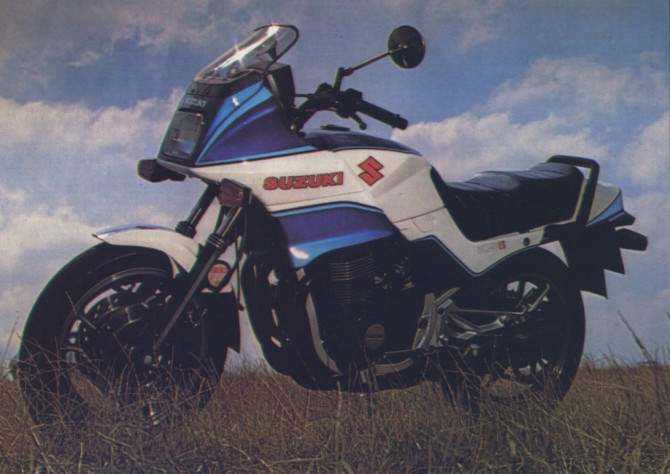
Suzuki GSX 550ES
About time 'n' all Suzuki, I thought as I poodled away from the importer's HQ in downtown Crawley. It has, after all, taken Suzuki a long time to come up with a replacement for the CS550, especially when you add up how many CBX and CPz 550s you see on the streets. Surprisingly, Suzuki's only new(ish) middleweight contender, the 650 Katana, never made the sales it deserved while the GS550 was dressed up in a Katana suit but not many people were fooled. By 1981 a 460lb 550 that could only just crack 113mph looked a little bit sad. But back in 77 when it first appeared the CS550 got rave reviews. Bike ran it with the Honda CB550K3 under the tag line 'So who needs a 750?'. Like everyone else, we were impressed with its reliability —especially the unburstable motor — and looks. Remember that Kawasaki didn't come in with the Z500 until '79 when Honda were still pushing their 550 derivation of the good old CB500. If you wanted a middleweight four stroke in the late'70s that could cut it with the 750s then you bought a GS550 or kept thrashing the old 400-4. I was so impressed I bought a CS secondhand in '79, it was the most reliable bike I've ever owned. It suffered two years of thrashing, crashing and neglect with never a complaint. A mate of mine not noted for his generosity even came up with a decent-sized wad of drinking vouchers when I came to sell it. Yup, a lovely bike and about the best looking lap four ever built, especially the early black ones that didn't have to suffer the later models' overdose of pinstriping. Then Kawasaki upped their 500 to 550 and in '81 came the first CPz along with the underrated Yamaha XJ550. In '82 came the Honda CBX550. What were Suzuki doing all this time? Still flogging the GS almost unchanged from its original spec plus the Katanaised version and a horrible custom variant. Not surprisingly, the new generation of faster, lighter middleweights cut Suzuki's sales drastically. They didn't seem in any particular hurry to get back in the game though — it wasn't until this year that the GS's replacement was first shown. Gentlemen, a toast: I give you the Suzuki GS550,1977-83: the definitive across the frame four. Right. Nostalgia trip over, let's have a butcher's at the GSX. Note that X'. It denotes four-valve heads with forked rockers instead of the GS's twin valves with the easiest-to-work-on bucket and shim system ever built. There's a clue here to Suzuki's thinking. Back to the early GS for a moment, check the nicely understated lines and gimmick-free motor that earned a justifiable reputation, along with its big brothers, as the most reliable engines to come out of Japan. It handled well except for a tendency to turn its front end in on slow corners, something that's totally unremarkable now nearly everything from 80cc up has twin discs. The suspension and ride matched the chassis nicely giving the reassuring impression that here was a motorcycle designed by and for motorcyclists, not by the marketing department. Now back to the GSX. What's the first thing you notice about it after studying the GS? Well, yes, it is a little garish isn't it? It's meant to look like Suzuki's Grand Prix racers you see. And no one's given a chance to miss the fact that Suzuki have slung as much high technology at the GSX as they could find. It's all there: rising rate, anti-dive, 16-inch front wheel, square section frame, you name it the GSX has got it. What it hasn't got is weight. Suzuki are at pains to point out how much smaller everything is on the GSX than on the GS. They claim to have lost over seven kilos (151b) from the motor, one-and-a-half (3.31b) from the exhaust system and about the same from the carbs/airbox. That's about ten kilograms (221b) gone from the power unit. Elsewhere the designers have managed to lose another five kilos (111b) of the old CS. And so, of course, they should — Honda's CBX550 weighs in at 200kg (4431b), the CPz at a kilo more, and the 550 Katana at a porky 214kg (472lb). The CSX tips the scales at 198kg (436lb). So far so good. Predictably, the motor gets Suzuki's four-valve head design with forked rockers operating pairs of valves and complimentary TSCC. That's Twin Swirl Combustion Chamber, which basically involves a sharp ridge running centrally across the roof of the combustion chamber from front to back, effectively separating each pair of inlet and exhaust valves. The shape is also supposed to ensure better filling and combustion and therefore better fuel economy. No doubt it can make the tea as well, but as the CSX turned in over 45mpg regularly I am impressed. And I was impressed with the performance 'n' all. Right down the bottom of the rev range the Suzuki is incredibly smooth. It'll pull from nowhere without a hint of snatch and carry on round its tacho dial, gathering speed and putting out more power the nearer it gets to the red line. The only vibes come in for around 1000 revs at five grand, and they only blurr the mirrors. There's no power band as such but you need to be above 6500rpm to really travel. The smoothness is deceptive, though. When you start trying to hustle around the countryside at a satisfying illegal rate of knots you find that smoothness hides peakiness. Mucho stirring of the six-speed box is necessary. I took to revving it into the red from time to time, something my mechanical sensibilities rarely let me do. There was plenty of urge left in the further reaches of the rev range and the motor made no complaints about going up there. Interestingly, some of the weight saving on the power plant has come from using two twin-choke carbs rather than the accepted Japanese one carb per cylinder. I only managed to catch the carbs out in one way. After a decent length of time at full bore, throttling back to around 6000 and then trying to cruise on part throttle results in the motor acting like it's fallen down a hole in its own powerband. A quick burst of full throttle gets you out of the problem. So, the CSX's motor wants to be treated like it lives in the chassis of one of Rob McElnea's TT bikes. Does its chassis match up? Well, in looks of course it does. It might be a little over the top on the styling front, but with a tiny 16-inch wheel holding the front end up it's always going to look a little odd. I expected the fairing to be more effective than it was. Looking at it you expect a pretty effective wind break but it actually doesn't do a lot. I think there's something wrong with its lines too, but that's probably more to do with the high handlebar, which makes the fairing look as if it's slipped down on its mountings by about nine inches. And now we come to a classic piece of Jap-tech. The frame. Notice that the exposed bits of tubing are square section just like on Randy's bike. And Suzuki go on about the fact in their adverts a bit don't they? Well, the bits you can't see are good old fashioned round tube. Couldn't tell that from the ads could you? Suzuki's ad men have gone for an endorsement on their artistic licence and put highlights on the round bits to disguise their shape in the drawings. Naughty, naughty. Anyway, the frame works extremely will in spite of the hype. The 16-inch wheel? Ah, now you're asking. At high speeds the bike is very stable in a straight line but still manages to change direction incredibly swiftly with the merest touch of rider input. That's a very racer-like habit, and naturally enough there's a trade off. At low speeds the thing over-steers badly. It puts the wind up me for quite a while but I came to terms with it. Not quite sure what to make of this, to me, strange behaviour, I consulted a couple of racers. They met me with looks of pity. No problem. They said, quite the opposite, and anyway you'll get used to it. Hmm, I still think slight less Frenetic riders may find this a problem. What I can't say is whether this behaviour is a function of the small front wheel or the steering geometry. There are some, er, interesting handling characteristics at high speed too. Maybe it's the Full-Floater rear suspension, I don't know but the rider receives one hell of a lot of feedback through the bars and the seat of his pants. On the CSX550 you know exactly what's going on. Trouble is I'm not sure whether this is too much of a good thing; on occasions I became paranoic. The front wheel would feel firmly planted on the tarmac, but remote. The back end kept on feeling like it wanted to step out. It was as if the bike was turning around a point somewhere below the motor rather than the angle of bank dictating the turning radius. Strange, but handling at the top end of the speed range was great. At this point I had to start asking myself if Suzuki had done more than just dress the 550 up like their racers. They've definitely given the thing some of the single-minded nature of an RC. One department in which Suzuki have signally failed to keep up with current technology is the tyres. The Japlops on this bike are horrible. While wimping about in front of the camera with a terminal first-division hangover I repeatedly found the front or rear end stepping out under the mildest provocation on anything other than a perfect road surface. The only owner of a CSX550 I met during my time with the bike said he'd gone over to Pirellis straight after his running-in period. Not because he wanted too, but because he had to - the original equipment had scared him so much. Japanese tyres have improved immeasurable over the past year or two, these take 'em right back to square one.
Now to another naff bit of Jap-tech, the anti-dive. Those impressive looking lumps on each fork leg are there for ornament only, they might look like Randy's but they don't do a thing. Check the photo of yours truly doing a spot of medium hard braking — not crash stop stuff you understand, the hangover couldn't take it — would you say the anti-dive was doing anything? While I'm moaning I'll have a go at the world's first designer fuel tap. This is a dinky little hinged cover in the left side panel. You have to open it to get at the fuel tap underneath. The first time I attempted to fiddle with this interesting device the Cosmic Foot stamped on my choc-ice by giving me a rear wheel puncture at the same time. Luckily, tubeless tyres go down gently rather than with a big bang as the tubed variety are prone to. This may sound like extreme nit-picking, but the current crop of middleweights are so good, and that includes the CSX550, that little things like these and whether you happen to like your local Suzuki' dealer more than the Honda man can make the difference. Sermon over, back to the Suzuki's good points. If you read Roland Brown's appreciative appraisal of the CSX750 in the June issue you'll be able to skip the next couple of paragraphs. The 550 has remote spring preload adjustment for the Full-Floater suspension unit but no provision for altering the damping. All you do is turn the screw under the left carb and watch the little red pointer. The suspension itself works well enough but tends to be caught out by the sort of major irregularities that are commonplace on today's roads. The front fork is excellent and mercifully devoid of air caps. Instead you get two-way adjustable spring preload — much more useful. Since I went over the top about the dual opposed piston calipers on the Yamaha XJ900 tested in the September issue, I think I'd better do the same about the CSX's brakes. All three discs are gripped by these excellent devices that maintain the stopping power they left the factory with, and reduce maintenance to the occasional pad change and fluid replacement. My only quibbfe is that although the brakes work as well as — if not better than — most people would want, the lever has a squidgy, long-travel feel about it. I'm inclined to blame the anti-dive for this. But in case you should be in any doubt, Suzuki have thoughtfully printed the words Opposed Piston' in big red letters on the plastic cover of each caliper. Similarly the tail fairing carries the words 'Full Floater' and two meaningful intersecting lines; subtle eh? I appear to have taken the easy way out and reverted to nit-picking, this must cease. So let me say how well Suzuki have attended to the detailing. It's little things like the way all major electrical connections are greased and enclosed by rubber boots, the way the welds are a lot tidier than you expect from something put together on a production line by robots, the sensible use of plastics; in a phrase good production engineering. This Suzuki should be as durable as its immediate ancestor. But the one thing that's going to handicap the CSX in the race for middleweight sales is the simple fact that the GPz and CBX were here first. Ignore the Suzuki's list price of £2099; most of the discounters seem to be advertising it at exactly the same price as the GPz, £1849. It's worth comparing the two bikes to see if Suzuki's delay has given them time to make any major technical advantages. Engine: both are very peaky, with the Kawa feeling the peakier. Suspension: both excellent, the Suzuki's front fork is the better, the Kawasaki's rear system marginally better than the Suzuki's although you have to remove the air filter to adjust the GPz's spring preload. Brakes: both excellent with the Kawsaki just shading it. Handling: the Kawa is brilliant, the Suzuki has some funny habits. Looks: very much a matter of opinion. Fuel consumption: the Suzuki is far more economical. Maintenance: the GSX wins again. Although I don't like threaded tappets on motors that get pushed to ten thou regularly, the Suzuki system is easier to deal with than the GPz's which has to have its cams removed to change shims. Performance: not a lot in it. The performance figures in our data panel were obtained in the teeth of a vicious cross-wind that refused to let the Suzuki rev out. If you look at Bikedata you'll see our GPz550 figure isn't exactly startling either. That was because the poor thing was thrashed to Switzerland and back before being tested at MIRA. So both figures can be regarded as realistic for a bike with a few thousand miles on the clock rather than as a theoretical maximum for freshly run in machinery. The quarter mile times show the Kawa to be a tenth quicker than the Suzuki. Well over 120mph is easily achievable given the motor's ability to pull into the red. We just struck bad luck with the wind conditions at Mira. So where does that leave the punter trying to decide what 550 to buy? Does the old favourite, the GPz, still cut it? Is a CBX worth the extra loot? Or is the GSX the new class leader? Er, how shall I put this, I don't know. The Suzuki is another truly fine middleweight motorcycle. As long as you ain't too tall the rather upright riding position won't bother you. And if you're prepared for the uncompromising nature of its handling and a motor with all the power up the top end then go out and ride one. Maybe I shouldn't have taken the piss out of the Suzuki's racer pretensions quite so enthusiastically, 'cos I've just remembered what it reminds me of — the first LCs. Source Bike Magazine 1983
|
|
|
Any corrections or more information on these motorcycles will be kindly appreciated. |