|
|

|
|
|
|
Classic Bikes
Custom Bikes
Individual
Racing Bikes AJP
AJS
Aprilia
Ariel
Avinton / Wakan
Bajaj
Benelli
Beta
Bimota
BMW
Brough Superior
BRP Cam-Am
BSA
Buell / EBR
Bultaco
Cagiva
Campagna
CCM
CF Moto
Combat Motors
Derbi
Deus
Ducati
Excelsior
GASGAS
Ghezzi Brian
Gilera
GIMA
Harley Davidson
Hero
Highland
Honda
Horex
Husaberg
Husqvarna
Hyosung
Indian
Jawa
Kawasaki
KTM
KYMCO
Laverda
Lazareth
Magni
Maico
Mash
Matchless
Mondial
Moto Guzzi
Moto Morini
MV Agusta
MZ / MuZ
NCR
Norton
NSU
Paton
Peugeot
Piaggio
Revival Cycles
Roland Sands
Royal Enfield
Sachs
Sherco
Sunbeam
Suzuki
SWM
SYM
Triumph
TVS
Ural
Velocette
Vespa
Victory
Vincent
VOR
Voxan
Vyrus
Walt Siegl
Walz
Wrenchmonkees
Wunderlich
XTR / Radical
Yamaha
Zero
Video
Technical
Complete Manufacturer List
|
Suzuki GSX 1100E
By the late 1970s, the world seemed to be closing in on the superbikes. Germany was the first to impose a ban on all motor cycles with more than 100 bhp, soon after the launch of the 120bhp Kawasaki Z1300. Kawasaki quickly responded with a restricted version of their flagship. Honda were the next to comply with the regulations. Their 1980 model CBX was equipped with a detuned 95 bhp engine for all markets replacing the previous 105 bhp engine since there were too many complexities involved in producing two separate power units, depending on the country of final sale. 'What power would the new 1100cc version of the popular GS1000 90 bhp Suzuki have when it arrived?' wondered the specialist press. It seemed obvious that with 10 percent more capacity than its smaller stablemates and a brand new four-valve head, it would have much more power. But this was in fact not the case, for the new GSX1100 had a fraction under the permitted 100 bhp. Yet it could still out-perform every other production motor cycle A whole new wave of technology has ebbed over the basic two-valve Suzuki engine to produce the GSX1100 TSCC (twin-swirl combustion chamber) motor. Apart from the obvious doubling of valves, the engine features round cylinder bores in conjunction with squared combustion chambers, an exceedingly complex combustion chamber design to increase swirl for more efficiency and a brand new crankshaft. Interestingly the one obvious advantage of having four valves per cylinder, that of greater valve area, has not been exploited. The 1100 has a total 38sqmm more valve area per cylinder than the 1100. Out of a total of 1976 sq mm this makes very little difference indeed. However, Suzuki state quite rightly that at lower valve openings the multi valve head is far more efficient. Four 34 mm constant-vacuum carburettors feed the engine which drinks fuel at a rate of 42-48mpg, which is reasonably frugal, considering the machine's performance.
A normal duplex cradle frame is used for the GSX in conjunction with air forks. With the 1100, Suzuki have sensibly fitted a balance pipe between the two fork legs, so that constant pressure is assured in both. With the 1000 it is quite easy to give one fork leg the slightest amount more pressure and consequently upset the handling. Aside from the usual air-pressure adjustment for the forks, adjustments are almost infinite on the 1100 for there are four spring pre-load and four rebound damping adjustments at the front and four rebound settings and five preload settings at the rear. All something of a nightmare for the novice, but a dream come true for the road-going racer who takes great delight in setting up his bike for every conceivable road condition and style of riding. Weighing just 535lb, considerably less than its rivals, and with something around 100 bhp on tap, the Suzuki flagship is quite a roadburner. In fact, its standing start quarter-mile time of a fraction under 11.5secs suggests that if anything, the quoted power figures of the engine are a little on the conservative side. Apart from the shattering acceleration and the gearing-governed top speed of 141 mph, the bike pulls like a train in the gears and the mid-range flat spot that is sometimes apparent on the 1000 is missing. Handling is excellent, even better than on previous Suzuki models. In short, it rates with just about any other bike on the market on its time. Source Super Bikes by Mike Winfield It’s easy with hindsight to knock the supersports bikes of the early 1980s, like the Suzuki GSX1100E, as lumbering dinosaurs of the Jurassic period of motorcycling. Potent, but large and heavy, these monsters grew because there was nothing to stop them. They were at the top of the performance food chain. The evolution of bikes like the Suzuki GSX1100E from the relatively nimble four-cylinder bikes of the 1970s was a result of the demand for power and speed that outstripped the factories’ ability to find an alternative to the ‘more is better’ philosophy. Without the benefit of weight saving technology as each additional horsepower was wrung from the increasingly larger engines, more kilos were added to beef up the tubular steel chassis.
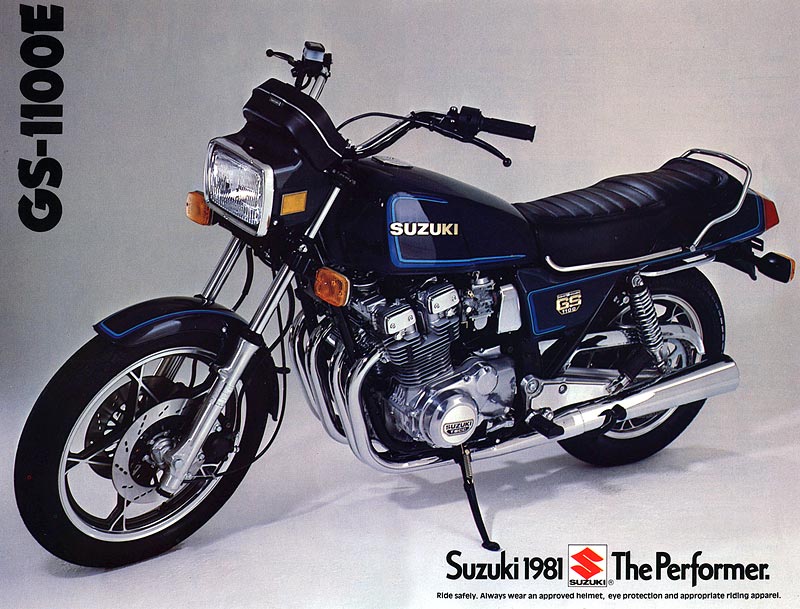
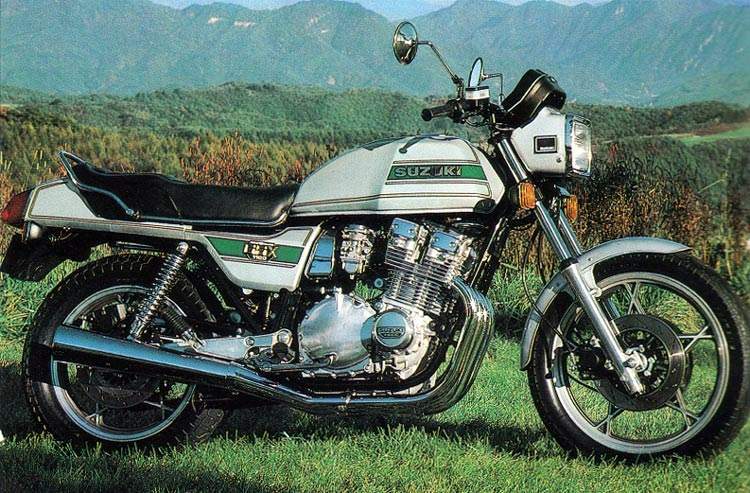
The Suzuki GSX1100E (or GS1100E in America) first appeared in 1980 as a replacement for the two-valve GS range. As the GS was always criticised as being a homologue of Kawasaki’s Z1, in one swoop the GSX changed the face of Suzuki’s four-cylinder, air-cooled line-up. The 1075cc four had a bore and stroke of 74mm x 66mm and while it retained chain-driven double overhead camshafts it now featured four valves per cylinder and the much-vaunted TSCC, or Twin Swirl Combustion Chamber. By machining a ridge between the valve pair and overlapping the valves slightly in the cylinder bore Suzuki claimed more swirl could be created with a resulting improvement in combustion efficiency. The bottom end still included a pressed-up roller bearing crankshaft and with a quartet of Mikuni 34mm carbs, the power was 100hp (73.6kW) at 8500rpm. To accommodate this more potent engine, Suzuki redesigned the chassis and incorporated styling that broke the traditional Japanese mould. The unusual angular styling was accentuated by a large rectangular headlamp and heavy-looking tail section. The large dash also included a groundbreaking LED-style warning light panel. The 37mm front fork was a leading-axle type, now with air assist, and the sturdier swingarm an aluminium alloy fabrication based on those of the Yoshimura superbikes. Unfortunately the rest of the chassis came from the dark ages. Although they included four-position damping adjustment, the twin rear shock absorbers weren’t great, and the front brakes were a pair of 275mm slotted discs gripped by a pair of weak floating-piston calipers. This was still the era where compromised floating-piston calipers went on the front while the rear had a superior dual opposed-piston caliper. Suzuki had yet to break away from the traditional wheel sizes of 19in on the front and 17in on the rear. And with a wheelbase of 1510mm and a dry weight of 243kg the GSX1100 was never going to be a nimble sportsbike. But when it came to outright performance it was at the top of the heap in 1980, regularly clocking 230km/h in road tests. Ultimately the GSX1100E was something of a watershed, blending the emergent engine technology of the late 1970s with a dubious and overworked chassis that typified the power race of the period. And while the later derivations had a more unified look, it is the early examples (like our pictured bike, a 1981 US-spec GS1100EX) with their chunky, macho style that epitomise the UJM (Universal Japanese Motorcycle) of the early 1980s. Powerful, stunningly dependable, and with the looks of the time, the early GSX1100E represented a pinnacle in the age of the dinosaurs. Motorcycle Trader
|
|
|
Any corrections or more information on these motorcycles will be kindly appreciated. |