|
|
|
|
Classic Bikes
Custom Bikes
Individual
Racing Bikes AJP
AJS
Aprilia
Ariel
Avinton / Wakan
Bajaj
Benelli
Beta
Bimota
BMW
Brough Superior
BRP Cam-Am
BSA
Buell / EBR
Bultaco
Cagiva
Campagna
CCM
CF Moto
Combat Motors
Derbi
Deus
Ducati
Excelsior
GASGAS
Ghezzi Brian
Gilera
GIMA
Harley Davidson
Hero
Highland
Honda
Horex
Husaberg
Husqvarna
Hyosung
Indian
Jawa
Kawasaki
KTM
KYMCO
Laverda
Lazareth
Magni
Maico
Mash
Matchless
Mondial
Moto Guzzi
Moto Morini
MV Agusta
MZ / MuZ
NCR
Norton
NSU
Paton
Peugeot
Piaggio
Revival Cycles
Roland Sands
Royal Enfield
Sachs
Sherco
Sunbeam
Suzuki
SWM
SYM
Triumph
TVS
Ural
Velocette
Vespa
Victory
Vincent
VOR
Voxan
Vyrus
Walt Siegl
Walz
Wrenchmonkees
Wunderlich
XTR / Radical
Yamaha
Zero
Video
Technical
Complete Manufacturer List
|
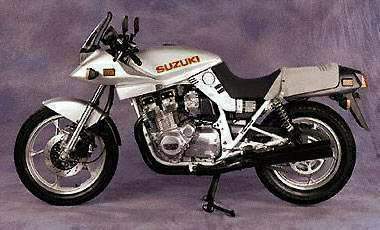
Suzuki GSX 1000SV Katana
|
|
Make Model |
Suzuki GSX 1000SV Katana |
|
Year |
1981 - 82 |
|
Engine |
Four stroke, transverse four cylinder, DOHC, 4 valves per cylinder. |
|
Capacity |
998 cc / 60.9 cu in |
|
Bore x Stroke |
69.4 x 66 mm |
| Compression Ratio | 9.5:1 |
| Cooling System | Air cooled |
| Air Cleaner | Dual element (Paper and polyurethane) |
| Lubrication | Wet sump |
| Oil Capacity | 3.2 L / 3.4 US qt / 2.8 Imp qt |
|
Induction |
4 x Mikuni VM32SS carburetors |
|
Ignition |
Transistorized |
| Ignition Timing | 15º BTDC below 1500 rpm / 32º BTDC above 2350 rpm |
| Spark Plug | NGK D8EA (in E-01,24,25,30,34), NGK DR8ES-L (the others) - gap 0.6-0.7 mm (0.024-0.028 in) |
| Battery | 12V 50.4 kC (14 Ah)/10HR - type YB14L-A2 |
| Generator | Three-phase A.C. generator |
| Starting | Electric |
|
Max Power |
80.5 kW / 108 hp @ 8500 rpm |
|
Max Torque |
91 Nm / 9.3 kgf-m / 67.3 lb-ft @ 6500 rpm |
| Clutch | Wet multi-plate type |
|
Transmission |
5 Speed |
| Final Drive | Chain, Daido D.I.D 630YL, 96 links |
| Primary Reduction | 1.775:1 (87/49) |
| Final Reduction | 2.800:1 (42/15) |
| Gear Ratio | 1st 2.500 (35/15) / 2nd 1.777 (32/18) / 3rd 1.380 (29/21) / 4th 1.125:1 (27/24) / 5th 0.961 (25/26) |
| Frame | Steel, double cradle frame |
|
Front Suspension |
Telescopic, oil damped, spring 4-way adjustable with anti-dive |
| Front Wheel Travel | 150 mm / 5.9 in |
|
Rear Suspension |
Dual shock oil damped, damper 4-way, spring 5-way adjustable |
| Rear Wheel Travel | 109 mm / 4.29 in |
|
Front Brakes |
2 x 275mm Discs, 2 piston calipers |
|
Rear Brakes |
Single 275mm disc, 1 piston caliper |
|
Front Tyre |
3.50 - V19 |
|
Rear Tyre |
4.50 - V17 |
| Trail | 118 mm / 4.65 in |
| Turning Radius | 3.5 m / 11.5 ft |
| Dimensions |
Length 2260 mm / 89.0 in Width 715 mm / 28.1 in Height 1195 mm / 47.0 in |
| Wheelbase | 1520 mm / 59.8 in |
| Seat Height | 775 mm / 30.5 in |
| Ground Clearance | 175 mm / 6.9 in |
|
Dry Weight |
232 kg / 511 lbs |
|
Fuel Capacity |
22.0 Litres / 5.8 US gal / 4.8 Imp gal |
| Reserve | 5 L / 1.3 US gal / 1.1 Imp gal |
|
Consumption Average |
5.9 L/100km / 17 km/l / 40 US mpg / 48 Imp mpg |
|
Standing ¼ Mile |
11.32 sec / 193 km/h / 120 mph |
|
Top Speed |
220 km/h / 137 mph |
|
Road Test |
Cycle World |
A 1000 cc version of the new GSX1000S was
made to homogenized the model for racing purposes. By decreasing the bore by
2,6 mm the cylinder displacement was decreased to 998 cc, just below the
one-liter mark. The GSX1000SD was available in shops already in 1981.
The UK 1000SZ, built for racing, had slide carburetors, whereas the 1100's
had CV carbs. The US 1000S, however, had CV carbs! Also, the US versions
never had the black ”fins”under the nose fairing - the mounting holes were
blanked-off on all US bikes.
Only 3000 units of the 1000 cc Katana were produced. Amazing but true: Not everyone thought this bike
was easy on the eyes when it debuted in 1982.
To realize why, consider exactly which molds were broken when Suzuki unleashed
the GS1000SV Katana. Back in the early ’80s, the norm in motorcycling was
big-bore standards, complete with squared-off tanks. Think Honda CB900F. Think
Kawasaki KZ1000. Heck, Windjammer fairings were still considered
state-of-the-art.
Into this world blasted one of the most radical styling departures ever
mass-produced. The Katana, named after a samurai sword, was shaped with help
from designer Hans Muth to look like nothing else on two wheels.
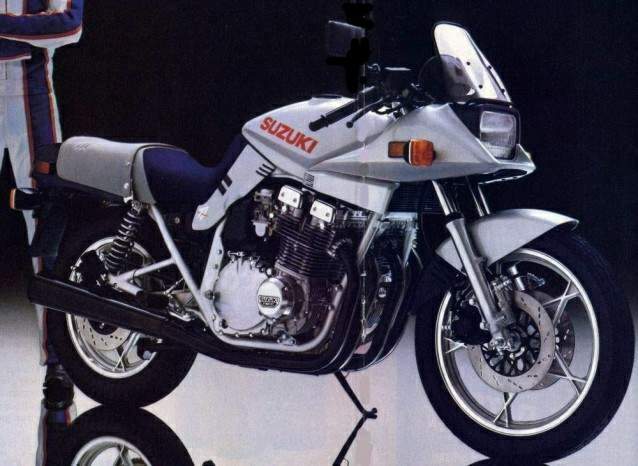
In hindsight, it’s easy to get a premonition of today’s sportbikes in the
design. The humpback, racer-inspired gas tank. The ready-to-pounce posture. But
there’s something that remains unique about the Katana as well. You can see it
in the two-tone suede-finish seat, the fairing-which is more accent than fully
enclosing bodywork-and the yin-and-yang speedo/tach.
The design actually drew a lukewarm response in magazines of the day. Editors
harrumphed that the bike was “an eyeful,” or that the “shapes don’t quite add
up.” Even Suzuki seemed timid about diving head-first into the future,
continuing to incorporate more mainstream styling in its GS550 and GS1100 models
that sold alongside the limited-edition Katana.
Underneath the bodywork, the bike was all ’80s Superbike, which is to say
capable, but hardly as innovative as the skin. Sleeved down from the previous
year’s GS1100, the Katana sported a double-spine frame, dual rear shocks and
dual front discs with anti-dive forks. It all added up to respectable, but
hardly earth-shaking, performance.
In the end, the Katana was a concept bike for the masses. As such, it was not an
overwhelming sales success. Offered for only a year, the limited-edition bike
then faded from the scene, although the Katana name continues on a 750cc machine
today.
But sales numbers aren’t everything. And with the Katana, Suzuki carved itself a
niche as a styling innovator, a role that continues with the new GSX1300R
Hayabusa.
Meanwhile, a machine that may have seemed merely strange in 1982 has since
become a classic.
|
Any corrections or more information on these motorcycles will be kindly appreciated. |