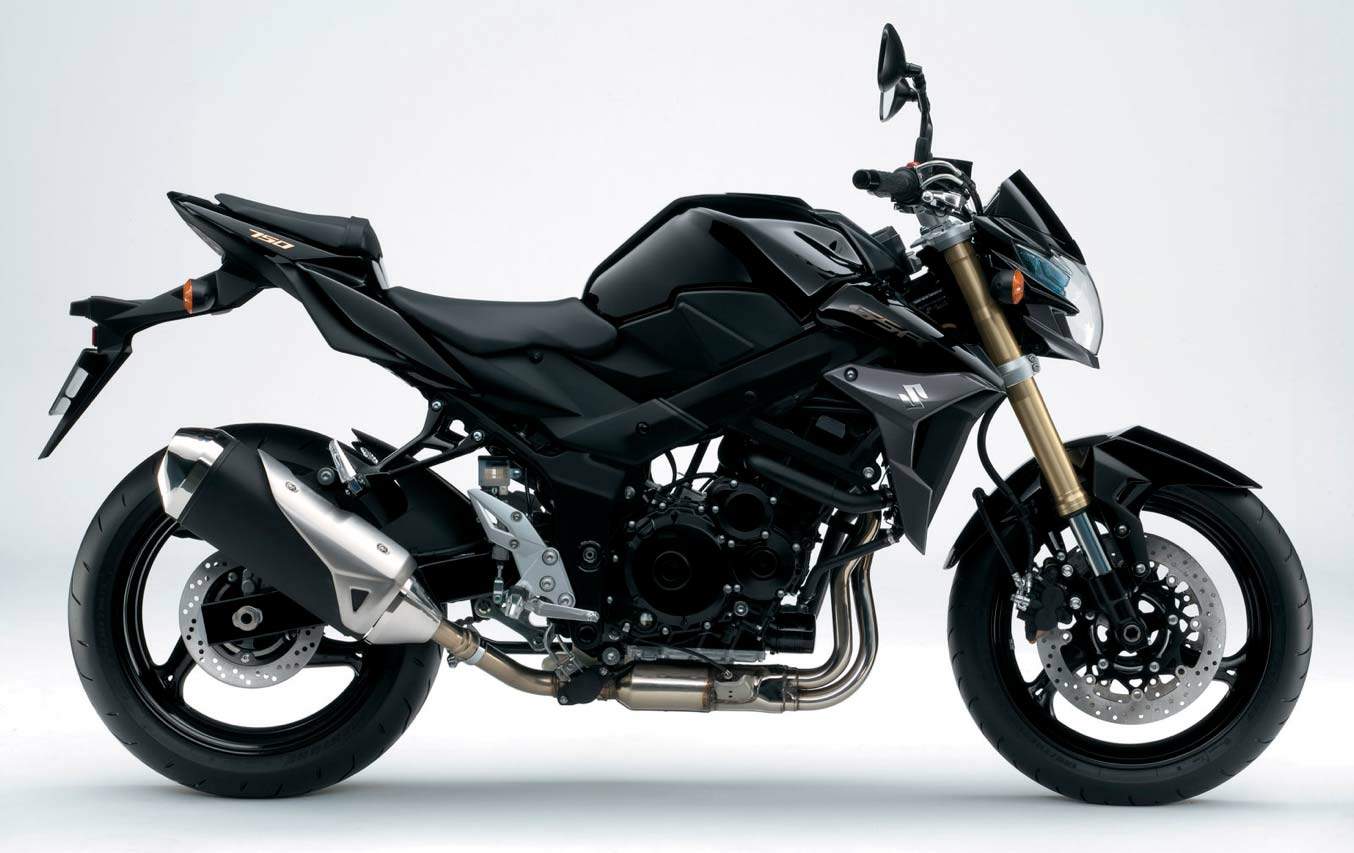
Following an award-winning debut in 2011,
Suzuki's renowned GSR750 benefits from another feature to keep it ahead of
its rivals in 2012, with news that the popular naked middleweight is now
available with ABS.
Introduced in the spring of 2011, the GSR750 quickly caught the imagination
of UK riders, following positive launch tests from the major publications,
before going on to win group tests and even picking up the coveted MCN
Machine of the Year award for its class too.
Suzuki GB general manager, Paul de Lusignan added,"The GSR750 has proven to
be an extremely popular machine both in the UK and mainland Europe. As well
as winning the MCN award in 2011, Zoo Magazine voted it their machine of the
year and we've received great praise from our customers too. ABS is
obviously a great safety enhancing feature which we hope will only add to
the GSR's desirability in 2012."
Enter the 2011 Suzuki GSR750. A blend of the
modern and the futuristic all rolled into a motorcycle. With a powerful
749cc four-cylinder fuel-injected engine, this motorcycle is a cool fusion
of technology, performance and style. An all-around motorcycle built for fun
and excitement.
The GSR750 is an entertaining naked bike meant for confident and experienced
riders. Motorcyclists who appreciate a dynamic ride, with strong
acceleration and sporty handling will consider this bike.
Strong lines start at the front and move up and back. Including a carefully
sculpted, vented front fender. A modern, vented headlight shell and
integrated instrument cluster.
Inverted front forks, a design developed in racing and mandatory for a
serious, high-performance machine. Molded rearview mirrors. Light and open
radiator side panels combined with aggressive front bodywork sidepieces form
the design.
A chiseled 17.5-liter fuel tank, and contrasting, textured tank side panels.
A well-shaped seat, frame side covers and an angular tailsection with
integrated LED taillight.
Even the compact turn signals complement the GSR750 design theme, with
carefully shaped lenses that look more like custom pieces than standard
parts.
Above all, this is a motorcycle, with the engine out in the open to for all
to see: The Suzuki exhaust system is on display as well, culminating in a
distinctive triangle-shaped muffler with a form-fitting, brushed-stainless
steel heat shield.
This is a piece of modern technological artwork; a machine to enjoy and
admire even when the ride is over and the Suzuki GSR750 is at last
stationary.
The new Suzuki GSR750 is ready for a weekend ride, or a weekday commute. It
starts with a sport riding position, created by a carefully crafted
relationship between the handlebars, footrests and seat.
It continues with effective suspension, designed to progressively react to
small ripples as well as larger bumps in the road.
Combined with a powerful Suzuki 749cc engine tuned to deliver a dynamic wave
of smooth torque and strong acceleration. With ultimate throttle response
all the way from low-rpm through mid-rpm to maximum engine speed..
And thanks to advanced combustion efficiency and effective, non-intrusive
control systems, the GSR750 is an exceptionally efficient four-cylinder
750-class motorcycle. Making it easier to enjoy the power and acceleration.
Each component has been carefully designed to not only work well but also
add to the GSR750's unique, mechanical style.
A prominent analog tachometer on the left features an easier to read
traditional needle pointing to a numbered scale on a round face.
To the right of the tachometer is a back-lit,
brightness-adjustable LCD display featuring a large, digital speedometer
readout; a gear-position indicator; a coolant temperature gauge; a fuel
gauge; a clock; and a selectable odometer/dual-tripmeter.
LCD indicator lights built into the silver-accented cluster include a
neutral indicator; turn signal light indicators; high-beam indicator; and
indicators for oil pressure, Fuel Injection (FI), *Antilock Brake System
(ABS) and immobilizer.*ABS version only
The engineers began with the compact and lightweight, race-proven GSX-R750
engine design, and modified it to maximize smooth throttle response and
immediate, controlled acceleration upon demand, with minimal emissions.
In technical terms, the engine is a liquid-cooled, four-cylinder DOHC
four-stroke with a bore and stroke of 72 mm x 46 mm and four valves per
cylinder.
The valves are set at a very narrow included angle, allowing the combustion
chamber to be very compact, with the intake valves each measuring 27.2 mm in
diameter and the exhaust valves measuring 22 mm in diameter.
The compression ratio is 12.3:1, with lightweight cast aluminum-alloy
pistons. Those details improve combustion efficiency, and more complete
combustion is the key to better low-rpm and mid-range response, acceleration
and fuel mileage, as well as reduced emissions.
The engine powers an integrated close-ratio six-speed transmission.
A set of Suzuki Dual Throttle Valve (SDTV) throttle bodies are used, each
cylinder served by two butterfly valves, the primary valve linked directly
by cable (because a cable provides a more positive, instantaneous connection
between the rider and the machine) to the handlebar twist grip operated by
the rider and a secondary valve controlled by the engine management
computer.
The digital system monitors engine rpm, primary throttle valve position (or
how much throttle the rider has selected) and gear position, then opens or
closes the secondary valves as needed to maintain the ideal intake air
velocity needed to pack the most fuel/air mixture into the cylinder and to
burn that explosive mixture as completely as possible. Each cylinder is fed
by a separate fine-atomization, 8-hole fuel injector.
An automatic Idle Speed Control (ISC) system improves cold starting and
produces a stable idle while also reducing emissions immediately after a
cold engine is started.
The latest transistorized digital ignition system contributes by igniting
the mixture in each cylinder at the precise instant needed to produce the
most complete combustion, firing advanced Iridium alloy spark plugs.
The rare Iridium alloy makes it possible to use a very fine electrode, which
provides a more condensed and hotter spark yet lasts much longer than larger
electrodes made of more conventional metals.
The engine management computer also operates Suzuki's built-in Pulsed-AIR
(PAIR) injection system, which injects fresh air from the air cleaner box
through a system of valves into the individual exhaust ports, reacting with
any unburned hydrocarbons and reducing carbon monoxide emissions.
The GSR750 exhaust system mid-pipe carries an oxygen sensor to allow the
computer to monitor the exhaust gases and adjust the fuel injection as
needed to minimize emissions by maximizing combustion efficiency.
A Suzuki Exhaust Tuning (SET) servo-controlled butterfly valve positioned in
the mid-pipe helps maximize torque, response and acceleration especially at
low-to-mid rpm and across varying running conditions, by optimizing exhaust
system back pressure based on engine rpm, throttle position and gear
position. A catalytic converter (or catalyst) is also incorporated into the
exhaust system.
Working together, the control systems reduce hydrocarbon, carbon monoxide
and nitrogen oxide emissions and allow the GSR750 to beat the toughest
European emission standards.
A unique chassis incorporates the best qualities of a compact tubular girder
streetbike frame and a twin-spar sportbike frame, and is built using a
combination of D-section and round-section steel tubes for an especially
smooth ride.
The black frame is slim and narrow in the
mid-section (where the seat meets the fuel tank), making it more comfortable
for the rider to put a foot down while at a stop sign.
Inverted KYB front forks feature 41 mm stanchion tubes and gold-color
anodized upper tubes and allow spring preload to be externally adjusted.
A black, rectangular-section steel swingarm is fitted with a KYB single rear
shock absorber working through a progressive linkage. The linkage increases
damping resistance as wheel travel increases, matching suspension response
to the size of road imperfections.
A small bump requires less wheel travel and produces lighter damping
response, while a larger bump requires more wheel travel and produces
effectively stiffer damping response. Shock absorber spring preload is
adjustable with a choice of seven positions.
Controls are mounted on traditional tubular handlebars mounted on the upper
fork triple clamps, and the distance between the front brake lever and the
handlebar can be easily adjusted to the rider's choice of five positions.
The rider's rubber-padded aluminum footrests are positioned on lightweight
aluminum plates mounted on each side of the frame. The knurled-aluminum
passenger footrests are attached to aluminum mounts bolted to the frame
tailsection; hooks built into the passenger footrest mounts make it easier
to secure a small bag or parcel to the rear seat.
A compartment underneath the removable passenger seat can carry a U-shaped
lock or can be used to store small items, such as a spare pair of gloves or
a pair of sunglasses. A convenient grab strap is positioned across the front
of the passenger seat.
The GSR750 features lightweight three-spoke cast aluminum wheels. The front
wheel carries two 310 mm fully-floating brake discs, with Tokico hydraulic
dual-piston calipers. The rear wheel is fitted with a single 240 mm brake
disc and a Nissin single-piston caliper.
An optional Antilock Brake System (ABS) will be available, with a new, more
compact control unit.
NOTE: Some of the photos on
Motorcycle Specs are owned by somebody. If you see any of your
photos, you can let me know so that I can acknowledge it, or if
you object to it, I can remove it altogether. If any copyright
holder objects to their articles being placed on Motorcycle
Specs, it will be removed upon request. Any correction or more
info on these bikes will kindly beappreciated
Contact MePrivacy
Policy
Website Stats