|
|
|
|
Classic Bikes
Custom Bikes
Individual
Racing Bikes AJP
AJS
Aprilia
Ariel
Avinton / Wakan
Bajaj
Benelli
Beta
Bimota
BMW
Brough Superior
BRP Cam-Am
BSA
Buell / EBR
Bullit
Bultaco
Cagiva
Campagna
CCM
CF Moto
Combat Motors
Derbi
Deus
Ducati
Excelsior
Fantic
GASGAS
Ghezzi Brian
Gilera
GIMA
Harley Davidson
Hero
Highland
Honda
Horex
Husaberg
Husqvarna
Hyosung
Indian
Jawa
Kawasaki
KTM
KYMCO
Laverda
Lazareth
Magni
Maico
Mash
Matchless
Mondial
Moto Guzzi
Moto Morini
MV Agusta
MZ / MuZ
NCR
Norton
NSU
Paton
Peugeot
Piaggio
Revival Cycles
Roland Sands
Royal Enfield
Sachs
Sherco
Sunbeam
Suzuki
SWM
SYM
Triumph
TVS
Ural
Velocette
Vespa
Victory
Vincent
VOR
Voxan
Vyrus
Walt Siegl
Walz
Wrenchmonkees
Wunderlich
XTR / Radical
Yamaha
Zero
Video
Technical
Manufacturer List Contact
|
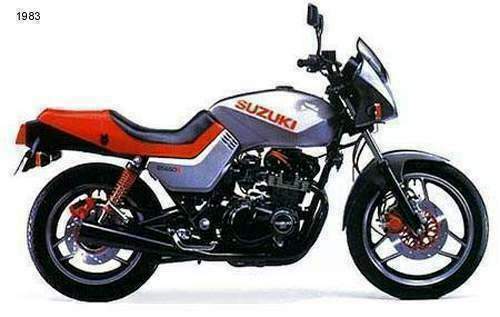
Suzuki GS 650G Katana
SUZUKI'S search for a new model range with a European identity has resulted in the Katana series and, in particular, the GS650G. Unlike the other models in the katana lineup the shaft-drive 650 is a completely new bike, purpose-engineered as well as styled for the likes of us poor souls this side of the Atlantic. It is less than radical in appearance than its bigger Darth Vader stablemates but it still turns heads and raises the occasional frown among the traditionally-minded. The brief given to Target Design, the Anglo-German freelance design studio, commissioned to do the artwork, was to capture a racy type 'southern European' look. In other words, Suzuki wanted to pass the Katana off as a piece of Italian sculpture with oriental horse power. Jan FellStrom, a director of the company, won't object if you criticise the bike's appearance as long as it provokes a definite reaction - and as long as you do not dismiss the company's work as cosmetic. He wants you to love or loathe the bike. On no account will he settle for a shrug of the shoulders when he asks your opinion. He stresses that the machine has been economically designed to make the rider feel part of it. To a large extent, styling has been dictated by practical considerations. The dual seat has been styled to act as a racing cradle with the rider held in place between the fuel tank and rear seat hump which serves as a rather precarious perch for the pillionist. The rider's knees slot into cutaways in the petrol tank allowing a firm embrace despite its generous 5.1-gallon capacity and bulbous appearance. The riding position itself is sporty, with semi rear-set footrests pushing the rider forward to the low, flat 'bars. It is a long arm-stretch to the controls which makes the machine uncomfortable to ride in slow-moving traffic but it feels good on the open road when the wind resistence begins to press into your chest. What lets the side down a little is the cheap, tarty finish. The red-painted brake calipers and disc trims look particularly poor and the Suzuki transfer on the tank has a nasty peel-off quality about it. By way of contrast, the four-into-two exhaust system has been black-chromed and should retain its good looks far longer than the painted variety. Black and red vinyl is used for the seat, while the lattice cast wheels are white -painted with polished rims, it looks a bit garish - but people notice you . . . The result may not look all that Italian but it does have a certain something and it's faster than everything in its class and most 750s. With a top speed of nearly 124mph, it is faster than the factory's own 1 6-valve GSX750 and is almost as fast over the standing quarter mile — with a best of 1 3.2 seconds. Suzuki are the last of the Japanese manufacturers to step into the 650 class. Kawasaki set the ball rolling with their popular Z650, now offered in a variety of different guises. Honda followed suit with their CB650 and Yamaha moved in to the arena last year with their XJ650. BMW field the R65, Benelli the 654 and Triumph have just got back into the act with the economy-minded single carb Thunderbird twin. If you cannot find something to meet your requirements among that line-up you must have some peculiar riding habits. The Suzuki joins the list of machines to choose from as a head-on competitor to Yamaha's celebrated XJ650 sporter. It mirrors many of the Yamaha's general specifications and has the same kind of performance characteristics. The four cylinder, twin cam Suzuki engine produces considerably more torque than the Yamaha but still thrives on revs. It will pull intopfrom about3,500rpm butto keep it buzzing down those back lanes you should not let the rev counter needle dip below 6,500rpm. A power output of 72bhp at the 9,500 red ling is claimed for the two valve per cylinder engine, which features twin-dome combustion chambers (TDCC) designed to improve efficiency. Both intake and exhaust flow is said to be improved by the twin dome design, which improves combustion by creating extra swirl inside the chamber. Conical swish zones are machined into the head which provides a high compression ratio despite the use of flat-crowned pistons Suzuki have patents pending on the design. Each cylinder is fed by its own 32mm CV Mikuni carburetor with the bank of four instruments all sharing a common air filter situated under one of the side panels. Suzuki have cheated a little in their climb to the top of the 650 performance tree for the 62 x 55.8mm bore and stroke of the engine gives an actual capacity of 673.8cc. When it comes to insurance it means you are going to have to pay the same rates as for a full 750 though that is also true of the XJ650 Yamaha and Z650 Kawasaki which are both a few cubic centimetres bigger than their actual designation figures suggest. Petrol consumption during the test varied tremendously according to how the throttle was used. Cruised at between 50 and 60mph on the motorway, the Katana returned 62mpg but ridden hard that dropped to 31 mpg resulting in an overall average of 44mpg. Engine vibration makes the mirrors useless between 4,500 and 5,000rpm but this rough patch clears up at higher revs. Each time we write that some Japanese machine or other has been fitted with the smoothest shaft transmission we have encountered, another model arrives on the scene that is even better. Surely the state of the art at the moment must be the enclosed shaft on the 650 Katana. It is impossible to believe it is a shaft drive machine for the power pick up is almost indistinguishable from that of a chain driven bike. The unit is based on a modified version of the shaft fitted to Suzuki's 1000 and 850 models. In place of the conventional double countershaft the new transmission system employs a spiral bevel gear for power transfer mounted on the same axle-shaft as a mechanical shock absorber. The presence of the shaft transmission cannot be felt through eitherthe rear wheel or gearbox. Gear selection is so good that if you mess up a change you have no one but yourself to blame. Doing away with one of the transmission countershafts has helped reduce the length of the engine and thus the length of wheelbase which is down to a squat 58.3 inches. Dry the Katana tips the scales at 481 lbs and it feels even lighter which is one of the main advantages 650s have over the largercapacity heavy-weights. Handling is as good as that of the XJ650 Yamaha - which is praise indeed - though at times the ride felt decidedly peculiar because of what felt like an incompatibility of spring and damping rates on the rear shocks. Soft springs and harsh damping seemed to be the problem. On occasion the rear suspension felt as if it was bottoming out when it was quite obvious that it could not have been. A dial on the top of each unit provides a choice of four damping settings and the springs can be jacked up to five different levels of pre-load. After a good deal of experiment I found the machine felt at its best with maximum spring pre-load and with the damping dials at the number two setting. The front forks also come with a choice of two spring pre-loadings though, to be honest, the adjustment did not produce any noticeable difference. Powerful, sensitive braking is provided by two 1 1 -inch front discs but extra care has to be exercised with the identical rear brake to prevent locking the wheel. The seven-inch headlamp provides a good night eye with a wide spread of light on both dip and main beam. The instrumentation and switch gear are also above reproach though failure to provide a passenger grab rail is an unforgivable oversight. Like it or loathe it; either way Mr FellStrom will be a happy man. BT. Source MCN of 1981
|
|
|
Any corrections or more information on these motorcycles will be kindly appreciated. |