|
|
|
|
Classic Bikes
Custom Bikes
Individual
Racing Bikes AJP
AJS
Aprilia
Ariel
Avinton / Wakan
Bajaj
Benelli
Beta
Bimota
BMW
Brough Superior
BRP Cam-Am
BSA
Buell / EBR
Bultaco
Cagiva
Campagna
CCM
CF Moto
Combat Motors
Derbi
Deus
Ducati
Excelsior
GASGAS
Ghezzi Brian
Gilera
GIMA
Harley Davidson
Hero
Highland
Honda
Horex
Husaberg
Husqvarna
Hyosung
Indian
Jawa
Kawasaki
KTM
KYMCO
Laverda
Lazareth
Magni
Maico
Mash
Matchless
Mondial
Moto Guzzi
Moto Morini
MV Agusta
MZ / MuZ
NCR
Norton
NSU
Paton
Peugeot
Piaggio
Revival Cycles
Roland Sands
Royal Enfield
Sachs
Sherco
Sunbeam
Suzuki
SWM
SYM
Triumph
TVS
Ural
Velocette
Vespa
Victory
Vincent
VOR
Voxan
Vyrus
Walt Siegl
Walz
Wrenchmonkees
Wunderlich
XTR / Radical
Yamaha
Zero
Video
Technical
Complete Manufacturer List
|
Suzuki GS 550
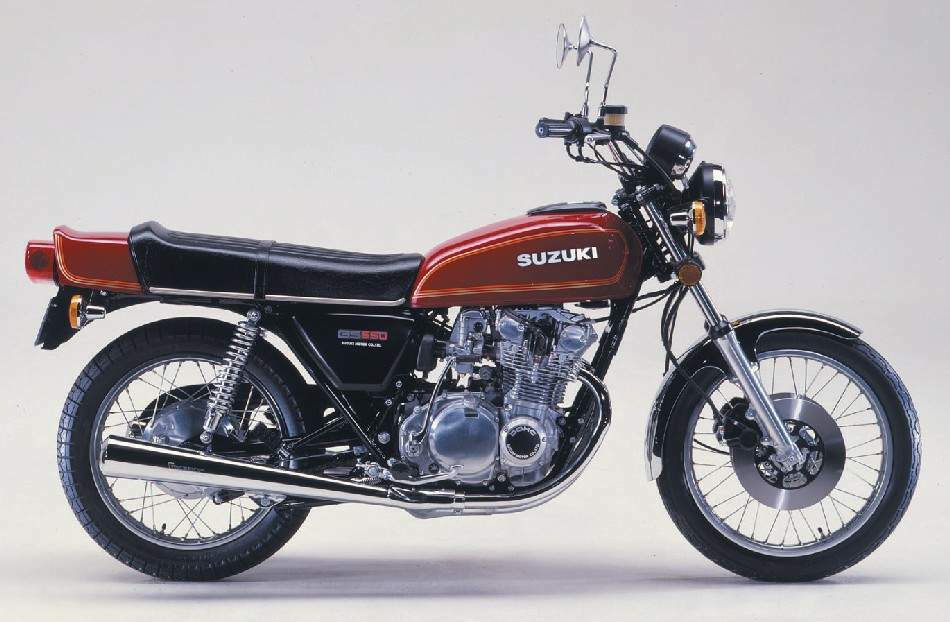
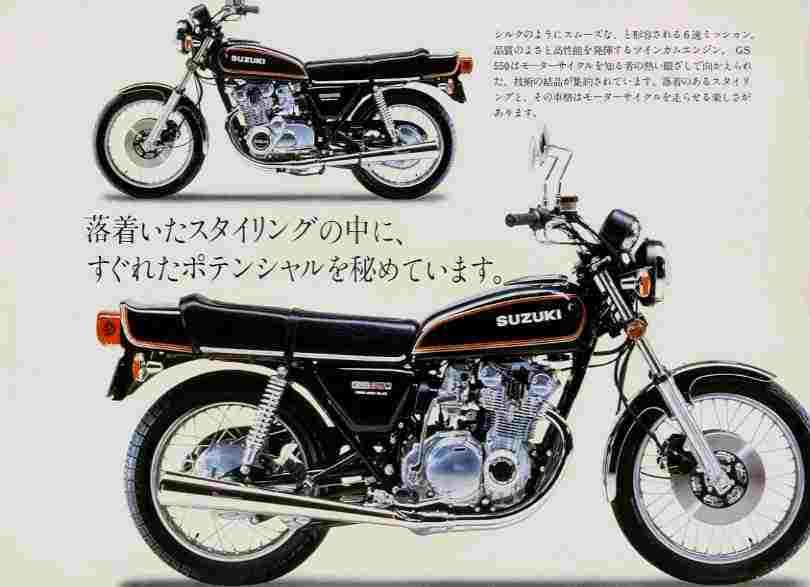
Traditions take time to build. Before 1969, real motorcycles had a pair of cylinders—arranged in a V or side-by-side, take your pick. Real motorcycles had push-rods, kick starting, drum brakes and 36-spoke wheels, and until 1969 motorcycles were virtually tradition-bound to use these items. It took one four-cylinder machine (the Honda 750) to depart from the tradition and begin a new one. In the 10 years since 1969, multi-cylinder roadsters have become the norm. The Suzuki GS550EN is in the mainstream of the 1970s tradition. With its transverse four-cylinder engine, four carburetors, dual-overhead camshafts, disc brakes and cast wheels, the GS is—to many of today's motorcyclists—the epitome of what a modern motorcycle should be. To be sure, the 550 has several completely conventional (some would say obsolete) features whose designs pre-date 1969. For example, the Suzuki has only two valves per cylinder, a breaker-points ignition system and an oil/spring fork when it could have CDI, four-valve heads and air-assisted suspension. But, regardless of the few up-to-the-minute designs it lacks, overall the GS offers in one neat package the basic designs which are generally considered 1970s state-of-the-art technology. It's easy to forget that the GS is also part of another tradition: the 550EN is a variant of the standard GS550N. For many years and for some pretty good economic reasons manufacturers have offered variants. It's been a sensible way, for instance, to produce two different displacement machines, each using the same chassis. Just a few years ago the manufacturers grew more inventive and began concocting slightly different and slightly more expensive models with ostensibly functional variations, such as four-into-one pipes. Suzuki in particular has taken a practical and economical approach to the production of functional variants. The EN has just a few trendy modifications—cast wheels, a rear disc brake and a stepped seat—which raise the cost of the EN to only $190 more than the standard N, but still give it the customized look. Suzuki's use of stylish and inexpensive variations has been commercially successful: last year the E models outsold the standard versions in all four displacement categories where they were offered-400, 550, 750 and 1000cc. Suzuki first introduced the GS550B in the spring of 1977, about six months after the debut of the GS750, their first four-stroke motorcycle. The 550's powerplant was a well-engineered, technically pedestrian unit. There's been one engine refinement in the intervening two model years: to cut down on gear whine, the original GS-B's straight-cut primary gears have been replaced by bevel-cut cogs, and its 93-tooth/47-tooth gear pair has been reduced to an 87/44 combination. For 1979, the GS550's engine design can now be considered even more straightforward in relation to some recently introduced unorthodox 500/550cc machines such as the Honda CX500. The middleweight class currently consists of two parallel twins (the Laverda 500 and the Yamaha 650), three V-twins (the Honda CX500, the Moto Guzzi V-50 and the Moto Morini 500), one opposed twin (the BMW R65), one single (the Yamaha 500) and four four-cylinder bikes (the Benelli 500, the Honda and Kawasaki 650s and the Suzuki 550). Traditional transverse fours are outnumbered by twins of all engine configurations, and that possibly foreshadows the building of a 1980s tradition. Regardless of what the future holds, the GS-EN's engine is currently one of the most reliable units around. A one-piece cast cylinder head houses hemispherical combustion chambers with two valves per cylinder. Adjustment of the valves is a simple matter of installing shims of different thicknesses in the tappet tops. The dual overhead camshafts ride on the head's plain bearing surfaces, and the shafts are driven by a roller chain. With a nearly square bore and stroke of 56.0 x 55.8 millimeters, the GS displaces 549cc and has a willingness to rev high. Suzuki engineers have chosen to use roller bearings at several points in the engine's bottom end where they might otherwise have used plain bearings. Though roller bearings offer no advantage in reliability over plain bearings and are actually a little noisier during operation, they do require less engine oil pressure. Six caged roller and ball bearings support the pressed-together crankshaft. The number four cylinder's inside crank wheel doubles as the primary gear, and there's bearing support just inside of that gear. All four of the one-piece connecting rods ride on roller bearings at the big end, and the slightly domed pistons ride on the rods' small ends' plain bearing surfaces. Since the GS engine is a well-constructed representative of the four-cylinder genre, it is expected that the 550 should be as smooth as glass. It is up to a point, and that point is 5800 rpm. For a reason which is peculiar to this engine, the 550 emits a very noticeable and irritating high-frequency resonance from just under 6000 rpm until redline. The vibration discourages the rider from high-rpm running for more than about 10 minutes at a time; in the lower rpm range the GS vibrates minimally and is very comfortable. Fortunately, around-town cruising and short highway jaunts are most usually accomplished at speeds below the resonance level. But canyon berserkos note that in third gear the 500 spins 6400 rpm at an indicated 55 miles per hour (and that's definitely in the Shake, Rattle and Roll zone). At 55 miles per hour in fourth, fifth or sixth gear, the engine is comfortable, turning 5400, 4900 and 4500 rpm. However, the GS's powerplant, like most medium-displacement engines, needs high revs to develop any serious horsepower. The Suzuki produces 27.51 horsepower at 6000 rpm, and the rider needs to chase the engine to 8500 to use its peak of 41.55 horsepower.
Historically, it's been the rare middleweight motorcycle which has used a six-speed transmission; the only two currently thus equipped are the Laverda 500 and the GS550. A six-speed gearbox has one primary advantage over a five-speed: it lets the rider keep the engine in its powerband easily. With the GS's horsepower married to vibration, though, the rider is not encouraged to use the gearbox to advantage, and the six speeds are instead occasionally something of a nuisance. For about the first 1000 miles of operation gear engagement is rather stiff, and neutral is difficult to locate except when the bike is standing still and the engine is idling. After the initial break-in period the gearbox loosens up and shifts just fine. Power to the gearbox is transmitted via a 15-plate clutch with a primary ratio of 1.977:1. When the engine is cold the clutch works pretty well, with easy lever actuation and a wide engagement spread. When the engine heats up, though, or when the rider abuses the clutch with some uphill starts, the engagement point becomes narrow and actuation grabby. Four 22mm Mikuni carburetors form the primary part of the GS's induction system. To meet increasingly stringent Environmental Protection Agency emissions standards, the carbs have been jetted somewhat lean—which produces some flat spots in the 550's carburetion, especially in the lower rpm range. The Mikunis' choke lever helps the GS start on cold mornings; it's needed whenever the bike sits for more than half an hour, even in 60 degree weather. A non-mechanical ignition system is a trendy item conspicuously absent on the stylish EN. The GS's breaker points setup in fact performs at least as well as a CDI system, except for the fact that points need periodic maintenance whereas the CDI rarely if ever needs adjustment. The GS uses two sets of points mounted outside of the left crankWheel, and the ignition fires two plugs every 180 degrees of crank rotation. A 12-volt battery, dual coils and three-phase AC generator complete the GS's electrical system. All of the GS-series motorcycles reflect a commitment by Suzuki to give their bikes stout, rigid chassis. The 550's mild steel frame uses 1.12-inch tubing for its main members. The heavily gusseted steering head produces a 29-degree rake and 4.72 inches of trail. Both the rigidity of the frame and its geometry result in excellent handling. At high speeds especially the GS maintains its composure: there's no frame flex you can feel, and very little wobbling overall. The GS's longish 56.5-inch wheelbase produces good straight-line stability, and that attribute makes the 500 a much better than average middleweight touring bike. Around town the 550 is a quick and willing handler, and the bike is easy to throw around. Designers of the GS emphasized strength over light weight in the swing arm also. The mild steel tubular assembly has 1.5-inch outside-diameter arms and moderately heavy gusseting at all the crucial points. Because of its hefty construction the 550 is not exactly the lightest middleweight available. Full of gas, the GS weighs 476 pounds, compared to the 469-pound Honda 650 and the 417-pound Laverda 500. In the area of suspension the GS is falling behind technologically. The GS1000, with its air/spring fork and shocks with adjustable damping, is the best-handling one-liter machine available. Obviously, Suzuki has the technology to design first-rate suspension units, but they have elected not to use it on the middleweight GS. Instead, the 500 uses an oil-damped steel spring fork, which is perfectly competent but not exceptional in any particular area. Damping action is slow over bumps of all sizes, and the resulting initial impression is that the fork is over-sprung. In fact, the springing is about spot-on for a 170-pound rider; the fork regularly uses much of its available travel over larger bumps and potholes. Though the suspension is constantly working over small road irregularities (indicating that Suzuki engineers have addressed the problem of stiction), there's still a lack of cushiness. The fork gets the job done, and nothing more. Nor do the shocks reflect the latest in suspension technology. The absorbers are oil-damped and have five adjustable spring preload settings. On the firm preload setting, the shocks perform acceptably for fast riding on twisty roads. The stiffer springing reduces shock travel, keeps the GS from wallowing and helps maintain needed ground clearance during hard cornering. On the lighter spring preload settings the GS tends to pogo when ridden hard, but yields a more comfortable ride on the open road. Shock compression and rebound damping is light, and that lets the shocks react quickly to bumps; it also encourages the bike's rocking-horse motions when the preload is on soft. During hard cornering on a tight road there are several chassis components which touch down. In a moderately hard turn, or when the shock springs haven't been jacked up, the centerstand is sure to drag. After that, during very hard turns, the footpegs, side stand and header-pipe brackets all scrape lightly at about the same time. At about the same time that the chassis components begin wearing grooves in the highway, the Bridgestone tires, especially the rear, begin to drift. The slippage is controllable, progressive and slow; it's primarily a polite reminder that the GS is cornering nearly as hard as it can. To its credit, the GS maintains its stability while any parts drag, or while the tires slip.
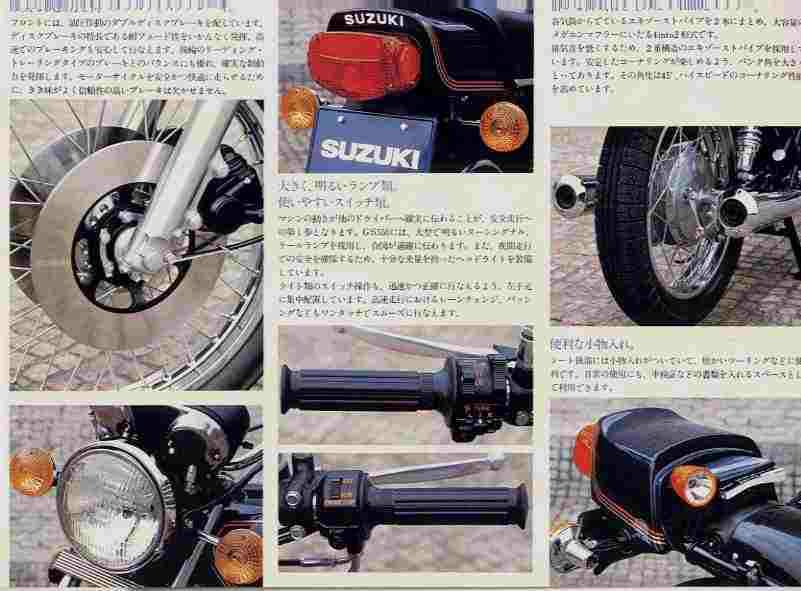
Both wheel assemblies walk the line between function and style. The cast wheels are indeed heavier than spoke units, but (aside from being better-looking) they're also more rigid. That rigidity goes a long way to aid cornering stability by helping to eliminate wheel flex. Moreover, the cast wheels don't need maintenance. Both disc brakes provide excellent stopping power. The two-piece riveted disc found on the original GS-B was replaced in 1978 by the one-piece item currently in use on the GS-EN. There's very little chatter when the rider activates the 550's front brake, even though there is a pattern which resembles heavy chatter marks on the disc itself. Regardless of any idiosyncrasy, the brake performs very well: it activates progressively and resists locking even during panic-stop situations. The GS's feel belies its categorization as a middleweight; it feels nearly as big as the average 750. The seat is roomy and allows two-up riding comfortably. Medium-density foam is used in the seat and it's good for a reasonably numb-free long ride. The handlebar is swept back very little, and it positions the rider naturally forward into the wind. Judging by the handlebar cant, we'd say that Suzuki does not anticipate too many owners attaching fairings. Folding footpegs are new for 1979, and they too are mounted in the right spot for non-faired cruising. Most of the 550's detail components, such as its various gauges and switches, petcock, fork lock and choke lever, are well-engineered and functional. For touring riders the '79 GS has a cluster of terminals located under the seat to accept some electrical accessories, so owners need no longer cut and splice wires to attach their CB radio or tape deck. New for this year is a starter interlock, a safety feature which requires the rider to pull in the clutch lever while starting the engine. The interlock switch is identical to the one which activates the brake light when the front brake is used. Touring riders had been complaining that the GS-B and C handgrips were not long enough to allow the convenient installation of mechanical cruise-control devices. The GS-N's hand-grips have been lengthened slightly to cure this minor annoyance. Just a few of the 550's detail items need refinement. There's only one helmet lock, and the seat must be lifted to get at it. The fuel tank's locking cover, which is at best minimally effective at keeping out thieves or vandals, is flimsy and a hassle to re-lock. Both rubber-mounted mirrors vibrate vigorously above 5000 rpm. Removing the intermediary sections of the mirrors' shafts—the portions which contain the rubber—neither increases nor decreases the severity of the blurring. Though the four-cylinder GS is smack in the middle of the 1970s tradition, it's in danger of becoming dated. The things it does well, it does very well. It's fast, it's comfortable both in town (because of its nimbleness) and on the highway (because of its roominess), it's absolutely stone reliable and it's inexpensive compared to any of its middleweight rivals. But if the GS is going to carry the banner of the Transverse Four into the 1980s, it's going to need some refinement to keep it up-to-date and competitive. That nagging problem of high-rpm vibration has to be exorcised. And some other 500/550s, notably the CX500, offer better suspension compliance. Still, for this year, traditionalists who are bound and determined to buy a four-cylinder middleweight could do a lot worse than the Suzuki 550. It's a perfectly competent 1970s motorcycle. Sure, the LN's stylistic variations intrude on the 550's functional ability, but that hasn't hurt the Low Slinger's success. Preliminary sales figures indicate that the LN is outselling both the standard 550N and the EN. Which only goes to show that a lot of riders prefer Summer Nights on the Boulevard to gassing it through the canyons. Responding to the market impulses for that high-bar, low-light, step-seat, long-fork, short-muffler look, Suzuki has introduced a set of machines for the Raked-out Randys of motorcycling. Early in 1979, the GS550LN, as well as the GS750LN and GS1000LN, appeared, a sure sign that Yamaha's discovery would not be Suzuki's loss. To their credit, the Japanese do not produce specials by snapping on cosmetic body work and hoping for the best. In the case of the GS550LN, suspension modifications abound. The new leading-axle fork carries three-rate fork springs which are different from those found on the EN-model. The preload portion is the same as the EN, but the middle rate is lighter, and the last portion stiffer than the EN. To complement the softer springing, Suzuki has lightened up the rebound damping. The shocks have the same springs and stroke as the EN, but the preload position has been shortened from 23.5mm to 6.0 millimeters, so the L-model has less preload on the springs, making the laid-back 550 feel softer in back, as well as in front, when compared to the standard Suzuki 550s. The wheelbase of the 550LN is almost two inches longer than the normal 550s; and despite appearances, the LN has less rake then the E- or EN-models (28 versus 29 degrees) and slightly less trail (4.6 versus 4.72 inches). There are at least three changes that current LN- and EN-models share. First, closer tolerances have been maintained in carburetion production to hold emissions within ever-tightening EPA standards. Second, early in 1978 the 550's primary gears were changed from straight-cut to bevel gears in order to make the engine quieter; and third, at the same time the primary ratio was altered slightly, from 93/47 (1.978) to 87/44 (1.977). Other than these changes, the LN differs from the EN only in cosmetics. This face and body treatment includes the special fork, a six-inch quartz-iodine headlight, high-rise handlebar, pulled-back gas tank, short mufflers, stepped-seat and grab-handle. Perhaps the most obvious thing about the restyle is the tank, which rides a considerable distance back from the steering neck. Viewed from the sides, the open space between tank and neck is covered by molded and pleated plastic panels that hide the steering neck/ frame tube junctures and parts of the wiring harness. These panels hint that Suzuki hurried into production with the LN-models. The LN doesn't function as well as the EN. While the LN rides more softly than the standard-type 550, the suspension does nothing to keep the cow-horn handlebar from tweaking the rider's right wrist inward. After a half-hour, the rider notices wrist-strain. Depending on your height and proportions, the step in the seat may be in exactly the wrong spot. The basic riding position which the LN Suzuki requires does not encourage brisk riding. Hard-riding enthusiasts accustomed to standard bikes will simply feel awkward and out-of-place on the GS550LN. They'll conclude that the LN is a boutique-motorcycle, best suited to boulevard nights. And they'll be right.
|
|
|
Any corrections or more information on these motorcycles will be kindly appreciated. |