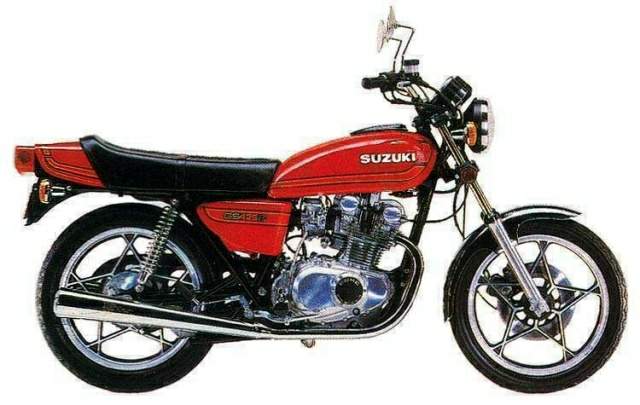
|
Make Model |
Suzuki
GS 425E |
|
Year |
1979 |
|
Engine |
Air cooled, four stroke, parallel twin
cylinder, DOHC, 2 per cylinder. |
|
Capacity |
423 |
|
Bore x Stroke |
67 x 60 mm |
|
Compression Ratio |
9.1:1 |
|
Induction |
2 x 34mm Mikuni |
|
Ignition /
Starting |
|
|
Clutch |
Wet multiplafe |
|
Max Power |
40 hp @ 7000 rpm |
|
Max Torque |
|
|
Transmission /
Drive |
6 Speed / chain |
|
Front Suspension |
|
|
Rear Suspension |
|
|
Front Brakes |
Single 11in disc |
|
Rear Brakes |
7in Drum |
|
Front Tyre |
3.00-18 |
|
Rear Tyre |
3.75-18 |
|
Seat Height |
31in |
|
Dry-Weight |
382 lb |
|
Fuel Capacity |
15 Litres |

TWENTY-THREE. THERE'S A NUMBER
TO conjure with. You may think there's absolutely nothing about the number
23 to commend it or make it special. Well, you'd be wrong, there's plenty.
For a start, well . . . errr, lemme see. Oh yeah, John Keats was 23 years
old when he wrote 'Ode on Melancholy', and that was no mean achievement. If
you add 2 and 3 together you reach five, and your writer was five years old
when he first mastered infinitesimal calculus. Ahem.
Oh yes, and one other thing.
Twenty-three is the amount of cc by which Suzuki have increased the volume
of their GS400. Not only have they added 23cc, but they've renamed the bike
the GS425. If that isn't a masterpiece of absurdity I'll ride CZs from now
until Christmas. Hogging-out the 400 by 23cc has rekindled my faith in (apanese
inscrutability. Eastern designers were becoming boringly logical in a
Western kind of way.
Gone are the days of the
arbitrary displacement figure, such as the 360 and the 900 (although the
latter has returned in a blaze of glory with the new Honda). Suzuki have
taken the Blue Riband for meaningless — the 423cc motorcycle, called the
425.
But why? Surely nobody who gave the original a miss is going to be attracted
by this addition, unless of course the styling change is all they're
interested in. Actually you couldn't blame them for that, it's a very slick
looking bike. Ours was black with contrasting gold decals on tank and side
panels, but couldn't they run to a bit of paintwork instead of tapes for the
striping?
Basically the motor is the same
DOHC balance-shafted unit as the GS400. Red-lined at nine grand it
appreciates being treated like a 2-stroke, ie held wide open and whanged
through the gears. No, that's not what I mean, perhaps a better way of
putting it is to say that the characteristics are such that it encourages
you to treat it that way.
There's a definite power band at
the 4000rpm mark and I kept running out of cogs a lot quicker than I
expected. The gearing wasn't altered along with the hop-up and the r.esult
is that it accelerates quicker than the 400 (which was no sluggard anyway)
and turned in a respectable 14.75sec standing quarter. That's more than half
a second faster.
A flick back to Peter Watson's
test of the 400 in May of last year also shows that with a few thousand
miles under its belt, this motor loosens up considerably, to the tune of
10mph on the top speed. So maybe our 101.8mph top whack could be improved on
later this year when the test bike has had a bit more of a thrashing.
When I got on the bike for the
first time I could hardly believe that it really was a 425, it felt so small
and low, and this was enhanced by the riding position. The bars are
practically flat and at 27%ins wide they're narrow too, but I felt the
footpegs could have been moved back three or four inches to increase
rider-lean and reduce the feeling of being perched on top of and a third of
the way back on the machine.
This position did tend to make
me feel a bit exposed on high speed bashes but I can't complain about the
comfort, it's a nicely
padded seat and there were no aches or pains apparent after a motorway
thrash. Incidentally, Timmy, that long-legged denizen of the Bike office,
complained that the most comfortable riding position for him on this bike
meant that his knees rubbed on the Suzuki decal and they did get chappie
chapped.
The handling hasn't changed with the motor, it is still very rigid and
totally predictable. During most of the test period the country was under a
few inches of white stuff which made assessment of the handling a little
difficult.
However, crossing London in good
weather in the rush hour was fun, the general narrowness of the bike and its
zoom-ability made it a great traffic dodger. Funnily enough, although the
front end felt heavy (it dived like a U-boat under braking) it was from this
department that I got the only negative vibes in the handling department. On
long high speed corners there was the tiniest hint of front wheel flutter
but I'd be inclined to put that down to the Jap Dunlops fitted as standard.
Here's one of those weird contrasts I was talking about: Suzuki build
themselves a great little frame based on the GS750, put on some of the
nicest mag wheels you're ever likely to come across and then spoil it all
with rubbish tyres. They are inscrutable, these orientals. Or are they just
cheapskates?
A
single 11 in disc up ront and a seven inch drum behind provide the stopping
power, and very effective they both are too, despite the way the forks dive.
Of course, any rain reduces the disc to the efficiency of a piece of soggy
cardboard.
Mechanically it's a very smooth and qujet engine, at high speeds you get a
slight tingle through the bars but nothing to write home about. The balance
shafts and 180 degree crank do their jobs very well. Noise is kept to a
minimum because there are only two chains on the whole bike, one to the back
wheel and another driving the cams.
There's a nifty little automatic
camchain adjuster too, a spring driven gizmo that hangs out under the carbs
on the right hand side of the bike. While we're in the area of the two 34mm
Mikunis another contrast rears its head. When will the Japs give us carb
fitments capable of a little English weather? Corrosion was very bad on the
hose clamps, choke lever, throttle return spring and all the other linkages.
Would it cost too much to have them plated before leaving the factory?
And so to the choke and general
starting of the bike. Not too hot I'm afraid. In the handbook it tells you
to switch on the choke, press the starter (there's a kickstart too) and
then, using the choke lever, regulate the revs to 2,000 for 30 sec in
summer, longer in winter, before moving off. Well, that's all fine and dandy
but I never could get the revs above 1,000 on the choke anyway and during
the very cold weather it took a long time for the engine to warm up. It
didn't help to leave the bike ticking over on choke for a while before
getting on, because after a while the revs would falter and die. As soon as
you open the throttle it by-passes the choke anyway so if you forget about
it you find yourself arriving at the first set of traffic lights, closing
the throttle and then wondering why the engine stopped.
That's just a niggle though.
Two more annoying points were a steering lock that was jammed (in the off
position thank God) and the fact that you still have to dismantle the
left-hand exhaust to get the back wheel out. Jeezus, I thought that went out
with 750 Commandos.