|
|
|
|
Classic Bikes
Custom Bikes
Individual
Racing Bikes AJP
AJS
Aprilia
Ariel
Avinton / Wakan
Bajaj
Benelli
Beta
Bimota
BMW
Brough Superior
BRP Cam-Am
BSA
Buell / EBR
Bullit
Bultaco
Cagiva
Campagna
CCM
CF Moto
Combat Motors
Derbi
Deus
Ducati
Excelsior
Fantic
GASGAS
Ghezzi Brian
Gilera
GIMA
Harley Davidson
Hero
Highland
Honda
Horex
Husaberg
Husqvarna
Hyosung
Indian
Jawa
Kawasaki
KTM
KYMCO
Laverda
Lazareth
Magni
Maico
Mash
Matchless
Mondial
Moto Guzzi
Moto Morini
MV Agusta
MZ / MuZ
NCR
Norton
NSU
Paton
Peugeot
Piaggio
Revival Cycles
Roland Sands
Royal Enfield
Sachs
Sherco
Sunbeam
Suzuki
SWM
SYM
Triumph
TVS
Ural
Velocette
Vespa
Victory
Vincent
VOR
Voxan
Vyrus
Walt Siegl
Walz
Wrenchmonkees
Wunderlich
XTR / Radical
Yamaha
Zero
Video
Technical
Manufacturer List Contact
|
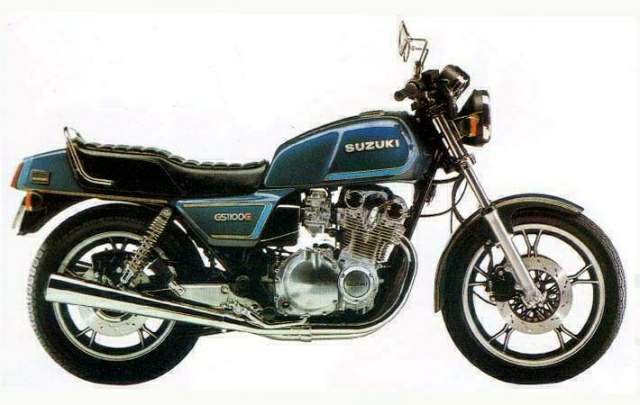
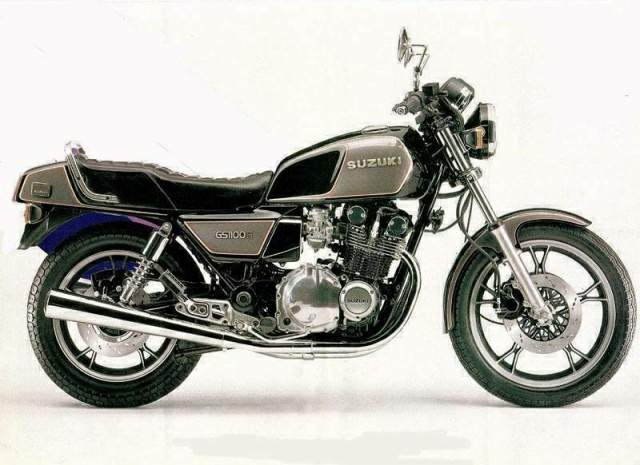
Suzuki GS 1100G
Source MCN of 1982 SUZUKI'S biggest shaft-drive machine - the GS1100G - is the lazy man's tourer. Like a two-wheeled Cadillac, the big four-pot cruiser demands no more than fuel in the tank in return for a guarantee that it will make the going easy — and the coming back. The bike seems to speak to the rider: "Sit back, open the throttle and relax. We'll be there in no time." With 92 horses and dynamo-smooth torque on tap, the suzuki makes easy work not only of pulling its own 550lb and five gallons of fuel, but carrying people and luggage as well. In one easy move, engineers have added a few important millimetres to the 70 x 64.8 bore and stroke of the GS1000 engine to give the extra torque to tackle the weight. While it looks similar, it shares no common engine components with the 1,000cc shaftie: crankcases, crankshaft and cylinder head all bear different part numbers, as do the slightly modified camshafts. The 34mm Mikuni carburettors are the same diameter as those feeding the 16 valve GSX1100 motor, but the internals are different. Interchangeable with the 1000 are the secondary gear set on the end of the gearbox and the final drive assembly. But even the ignition has undergone a change to reduce problems. While the GS1000G has mechanically advanced ignition, the 1100 relies on electronics to complement its transistorised sparking system. Brute bhp is down compared to the muscular GSX1100, but the softer tuned shaftie developes a little more torque at slightly higher rpm. The effect of Suzuki's tuning exercise has been to smooth out the power curves so that the multi delivers an avalanche of grunt from 2,000rpm to the 8,000rpm red line. This will endear it to those lazy riders. A weekend's touring on a variety of roads showed how effortlessly the GS covers the miles. Loaded with a pillion and camping luggage, the tourer felt just as easy to control as it did solo, with plenty of engine flexibility from trickling speeds near tickover. So flexible was it, that the gear ratios seemed artifically low. On twisting country roads, top gear could pull the weighty beast out of corners from as low as 30mph. Gearchanging was unnecessary. We simply drifted along with a touch of brake, a whiff of throttle, content to know that traffic could be overtaken with speed and safety after a couple of snicks on the gear pedal. On such roads the riding position felt a little strange to a newcomer - with the semi-flat 'bars a good stretch away from the seat. But this made a lot of sense while blasting down the A45. It forced me to lean hard into the gale behind my tank bag. As with all unfaired superbikes, wind resistance can be a pain in the neck, but at least this riding position takes the strain out of a bit of illegal enthusiasm. Suzuki seem to have their seat design well sorted out - thank heavens. It's wide, well padded, long enough for two people without becoming over-intimate. And there's a grab rail. One minor criticism from my pillion was that the footrest height was a little too tall for her. It's likely to be OK for smaller ladies. There's a black mark for the rear view mirrors. Vibration blurred them between 70-80mph. Just at the sort of speeds when riders are likely to use them most frequently. But vibration was no problem to the rider through most of the speed range. It began to tingle at the top end, but then few people are likely to spend long at 120mph-plus. With this chassis/suspension set-up, Suzuki have stayed with tried and tested designs. A conventional frame holds a pair of forks which feature adjustable springs- in common with all the shaft drive Suzies. The only problem was that the handlebars obscured the adjuster! Basically, the adjustment is made in a similar way to Yamaha's system - a screwdriver slot can be turned to select four different spring pre-load positions. These adjusters are located behind push-fit plastic caps on the top of each fork leg, but they were a little too close to the 'bars. A pity they were not as easy to adjust as the damper controls on the forks of the GSX -simple knobs by the spindle. There's no fiddling about with air pressure in order to balance the front suspension with the rear. It's often more important to get this balance right in orderto get the handling right rather than simply stiffening both ends. I felt the Suzuki handled best when on medium-to-soft springing, but with the rear dampers set on the hard side of the four positions. Given the fact that the 1100 is likely to be a beast of burden one weekend and a back road scratcher the next, this suspension tuning is essential for the serious rider. Just one handling fault remained beyond reach of this adjustment - a tendency for the bike to weave slightly at around 90mph. This side-to-side oscillation was never felt at all while two-up. For a machine which is basically a big bore multi in the modern mould, the 1100 has a fair helping of character. It was easy to get to like it. The only crazy thing about this bike is that it's so similar to Suzuki's own 1,000 and 850cc tourers. It's great to be spoilt for choice, but the 850 at £700 less sure does look attractive. TS. Source MCN of 1982
|
|
|
Any corrections or more information on these motorcycles will be kindly appreciated. |