|
|
|
|
Classic Bikes
Custom Bikes
Individual
Racing Bikes AJP
AJS
Aprilia
Ariel
Avinton / Wakan
Bajaj
Benelli
Beta
Bimota
BMW
Brough Superior
BRP Cam-Am
BSA
Buell / EBR
Bullit
Bultaco
Cagiva
Campagna
CCM
CF Moto
Combat Motors
Derbi
Deus
Ducati
Excelsior
Fantic
GASGAS
Ghezzi Brian
Gilera
GIMA
Harley Davidson
Hero
Highland
Honda
Horex
Husaberg
Husqvarna
Hyosung
Indian
Jawa
Kawasaki
KTM
KYMCO
Laverda
Lazareth
Magni
Maico
Mash
Matchless
Mondial
Moto Guzzi
Moto Morini
MV Agusta
MZ / MuZ
NCR
Norton
NSU
Paton
Peugeot
Piaggio
Revival Cycles
Roland Sands
Royal Enfield
Sachs
Sherco
Sunbeam
Suzuki
SWM
SYM
Triumph
TVS
Ural
Velocette
Vespa
Victory
Vincent
VOR
Voxan
Vyrus
Walt Siegl
Walz
Wrenchmonkees
Wunderlich
XTR / Radical
Yamaha
Zero
Video
Technical
Manufacturer List Contact
|
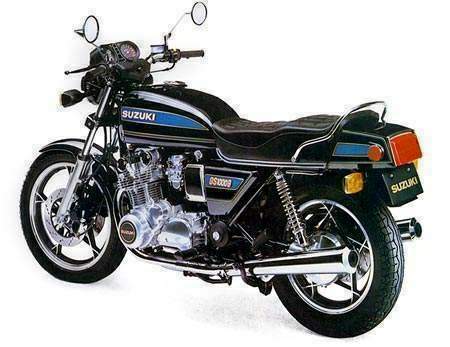
Suzuki GS 1000G
Suzuki's new gsiooogt should give headaches to Categorical Thinkers. Those who think that street riders can be segregated and slotted into neat little compartments—such as pure tourers, sports-tourers, backroad roamers, street cruisers, etc.—may puzzle over the one-liter shaft-drive Suzuki. Here's a motorcycle that's marvelously comfortable, impressively quick, and respectably well-mannered around corners. The GS-GT works splendidly in the "see-ya-tonight-two-states-over" mode, but can't be called a two-wheeled Greyhound. The bike can take care of itself in stoplight grands prix, yet possesses the shaft-drive civility of grown-up motorcycling. And the GS1000GT won't embarrass itself or terrify its thoughtful owner chasing down snaky roads, though the Suzuki can be as mild and smooth as vanilla ice cream on the interstates. This Suzuki is probably as close to the BMW R90S-R90/6 blend of motorcycling as anything ever built in Japan. To create the GS1000GT, Suzuki engineers cross-bred out of two distinct, if not separate, engineering bloodlines, the GS1000 and the GS850. Categorical Thinkers who believe that a successful motorcycle must be shaped from the ground up according to a singular idea scorn the notion that an artful rearrangement of parts can function effectively. For Suzuki engineers, less concerned with grandiose theory than functional results, the problem and solution must have seemed simple enough. Problem: Buyers liked the traditional-pattern big-bore Japanese motorcycle but with shaft drive. Honda, Kawasaki and Yamaha all had something to suit. Solution: Suzuki had the wherewithal for a one-liter creation. Suzuki's first shaft-driven model was the 1979 GS850G, a weighty but surprisingly strong-running sport-tourer with many of the good characteristics of the GS750, from which Suzuki derived the 850 shaftie. This year's one-liter addition carries the model designation "GS1000GT." The G indicates shaft drive; the T denotes a 1980 model run. In essence the G-shaft is a one-liter top end attached to an 850 bottom end and chassis. Since the 850 is a direct descendant of the original GS750, then so is the 1000G. The GS850 was extremely successful, but when fully loaded the bike lacked arm-tightening acceleration. Despite this drawback, Suzuki's first shaft bike really pulled its weight in the sales department; the largest problem with the original 850 was simply keeping enough of them flowing out to dealers. That kind of activity encouraged Suzuki to build a more muscular 1000cc version; and since most of the necessary components already existed, the 1000G became a reality without too much wasted time. Obviously, Suzuki's engineers must have had the 1000G in mind even as the first 850s rolled off the assembly line. Literally all the components from the crankcases up are shared by the 1980 GS1000E and G-models. The list includes the cylinders, carburetors, pistons, camshafts and the head. The two bikes' exhaust systems do differ: the G-model has an exhaust chamber which has relocated the torque curve in a lower rpm range and in the process bucked up the curve. According to Suzuki, the G has slightly less peak horsepower than the chain-drive 1000 (due, in part, to the G-shaft's use of a GS850 airbox and filter), but horsepower at redline is relatively unimportant in a motorcycle focused toward touring. Both the G-bike's lineage and focus help to explain why the engine has two valves per cylinder, not four. Economic considerations were likewise important; the four-valve TSCC technology found on the GS250, 750 and 1100 bikes is expensive; and since the GS1000GT can get strong mid-range punch by other means (displacement and exhaust chamber), a 16-valve top end might be sales-appealing but unnecessary. Bore and stroke of the GS1000G are 70.0 x 64.8mm, respectively, and these figures are closer to "square" than the GS850's 69.0 x 56.4mm dimensions. While the crankshaft, of course, differs between the 850 and 1000cc bikes (the 1000G- and E-model cranks are identical except for their primary drive gear placement), the one-liter G follows standard GS850 lower-end practice: roller-bearing rods on a pressed-together crankshaft riding in four roller mains and one ballbearing main. Driven from the center of the crankshaft is a roller camshaft chain, which is kept in proper tension by an automatic, spring-loaded adjuster. One notable change between the 1979 and 1980 GS1000s is their carburetors. Last year's chain-type E-model came equipped with a quartet of 26mm slide-throttle Mikunis; this year the G-model has four 34mm constant-vacuum instruments of the same make. Suzuki indicated the CV carbs allow more freedom in jetting (spelled performance and quicker engine warm-up) without running afoul of emissions regulations. The enormous carburetor bodies are linked together as a unit and clamped to the engine's rubber intake spigots. A single cable opens the carbs' butterfly throttles, and springs snap them shut—there is no return cable, and none is needed. A cable-operated choke knob, mounted on the GS's dashboard with its cable running through the steering stem, activates four enriching galleries for cold-weather starting. No external adjustments are possible with the Mikunis except for their idle stops, which respond to one knob. The lack of adjustability may not matter. This Suzuki was practically free from the annoying "lean" hesitation that plagued the GS450, 1100 and 750 we tested earlier this year. While the G-bike's crispness may have something to do with its revised carburetion, it's also true that Suzuki has had more time to fine-tune the eight-valve fours to American conditions than it has the 1980 16-valve numbers. With the choke on, the Suzuki starts at the first stab of the starter button; then it idles rather fast until the choke is pushed back partway off. The bike is ready for normal choke-off operation once it has been ridden for a couple of miles; until then the exceedingly lean choke-off mixture will make the engine stumble. Our particular test bike seemed somewhat sluggish until it had accumulated several hundred miles—then the break-in effects appeared and the bike's performance noticeably improved. At this point the mid-range torque was quite satisfactory. At about 5000 rpm the engine starts making power in scenery-flashing earnest, and the rider can feel a definite hump in the power curve. If you need more acceleration, a drop of one or two gears will effectively transfer most four-wheel debris right back into your slipstream, neat as you please. Our certified scales registered 594 pounds with the Suzuki on board, putting the one-liter GT 11 pounds under last year's GS850G. That's significantly lighter. On the other hand, compared to last year's chain-drive GS1000E the G-model is heavy; the E weighed 565 pounds wet, 29 pounds less than the 1980 GS1000G. No doubt about it: you'll pay a weight penalty for shaft drive. In the performance department, the shaft-drive 1000 hardly penalizes the rider. The GS-GT turned in a best run of 12.35 seconds at 107.27 miles per hour at the drag strip. That's quicker—though slower—than last year's chain-drive 1000 which clicked off the quarter in 12.44 seconds at 108.43 mph. While the GS1000GT won't threaten an 11-second GS1100, the eight-valve shaftie can keep comfortable road company with the 1980 CBX and Kawasaki Z-1 Classic fuel-injection bike. Fortunately, the GS1000's healthy capacity for generating speed does not hinder its ability to conserve fuel: our test bike consumed one tankful of gas at the rate of 45.6 miles per gallon, and the worst one-tank mileage it gave us was 38.6 mpg. In all, the bike averaged 41.6 mpg, enough to take it 242 miles before trickling that last drop through its vacuum-operated petcock. The Suzuki's 5.8-gallon fuel tank minimizes the gas-station scanning that comes with longdistance touring. Helical-cut primary gears drive the GS's clutch, and 18 plates are contained within a solid-aluminum basket. Though the basic driveline components are shared with the more docile 850, most of the pieces have been strengthened either by using stronger materials or different heat-treating techniques. Not to be left out, 1980's 850G has some re-strengthened gearbox components also. The 1000cc shaft bike has a taller ratio than the 850 thanks to an altered gear ratio at the first 90-degree power "bend." Though geared taller than the 850 shaft bike, the 1000 shaft is geared lower than the GS1000 chain-drive motorcycle. Final drive ratios differ between the GS1000E and the G-model since Suzuki figured touring riders would be more likely to install fairings and pack heavily than owners of the chain versions. The shaft-drive bike has an overall gear ratio, in top gear, of 4.96:1; the E-model uses a 4.78:1 ratio.
Three cush-drive assemblies keep shocks from damaging transmission and engine components. Automotive-type coil springs take up shock in the clutch basket; a large cam-type spring-loaded shock absorber protects the transmission gear clusters, and rubber doughnuts work in the rear hub assembly. Two sets spiral-bevel gears transfer power to the rear wheel from the transmission. The first set turns the drive 90 degrees, feeding back through a U-joint on the left side of the chassis. The second transfers power to the rear wheel across a "ring and pinion" set of spiral-bevels, this time in the rear hub assembly. Each transfer case holds its own oil. The secondary case, though an integral part of the main cases, is a sealed compartment, as is the final drive case. Each unit has its own filler, check and oil drain plugs. The Suzuki's clutch has a moderately firm pull, but engagement is somewhat jerky and happens over scarcely more than a twitch of lever movement. We adapted to this suddenness almost immediately. You'll get used to it, too, and when threading your way through a maze of traffic you will just as immediately grow weary of its grabby sensitivity. Happily, there is little gearbox slack, and that makes for smooth shifting. The Suzuki has crisp, clunk-free action, and the GS1000G's gearbox makes other shaft-drive bikes, like Yamaha's Eleven, seem to shift like a 1955 Ford pickup. Suzuki's own research indicates that touring riders really use their adjustable suspension systems, though perhaps not always correctly. Tourers tend to experiment with their machines more than short-hop riders do, perhaps because long-distance riders are more apt to be physically sore if they don't make necessary alterations. If they add the weight of saddlebags and fairings, touring-types really notice the need for suspension changes in springing and damping. A low-stiction, center-axle fork with 37mm tubes and 5.9 inches of travel graces the front of the Suzuki. Unlike the GS1100, the GS1000G has no damping adjustments within the fork, but dual-rate fork springs do team up with air pressure to provide a versatile, competent ride. The fork's suggested pressure range is 8.5 psi to 17.0 psi, and most of the settings between these limits will provide a comfortable, compliant ride. At approximately 10 to 12 psi the fork allows a comfortable ride while providing the stability we like in cornering and hard-braking modes. With less pressure the fork is almost too soft, though it responds better to road irregularities. When the pressure is raised right to the 17.0 limit, the fork absolutely loses that special ability to follow the minor ripples but it helps the GS remain stable during fast road work or travel on rough roads. Unfortunately, though a pressure gauge is included with the GS, a pump is not; you must carry your own along or stop at gas stations. In back you can work with five spring preload positions (as usual) and four separate rebound damping characteristics. A knurled plastic knob at the top of each shock absorber turns a slender steel shaft that rotates inside the otherwise normal shock rod. The small rods have holes of varying sizes drilled in them, and these line up with windows that complete oil galleries which make passing oil hard or easy. The G's shock absorbers are a little softer than those on the GS1000E: they have slightly different internals that make rebound damping a bit lighter. For solo riding, the rod's first or second position and the shock springs' first, second or third positions provide plenty of comfort. The best handling comes with increased pressure in the fork and stiffer spring and damping settings in back, and a happy medium can be achieved between this and zero-support for almost all types of riding. In straight-line riding, the Suzuki's suspension system is bothered slightly by cement-slab roadways, the same way Yamaha's Eleven is: the Suzuki, at touring speeds, gets into a rocking rhythm and after a time this becomes wearing. Fortunately, this rocking is less pronounced than the Yamaha's, and otherwise the GSIOOO's ride is excellent. Along with its compliant suspension, the GS1000GT has excellent high-speed stability—a real asset for a touring-type bike. Solo riders will only appreciate the full-tilt positions on the rear suspension when they're going fast through bumpy or winding roads: there, the firmer settings help keep the big four stable. If you do a lot of this type of riding you would do better to choose a chain-drive model, even though the GS1000G has a fairly minimal amount of uplifting shaft-drive torque reaction. Moderate cornering attitudes won't result in your leaving scrapings from the GSIOOOG's lower sides sprinkled along the blacktop, but if you start stretching the throttle cable a little you'll find yourself running out of cornering clearance. Unlike the E-model, the 1000G sometimes loses its aplomb when forced to hustle down winding roads. Though it steers and handles much like the 1000E, the G-model is sprung a little softer, and its drive shaft contributes to that up-down, up-down surge as the throttle is yanked open and snapped shut. Happily, the G-model's suspension is soft enough so that the bike just bobbles when pieces drag instead of lifting one wheel in the air and snatching sideways. Even with the suspension adjusted to full firmness, the bike wallows in flat-out sweepers. This can be excused: the G-model is intended to be a sports-touring bike, which means that its handling quirks are less important than its lush ride. The Suzuki has light steering, but if you're in a hurry you'll have to do some tugging on the handlebar; the four carries weight fairly high, and that makes flipping the bike back and forth through esses a proposition you need to set your mind (and shoulders) to. At the limits of cornering, the GS1000G pushes its front tire-not the fault of the tire particularly, but in part due to the bike's weight bias. Some GSI000Gs may show up with Bridgestone or Dunlop tires; ours came with IRCs—Grand High Speed GS-11 AWs, 3.50 V 19 front and 4.50 V 17 rear. Beyond high-speed ratings, these tires are strong—their load limits, combined, are 1130 pounds. Though our test bike's tires stuck pretty well when ridden hard and gave adequate signs of breakaway before giving up traction, the IRCs are bothered by rain grooves: the front tire, particularly, has a center rib that catches those lines and makes the front end dance a little jig. Suzuki utilizes twin single-piston brake calipers in front and a single dual-piston caliper at the rear. Stylish "triple-hyphen" holes are stamped in each of the stainless steel, one-piece discs. The brakes don't pulse, as those on some other Suzuki models, but they do buzz when applied gently, a result of the pads skimming over the holes. The rear brake will fade before the front, but its feel always returns to normal shortly. Mild steel tubing is used for the Suzuki's double-backbone, twin-downtube frame. The engine is bolted solidly to the frame in eight places four on each side. One reason for the Suzuki's generally light handling is its chassis geometry: a 59.1-inch wheelbase, somewhat short for a 1000cc tourer; 28-degree steering-head angle and 4.5 inches of steering trail—also accepted as "quick" figures. Cycle staffers found the GS1000G handlebar too tall for a fairingless motorcycle, though it would be suitable for touring with a fairing. At highway speeds the wind tends to push you back, and since you must sit upright on the GS, your wrists and back get tired. A slightly lower bar would allow the wind to buoy the rider up on long trips, adding much to riding pleasure. An advantage, as far as law enforcement agencies must be concerned, is that the tall handlebar makes touring in the upper ranges of the GS's speed capabilities wholly unsatisfactory for very long. The handlebar, however, is the only comfort-related black mark. And fortunately, it's easy to change, or simple to shield with a fairing. The Suzuki's seat is superb. The stamped steel-based saddle is immense and extremely comfortable for short or long trips. The seat offers more room than you'll likely use, unless you're extremely large or have lots of gear to pack along and no rack to put it on. There's plenty of room for two people, and the wide seat and handrail seem to do much to boost the confidence and comfort of passengers. The seat, though two layers high, is flat and you can sit wherever you please. The padding is just right—you won't tire of riding the GS for lack of seating comfort, even if the seat is fairly high: 32.0 inches from the ground. Vibration in the G-model is minimal; it's felt only within a narrow rpm-range. Our test bike had a light-duty buzz between 5800 and 7200 rpm that affected the handlebar grips only; the footrests and seat remained still, and the rubber-mounted mirrors remained crystal-clear—a great safety feature. The little vibration we did feel didn't appear until we had passed legal cruising speeds. The worst service chore that will ever confront most GS 1000G owners will be a flat tire. Like on so many other shaft-drive Japanese motorcycles, fixing a rear flat beside the road necessitates a remarkable sequence of operations: it involves locking the centerstand, removing the shock absorbers, locking the swing arm in place and removing the rear-brake-caliper torque arm and hose. Then the axle can come out. Next, you loosen the wheel spacers and brake caliper and set the wheel on the ground. Last, compress the fork with the help of a special wire-and-lever tool, and slip the rear wheel beneath the fender. There you have it— finally. Then it's patch time for the tube— or install a new tube. Little else is required of the owner except normal maintenance, and there's not much to that. Suzuki recommends changing engine oil about every 4000 miles; spark plugs, secondary and final drive oil every 7500 miles. The cam chain is adjusted automatically, and the ignition unit is set for life. Highlighting the electrical accessories is the quartz-halogen headlamp; it throws a powerful beam, good enough for country roads on the darkest of moonless nights. The Suzuki's dual horns are happily loud, and the gas gauge seems to be more accurate than the GS1000E's we tried last year. Nobody liked the GS's combination turn signal/headlamp dimmer switch; it was awkWard to use. The self-canceller, however, worked nicely. A fuse box containing five fuses for individual wiring circuits resides beneath the left side panel. Here's a Japanese shaft-drive that's sensibly styled, ultra-smooth, comfortable, fast and stable. Its faults are few: tubeless tires would be in order, as would a lower handlebar and a better turn signal/headlight switch. The Suzuki's virtues are many. Its coupling of shaft drive to the transverse, air-cooled four-cylinder layout has been remarkably successful. It's worth noting that motorcycles of this genre have not been uniformly impressive when shaft drive has been adapted almost as an afterthought. Suzuki's cross-breeding method allowed for greater engineering refinement because the GS1000GT isn't the GS1000 with an add-on shaft, nor a punched-out 850 shaftie. Suzuki's method put the GS 1000GT one generation away from its predecessors. And from its Oriental competitors in the sports-touring market. Source CYCLE 1979
|
|
|
Any corrections or more information on these motorcycles will be kindly appreciated. |