|
|
|
|
Classic Bikes
Custom Bikes
Individual
Racing Bikes AJP
AJS
Aprilia
Ariel
Avinton / Wakan
Bajaj
Benelli
Beta
Bimota
BMW
Brough Superior
BRP Cam-Am
BSA
Buell / EBR BullitBultaco
Cagiva
Campagna
CCM
CF Moto
Combat Motors
Derbi
Deus
Ducati
ExcelsiorFantic
GASGAS
Ghezzi Brian
Gilera
GIMA
Harley Davidson
Hero
Highland
Honda
Horex
Husaberg
Husqvarna
Hyosung
Indian
Jawa
Kawasaki
KTM
KYMCO
Laverda
Lazareth
Magni
Maico
Mash
Matchless
Mondial
Moto Guzzi
Moto Morini
MV Agusta
MZ / MuZ
NCR
Norton
NSU
Paton
Peugeot
Piaggio
Revival Cycles
Roland Sands
Royal Enfield
Sachs
Sherco
Sunbeam
Suzuki
SWM
SYM
Triumph
TVS
Ural
Velocette
Vespa
Victory
Vincent
VOR
Voxan
Vyrus
Walt Siegl
Walz
Wrenchmonkees
Wunderlich
XTR / Radical
Yamaha
Zero
Video
TechnicalManufacturer ListContact
|
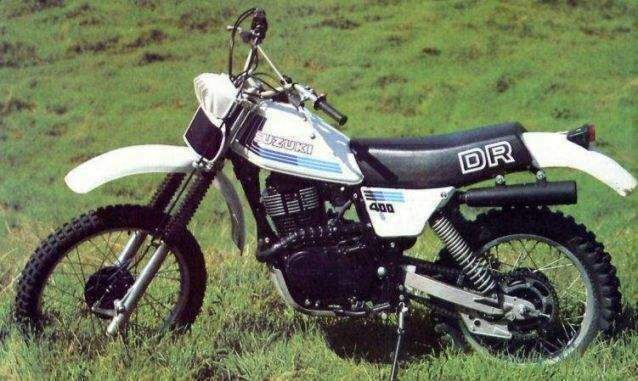
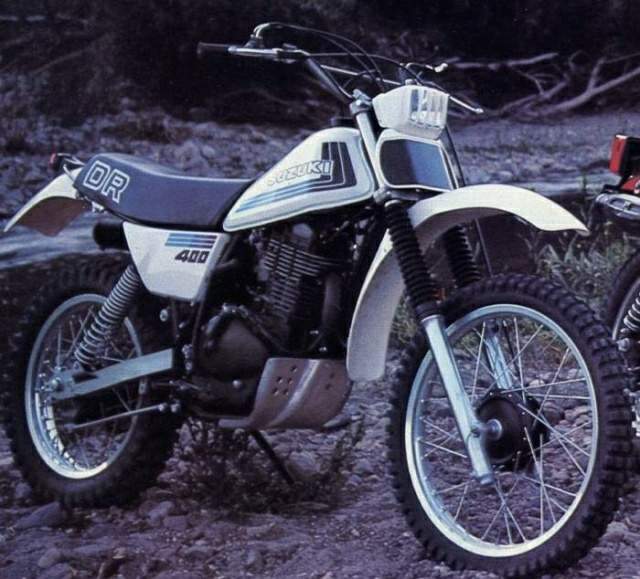
Suzuki DR 400S
Remember the first DR370 Suzuki? It had a funny
sized four-stroke single cylinder engine bolted into a decent frame. But the
general styling and suspension travel were comparable to
1968 enduro bikes. The same bike received a square headlight and different paint
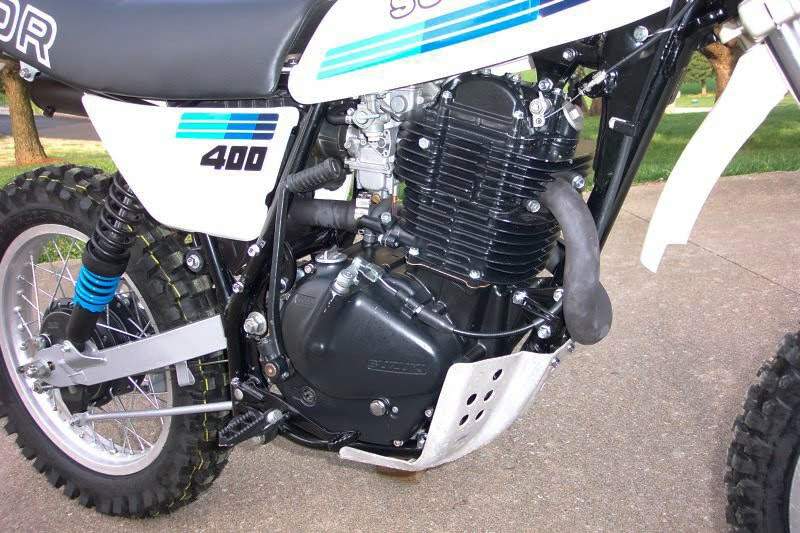
for '79 . . . yawn. The biggest change to the engine comes from a 3mm larger bore, 88mm verses 85mm. Stroke stays the same, 65.2 mm. The head has reworked ports, improving flow but maintaining the same intake and exhaust valves, (one of each). The Mikuni push/pull carburetor is slightly larger at 33mm, up from 32mm. Ignition is new. The flywheel point system is scrapped and an electronic ignition is used. A single overhead cam turns in the head easting without benefit of insert bearings. Oil flow to the head is only 7 psi but volume is great and the unit is lighter than one with bearings. A couple of parts have been beefed to better cope with the increased displacement: the rod has bigger pins at both ends; the piston pin diameter is now 34mm compared to 32mm on the 370, and the flywheel pin is 43mm versus 41mm before. Also, the clutch has had one disc added for a total of six. Internal transmission gears have been strengthened and the ratios have changed some. First gear is slightly taller, 20.69:1 now, 22.47 before. Second and third are unchanged but fourth and fifth have lower ratios. The new ratios match the engine's performance perfectly and the strengthening should halt the transmission problems experienced by people who hopped up the 370. The overall size of the head and cylinder have grown with the bore, and the engine has a larger look. The increased outside dimensions of the cylinder and head provide more cooling fins and the engine doesn't run hot when ridden hard for long periods of time. A sight gauge is used to check engine oil levels and the wet sump design eliminates the need for exterior oil lines. A semi-automatic decompression release has been fitted to the 400. It has a lever mounted to the left side of the handlebar. To start the bike the lever is pulled and released, locking the lever in. Next the kick lever is depressed slowly until the decompression lever returns with an audible click. The kick lever is then placed at the top of the stroke and given a hard shove. We found it more trouble than necessary and usually just kicked it without fooling with the lever, although the device does make it easier when the engine is warm. The DR frame and swing arm are impressive. Both are strong designs but unfortunately made from heavy mild steel. The frame is a single downtube design that uses large diameter tubes throughout. The main backbone and downtube are braced with a smaller tube and generous gusseting. The critical area under the seat is triangulated and the swing arm mounts to thick gusset plates. The swing arm is a large boxed design with double cross bracing and good strength. It's a nice touch after some of the water pipe tubing used on other four-stroke Singles. Early prototypes had aluminum arms but they didn't make it into production. Suzuki compromised, used steel and painted it to look like aluminum. The steel arm is very strong and doesn't flex but probably weighs several pounds more than an aluminum one.
The new frame and swing arm are complemented by new
suspension and a steeper fork rake. The rake has been pulled in to 30° from 31°
and the suspension travel has been substantially increased. Fork stanchion tube
diameter has grown from 36 to 38mm and the lower legs look identical to the
units used on RMs. Travel is 9.1 in. Triple clamps are beefy RM parts and
furnish wide clamping surfaces and strong pinch bolts. Handlebar pedestals are
rear-set but not rubber mounted. Shocks are gas/oil KYB non-reservoir units with
progressive springs and five spring preload settings. The shock design dates
back to about '75 when KYB first introduced gas/oil shocks. They have large
heavy bodies and can't be rebuilt. Back in '75 they were very good, in 1980 they
are just barely acceptable. Rear wheel travel is 8.3 in., up from 5.9 on the
first DR. All of the DR's plastic parts are new. The fenders are wide and long, giving good rider protection. The square headlight has been discarded in favor of a new headlight/numberplate combination. The headlight is placed above the numberplate so the light doesn't reflect off" the fender into the rider's eyes. A plastic grill over the lens prevents broken lenses but it'll only stop large objects. The number plate is hinged at the top and lifts to reveal a tool compartment and tool roll. Tools are the basic pot metal models that are used once and discarded but the storage compartment is a neat idea. The taillight is larger than before and mounted in a rubber housing. The bike isn't street legal in California though it could be registered in some states. The poorly styled tank and seat from the 370 are history. A short motocross-shaped tank and comfortable seat give the DR400 that right look. The tank is made from steel and holds 2.2 gal. The cap is made from plastic and has a rubber sealing device that kept coming out of the cap and falling into the tank. We finally left it out rather than fish it from the bottom of the tank at each fill-up. It didn't leak without it and stopped a lot of hassle. Controls on the DR400 are properly shaped and placed. The bars are a little high but most trail riders will like them that way. Hand levers are a dog-leg shape and work well. The brake pedal is adjustable for height and has a saw-toothed top. Shift lever length is right but doesn't fold. The footpegs are copies from the RM and work great. The kick start lever doesn't have a ribbed end but does have a rubber cover. The rubber cover isn't as efficient as steel ribs but much better than the slippery end used on RMs. Maintenance is fairly simple for a four-stroke. Valve adjustment can be done without a feeler gauge and the CDI has eliminated the points and the need to adjust them. Oil can be changed by removing the drain plug through a hole in the skid plate but oil filter cleaning (recommended at each oil change) requires removal of the skid plate (six cap screws). Cam chain adjustment is simple and only takes a few minutes. The air cleaner is a quick removal job, once the seat is removed. The foam filter is removed through the top of the box by pulling two wire clips and lifting the unit out of the top of the box. Once out the foam is cleaned and re-oiled before replacing on the wire cage. The air inlet for the filter is placed toward the rear so splashed water doesn't enter and the whole works is housed in a nice plastic box. We were surprised when we weighed the new DR. With a half tank of gas it weighed in at 288 lb. Our 1978 DR370 test bike weighed 270 lb. with a half tank, 18 lb. less than the newest offering. Where does the extra weight come from? Suzuki couldn't explain the difference. We looked the bike over carefully and started adding up the heavier parts: the forks are larger and have more travel, the shocks are heavier, the swing arm is larger and stronger, the frame is beefier and still made from heavy mild steel, the kick stand is stronger and heav: ier, the larger cylinder and head have added weight, the silencer is larger and quieter and heavier. It all adds up quickly. Riding the DR400 is the best part. It starts hot or cold and warm up from cold is quick. The added engine displacement has boosted the torque but we couldn't tell much difference in the horsepower. Clutch pull is pleasantly easy and engagement is smooth and predictable. The DR doesn't lurch away from a dead stop, nor does it jump a bike length as the clutch is released, like other large displacement four-stroke Singles. It just pjills smoothly away. Gear ratios are perfect as is overall gearing. Without a speedo or odometer, top speed is a guess but it'll go as fast as most riders will want.
The horsepower won't awe anyone and the acceleration
won't tear your arms from their sockets, but power is everyplace and extremely
predictable. Shifting every 10 feet isn't necessary and the rider doesn't have
to try and ride three corners ahead. The engine is best described as mild and The best thing about the DR is the way it steers. It steers better than any large bore four-stroke we have tested. Double-rut sand roads are pure fun. Nothing twists or flexes and lines through rocks and other potentially bad spots are easily traversed, even at speed. Sand washes are equally fun. The bike goes straight, doesn't wobble or shake its head, and instills confidence. Sliding fire roads is also great fun but due to the mild power output, big slides require going into the corner very fast and pitching the bike, depending mostly on speed to induce the slide. Once sliding, the bike is easy to control and doesn't saw or do other nasty things. With more power it would be a great fire road bike. Mountain trails are where the DR400 shines; it is almost perfect as is. Power is adequate and steering precision on tight trails is matched only by the Kawasaki KLX. Getting the front wheel off the ground is nearly impossible. With practice it can be lifted by quickly pushing down on the bars and then lifting and turning the throttle on full. So crossing erosion ruts at speed can be touchy. If an attempt isn't made at lifting the front, the front wheel may fall into the ditch and pitch the rider. If lifted slightly, the bike and rider will cross in one piece. Even small ruts are hard to cross on a bike that lifts the front so reluctantly. Any way they are crossed, the back of the bike will bottom. After being used to yards of rear wheel travel, a hard rider can get into trouble with only 8.3 in. The bike isn't designed as a desert or motocross racer but many people will probably modify the suspension and engine for such use. The forks aren't half bad and with over 7 in. of stanchion tube engagement, adding travel is easy and safe. In fact RM damper rods and springs may bolt in. The RM rods would extend travel to 11.2 inches and cost would be reasonable. An easy rider or woods rider probably won't want more travel and won't need to modify the forks. The damping and spring rate are perfect. All types of ground are crossed with comfort and control until the travel is used up. And the low seat height is nice. The rear is another matter. The bike could be more fun with better shocks. The stockers work fair and don't punish the rider as long as moderate speeds are maintained, but get hot and go away if pushed through rough ground at higher speeds. In past experience this model KYB has proven short lived, so the DR buyer will have to change them fairly soon anyway. If the forks are stretched, longer shocks should be used to keep the bike's attitude correct. Brakes on the DR400 are strong and effective. The rear has a full-floating backing plate so chatter on rough ground isn't a problem while braking hard. The only criticism is a lack of feel. We had to adjust the lever loose to keep from unknowingly riding it. Overall, we like the DR400. It is aimed at the trail rider not the racer, and for that purpose K's great. Seat height may be a bit much for a short rider, although it's lower than just about any motocross or true enduro on the market, and light people and kids may find that the sheer mass of the DR gets tiring in the tight stuff, where you do need body english to throw that 288 lb. where you want it. For adults of medium or hefty build, though, the DR will be good as a beginning dirt bike, or for experienced riders who don't need the thrill of instant wheelies but do want a good steering, polite motorcycle for pleasure. D Source Cycle 1980
|
|
|
Any corrections or more information on these motorcycles will be kindly appreciated. |