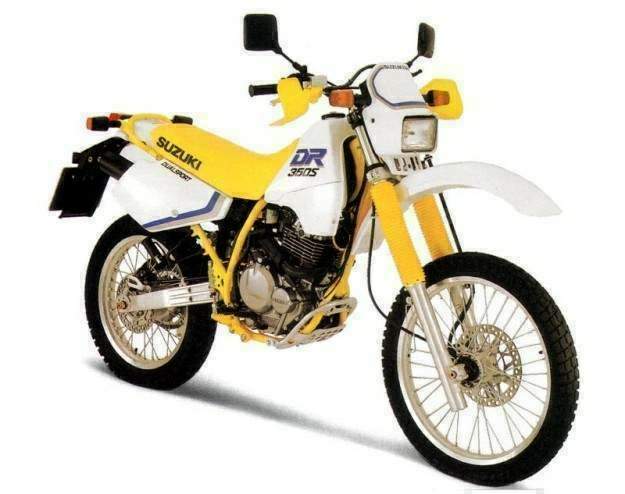
Suzuki DR 350S


Make Model

Suzuki DR 350S

Year

1993

Engine

Air cooled, four stroke, single cylinder, SOHC, 4 per cylinder

Capacity

349
Bore x Stroke 79 x 71.2 mm
Compression Ratio 9.5:1

Induction

Mikuni BST33 carb

Ignition  /  Starting

Digital CDI  /  kick

Max Power

30 hp 21.9 kW @ 7600 rpm  ( rear tyre 27 hp @ 7600 rpm )

Max Torque

29 Nm @ 6200 rpm

Transmission  /  Drive

6 Speed  /  chain

Front Suspension

Telescopic, cartridge-type, 13-way adjustable compression damping and 17-way adjustable rebound damping, 280mm wheel travel

Rear Suspension

Link-type, fully adjustable spring preload, compression and rebound damping, 254mm wheel travel.

Front Brakes

Single 250mm disc

Rear Brakes

Single 220mm disc

Front Tyre

80/100-21

Rear Tyre

110/90-18

Dry-Weight

130 kg

Fuel Capacity 

9 Litres

Consumption  average

18.2 km/lit

Braking 60 - 0 / 100 - 0

15.1 m / 50.0 m

Standing ¼ Mile  

15.1 sec / 132.0 km/h

Top Speed

145.7 km/h

F YOU'RE ONE OF THOSE PEOPLE who view the great outdoors as a place infested with uncooked birds, uncut shrubs, and unpaved roads, Suzuki's DualSport DR350S is probably not the bike for you. This is a motorcycle for people who believe the fun starts at pavement's end, the folks who can't get away from it all without also leaving behind a cloud of dust and Hying dirt clods.

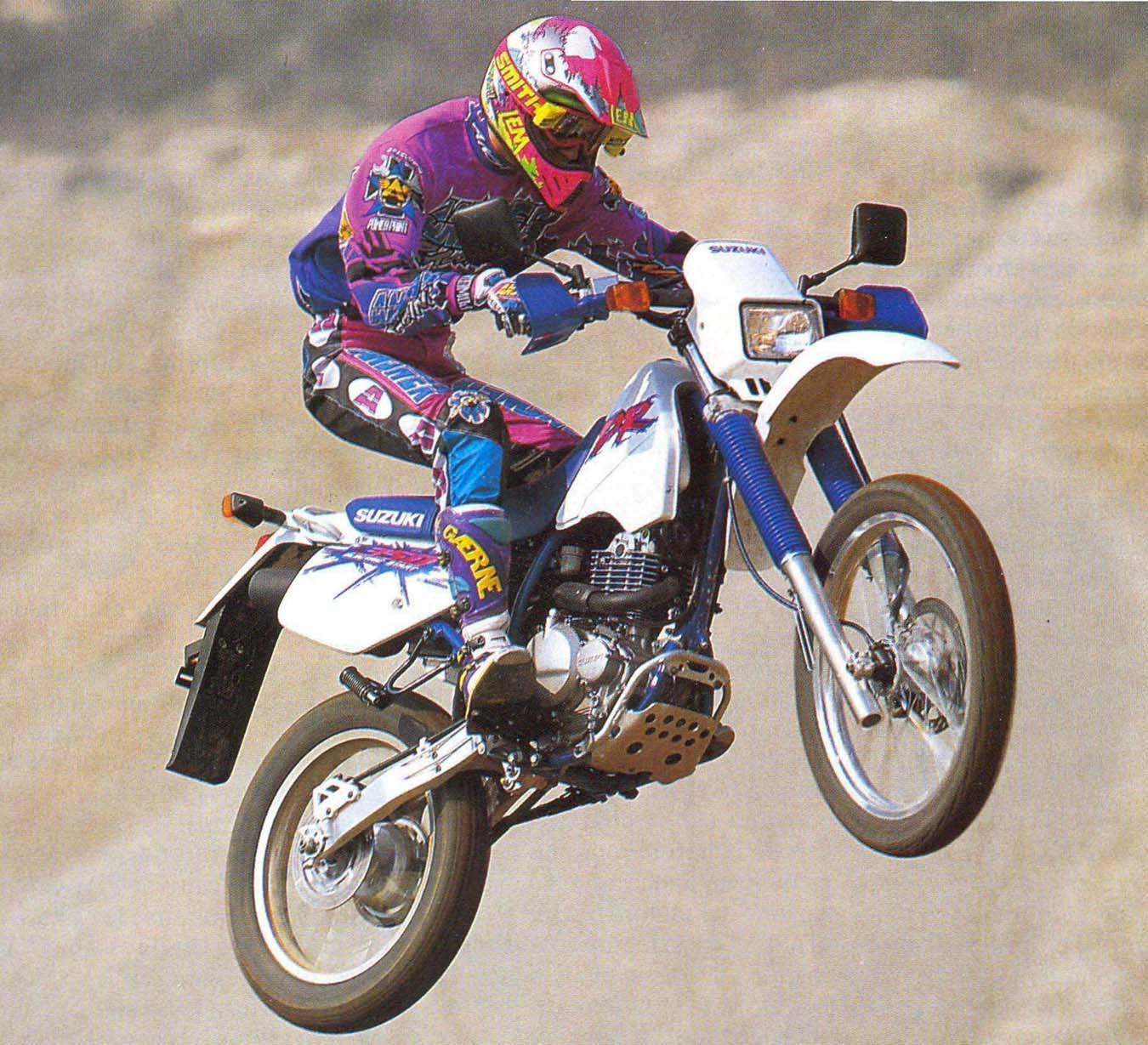
One glance at the DR350S' dirt-bike styling should tell you this is not your average dual-purpose street/trail footer. The S is a street-legal dirt bike, a motorcycle capable of enduring unmerciful and sustained thrashing off road while maintaining a pace across jagged terrain just a tick behind full-on dirt bikes. With the introduction this year of the DR350S, and its smaller sibling the DR250S, Suzuki has targeted serious riders frustrated by the off-road ineptitude of bulbous Paris-to-Dakar pretenders that populate the current dual-purpose class.

Conceived and developed by a coterie of dirt specialists within American Suzuki Motor Corp., the DR350S and DR250S are street-legal variants of the all-dirt DR250 and DR350, a new generation of four-stroke singles that reflect Suzuki's unique ability to resolve price and performance conflicts through the economy of parts commonality.

Sharing the same basic sohc, four-valve, six-speed engine, single-shock frame and running gear, all four bikes sprang from the development of essentially one mule. Suzuki has had tremendous success with the shared-parts approach in the past. The Katana and GSX-R lines now five models strong—use the same basic powerplant, and are often the least expensive bikes in their classes. Despite extending the shared experience to the chassis department as well, the DR350S doesn't bottom the price scale: At $3299, the DR-S is $350 more than Yamaha's XT350, but that premium buys far greater off-road capability.

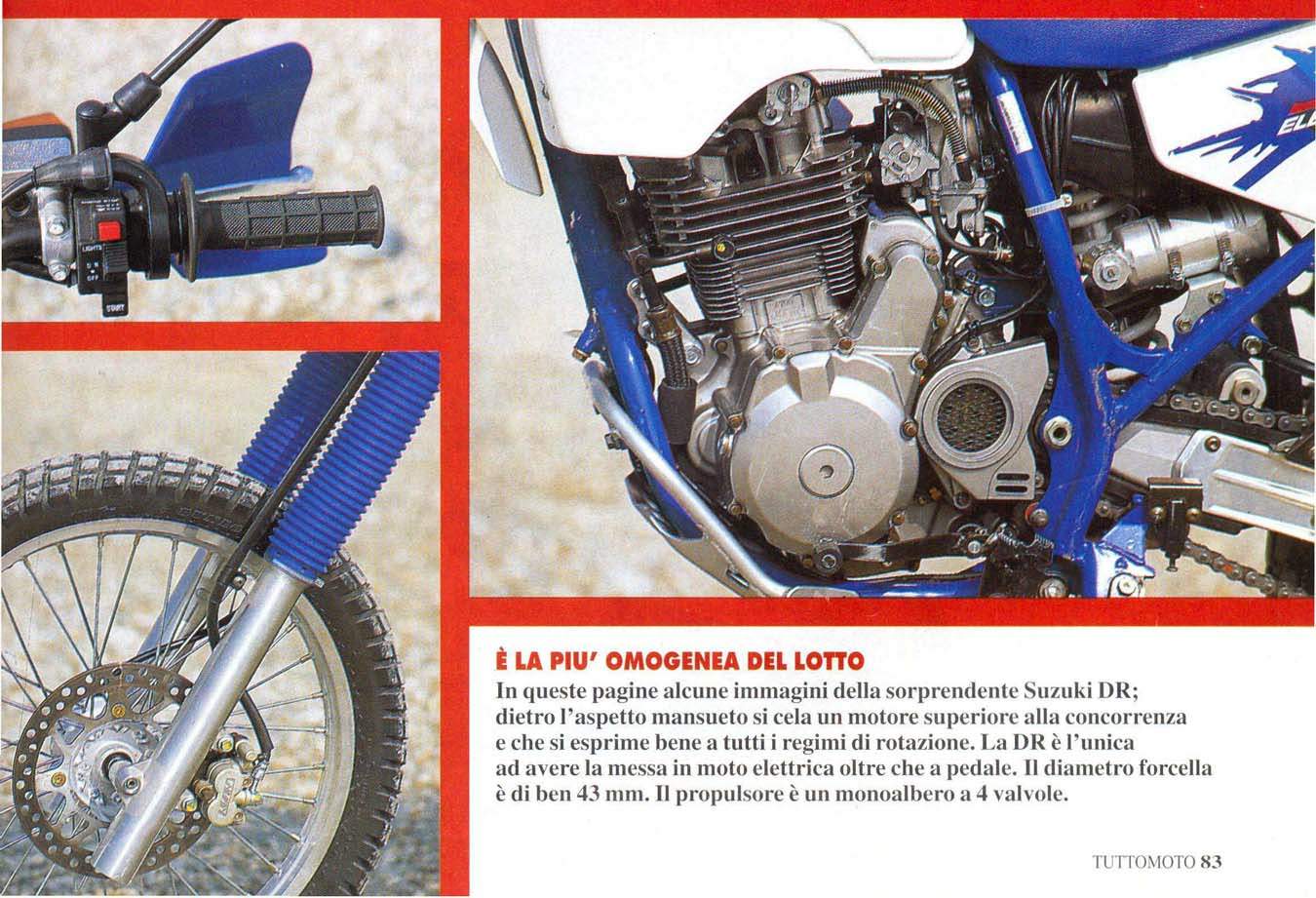
With a wheelbase shorter than the average 125 motocrosser's and a wet weight of 306 pounds only 21 pounds more than the DR the 350S is a compact piece, thanks mostly to the diminutive dimensions of its engine. Suzuki engineers wanted a small powerplant for optimal engine placement and a low center of mass, and they got it by conventional means. Like most four-stroke singles, the S uses a dry-sump lubrication system that stores oil in a sealed reservoir within the frame backbone. Eliminating the engine oil sump decreases engine height and allows positioning the engine lower in the frame without sacrificing ground clearance. In this system, oil is channeled to the top end and transmission through external lines rather than cast-in crankcase galleys, further reducing engine size and weight.

In addition to its lubrication system, this engine employs the Suzuki Advanced Cooling System, a variation of air-and-oil-cooling SACS technology used in the GSX-R engine. Fine-pitched cylinder fins bleed BTUs to the atmosphere while a high-volume oil pump circulates 2.0 quarts of oil to jets that douse notorious hot spots camshaft lobes, cylinder wall, combustion-chamber crown, and the underside of the piston. While the DR350S lacks the aluminum oil cooler of the DR650S, Suzuki offers an optional cooler for riding in particularly hot climes. Our bike, even flogged in a 90-degree blast of summer heat, kept a cool head.

Snoop around inside the 350S' engine cases, and you'll find other nice touches. To reduce vibration, a gear-driven coun-terbalancer spins in the bow of the engine, its counterweights positioned and timed to rotate between the crankshaft's flywheels. A large clutch features rack-and-pinion actuation, with the pinion pivoting on needle bearings. The result is light lever effort and precise clutch control that makes it easy to flow rather than lurch away from stoplights.

According to Suzuki, the 350S' internal engine components are identical to the DR's. The clutch passes power through straight-cut gears to the same wide-ratio six-speed transmission. Upstairs, the 350S positions four valves at a narrow, 40-degree included angle inside a TSCC head. Screw-and-locknut adjusters take up valve lash, and Suzuki recommends a clearance check every 3500 miles. Valve sizes (30.6mm intake, 27.0mm exhaust), valve timing, camshaft, compression ratio (9.5:1) and bore and stroke (79.0 by 71.2 mm) all critical specifications are the same.

Minor differences distinguish the two engines. Four fewer teeth on the rear sprocket gives the street-going 350S 10-percent taller gearing than the DR, dropping engine speed to 5750 rpm at 60 mph. While the digital CDI ignition metes out the same timing for DR and S models, the S replaces the DR's flywheel magneto with a three-phase AC generator, and tucks a small 12-volt battery behind the left side panel to accommodate its street lighting.

To meet EPA noise and emission standards, the S growls through a two-stage muffler that's more restrictive than the DR's single-stage barker. Both bikes breathe through large-capacity airboxes and semiflat-slide 33mm Mikuni Slingshot carbs; the 350S uses a GSX-type constant-vacuum carb that more precisely meters fuel at low engine speeds where the EPA performs its sniff tests.

What effect has EPA certification had on this 349cc thumper? Not much. Run back to back on the Kerker dyno, the 350S and DR engines produced nearly identical power: At 7000 rpm, the 350S made 23.5 horsepower and 17.6 pound-feet of torque, only half a horse and 0.3 pound-feet short of the DR. For reference, Honda's off-road 1985 XR350, run on the same dyno, made 25.8 horsepower at peak. These thumpers are hardly powerhouses: The average 125cc two-stroke motocrosser makes about 27 horsepower at peak.

But we're talking about completely different objectives here: The four-stroke concept is not to extract the maximum possible power from the smallest possible displacement, but rather to create a tractable, easy-to-use engine. In contrast to toggle-switch two-stroke power, the 350S' torque curve is broad and flat, the engine pumping out 85 percent of its peak torque from 3500 to 8000 rpm. From 2000 to 8000 rpm, power delivery is instantaneous and potent enough to zap past traffic or chug up a steep, rocky trail without drama. The 350S is smoother and accelerates harder at low revs than the DR350, thanks to the flawless response of its CV carb. Above 8000 rpm, power falls dramatically, making the 350S feel breathless on top. Short-shifting keeps the engine in the grunt zone.

Unfortunately, the 350S' kick-starting procedure may elicit a grunt or two from the rider. Our expert off-roaders consistently fired the engine after only a couple of boots, but novices more accustomed to the push-button technique had more difficulty. Suzuki's manual decompression mechanism—which holds one exhaust valve open until the piston passes TLX!, then snaps the valve closed isn't as sophisticated or effective as the KACR system on Kawasaki's KLR250, or the automatic compression release on Yamaha's XT350. Both bikes start with less effort. The DR350S requires a stout boot, and proper technique. Cold-starting is easiest: Full choke, no gas. But hot starting  especially after a tip-over sometimes requires full throttle, and several manly kicks.

In every other respect, the 350S offers excellent engine performance on and off the road. It has great low-end punch, smooth power delivery, and ample highway power as long as you don't cruise far beyond 70 mph. In its street mode, the 350S benefits greatly from its counterbal-ancer: Though some low-amplitude vibration sneaks into the grips at low revs, the engine is otherwise laudably smooth— especially at highway cruising speeds. Off road, the clutch thrives on abuse, and the bike could be hammered through deep whoops without any hesitation from the engine. In fact, our 350S never coughed, sputtered, spit, backfired, burped or acted otherwise uncivilized, and returned 39 mpg even when flogged.

Darting through city traffic or cruising the highway, it's a relief to sit upright behind the 350S' off-road handlebar. Plastic hand guards block the morning chill, and there's adequate legroom for six-footers to stretch. Unfortunately, the seat is your basic butt-wedge narrow and hard, with a strap right where you sit. Even the staff hardass was fidgeting after 40 straight-line miles, and the seat's 34.6-inch height kept shorter riders on their toes. Ironically, the softer, strapless DR seat is more comfortable.

On pavement, the 350S steers quickly, easily, and the Dunlop K560 all-surface tires (a 21-incher in front, 18-inch in back) provide a remarkable amount of traction: A talented rider can push the 350 through twisting backroads faster than most street riders can imagine. Bump-response from the S' long-travel suspension is excellent on pavement, the highway ride surprisingly plush. The brakes a 9.8-inch disc and Nissin dual-piston caliper in front, 8.7-inch/single-piston combo in the rear are calibrated more for off-road riding: In the dirt, they provide progressive feel and hard stopping power, but feel spongy and fade  especially the front with repeated hard use on the street.

Where the 3 5 OS differs most emphatically from the dual-purpose crowd is in its chassis and suspension. Apart from additional brackets for the battery, passenger pegs, sidestand interlock, etc., the 350S wears the same thin-wall steel frame as the DR. Bolted to the back of this frame is a unique box-section aluminum swing arm composed of two forged arms and a single pivot casting. Instead of welded construction a process that invites distortion and requires expensive assembly jigs the forged arms are attached to the casting using advanced aerospace adhesive and threaded fasteners. Stronger and less expensive to produce than conventional alloy swing arms, the bonded-type arm may see broad street-bike application in the near future, according to Suzuki.

The 3 5 OS suspension components differ from the DR's legs, but not in ways reported by Suzuki in preproduction previews. Originally, both bikes were to get cartridge forks, with an inch chopped out of the 3 5 OS' suspension travel front and rear, but production versions of both bikes arrived with conventional emulsion dampers courtesy of the Product-Cheapening Department. The good news is the 350S sports 11.0 inches of travel front  and back same as the DR and a beefy 43mm fork with adjusters for compression damping and preload. In back, Full-Floater linkage identical to the DR's compresses a remote-reservoir, aluminum DeCarbon shock with adjustable preload and compression damping, but lacking the rebound-damping adjuster found on the DR. To improve ride quality on the street, the 350S has softer springs front and rear, and lighter damping rates in the rear. The fork maintains the same rebound and compression damping as the DR.

Off-road, the 350S has advantages and disadvantages compared to the DR, depending on where and how hard you ride. Expert-level riding over rough terrain begs for suffer suspension. Cranking in maximum fork preload, and adding preload to set rear sack at 75mm, and dialing up compression damping in the shock stiffens the S' suspension considerably and prevents bottoming over all but the most vicious obstacles. In the fast rough stuff, the heavier, softer 350S still bottoms often, and as a result hammers through bumps the stiffer DR floats over.

Tires more than suspension calibration or weight limit the 350S' ability to keep pace with the knobby-shod DR. Dropping tire pressures (from 28 on the street to 18 psi in the dirt) improves grip considerably, but the short-block all-surface rubber still knifes into sandwashes, skitters across surfaces where knobbies bite, and runs out of traction on hills long before the 350S runs out of power. Knobby tires transform this machine off road.

There are times when the 350S' softer suspension has distinct advantages off road, however. At a relaxed-to-brisk pace, the suspension is more plush and responsive than the DR's, and that makes the S a more pleasant platform on which to explore unpaved tributaries. Serious dirt riders will be surprised to discover the S also handles tight, rutted, rocky goat trails better than the DR. On these first-and second-gear enduro trails, where the DR can't muster the speed to make its stiffer suspension work, the 350S holds its line through sharp bumps and jagged rocks that jar the DR off course.

That alone makes the 3 5 OS easier to ride fast or slow on some trails than the DR, but there are other reasons. The 350S' stronger engine response at low speeds helps yank the bike out of tight spots without as much shifting as the DR, and, though 20 pounds heavier, the 350S never feels heavy or clumsy off road. The combination of a thinner seat, lower-profile tires, and softer suspension places the rider closer to the ground on the 350S than on the DR, and this makes the S easier to handle in the tight stuff. Conversely, the lower 350S could use more ground clearance: We cased it hard once over a log, and proved the worth of its alloy skid plate.

There are other areas that need improvement. Hard riding can drain the S' 2.4-gallon steel gas tank in under 100 miles, and the tank's cosmetic lower lobes—designed to mimic the DR's plastic tank sumps look cheesy. More fuel range, a more powerful front brake, and a better saddle would broaden the S' versatility, but these shortcomings surface mostly on the street. Perhaps that's the inevitable compromise of a design philosophy that places off-road performance above pavement persona. It's a compromise that's easy to accept because the DR350S achieves a level of dirtworthi-ness no other dual-purpose bike can match, and it's tough enough to take a pounding: With no superficial bodywork and minimal instrumentation—speedo, tach and idiot lights only our bike survived two off-road tumbles with only minor flesh wounds.

It is difficult when assessing the DR350S to maintain perspective, to remember that this is a street-legal motorcycle. The DR350S works so well off road that it begs comparison with full-on dirt bikes. Whether or not Suzuki's off-road formula proves compelling enough to boost the sagging dual-purpose market remains to be seen. But for riders who spend more time in the dirt than on the street, the DR350S will take you places you wouldn't dare ride other dual-purpose bikes and at a pace just a set of knobbies away from seriously fast. ■

Source Cycle Magazine 1992


NOTE: Some of the photos on Motorcycle Specs are owned by somebody. If you see any of your photos, you can let me know so that I can acknowledge it, or if you object to it, I can remove it altogether. If any copyright holder objects  to their articles being placed on Motorcycle Specs, it will be removed upon request.  Any correction or more info on these bikes will kindly beappreciated                                          Contact Me      Privacy Policy     Website Stats