|
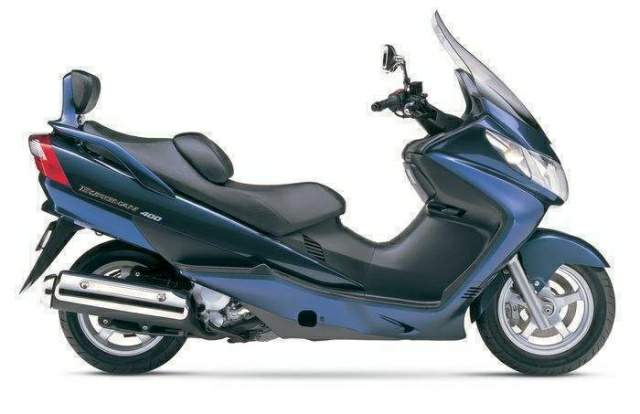
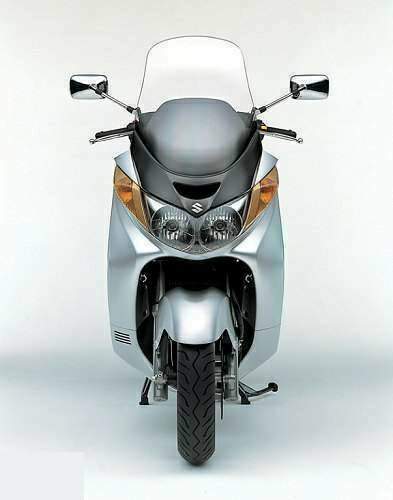
Suzuki AN 400 Burgman

|
Make Model |
Suzuki AN 400 Burgman |
|
Year |
2005-06 |
|
Engine |
Liquid cooled, four stroke, single cylinder,
SOHC, 4 valve per cylinder. |
|
Capacity |
385 |
|
Bore x Stroke |
83 x 71.2 mm |
|
Compression Ratio |
10.2:1 |
|
Induction |
Fuel Injection |
|
Ignition /
Starting |
Digital electronic
|
|
Max Power |
32 hp 23.4 KW @ 7600 rpm |
|
Max Torque |
32 Nm 3.3 kg-m @ 6000 rpm |
|
Transmission /
Drive |
V-belt, CVT- automatic |
|
Front Suspension |
41mm
Telescopic, coil spring, oil damped |
|
Rear Suspension |
Link-type, coil spring, oil damped,
adjustable preload |
|
Front Brakes |
Single 260mm disc |
|
Rear Brakes |
Single 210mm disc |
|
Front Tyre |
110/90-13 |
|
Rear Tyre |
130/70-13 |
|
Dry-Weight |
179 kg |
|
Fuel Capacity |
13 Litres |
|
Consumption average |
18.2 km/lit |
|
Standing
¼ Mile |
17.2 sec |
|
Top Speed |
152.1 km/h |
|
Reviews |
Motorcycle-USA
/
Motorcyclist |
 
Motoring across San Francisco's iconic Golden
Gate Bridge at 70 mph I found myself repeating an already familiar phrase in my
head: Remember, you're test riding a scooter.
For most riders, myself included, the scooter market gets identified by
small-displacement (most often 50cc) whining machines that are fun to zip around
town but aren't fit for duty out on the real roads. That perception has changed
in recent years with the introduction of the luxo-scooter category, comprised of
larger displacement machines capable of big-time roads and cross-town traffic.
The Burgman 400 has earned a reputation as a formidable commuter and weekend
warrior, so to evaluate the 2007 edition what better place to test versatility
of the best-selling luxo-scooter than a ride through scenic San Francisco?
Available in 400cc and 650cc versions, the Burgman 400 has been upgraded for '07
with a tweaked motor, comfier ergos and improved componentry. Of the two
versions, the Burgman 400 is the better seller and, in fact, is the best-selling
scooter in the 126cc-and-over category. Dividing the scooter category at the
125cc mark, Suzuki presented some compelling data supporting the surprising
growth of the 126cc-and-over scooter market and the Burgman's dominating
position in it.
In 2005 the smaller machines still sold more units in the U.S., tallying 37,500
sales compared to the larger machines' 21,400, yet the increase in the smaller
units was just 9% compared to the even healthier 21% of the larger scooters. The
Burgman's numbers from 2005 were a 23% increase over '04, and taking a snapshot
of 2006 thru June, Suzuki's overall scooter numbers are up 60% compared to the
industry's already impressive 20% increase. Right now the Burgman 400 remains
the best-selling scooter in the 126cc-and-over market.
Making its stateside debut in 2003, Suzuki prepared the Burgman for success on
American shores by launching an aggressive urban marketing campaign in major
metropolitan areas, including a billboard in New York's Time Square. That a
scooter would be aimed at the big-city crowd is not a shock, but the demographic
of Burgman purchasers reveals some surprising numbers. The typical scooter rider
in my imagination is a frizzy-haired European fellow, who looks a lot like
Valentino Rossi, buzzing around town craning his neck and beeping his horn while
checking out the young ladies in the plaza. I had to readjust my reality tunnel
when Suzuki presented its sales information and I discovered the typical Burgman
400 rider was more inclined to carry a AARP card in their wallets than a college
ID.
It turns out the average Burgman 400 rider has 12.4 years of riding experience
under his or her belt, is 52.1 years of age, and has a household income of
$71,884. Compare those figures to the rates of Suzuki's typical motorcycle
owner: 12.1 years of riding experience, 38 years old, and $60,750 household
income; and you don't have to be a statistics professor to draw some pretty
general conclusions. For one, the Burgman ranks are made up of an older crowd.
Another number that jumped out during Suzuki's presentation was the number of
women riders making up the Burgman demographic, with 24% of the Burgman 400
customers hailing from the fairer sex compared to 12% of Suzuki's overall
motorcycle owners. Another significant number is that extra $11,134 in income
which, when combined with a more tempered outlook on street riding, makes the
$5,899 MSRP an attractive one for those seeking a sensible form of two-wheeled
transport.
The Burgman is something of a hybrid, with the luxo-scooter representing the
offspring of a sport-touring motorcycle and 50cc scooter. The Burgman does its
best to meld the two worlds but taking the controls after throwing a leg
through, instead of over, the machine, the differences are noticeable right
away. Claiming a dry weight of 438 lbs, the Burgman is a different beast
altogether from its smaller scooter siblings, yet the low center of gravity and
28-inch seat make it scooter-like easy to control at low speeds or when stopped.
Equipped with both a center and sidestand the 400 features a parking brake to
keep the machine stationary when left stopped on an incline and can be set and
released with one hand.
Turn the key and the Burgman's analog tach and speedo needles flip all the way
over and back, the dominant features of an impressive control panel. A fuel
gauge resides on the far left of the instrument cluster with an engine
temperature gauge on the right. Dead center in the cluster a clock display is
positioned above the main display screen, which with the touch of two buttons
below can cycle through useful info such as the ambient temperature, odometer,
dual tripmeters, and the all-important mpg figures - so that poor
gas-consumption-obsessed commuters, such as myself, can wax euphoric about the
Burgman's budget-saving fuel efficiency (but more about that later).
Pulling in the rear brake with the left hand control and thumbing the starter,
the Burgman's 400cc single-cylinder engine pulses to life. While it doesn't
thrill the senses in quite the same way as Suzuki's Gixxer sportbikes, the
Burgman's exhaust note is sturdy enough without being obnoxious. The powerplant
in 2007 features an upgrade in displacement from 385 to 400cc via an elongated
stroke, with the 81 x 77.6mm bore/stroke figures replacing 2006's 83 x 71.2mm
numbers. Dual overhead cams supplant the SOHC configuration of 2006, and an EFI
system provides a more efficient engine, with an Idle Speed Control (ISC) system
eliminating the need for a choke lever. Suzuki officials were proud of the EFI
system in particular, explaining how the design was derived from the venerable
GSX-R lineup. Suzuki claims the improvements will provide strong acceleration,
and the cleaner-burning machine employs an exhaust catalyzer with an O2 sensor
to reduce emissions, making the new 400 compliant with stringent Euro 3
standards.
Having gotten myself acquainted with the Burgman in the courtyard of our
lodgings near Fisherman's Wharf in San Francisco, I got off the machine to play
around with its adjustable backrest and explore its many storage spaces. Perhaps
catering to the touring-oriented consumers who purchased the earlier Burgman,
this 400 is something of a mini-tourer in its own right. The cavernous 62-liter
underseat storage is up from the 55 liters of '06 and can stow away two
full-face helmets with ease. Worried that I might be underdressed with just a
mesh jacket I stowed a hoodie pullover in the underseat along with my small
video camera and shoulder bag, with plenty of room to stash my helmet and gloves
at intervening stops on our planned route. The storage space is also
supplemented by two lidded cubby holes up near the instrument cluster and a
glove compartment, which houses a handy DC power outlet.
Suzuki brass and Top Shelf Tours had planned out a special route to showcase the
Burgman's strengths, which would take us up and down the streets of San
Francisco and over the Golden Gate Bridge into Marin County for some more
urban/sub-urban riding, and then head north via twisty mountain roads to our
destination of Sonoma, California.
Our test ride got underway by motoring up and down the famous hills of San
Franciso and included a winding ride down Lombard Street, whose 27-degree slope
and eight switchbacks have given it the distinction of being the twistiest
street in the U.S.. Suzuki's decision to pick SF as the city to showcase the
Burgman was a sound one, as nothing makes you more appreciative of the
simplicity of an automatic centrifugal clutch than when perched at a stop sign
headed up what seems like a 60-degree hill. Holding the brakes and rolling on
the throttle is so much easier without that pesky clutch lever to worry about.
The Burgman made mincemeat out of the most daring hillclimbs SF could throw at
us, and I was impressed by the 400's steady engine delivery and CVT automatic
transmission, with the powerplant more than capable of tackling the steep,
daunting inclines without bogging down. The big-city portion of our ride
included tooling around the winding roads of the scenic Presidio where the
scooter excelled at handling the twists and turns interlaced with numerous stop
signs. After snapping photos it was time to hop on the Pacific Coast Highway and
head north toward wine country.
Crossing the Golden Gate Bridge, I kind of felt like Suzuki was cheating just a
little by providing such a scenic route to try and confuse our objectivity.
Although I profess to be a sophisticated, literate member of the motorcycle
press, I'd be lying if I didn't admit that there is a little lingering
rope-belted rube inside me who gawks at all the big-city sites like I was Jethro
from The Beverly Hillbillies. That said, while I motored across the
Golden Gate Bridge, taking frequent glances to my right to take in the vista
which included the infamous Alcatraz, I contended with one of my few gripes
about the Burgman as I experienced some high-speed wind buffeting.
Right off the bat at a couple of stops, some of my fellow journalists were
murmuring about the view from behind the windscreen. Being 6'1" and with a
longer torso I had to tuck down while riding to snag a peek, but there was a
definite distortion or weird magnification going on behind the odd shape of the
screen. While the vision element of the windscreen's deficiencies didn't bother
me, the aforementioned wind buffeting I experienced at higher speeds did. My
head and shoulders got battered around pretty well at different points during
our ride, and to be fair I did notice a couple of trees blowing from crosswinds
on a couple occasions, but the wind protection is a facet that potential
purchasers might want to check out on their own with a test ride. On top of it
all, and as a matter of arbitrary styling taste, I thought the funky shape of
the windscreen could benefit from a redesign. An optional short windscreen
showed up on the Burgman's list of accessories, so that might be worth a try.
The wind buffeting, while annoying, was by no means a deal-breaker and was easy
to overlook once I opened up the throttle. The power generated by the
liquid-cooled four-stroke Single is manageable and easy to apply. While Suzuki
does not make public horsepower or torque numbers on their U.S. website, if my
German is up to snuff the power numbers on Suzuki's German website claim 33.5
ponies and 26.8 lb-ft of torque (by the way, the Burgman moniker carries over
from the model's German introduction, with the same scooter dubbed the Skywave
in Japan). I had discovered the Burgman's modest but ample power earlier on the
hills but it was further confirmed on the highway. As far as acceleration goes,
while speed freaks won't be impressed, getting a little extra oomph to make a
pass was not a problem, and there were a couple times when I had to do a
double-take just seconds after hopping off a stoplight and saw the speedo had
already hit 50 mph. The laughable generosity given to most scooter speedos isn't
so outlandish on the Burgman, evidenced by the ease of motoring up to 75-80 mph
without any problem whatsoever. There is no question as to the Burgman's freeway
capabilities and, for those so inclined, I am sure higher speeds could be
reached without problem, although I did not attempt them on the crowded PCH.
Out on the open road (we didn't sample any actual interstates, but the very
interstate-like Pacific Coast Highway comes awful close) is where I felt the
Burgman most blurred the line between scooter and motorcycle. At first I found
the conventional feet-down scooter stance to be a bit tiring and somewhat
sketchy when the speeds picked up, but once I pitched my legs forward and put my
feet up on the angled forward floorboards my ergonomic reality flipped around.
Pressing my feet against the forward boards the small of my back pushed into the
adjustable backrest and transformed my overall impression of the seat from a bit
uncomfortable to relaxing. In fact on a particular stretch of less than ideal
asphalt the slight vibration of the bumpy surface, combined with my new-found
riding position, had me looking and feeling like the jerk at the mall getting
his kicks by sampling the massage chair at Brookstone. The feet-forward approach
helped remedy one drawback I have against scooters because it gave me the
confidence-inspiring feel of being locked into place, kind analogous to the
feeling of stability on a motorcycle when the legs squeeze against the tank.
After crossing the Golden Gate we continued our urban experience by riding
through the communities just north of SF in Marin County and then began the more
touring-esque portion of the route, taking California's picturesque winding
backroads into Sonoma. Leaving the big city behind, I had time to reflect on the
Burgman's commuting credentials. The machine's commuter advantages are the
budget-saving 50-plus mpg fuel efficiency and easy parking. The Burgman also
helps assist its everyman commuter chops by being idiot simple to ride. You just
point and twist. For an able-bodied person, or even a former rider who has been
put off riding by a game leg or ankle, the Burgman would make an ideal fit for a
modest daily commute. This rings true for California in particular, where I got
my first taste of the advantages and perils of lane-splitting, and I can vouch
that the Burgman is slim enough to squeeze its way through apoplectic cagers
without any trouble.
The riding between Marin and Sonoma went through so many beautiful twisting
country backroads, I gave up trying to keep track of the particulars of our
route and instead focused on the asphalt ahead of me and how the Burgman
handled. Although the 400 doesn't showcase anything special in its suspension
setup, sporting a conventional 41mm fork working in tandem with a single rear
shock, things stayed smooth and stable on reasonable surfaces. The front fork
offers 4.3 inches of travel with the rear shock providing 3.9 inches to suck up
most bumps, and the rear shock is also preload adjustable, although it would
take some doing to get at it through the underseat storage area. The 400 excels
at low-speed maneuvering, and throwing it around corners with the velocity
cranked up a bit, the Burgman was stable and more than adequate. The '07 upgrade
from a 13 to 14-inch front wheel helps the 400 feel almost bike-like, and Suzuki
claims the new front has increased the available banking angle to 43 degrees. I
can't verify those claims, but after spectating a couple of passes during a
photo stop, I could testify under oath that the lean angle is steep enough to
drag the centerstand under more aggressive riders.
The front end also showcases another '07 upgrade, as dual 260mm front discs
replace the lone disc of the 2006 model. I have to confess that at the beginning
of our test ride I found the Burgman's front brake to be a bit deficient, with
the 210mm rear disc brake the more reactive and powerful of the two. While this
was contrary to what I had expected, once I became more familiar with the
machine, I was very appreciative of the smooth and consistent stopping power
provided by the front binders. There was almost no front-end dive, and when I
simulated a couple of panic/emergency stops I was able to slow down in a hurry
with a healthy pull on both levers.
My main complaint with the Burgman evaluation was that it was over so soon. Due
to a lot of stops for photos and leisurely breaks, the day had whiled away and
we hadn't quite reached the triple-digits on our tripmeters. This was a bit of a
let down, as the Burgman is well-suited for medium-distance touring. The
accessories list already includes upgrades like bungee hooks and a rear
carrier/luggage rack to increase the 400's touring capabilities, on top of extra
amenities like handguards, heated grips, and a passenger backrest.
Perhaps the best compliment I could give the Burgman is that as we entered
Sonoma I was wishing we could just keep on riding. I did get a kick motoring
into town with a big group of scooter riders though. The poor fools hoping to
glimpse the idyllic scenery of Sonoma County's wine country must have been much
aggrieved to become all at once surrounded by a legion of lane-splitting
Burgmans. It was like a historical reenactment of Ghengis Kahn's Mongol hordes
with his pony-riding archers replaced by swinging mods fresh out of the big
city.
At the conclusion of our 90-mile ride, everyone's fuel economy stats were
tallied with the highest in the group being a lofty 57. Almost every rider in
our testing posse registered in the mid 50s, with my fuel efficiency reading an
even 54 mpg. Possessing a 3.6-gallon fuel tank the Burgman's effective operating
range is somewhere in the 180-mile area. With a full tank an adventurous rider
could spend a relaxing afternoon exploring the backroads in comfort and manage
to pack along a rather bounteous picnic in the underseat storage. Boasting a
solid all-around package that forces its rider to remind themselves it is a
scooter, the 2007 Burgman 400 should continue to stay at the top of the luxo-scooter
sales numbers.
Source
Motorcycle-USA
|