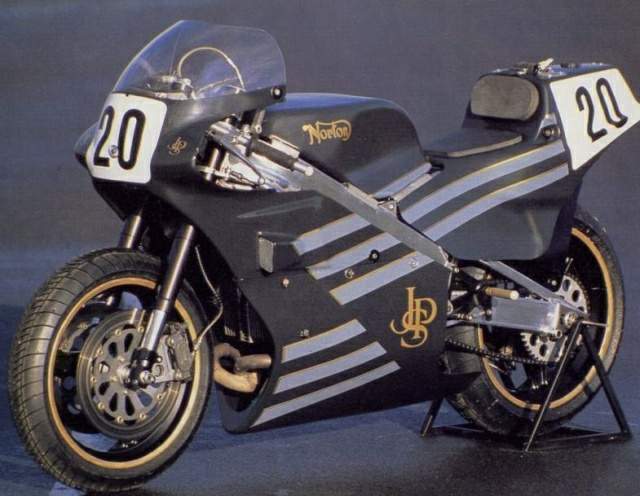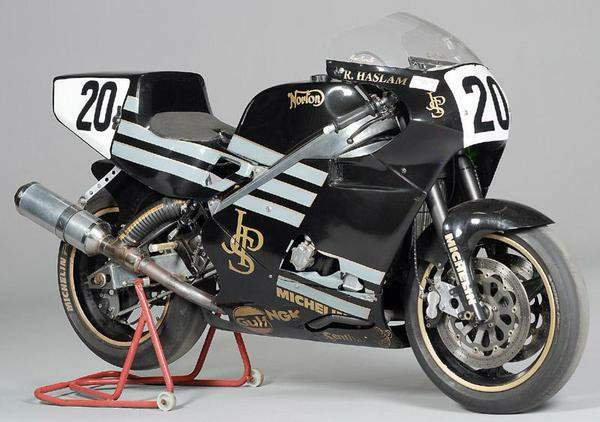
The second 588cc rotary engined Norton race bike, used throughout
the 89, 90 and 91 season.
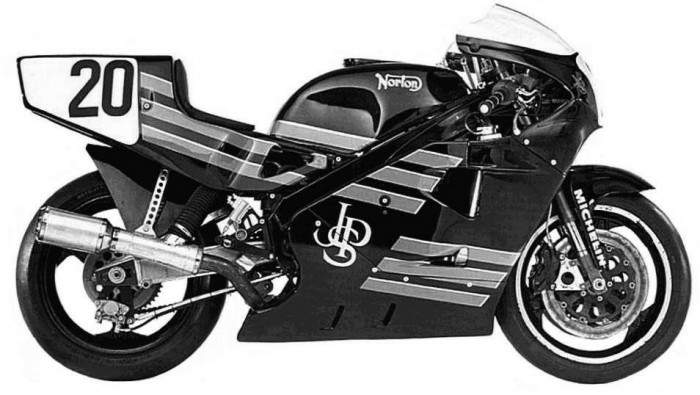
The RCW588 was superceded by the NRS588 in 1991.
Technical Specification
Engine: Liquid pressure cooled twin-rotor rotary
Displacement: 588cc
Compression ratio: 9.2:1
Carburation: Twin amal smoothbores
Ignition: Norton "hall effect" triggered capacitor discharge
Gearbox: Five speed, constant mesh
Clutch: 20 plate "wet" clutch using sintered bronze friction plates and
diaphragm spring
Power Output: More than 135 bhp at 9,800 rpm at shaft
Maximum torque: 77 lbs / ft at 8,000 rpm
Frame: Spondon twin spar aluminium
Brakes: Twin 320 mm front discs with four piston Lockheed calipers. Single 220
mm rear disc with twin piston Brembo caliper
Wheels: 3.5 x 17 three-spoke magnesium Dymag front wheel. 5.5 x 18 three-spoke
magnesium rear wheel
Tyres: Dunlop radials
Weight: Less than 145 kgs
Brian Crighton, a former road racer and motorcycle dealer,
originally joined Nortons in 1984 and worked in the service department before
moving on to research and development. As a former competitor he quickly
realised the enormous potential of the rotary.
I wanted to go racing. But no one wanted to know. I was
convinced that I could up the power from the 92 the best engines were giving
to around 120 and eventually it was agreed that I could work on a racer
provided I did so in my own time and at my own expense - working evenings and
weekends.
Fed up with the lack of interest in his racing project,
Crighton left Nortons in 1986 and went back to his original profession as an
electronics expert in the computer industry. But when Lc Roux took over the
Norton group in 1987, things changed. Crighton went to see him and the South
African agreed to finance a pilot racing scheme. Crighton says:
He let mc have the kitchen in the caretaker's house as a race
and we finally split up. This meant that we had a bike spare for the final
round at Brands Hatch and I invited Steve to try it. He'd never ridden the
rotary before and it wasn't set up for him but when I asked him after
practising if he wanted us to change anything he said everything was fine just
fill it up with petrol! He then went out and won the race. A fabulous
performance.
This late run of successes literally transformed the British
racing scene. Fans at last had something to cheer about and this, coupled with
television exposure, led to John Player stepping in with major sponsorship for
the 1989 season.
The riders for 1989 were Nation and Spray and both the riders
and the bikes were finished in the black, silver and gold colours adopted by
John Player during their Formula One car-racing days. Additional staff were
signed on and Nick Coll is appointed team manager, leaving Crighton free to
concentrate on technical matters. The first major change was to abandon the
air-cooled RC588 in favour of the water-cooled RCW588. Again the 'IT results
were disappointing. In the Isle of Man, Nation teamed with Ireland's Steve
Cull (Spray prefers not to ride in the TT) and both retired from the TT
Formula One Race - Nation when he ran out of petrol and Cull when the gearbox
failed. In the final race of the week, the Senior TT, Nation was in fifth
place on the fifth lap when the water pump failed, while the chain of Cull's
bike broke when he was holding eighth place with just three miles to go. He
pushed home to finish 23rd, and got a great ovation from the partisan crowd.
Following the pattern of the preceding year, the Norton team
really came to the fore after the TT. Roland Brown puts it well in his review
of the British season for Moiocouru.
The story of British Racing in 1989 was undoubtedly the return
10 victory of the Norton. Riding an all-black JPS sponsored rotary (hat
fully lived up to its promise of the season before, Steve Spray roared to win
after win to take two major championships amid much patriotic programme
waving.
The two championships were the British 750 cc TT Formula One
and the MCN/ACU British Championship, and during the season Spray set no less
than nine new lap records at British short circuits. On the surface all was
well, but behind the scenes the team was split by internal politics and petty
squabbles. Unable to keep the peace and to get the team all pulling together,
team manager Collis left at the end of 1989 and was replaced by former Honda
Britain team chief Barry Symmons.
The FI sports roadster was launched at the National Exhibition
Centre, Birmingham in November 1989 with a price tag of over £12,000! A
handsome machine, finished in John Player racing colours, it was powered by an
RCW588-typc engine which produced 95 bhp at 9500 rpm with a compression ratio
of only 9 to 1.
The 1989 racing engines gave between 145 and 148 bhp at 10,000
and were not critical on fuel. In fact the) would run on two-star. We actually
used normal pump four-star and did not have to worry about the very high
octane special fuels that the rival teams now use.
For the team 1990 began well with Robert Dunlop, signed to
team with Nation at the TT, winning the big class at the North West 200 where
he went through the radar speed trap at an incredible 189 mph - almost 20 mph
faster than the best of the Japanese four-cylinder machines! At the TT Dunlop
and Nation finished third and sixth in the opening Formula One race after
Dunlop had set the fourth-fastest lap around the island during practice at
119.74 mph and Nation had overcome the handicap of rib injuries sustained at
Snctterton just before the TT. Then in the Senior Nation rode a well-judged
race in poor conditions to finish second, beaten only by Honda hot-shot Qui
Fogarty. Dunlop retired while holding fifth place when a stone jammed the
throttle open.
It was at the TT that news came through that the FIM had
decided to scrap the handicap imposed on
only to be excluded when the tank was measured and found to be
.7 litre (just over a pint) over the 24 litre maximum.
Commented Nation:" 11 was a flat bottomed tank and under a
full load of fuel I think it bulged and increased the capacity slightly - just
enough to get me excluded. I finished with ample fuel so there was no question
of me running out if the tank had been a tittle smaller.1 In Friday's
Senior TT Nation led the race at Ramsey halfway round the first lap but was
then slowed by a loose exhaust system. This led to overheating aad he
eventually retired when the engine seized at the Bungalow on the third lap.
In lesser events the team had been doing well. Haslam had
captained the British team to a resounding win in the annual UK versus USA
Transatlantic scries, winning two of the three races at Brands Hatch, while
Nation and Dunlop had dominated the North West 200 in Ulster where Nation won
the main event at an average of 120 mph and his Irish team-mate took the
Super-bike event with Nation second.
After the TT the riders switched to the new machines and when
Haslam won on his debut on the NRS588 at Brands Hatch things looked to be
going well as far as he was concerned - though Nation was not so happy. 'The
bike had been developed by Ron and his likes and dislikes when it comes to
setting up a bike are completely opposite to mine. I simply couldn't get on
with the new machine and struggled for the rest of the season,* said Nation
who left the squad at the end of 1991.
A highlight for British fans was when Haslam took twelfth
place in the British Grand Prix at Donington in August 1991 - competing
against the full might of the Japanese teams with their vec-four two-strokes.
The FIM agreed to allow the 588 cc rotary to compete in the 500 cc class and
Haslam rode his normal short circuit machine. Said the team chief Symmons: The
idea was to show the flag and finish the race so Ron paced himself rather than
racing flat out. I^tcr the same day he went out on the same machine and won
the MCN/TT Supcrbikc round, lapping faster than he had done in the actual
Grand Prix.
At the time Haslam was favourite to take the MCN/ TT
Championship but then a string of poor starts cost him vital points. In race
after race the pack roared away while he struggled in mid-field. It made for
incredibly exciting television as he carved his way through the field but cost
him vital points as he was unable to score the outright wins needed for
championship success. Haslam broke six lap records during these epic rides but
could still finish only fourth in the main MCN/TT Supcrbikc series - though he
did climax with a flourish when he set a new lap record at 91.99 mph for the
Brands Hatch short circuit at the final round of the year in October. In the
lesser six-round Supcrbike Championship Haslam was second.
The year ended with two notable happenings. First David
Garsidc's patient development of the rotary engine was recognised with the
award of the MBE and then John Player affirmed their intention to back the
Norton racing project again in 1992 with Ron Haslam as number one, with
support from Ireland's Robert Dunlop who will also carry the Norton colours in
the TT.
In contrast the Norton racing effort ended in a blaze of
glory. The first really major success for the promising rotary-cngmed racer
came at the 1992 Isle of Man TT when Steve n. . ; having a one-off factory nde
on a factory bike with private (not John Player) sponsorship won an epic
battle with Carl Fogarty (Yamaha) to take the senior TT at the record avaragc
speed of 121.28mph - the first TT win for Norton since 1973.
And after John Player pulled out at the end of the 1992
season, during which Robert Dunlop finished second on a Norton m the MCN
Supcrcup senes (Ron Haslam's hopes being dashed by a broken leg) Duckhams look
over as the ma jot sponsor for 1993 and 1994 with Colin Sec ley as team
manager and Brian Crighton as the technical brain.
After a 'shakedown* season in 1993 during which Jim Moodie
finished second in the Bntish Supcrcup senes the team dominated the 1994
cham-piomhip which Ian Simpton won with 319 points to Moodic's (now on a
Yamaha) 287, Phil Borley on the second Norton only three points behind him. At
the end of 1994 See ley had to take stock The Norton racing effort was costing
£200,000 a year and the team had scored 22 wins, 21 second places and ten
thirds. We had some technical help from Norton* but we didn't get a word of
thanks or congratulations from the Aquihms, so when Honda offered us a deal
for 1995 we took it.' And that was the end of the Norton racing effort, the
190mph machine* wheeled into retirement mil the fastest bikes in their class
...
NOTE: Some of the photos on
Motorcycle Specs are owned by somebody. If you see any of your
photos, you can let me know so that I can acknowledge it, or if
you object to it, I can remove it altogether. If any copyright
holder objects to their articles being placed on Motorcycle
Specs, it will be removed upon request. Any correction or more
info on these bikes will kindly beappreciated
Contact MePrivacy
Policy
Website Stats