Air cooled, four stroke,
transverse 90° V-twin cylinder, OHV, 2 valves per cylinder.
Capacity
744
Bore x Stroke
80 x 74 mm
Compression Ratio
Induction
Weber- Marelli electronic injection
Ignition /
Starting
Magneti Marelli electronic digital
Exhaust system
3 way catalytic converter with twin oxygen
sensor
Max Power
37.5 KW 51hp @ 6200 rpm
Max Torque
58 Nm @ 5000 rpm
Transmission /
Drive
5 Speed / shaft
Clutch
Single disc, dry, with cush drive
Frame
Detachable tubular duplex
cradle
Front Suspension
Marzocchi Ø 40 mm telescopic front forks
Rear Suspension
Swinging arm in light cast
alloy with two dampers and adjustable preload
Front Brakes
Single 320mm discs 2 piston calipers
Rear Brakes
Single 260mm disc 2 piston caliper
Front Tyre
100/70-18
Rear Tyre
130/80-17
Seat Height
805 mm
Wet-Weight
179 kg
Fuel Capacity
22 Litres
This represents the entry level model to the range,
more for the versatility of its style than for essentiality in its equipment.
Thanks to the new lightweight and minimalist alloy wheels, the new V7 winks at a
more varied audience than the other two versions, clearly inspired, even in the
chromium plating choices, by the legendary Moto Guzzi bikes of the past. The
plain colour combined with the simple design of the doubled six spoke wheels
enhances the brightness of the chromium plating and the various metallic tones,
providing the whole package with great appeal and modernism, representing the
ideal base for developing new aesthetic personalisations.
The lightweight alloy wheels allowed a reduction of 1440 grams at the front and
860 on the rear, with a consequent drop in gyroscopic inertia of about 30%, an
advantage in terms of dynamics which translates on the road into greater agility
and speed entering turns.
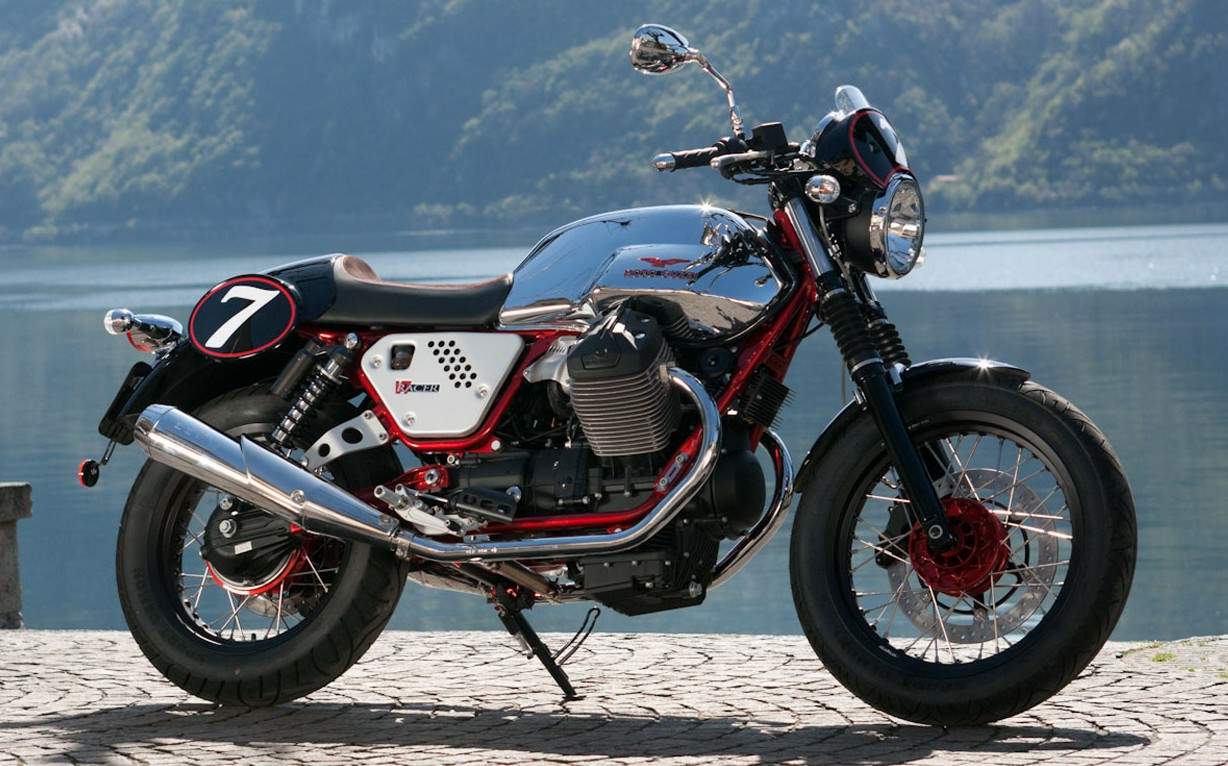
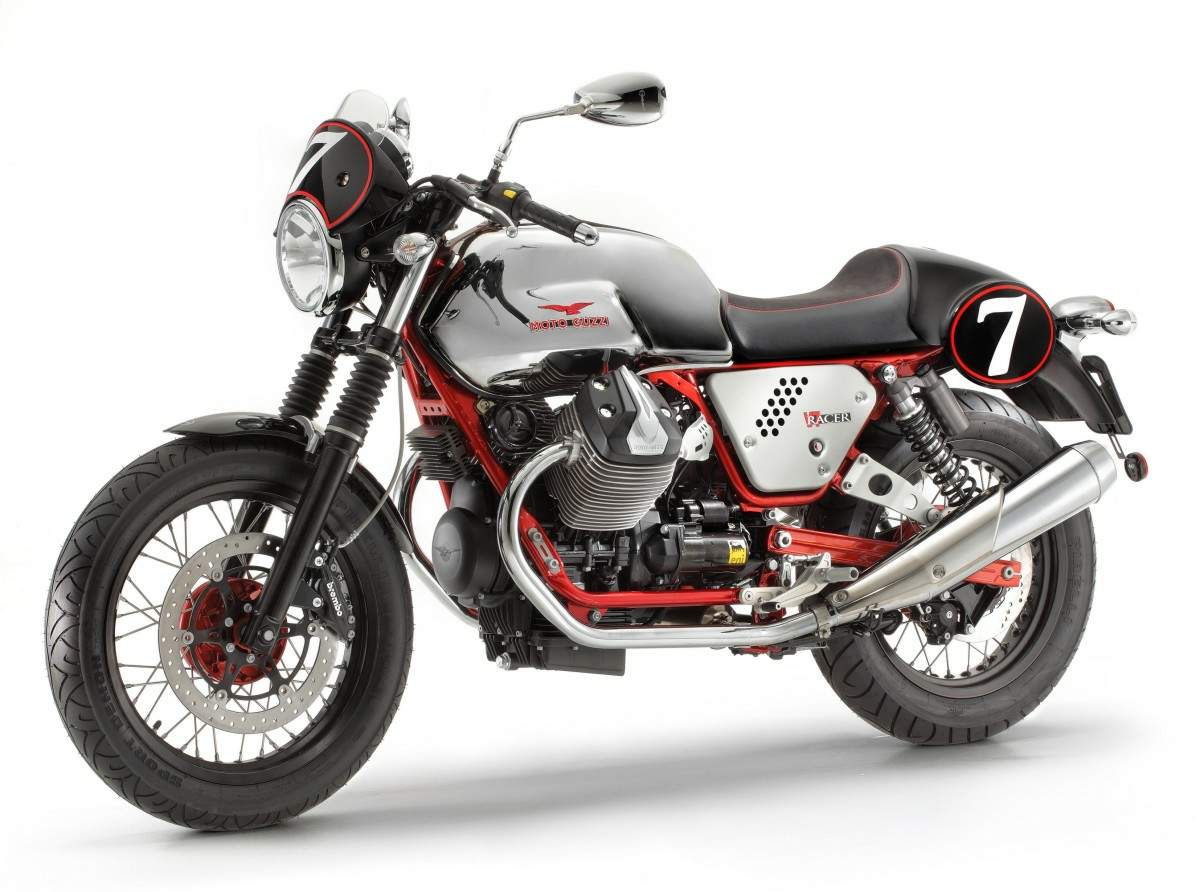
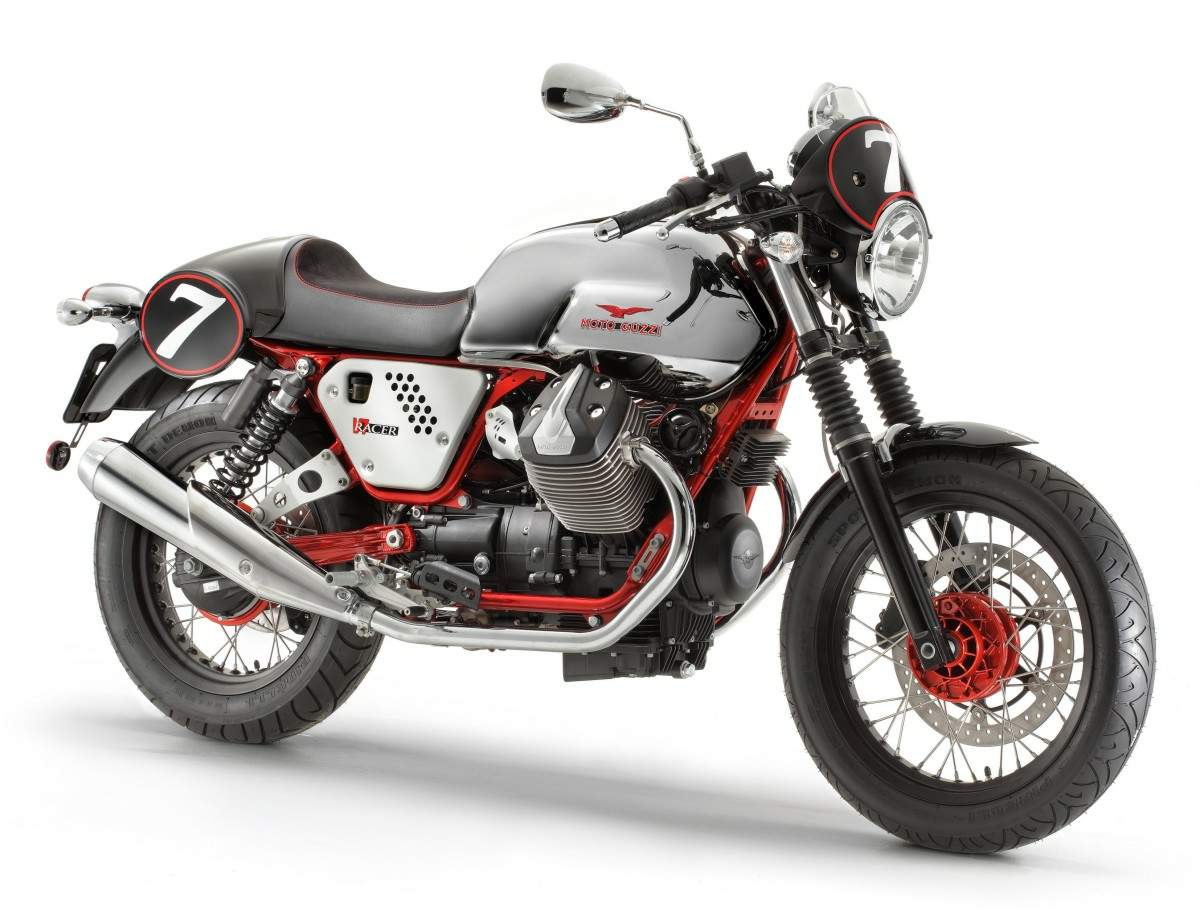
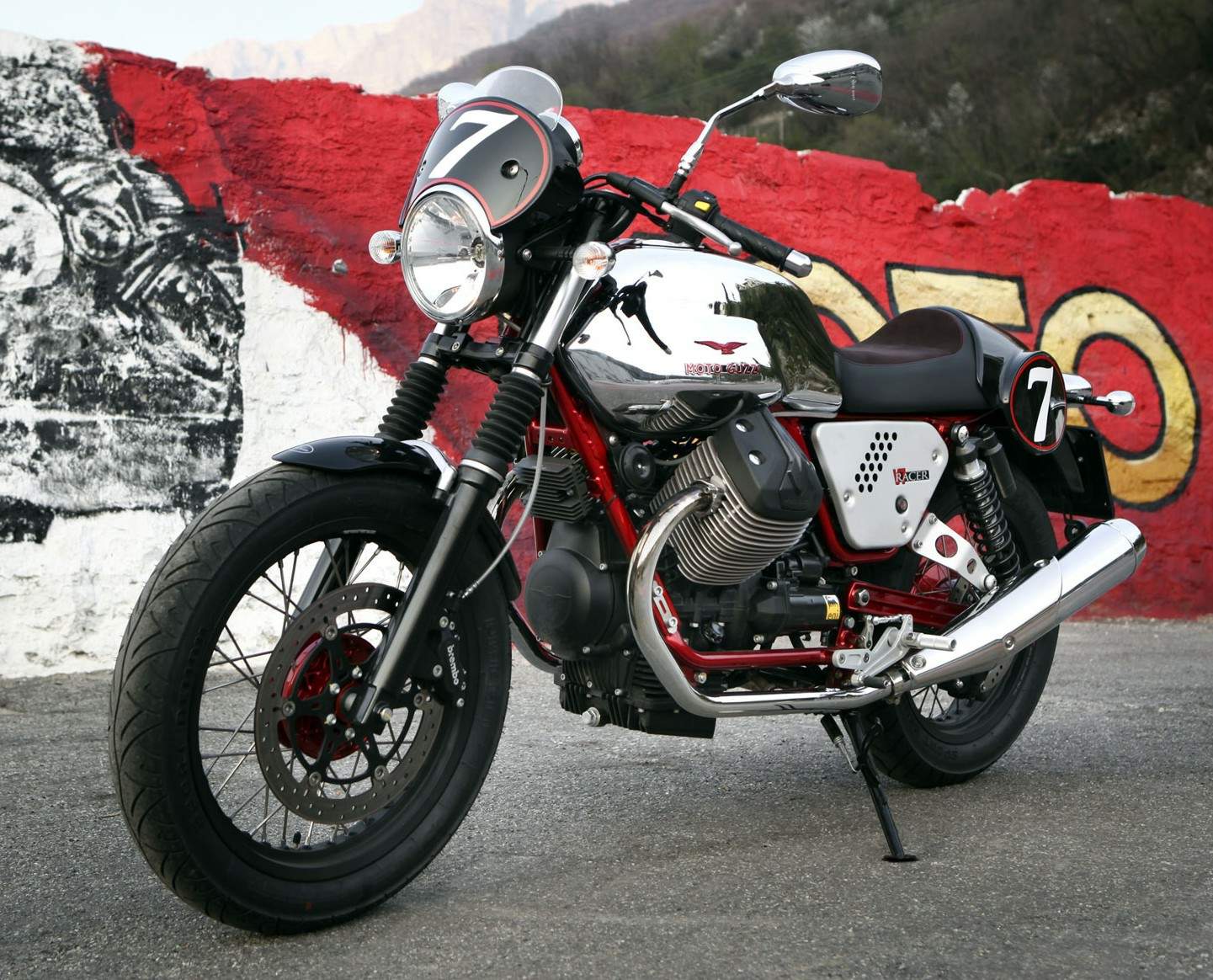
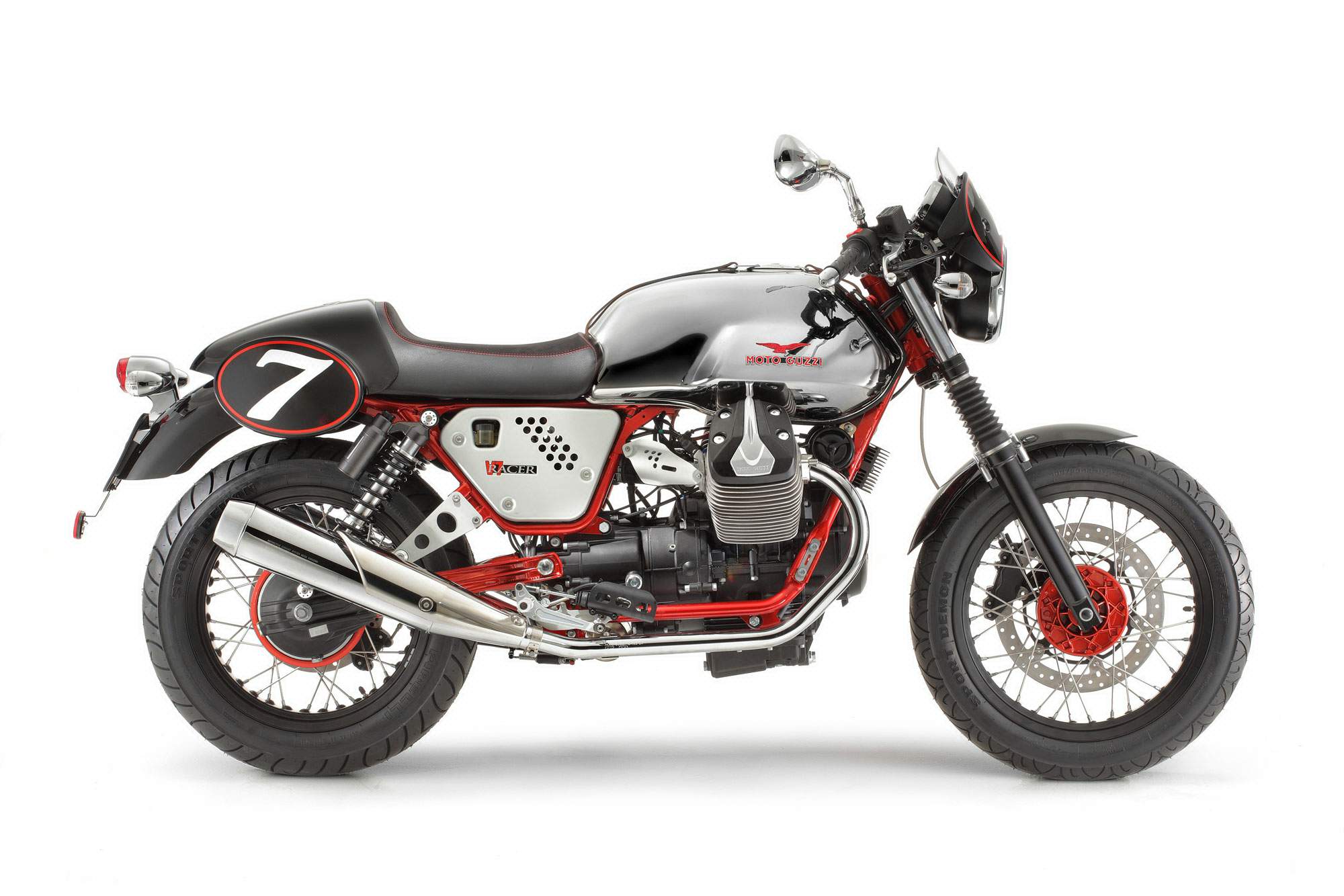
Moto Guzzi V7 Racer:
This is the closest to the original V7 concept, not only because it shares its
name with the first V7 signed by Lino Tonti, but because if faithfully cites the
same riding philosophy, that of a touring bike with sophisticated finishings and
exclusive technical solutions. Just like its ancestor, it is wrapped in a
two-tone colour concept and equipped with precious spoked wheels with aluminium
rims which, as in the case of the V7, contribute to improving the riding dynamic
thanks to the lower weight compared to the V7 Classic. The new engine,
significantly more powerful, is perfectly suited for medium range touring and
contributes to low fuel consumption and greater tank capacity. It provides a
flagship riding range, a role which it can easily interpret once equipped with
bags and windshield, accessories which go well with the overall design of the V7
Racer.
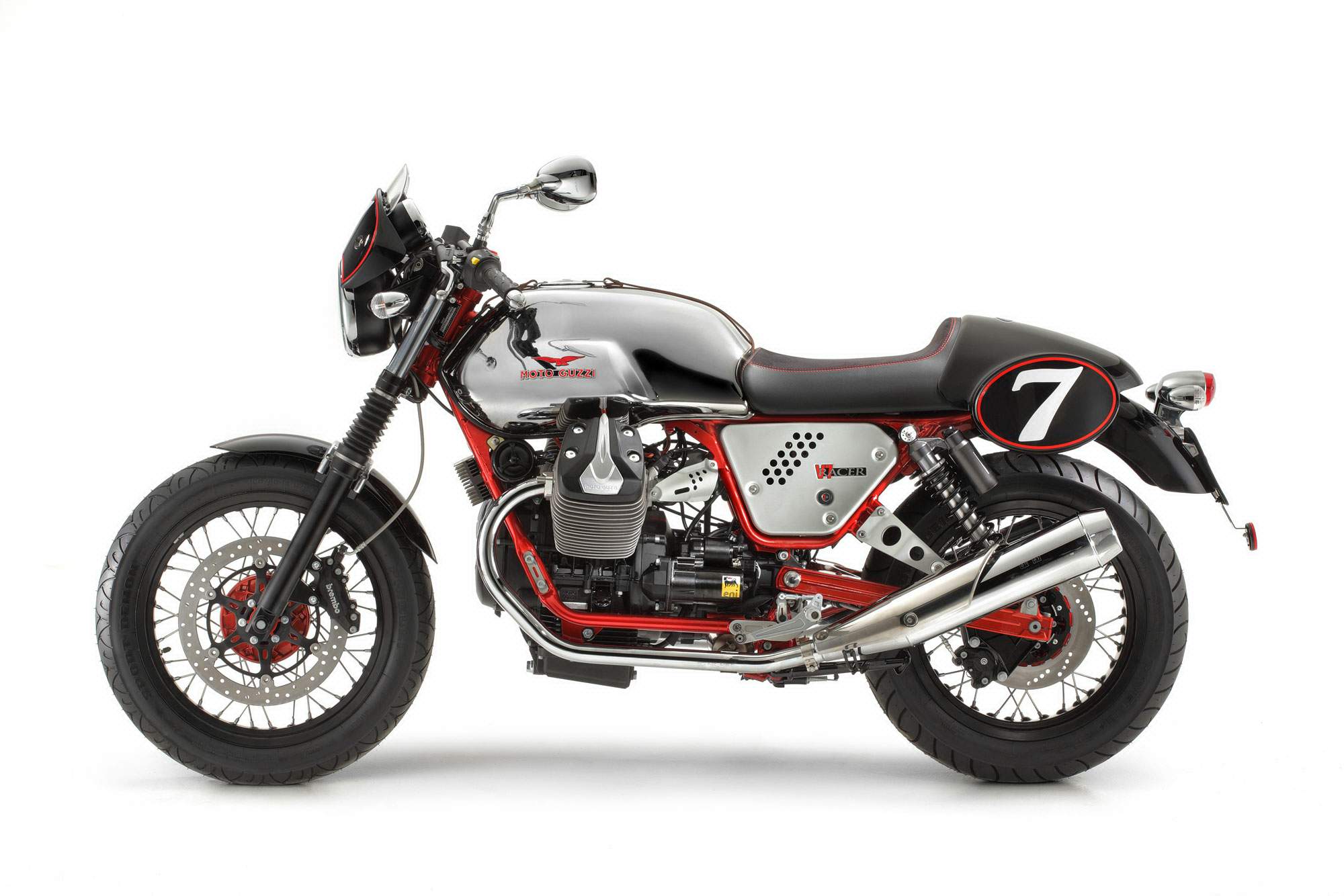
Moto Guzzi V7 Racer:
The Racer is now the only sport version of the V7 and the model in the range
which benefits the most from the two most significant new features: the new
single throttle engine which provides more sporty performance and the metal fuel
tank, further enhanced by the specific chromium treatment for this prestigious
version.
Manufactured in a numbered limited edition as shown by the commemorative plaque
on the steering yoke, the V7 Racer stands out for the executive refinement of
the details as well as the elegant leather strap. This is a clear reference to
legendary bikes of the past, as are the metal accents of the Moto Guzzi badge
which is colour-coded with the frame. The red frame, itself inspired by the
legendary early V7 Sport with CrMo frames, is the result of a special painting
treatment extended to the hubs, wheels and swingarm as well, which accentuates
the architectural purity of the frame.
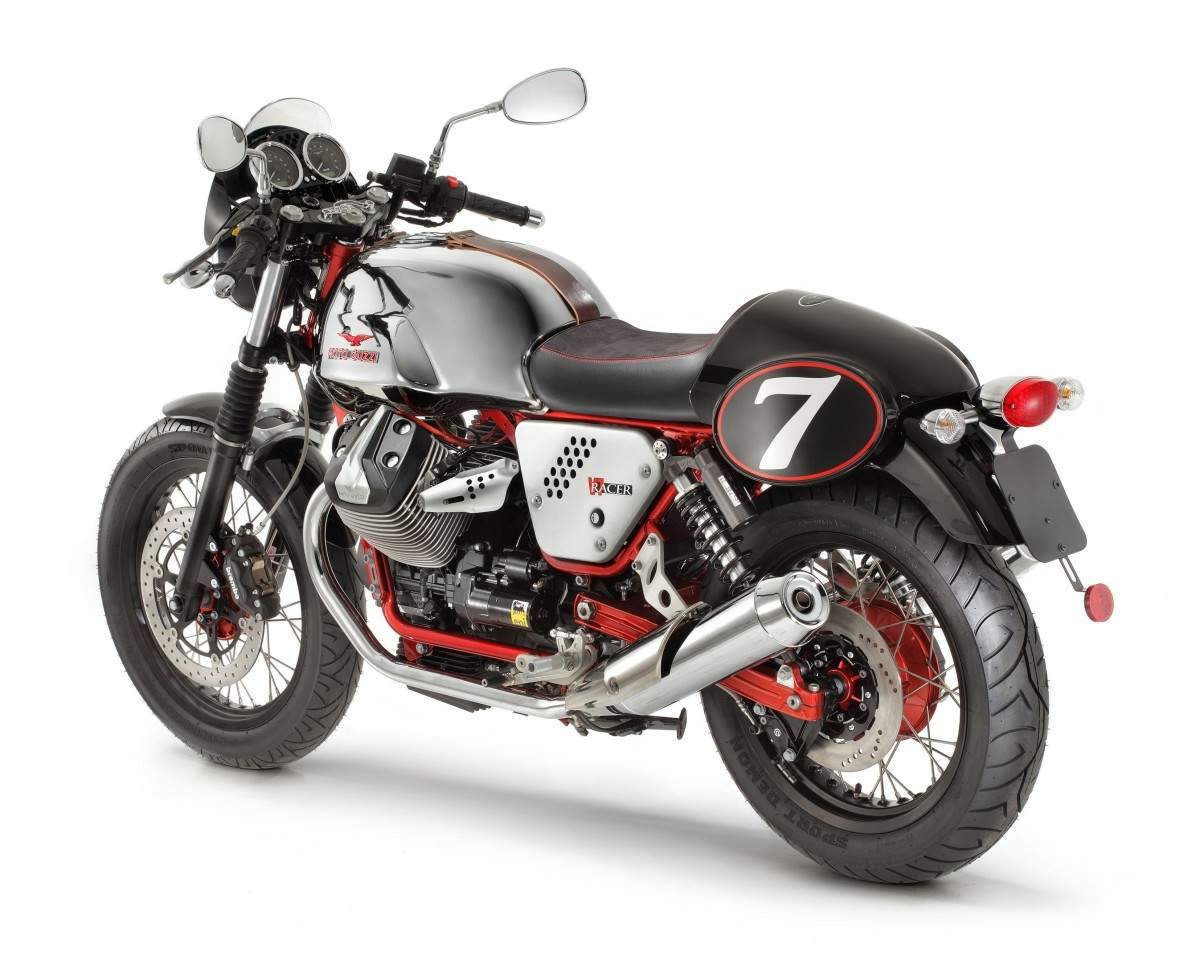
Perched on top of the frame's tubes is an ultra sporty single-seater saddle (a
two-seater saddle and pillion footpegs are available as optional accessories),
upholstered in suede and terminating in an aerodynamic tail fairing that also
incorporates lateral race number panels in true Seventies style.
With its tiny Plexiglass screen above a race number panel, the top fairing - an
exemplary expression of the Guzzi school - cites the front of the legendary
Gambalunga. This unequivocally sporty element is in perfect harmony with the new
design of the front mudguard. One of the most distinctive features of this
unique special edition is the widespread use of brushed, drilled aluminium. This
hand-crafted treatment, which requires superb artisan skill, has been applied to
the side panels, the throttle body guards and the silencer mounting brackets.
Other standout features are the adjustable set-back billet footrests, the
lightweight steering stem and the steering yoke guard consisting of a double
chromed ring, which is so exquisitely crafted that it looks like an ornamental
feature. There is also a pair of prestigious Bitubo WMY01 shock absorbers with
adjustable spring preload in rebound and compression thanks to a 12 click
adjusting knob. This is a bike which should be ridden strictly in black, with a
skullcap helmet and leather studded gloves.
V7 RACER OUTFITTING:
- Numbered limited edition plaque.
- Frame, swingarm and hubs in red finish.
- Chromium metal fuel tank.
- Leather fastener strap along centreline of tank.
- Single-seater saddle in suede.
- Singe seat tail fairing with integrated race number panels.
- Top fairing with integrated race number panel.
- Sports mudguard.
- Side panels in brushed, drilled aluminium.
- Throttle body guards in brushed, drilled aluminium.
- Silencer mounting bracket in brushed, drilled aluminium.
- Chromed upper steering yoke guard.
- Chromed heat shield.
- Front fork stanchion dust gaiters.
Moto Guzzi V7 Racer Model Highlights
V7 CHANGES EVERYTHING TO REMAIN FAITHFUL TO ITS LEGEND.
New engine, revamped design, brand new equipment: the legend of the V7 reaches
its highest expression.
1. THE NEW V7: EVOLUTION IN KEEPING WITH TRADITION.
Created in 2008, the V7 Classic won over enthusiasts with its design inspired by
the famous forerunners, V7 Special and Sport from the seventies, but combined
with the technology and usability of a modern Moto Guzzi. Later on the V7 Cafè
in 2009 and the exclusive V7 Racer the year after contributed to the success of
the V7 Classic, first appearing as a show bike at EICMA 2009 before production
began at the unanimous demand of the markets until it well exceeded the barrier
of 1000 units sold.
These three models completed the range which was able to rekindle youthful
memories for more expert bikers, memories of trips and friendships experienced
in the sixties and seventies, when the motorcycle represented a symbol of
freedom and non-conformism. These values, sustained by a brand that celebrated
ninety years of history, made the V7 a bike which fully expressed the passion
and skill of the rider.
The new Moto Guzzi V7 project begins with an examination of its identity:
elegant, Italian, two cylinder, affordable and with a unique history. In order
to preserve the traits of this personality and project it into the future, the
only path that could be taken was that of totally innovating it within a
perimeter of tradition delimited by its technical specifications and its design
style. This is why we can say that the V7 is a completely new bike, more
powerful, faster, thriftier, more ecological, better refined and more
comfortable than the previous version, and yet still with a cardan shaft driven
90° transversal V two cylinder engine and double frame. That is, the distinctive
elements of a tradition which has its roots in an idea conceived in 1967: the
Moto Guzzi V7 700cc.
2. THE NEW, SINGLE THROTTLE V7 ENGINE.
The original engine design dates back to 1977, the year of the Moto Guzzi 50s
fortunate début.
Since then the engine has been continuously updated, sustaining displacements of
350 up to 750 cc, going from carburetor to electronic injection, but staying
faithful to the genial layout introduced in the original design by engineer Lino
Tonti. Appreciated all over the world for its proverbial reliability and
functional regularity, the small block, after many years, needed a bit more
liveliness at high rpms.
And so, the search for greater performance opened the door to a new design, rich
with innovative solutions that project this engine among the most advanced in
its category with more than 70% new parts, equal to more than 200 new or
redesigned mechanical organs.
This design freshness can already be seen in the layout of the thermal group
which is a summary of the design philosophy for the entire bike: innovation
which respects tradition. And so it is that the square finning, legacy of
production from the 1980s, passed the baton to a rounded shape which is
reminiscent of the first generation of two cylinders from Mandello.
The valves cover is also a homage to the origins of the V7; made in aluminium,
it faithfully covers the profile of the finning, showing off the Moto Guzzi
signature in bas-relief. Another element which is immediately recognisable is
the disappearance of the two intake manifolds and relative throttle bodies: in
fact, the new small block is the first single throttle Moto Guzzi engine.
The manifolds were replaced by a single Y manifold made of rubber, completely
ribbed and straight (diameter of 36 and 39 mm respectively from the injector
groups and the throttle body) which links to a single Magneti Marelli MIU3G 38
mm diameter throttle body.
This is a modern unit which allows two lambda probes to be managed, thereby
obtaining a mixture to the cylinders which is more uniform with consequent
improvement in fuel economy and harmful emissions, besides contributing to the
increase in performance, which was the goal of the entire design. For this
purpose a new head was designed, working on the intake ducts, now larger in
diameter and better linked to reduce losses and increase turbulence, as well as
repositioning the spark plug hole more centrally, thanks to the use of a more
modern plug with d=10mm threading and a prominent electrode.
The squish area and the compression ratio is also increased, thanks to the use
of new, higher performance pistons which increased the ratio by one point, going
from 9.2 to 10.2. In addition to the pouches obtained at the top of the piston,
the bottom of these are completely redesigned to make the structure more sturdy
without increasing the weight. The segments are also new, with more modern
sizes, material and shapes, and they contribute to improving efficiency and oil
consumption.
The general efficiency of the engine stems from the contribution of the new
cylinder finning, greater dimensions and wheelbase which lowered average
operating temperatures, and the new filter casing, redesigned to accommodate the
"breathing" needs of the two cylinder from Mandello.
With this new configuration, the two cylinder from Mandello became significantly
more sturdy in engine torque and above all in maximum power, growing 12% with
higher inclination for spurts and a power curve which expresses its additional
horses already from 3500 rpm.
The transmission has also been revamped, still five speeds, but with a new
pre-selector which has made control more precise, smooth and quiet.
3. DESIGN: SKILFUL ALCHEMY BETWEEN TRADITION AND MODERNISM.
The design of the new V7 tells of the historic lineage of the model through a
mix of forms and volumes which cite the famous ancestors, from the V7 750
Special remembered in the accents and the side panels, to the V7 Sport, which
influenced the tank, the main new feature introduced in the new V7.
A change in look, now more imposing in form and capacity, the new tank brings
with it a superior material perception of metal with respect to polyethylene,
the material which was used to make the previous unit. This is thanks to the
most advanced moulding technologies which allow construction of a metallic tank
which is the same size, but lighter and with greater capacity (22 l) compared to
the previous polyethylene unit. This is further proof of the design philosophy
that guided the entire V7 project where innovation of the processes restored the
pleasure to the rider of gripping a real, resounding metal tank in true Moto
Guzzi tradition.
The rest of the new V7 design confirms that alchemy of tradition and modernism
introduced in 2008 with the first V7 Classic, where, through the generous chrome
trim, enthusiasts will be able to appreciate the cigar shape of the silencers,
the dials on the instrument panel, clearly inspired by the Veglia-Borletti from
the 1970s, the flat and long saddle, with the proud "Moto Guzzi" inscription
emblazoned on the rear part as well as the new valves covers.
The Moto Guzzi V7, iconic and prestigiously manufactured, is now available in
three version, two touring and one sport, respectively the V7, V7 Special and
the V7 Sport. Just like in 1971 when the sport version completed a range made up
of the dominating V7 and V7 Special.
4. THE FRAME: THE CERTAINTY OF THE DOUBLE CRADLE, THE NEW, LIGHTENED WHEELS.
The double cradle frame, with bolted and removable lower elements, is a key
element of the V7 project and it has not undergone any changes compared with the
previous version.
This is a unit of legendary solidity and sturdiness thanks in part to the
headstock angle of 27°50', an angle which ensures stability and directional
precision.
The Marzocchi fork is also confirmed, using 40 mm stanchions and equipped with
dust boots in the Racer version, with 130 mm travel.
Sachs shock absorbers for the V7 and the V7 Special with adjustable spring
preload and offering 118 mm of travel, while the Racer, as usual, stands out
with a pair of refined Bitubo WMT gas shock absorbers equipped with an external
tank. The brake system consists of a 320 mm floating front disc and a 260 mm
rear disc.
The entire range is now equipped with one of two different types of new wheels:
in lightweight alloy with doubled six spokes for the V7, spoked with new
aluminium rim for Special and Racer. A reduction in weight for all three
compared to the previous version which means an advantage in terms of gyroscopic
inertia which translates on the road into greater agility and superlative feel.
The Pirelli Sport Demon tyres which are standard equipment on all three versions
also contribute to the efficient and safe ride.
5. THE ORIGINS OF THE LEGENDARY V7.
The year was 1961 and the success of the mass produced car was radically
reorganizing the motorcycle market. Moto Guzzi, empowered with enviable design
capacity reacted to the unfavourable circumstances by exploring new markets,
from delivery tricars to agricultural machinery and special vehicles - even
cars. For the latter, the genius designer Giulio Cesare Carcano designed a two
cylinder 90° V air cooled engine destined for a sport version of the Fiat 500,
capable of touching 140 km/h.
They liked the new engine in Lingotto, but the annual quantity that Vittorio
Valletta requested exceeded the production capacity of the Mandello del Lario
plant, so the agreement never came to fruition.
Engineer Carcano, however, did not lose heart and he increased the size of the
two cylinder engine to 754cc to use it on the "3X3", a popular, variable track
three wheel drive vehicle destined for the Alpine troops. At the same time a
ministerial tender was launched to provide motorcycles for the Highway Police;
the winner would be whoever could travel 100,000 km with the lowest maintenance
cost. It was the right occasion to place engineer Carcano's two cylinder on a
bike, the Moto Guzzi V7. It was an innovative project that combined the
reliability of automotive standards with a level of comfort and mechanical
affordability unknown to the competition that arose the curiosity even of
foreign police forces, Los Angeles being among the first. The commissioning of
the new V7 began in 1964. The bike had a 703.3 cc engine which developed 40 hp
and it weighed 230 kg. In 1966 mass production began, destined for the police
department and foreign markets, while the next year the V7 was distributed in
Italy at the competitive price of 725,000 lira, much more convenient than the
German and English competition.
6. EVOLUTION ACCORDING TO LINO TONTI.
Giulio Cesare Carcano's creation was perfected by an expert designer who joined
Moto Guzzi in 1967: Lino Toni. Hailing from Forlì, with a great deal of
experience in competitions with Mondial, Bianchi and Gilera, the engineer was
called on by the general manager Romolo Stefani to expand the range of the
maxi-bike from Mandello del Lario. The V7 appeared at the right time, bikes were
coming domineeringly back into fashion almost as a reaction to the conformism of
the car and the market is particularly open to innovations. The first thing
Tonti did was to increase the engine size to 757 and the power to 45 hp to
launch the V7 special in 1969, faster, more refined and elegant compared to the
V7. Then he created, initially for the American market, the V7 Ambassador and
the California, the latter destined to be one of the great Moto Guzzi success
stories. The next milestone coincided with Lino Tonti's masterpiece: the V7
Sport. The designer from Forlì had clear ideas and he set the three parameters
of the sport bike from Mandello: 200 km/h, 200 kg, 5 gears. To reach the
objective he made some changes to the engine, taking the displacement to 748.3
cc and the power to more than 52 hp, redesigning the crankshaft and camshafts,
in addition to placing the alternator in the front in order to keep the vertical
bulk down.
The engine was lodged in a tight, double cradle frame, painted red for the first
200 units made in CrMo and assembled directly in the experience department on
via E.V. Parodi, No. 57. The bike made its début in 1971 and in June of the same
year it participated in the "500 kilometres of Monza" race taking third place
with Raimondo Riva. And this was the beginning of a series of flattering results
obtained in endurance races such as the 24 Hour Le Mans and Liegi races which
would contribute, together with very popular riders such as Vittorio Brambilla,
to making it the most famous Italian sport bike of the 1970s.
7. FROM THE V7 TO THE 850 GENERATION.
Over a couple of seasons the technological evolution which was achieved with the
V7 Sport Moto Guzzi was also transferred to the rest of the range. The new
frame, the four pad front brake and the five speed transmission introduced on
the V7 Sport represented, together with the increased engine size, the primary
innovations of the V850 GT, a model which would mark the retirement of the lucky
V7 Special in 1973. The Sport would also lose the famous alphanumeric name,
replaced in 1974 by the Moto Guzzi 750S. The last model to give up the glorious
alphanumeric name was the V7 850 California, which would not pass the baton to
the new 850 T California until 1976.
NOTE: Some of the photos on
Motorcycle Specs are owned by somebody. If you see any of your
photos, you can let me know so that I can acknowledge it, or if
you object to it, I can remove it altogether. If any copyright
holder objects to their articles being placed on Motorcycle
Specs, it will be removed upon request. Any correction or more
info on these bikes will kindly beappreciated
Contact MePrivacy
Policy
Website Stats