|
|
|
|
Classic Bikes
Custom Bikes
Individual
Racing Bikes AJP
AJS
Aprilia
Ariel
Avinton / Wakan
Bajaj
Benelli
Beta
Bimota
BMW
Brough Superior
BRP Cam-Am
BSA
Buell / EBR
Bultaco
Cagiva
Campagna
CCM
CF Moto
Combat Motors
Derbi
Deus
Ducati
Excelsior
GASGAS
Ghezzi Brian
Gilera
GIMA
Harley Davidson
Hero
Highland
Honda
Horex
Husaberg
Husqvarna
Hyosung
Indian
Jawa
Kawasaki
KTM
KYMCO
Laverda
Lazareth
Magni
Maico
Mash
Matchless
Mondial
Moto Guzzi
Moto Morini
MV Agusta
MZ / MuZ
NCR
Norton
NSU
Paton
Peugeot
Piaggio
Revival Cycles
Roland Sands
Royal Enfield
Sachs
Sherco
Sunbeam
Suzuki
SWM
SYM
Triumph
TVS
Ural
Velocette
Vespa
Victory
Vincent
VOR
Voxan
Vyrus
Walt Siegl
Walz
Wrenchmonkees
Wunderlich
XTR / Radical
Yamaha
Zero
Video
Technical
Complete Manufacturer List
|
Moto Guzzi V 50III
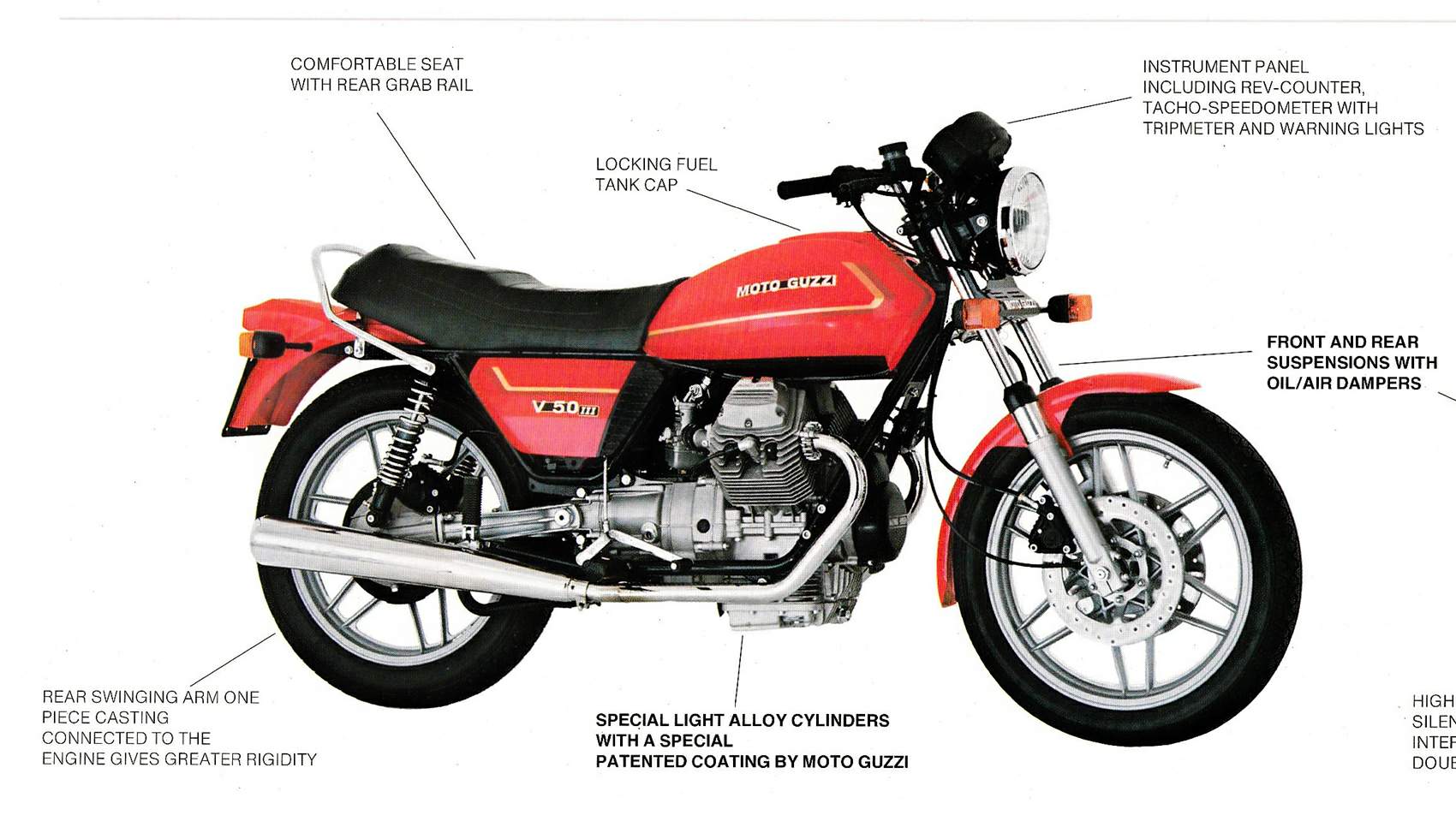
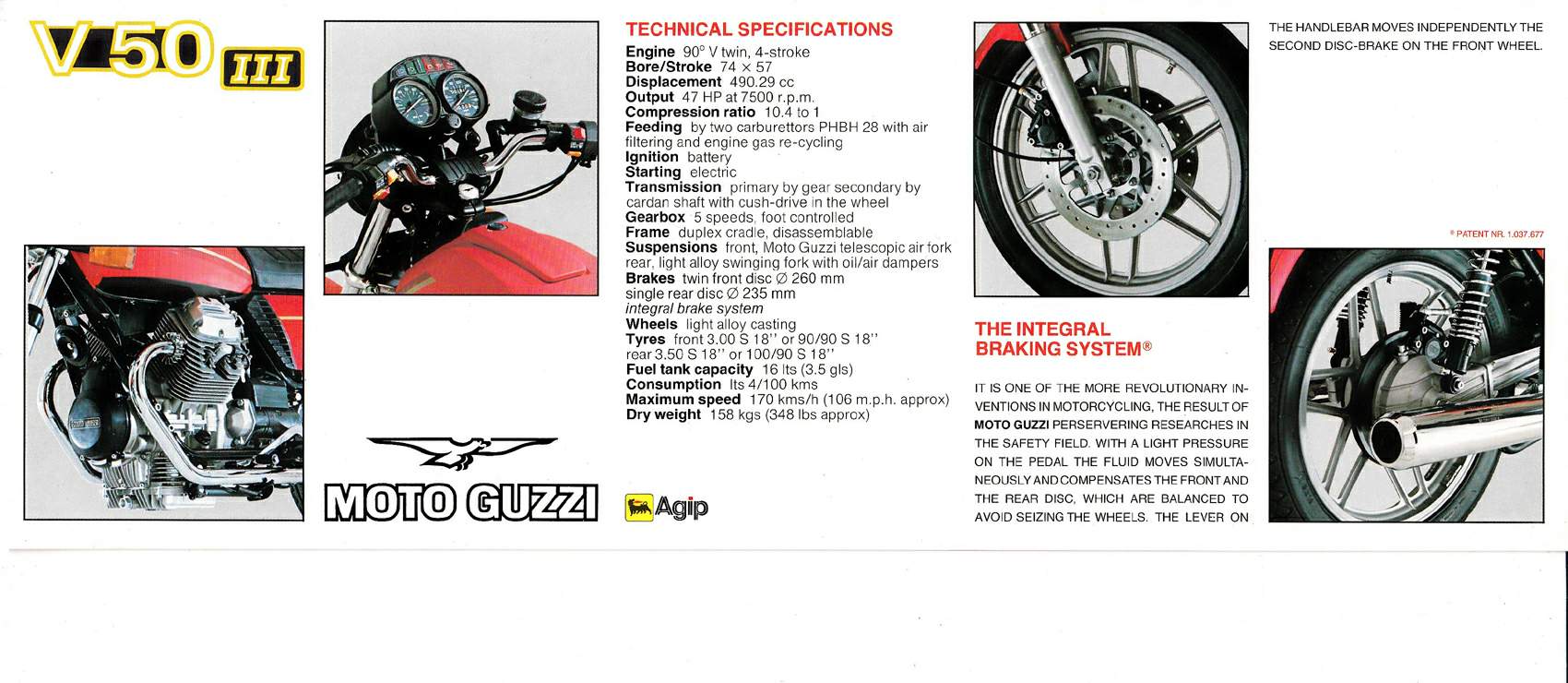
LIVING WITH A BIKE AS SMALL AND pretty as Moto Guzzi's new V50 Monza should have been dead easy, especially as it tended to attract torrents of attention whenever and wherever I stopped to rest its mere 360-odd pounds on the prop stand. Strangers; men who'd given up riding many years ago, would limp across to admire the Monza's lack of rocket thrusters (for lifting excessively heavy bikes from rest) or hydro-assisted servo retarders (for stopping same), or to comment on its sheer Italian elegance. Unfortunately, there was also always some scruffy smart-arse who'd look pityingly at the little 500 and say: 'Bit slow innit?' It was a refrain I'd heard before — the first time from a guy trying to sell me a really exotic V-twin 500 (Spell it Pantah) but if /was blind to the £700 price differential (£900 on a Duke not pre-registered to beat the last budget), my bank manager wasn't. And anyway, how slow is slow? Around 1 lOmph isn't an unrespectable top end for an ordinary-priced 500. The Monza certainly isn't terrifyingly quick but Guzzi have never pretended their V50s should be labelled: 'Heroes and half-wits only.' But when a bike gets a reputation for being slow, it sticks like a leech. Back in 1978, the solitary V50 Mkl tin warthog which made it into the UK struggled up to 100 point nought nought miles an hour and called it a day. Seeing as the price was said to be £1,750, and seeing as the V50 was a brand-new line from Guzzi and it was Italian, it was therefore supposed to Exotic (ie not Brit or Jap), Expensive (half-wits and heroes could have a GS1000 for the same money) and everything with goes with the first two. Which is fast. Which it wasn't. Guzzi got round the problem of trying to convince people that everything which was red and Italian wasn't necessarily a Ferrari by bringing in the Mkll V50, which tended to be blue, wasn't any faster but only cost around thirteen hundred notes. As far as appearances went, they still looked like warthogs to me but lots of the world's smaller inhabitants found the diminutive 500s an acceptable alternative to large, heavy, competitors like Honda's CX500. And then came the Mklll. Newer, faster, and (in the case of the Monza) much prettier. Its powerplant is built by famous Italian robots and the whole V50 has benefited from more of the constant up-dating De Tomaso and his gang are carrying out on the 10-year-old design. Altogether, there are more than 160 new numbers in the Mklll V50 parts list but major changes to the motor concentrate on the ignition and breathing in order to bring the Monza's output up to 48bhp — four more horses than its immediate ancestor, the Mkll The Dell'Orto carbs are now of 28mm choke in place of the former 24mm jobs; inlet valves have also grown 2mm to match. As well as helping the 490cc 90-degree twin to suck through more gas at high rpm, these changes, coupled with a lowered compression ratio 10.8:1 to 10.4:1, are said to improve the Guzzi's tractability at lower engine speeds. The most surprising change is the switch from electronic ignition to contact breakers — seemingly a retrograde step at a time when point ignition is being abandoned wholesale by everyone else. But according to Coburn and Hughes' service manager, Dave Martin, the factory found that fitting contact breakers scrounged from the Benelli line improved the mid-range flat spot suffered by earlier models. Only differences between the Monza and its 'touring' sister MklII, apart from the styling, are in the pipes — the Monza's less restrictive zorsts give it an extra hp or thereabouts and in the gearing. A taller primary drive gear on the sporty one give extra mph, or so they say. Talking of drive, Guzzi claim to have eradicated the problem of shaft drive oilseal failures by bringing in new assembly procedures. All the tech-talk gets forgetten, though, when you get round to approaching a fire-engine red Monza and swinging a leg over the narrow Le Mans lookalike seat. Smallness is the overwhelming impression. It's just a touch over two feet wide, 31 inches from bum to ground and weighs-in at a mere 3641b complete with half a tank of fuel and a full load of lubricants. Starting would appear to be an art requiring long practice. A cold-start lever lives under the left-hand intake stub and you can have it on or off, nowhere in between. According to the book, you pull on the cold start tab, pull in the clutch lever, give the throttle a couple of squirts and thumb the awkWardly placed starter button. If you are rewarded with a burst of life from either pot, good luck. There is then a juggling act to perform with throttle and start lever to keep the thing turning until both pots are truly alight. Woe betide anyone who gets it going on a cold(ish) night and then lets it die. It then takes a lot of persuading back to life. Luckily the battery stood up well to prolonged starter motor treatment — just as well because there's no kickstarter. Once running, the pipes emit a melodic burble until you boot it into first gear and give it a handful of throttle, whereupon it gives out a soulful growl, rising to a near-wail. Ears used to the flat splutter of oriental twins may find the Monza loud but when we noise-tested it at MIRA, it clocked up less than half the noise output of a GPZ1100 or an XS1100 — big bikes, 'tis true, but neither renowned for rorty exhaust notes.
What quickly impressed me both at home and during a brief ride on the Monza in Italy was the relaxed way it gathered speed. Running the tacho needle up to around six grand before changing up made for unhurried-feeling acceleration, but glance at the speedo expecting to see about 45mph and like as not you'll discover the needle climbing purposefully past sixty. The Monza didn't mind being ridden down to about 2,000rpm solo, and though it felt sluggish pulling away, the speedo needle would wind round the dial pretty quickly. Two-up riding generally called for downshifting before 3,000rpm. So relaxed was the Monza's style of progress that I became convinced the speedo was telling me blatant lies. Strolling down the motorway, two up, the bike was rock steady and felt as though it was hardly moving, yet the Veglia clock was reading 85mph. Couldn't be. But a check on the speedo at MIRA proved that the bike had been doing at least 82. A combination of factors help fool you about cruising speeds. The handlebar fairing does its job really well — so well that we only recorded a 3mph difference between top speeds sitting up and prone. Deflected air strikes the rider's face but there's little turbulence and none of the wind pressure on chest and shoulders which can make prolonged high speed riding real Hell. Engine and exhaust noise dies away at constant speed and there's hardly any vibration, so the bike feels happy to lope along at all but its highest speeds in a reassuringly unburstable fashion. Last, but by no means least, is the stability factor. The Monza never reaches a point where you start worrying it'll do something silly if you have to make a sudden move at more than 70mph. After several fairly long motorway hauls, it was clear it'd roll along at a rapid pace without feeling nearly as busy as you'd have expected in such a small bike. But there's no question that it's heads-down no-nonsense solo ear'oling that the Monza's best at. Its power-to-weight ratio makes it a real joy in back road twistery. You can shoot into bends as fast as you dare, only to find the Monza could have gone faster and by the time anything on the V50 touches down, you've already fallen off. Maybe one day I'll adjust to the helpless horrors frequently encountered when trying to push a heavy multi through even reasonable twistery, but until then give me a bike like the Monza every time. It lets you know that you are in control — you can even change your mind about your course when you're cranked right over in the middle of a bend. Guzzi's excellent linked braking system which apportions pressure 75/25 per cent to left front and rear discs each time you tramp on the foot lever helps a lot. It is almost impossible to lock the back.wheel, while in situations calling for very heavy braking, the handlebar lever feeds the other front disc into the equation. The Brembo discs lagged in the wet, though, and of course they go rusty at the drop of a hat in the rain but who cares, the system is just so good. In traffic, a bike as small as the Monza is perfect for nipping in and out of gaps, slipping up between all but the most closely spaced lines of queue-bound four wheelers. Unfortunately, the test bike exhibited a tendency to stall too easily throughout the test, and it sometimes followed up this act by obstinately refusing to start while holding up the line of vehicles I'd j ust nipped past. Most embarrassing. Never mind. The Monza's so light that I simply picked it up an placed it on the pavement with one hand while laughingly explaining to irate motorists that I just wanted to show them the new Moto Guzzi. You don't believe me? Six and a half feet tall readers and 18 stone food lovers will probably need no reminding of the problems arising from teaming big bikers and small bikes, and riders much bigger than l'il ol' average (5' 10") me should try out their porportions on a Monza before rushing into ownership.
The dropped bars and high-set footpegs make for a comfortable rising position but one which leaves not a lot of daylight twixt elbow and knee. With this last point in mind, I entertained a few misgivings about taking the Monza on a two-up trip to Wales to celebrate my birthday in the town they named before me. Would there be enough carrying space? Would there be room for two? Would it make the trip in one piece? The answers were no, no and no but things weren't as bad as that sounds. Our average-sized throwover panniers proved too big to cope with the narrow seat and its close relationship to the upswept silencers, resulting in our taking merely what we needed in a tankbag, rather than what we thought we needed. Janet, that's my girlfriend, pronounced the seat firm but comfortable but the pillion footrests were a bit too high (not that there's room for them anywhere else) and she was glad of a break to stretch her legs every 50-60 miles. Only the brave should attempt long, non-stop, two-up dashes on a Monza. On the motorway, the bike quickly wound up to a happy 80 or so but on the single carriageway roads past Oxford it was necessary to make full use of the gears to keep the motor spinning around six grand to maintain steady progress against hills and headwinds. In traffic moving at 50-60mph, the bike felt happier and more responsive in fourth gear, top gear being better for steady cruising at 65mph or more. Overtaking lorries and coaches safely two up was definitely not a fifth gear job. At best it was a fourth cog do, often a third, but once past six and a half grand, the tacho needle dived for the 8,000rpm redline, making for entirely acceptable, if not exactly shattering, acceleration. It rained on and off all the way to the Wye Valley, our first stop, but the Michelin M38 tyres coped with wet and damp roads as well as they did dry ones. It was only after I'd been out for a highly illegal attempt to find out how fast the bike could go that a friendly Monmouth dealer pointed out that the M38s were only 'R' rated; i.e. up to 95mph. The rating actually refers to sustained high speed suitability but it may be a hint as to what kind of sustained high speed Guzzi think their V50s should be held at. Over the next three days, the Monza was subjected to a pretty gruelling tour of the Forest of Dean and the Brecon Beacons on all the most hilly, tortuous back lanes we could find. Pulling up long, steep, winding hills and dropping down badly surfaced tracks, littered with gravel, loose stones and sheep shit, into damp misty valley bottoms, it never missed a beat or put a foot wrong. The linked braking was a godsend in wet, loose-surfaced corners, though when unfamiliarity led me to grab the handlever alone in one emergency involving a fluffed getaway and a pushy bus driver, the weak response was nigh disastrous. The first problem we suffered on the trip was with the air suspension. When I first came across the Guzzi suspension, it was with a surge of approval that I eyed the note on the sealed-air-chamber teles and rear shocks to the effect that recommended pressure was around 40psi front and rear. This seemed such a good thing compared with the fiddly Japanese systems running at about lOpsi, which drop dead if you wave a garage air line under their nose, that I thought air suspension had come of age. Unfortunately there was no way the Schrader valves on the Guzzi forks would accept the connectors on either the bicycle pump or air lines we tried on them. Unless you can find some way of getting an extra O ring seal into the airline connector, it won't make a proper seal on the shock valve and you can't get enough air in. Ordinary common-or-garden pressure gauges present a similar problem. This became clear when I attempted to establish the suspension pressures and merely succeeded in leaving myself with none. Losing the air reduced the springing, giving a flat, soggy feel to the handling two-up and transmitting jolts through the frame to rider and passenger, while it wobbled and weaved — though not seriously — under acceleration and braking when ridden solo. Landlines between South Wales and Luton buzzed with reverse charge telephone calls and it was eventually suggested that the forks and shocks should be pumped up to about 120psi and then the connector should be whipped off double quick in the hope that some air pressure would remain in the sealed chambers at the top of the forks and the bottom of the shocks. 120psi!?! Apply a dose of that to your Kawa's teles and the rest of the bike would shoot up into the air and fall over on its side, dead. Anyway, the deed was done and the ride and handling improved to the point where I got quite daring when we got back and I took the Monza out for some serious ear'oling. When I took it back to Coburn and Hughes, Dave Martin checked the suspension with a Suzuki air shock gauge (price: £6.05) and found the offside fork leg and nearside rear shock were up at around 50psi and the others were all but empty. You know, if that's all the difference air springing makes, I can't see why they bother. Has anyone ever complained about Italian suspension before? On the M4 coming home at the regulation 85 per, I notice a thin coating of oil spray appearing on my left boot. Investigation traced this to a slight leak round the tacho drive take-off. Funnily enough, the oil didn't consistently find its way on to my boot. Some days it would appear, others not. Perhaps due to the intrigue going on down on the left hand side, I failed to notice until it was too late that my other Derri boot was touching the right hand pipe. There are no heat shields on the exhausts but I think I can fix the hole in my boot with Araldite. Finally, just when I was preparing to be totally impressed with the Monza's resilience over nearly 600 of the sort of miles it didn't look like it was designed for, the thing broke down. Well, nearly. What happened was the nipple broke off the twistgrip end of one of the throttle cables. Fortunately there is a separate cable for each carb and the effect was merely to convert the Monza into a 245cc single, three miles from home. I have to admit that a bike which gets you that close to home before playing up shows real class— made quite an acceptable single, too. The only other bit which malfunctioned during the test was the barometer — sorry, rev counter. The tacho needle developed a habit of getting stuck around the 2,500rpm mark as the engine slowed and I had to give the dial glass a sharp tap to get it to read properly or settle on its rest. Speaking of reading properly, the Veglia tacho is marked up in rpm x 100 — i.e. it looks like a speedo dial. Should you get a pull for doing 60 in a 40mph limit, you could always point at the tacho and feign dyslexia. Probably won't help you much but it's the thought that counts. The rubber hood on the end of the propstand fell off but it wasn't missed. The propstand is of the self-retracting type which is hard to get down when you're astride the bike, and it's positioned so far forward you have to be really careful where you use it or the bike pivots on it and falls over. The Monza is so easy to get on to its centrestand that there's no excuse for not using it. By the time I received the bike (it had done about 950 miles) the rubber on the centrestand tang was half melted away by contact with a hot silencer. A neat touch is a lever hidden away in the fairing which allows you to tip the rectangular H4 headlight downwards to counteract the effect of carrying a pillion. The light gave a good cut-off on dip, combined with a wide spread, and excellent penetration on main beam. Headlamp adjustment was by two long screws at the rear of the unit; one for vertical adjustment and the other for horizontal. There wasn't a small enough spanner in the toolkit to fit the screw head, but it was possible to turn them with the pliers. Necessary, too, because a real blindo madam in her four wheeled shopperette ran over the front of the bike before I collected it, wreaking havoc with the fairing. The damage had been largely patched-up by the time I got the bike but the first time I turned the lights on, it was pointing to the green, green leaves in the treetops. Owing to a typical case of Post Office paralysis, we found ourselves hastily bolting new throttle cables by the trackside at MIRA and the Monza went out on its top speed runs without benefit of a carburettor check. The speedo needle would just creep up to 110, giving a true figure recorded in the checkout panel of just over 107mph. In Wales, I once saw just under 115mph on the clock, probably a true 110 or so — so Guzzi's claim of a 109mph top end looks like it'll stand. So is it slow? Well, yes — if all your mates have bikes capable of cruising all day at a ton-ten, and licences to match. It's no blitzkreig-quick buzzbomb capable of meeting the cravings of terminally-crazed adrenalin addicts, either. The only excitement you'll maybe get is from little wobbles at high speeds stemming from insufficiently-braced forks. But if you want a bike which is a hell of a lot of fun to ride, fairly economical — Guzzi claim 60mpg, I got between 52 and 57 from the 3 Viz gallon tank, two-up — and which will set you back no more than the price of yer average Jap 650 and a lot less than any other European 500, the Monza's worth a try. It's not a boy racer's bullet and slick-shifting up through the gears just won't work with the single-plate clutch and a gearchange which often needs force eight welly application to effect a cogswap. Me? I'd like a Pantah same as anyone else, but all things taken into consideration (monetarism, interest charges, staff writer incomes etc), I'd be more than happy to take this quiet Italian if that's where my price ceiling lay. Source bike 1983
|
|
|
Any corrections or more information on these motorcycles will be kindly appreciated. |