|
|
|
|
Classic Bikes
Custom Bikes
Individual
Racing Bikes AJP
AJS
Aprilia
Ariel
Avinton / Wakan
Bajaj
Benelli
Beta
Bimota
BMW
Brough Superior
BRP Cam-Am
BSA
Buell / EBR
Bultaco
Cagiva
Campagna
CCM
CF Moto
Combat Motors
Derbi
Deus
Ducati
Excelsior
GASGAS
Ghezzi Brian
Gilera
GIMA
Harley Davidson
Hero
Highland
Honda
Horex
Husaberg
Husqvarna
Hyosung
Indian
Jawa
Kawasaki
KTM
KYMCO
Laverda
Lazareth
Magni
Maico
Mash
Matchless
Mondial
Moto Guzzi
Moto Morini
MV Agusta
MZ / MuZ
NCR
Norton
NSU
Paton
Peugeot
Piaggio
Revival Cycles
Roland Sands
Royal Enfield
Sachs
Sherco
Sunbeam
Suzuki
SWM
SYM
Triumph
TVS
Ural
Velocette
Vespa
Victory
Vincent
VOR
Voxan
Vyrus
Walt Siegl
Walz
Wrenchmonkees
Wunderlich
XTR / Radical
Yamaha
Zero
Video
Technical
Complete Manufacturer List
|
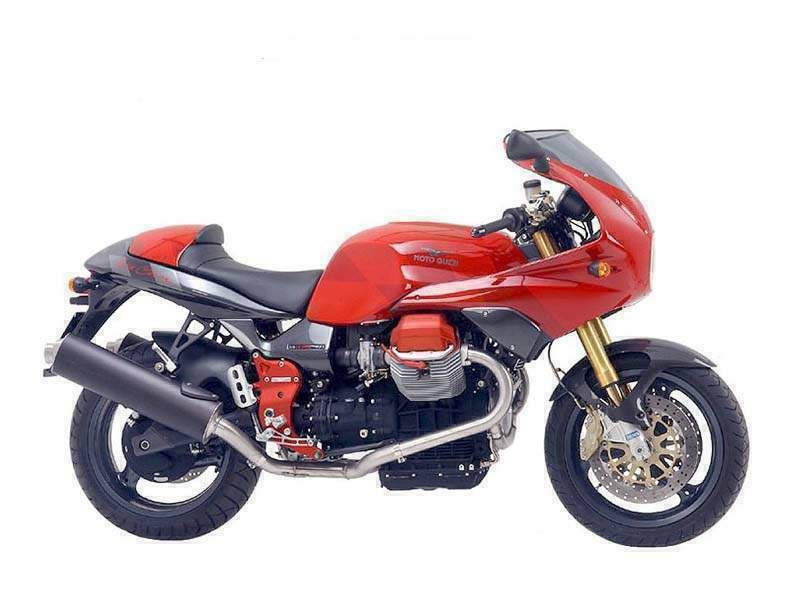
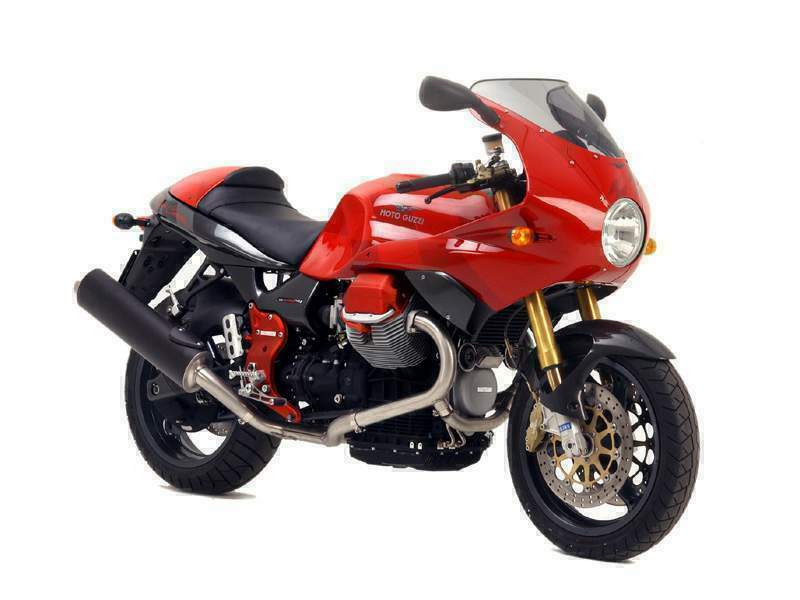
Moto Guzzi V 11 Le Mans Rosso Corsa
Most people are more likely to think Mandello del Lario is a new antipasto special at Locanda Veneta rather than the home of Italy's oldest motorcycle manufacturer. Even a well-informed sophisticate such as yourself might not know that Giorgio Ripamonti and Carlo Guzzi built their first bike in 1920. You might be more surprised to learn that their first engine was a double-overhead-cam, four-valve, 500cc, four-stroke single—steamy stuff at the time Woodrow Wilson lived in the White House. If you couldn't care less about any of that, you probably really don't care about Guzzi's Rosso Corsa—the latest in a celebrated line of sporting Le Mans V-twins going back to '75. You would very likely recommend counseling for anyone willing to lay down $13,990 for this 557-pound, 1064cc, air-cooled, 80 rear-wheel horsepower and 65 foot-pounds of torque pushrod twin. You probably don't get it. But to any true Guzzisti, it's just the natural order of things. We find ourselves somewhere in the middle. As Guzzi's current top-drawer sportbike, the Rosso has a certain undeniable panache to well-schooled students of motorcycle sport. It has plenty of the Right Stuff. Educated eyes spot Öhlins suspension and Brembo calipers at both ends. We see those bits, too, but could do without the checkered-flag graphics for the same reasons we don't need to see Hillary Clinton in a thong. Oblique racing affectations aside, modern, less soulful combatants such as Suzuki GSX-R1000s and Ducati 999s put this thing a lot closer to a sporty sport-tourer. Ergos are classic Italian, accommodating riders with long arms and short legs most comfortably. Everyone else needs to deal with it. Approached with the Guzzisti's necessarily forgiving nature, the Rosso is reasonably easy to live with. An "anti-tip-over valve" designed to cut fuel flow if the bike tips over keeps air from getting in, too, creating a vacuum that made opening the filler cap somewhere between difficult and impossible. Once it's disconnected, as any late-model Guzzi owner already knows, there are no worries. The fuel-injected twin wants its enriching lever pulled all the way back and a handful of throttle before lighting. When it does, the same whirring, clanking, whining, chuffing and shuddering that delights ears accustomed to the longitudinal V-twins can convince CBR600 owners that something is horrifyingly, expensively and inexorably wrong. Fear not. The stock engine is understressed, overbuilt and spectacularly durable. The longitudinally oriented crankshaft torques everything stage left when you blip Mr. Throttle at a stoplight. However, get moving and you'll never notice. A determined pull on the left-hand lever convinces the intervening hydraulics to disengage a suitably beefy single-plate dry clutch. Beyond that, the driveline on our test bike was great. The six-speed gearbox shifts as well as anything from Japan. We could do with a touch less slack in the shaft final drive. Still, Magneti Marelli's injection mixes fuel and air admirably, though our bike would bog occasionally right off idle before showing any real interest in the whole acceleration thing. As delivered, the Guzzi twin doesn't feel as strong off the bottom as equivalent BMW or Ducati twins. Still, there's enough thrust from 4500 rpm on to generate reasonable get-up. The engine spins up happily, which is a good thing because maximum forward progress means keeping the tach needle between 7000 and 8000 rpm. The Rosso is reasonably smooth in that rev band; not quite the finger-in-a-light-socket vibration inflicted by the old V11 Sport, though it does shake more than a BMW or Ducati twin. You really do get used to it. And with excellent fairing protection and 5.5 gallons of gas on-board, we could do 170 fairly painless miles between fuel stops. Eighty rear-wheel horsepower won't keep you in the draft of a well-ridden Japanese 600 at the next track day, but it's three more than Ducati's admittedly lighter Supersport 900 i.e. and 12 less than a BMW R1100S, which is only slightly (12 pounds) lighter. Off the dyno chart and in motion, the Rosso makes brisk progress down Racer Road if you're smooth and use less lean angle than Aaron Yates. The sidestand touches down before the footpeg in a hard left. On the right, the stock LaFranconi muffler drags first. Beyond that, the Rosso's back-road manners are plenty good. It turns in easier than most open-class GTs, and once carving, stability is exemplary. Spend a little time dialing clickers and the Öhlins suspension is every bit as good as you'd expect, no matter what sort of pavement you throw at the bike. Brakes could use a little more initial bite, but that's only a pad swap away. In the end, the Rosso is a solid motorcycle with excellent road manners. Still, dropping $14,000 on one only makes sense if owning a Moto Guzzi tops your priority list. If it does, a few extra bucks spent on brake pads and exhaust mods are just part of being a Guzzisti. In that case, being passed by GSX-R infidels at the track or some slinky back road won't matter. Riding a bike with that venerable eagle on its flanks is more important. It's the same eagle worn by 11 Isle of Mann TT winners and 14 world champions between '21 and '57. OK, so most of Chillicothe, Missouri, probably still thinks Mandello del Lario is something you should wash down with a nice Chianti. But for those of us who like doing things differently, that's a good thing. You want exclusivity? Our Rosso was the only Guzzi parked at the Monterey Starbucks on World Superbike Sunday. Better still, as it warms up for the ride home, you know that somewhere out there, Carlo Guzzi is smiling that smile. Last time we checked, there's no way to put a price t
|
|
|
Any corrections or more information on these motorcycles will be kindly appreciated. |