|
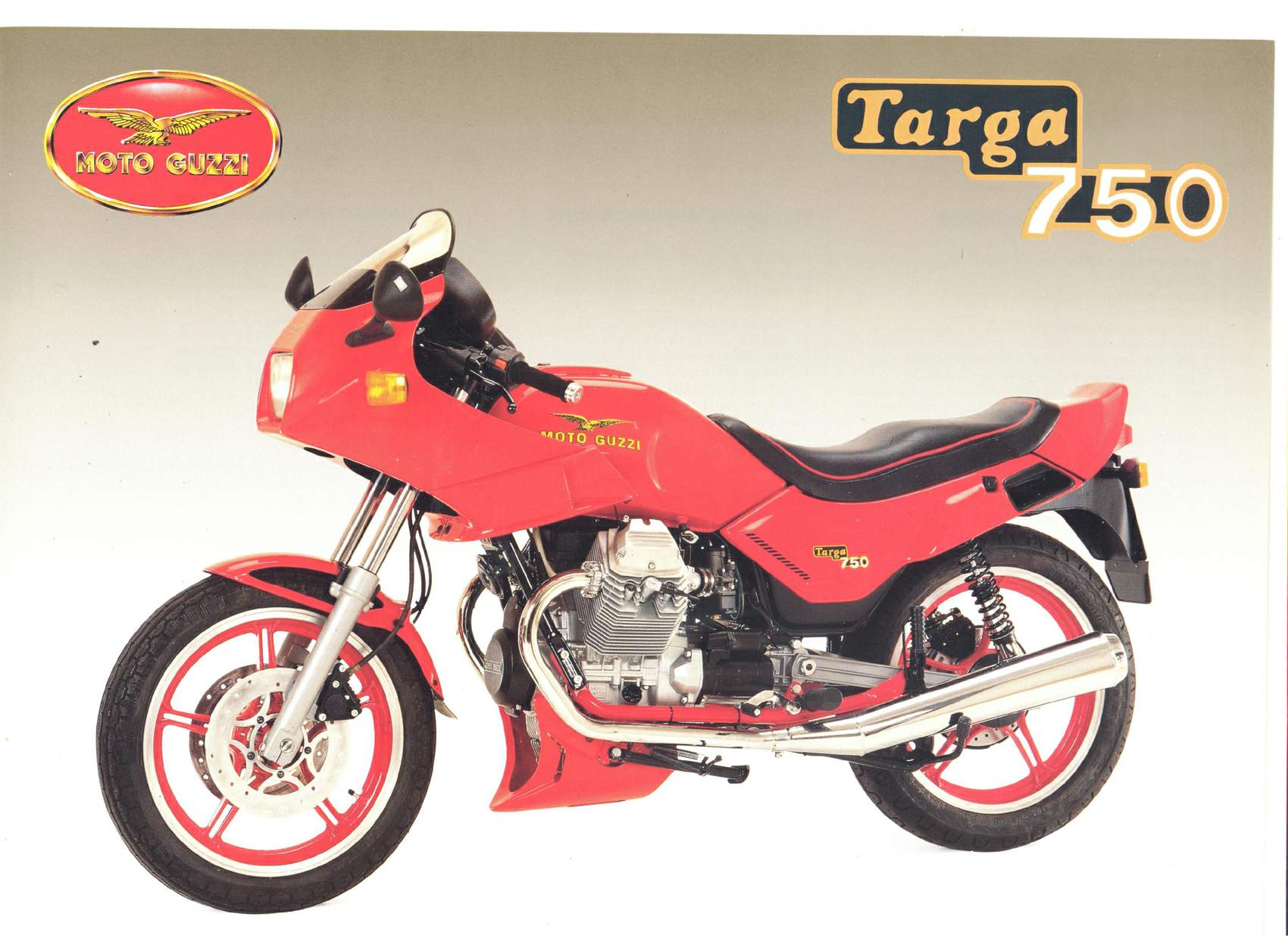
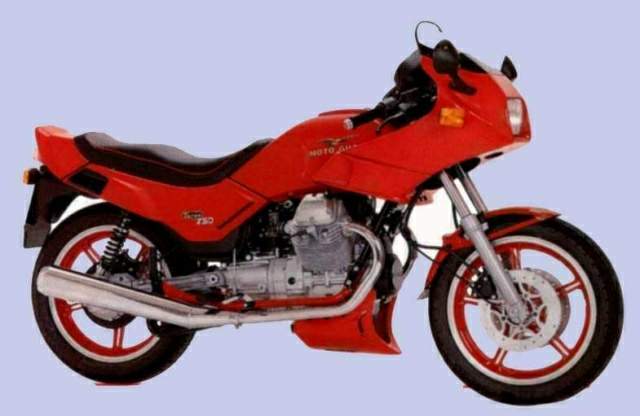
Moto Guzzi Targa 750

|
Make Model |
Moto Guzzi Targa 750 |
|
Year |
1991 |
|
Engine |
Air cooled, four stroke,
transverse 90° V-twin cylinder, OHC, 2 valve per cylinder. |
|
Capacity |
744 |
|
Bore x Stroke |
80 x 74 mm |
|
Compression Ratio |
9.7:1 |
|
Induction |
2x 30mm PHBH Dell'Orto carbs |
|
Ignition |
|
|
Max Power |
46 hp @ 6600 rpm |
|
Max Torque |
44 ft-lb @ 3000 rpm |
|
Transmission |
5 Speed |
|
Front Suspension |
Telescopic air assisted |
|
Rear Suspension |
Marzocchi 5-way preload adjustment, |
|
Front Brakes |
2x 270mm disc |
|
Rear Brakes |
Single 235mm disc |
|
Front Tyre |
110/90 V18 |
|
Rear Tyre |
120/80 V18 |
|
Dry-Weight / Wet-Weight |
180 kg / 195 kg |
|
Fuel Capacity |
18 Lutes |
|
Consumption average |
17.2 km/lit |
|
Braking 60 - 0 / 100 - 0 |
13.2 m / 39.6 m |
|
Standing
¼ Mile |
13.8 sec / 152.9 km/h |
|
Top Speed |
183.8 km/h |

Everyone knows that Italian bikes are not
merely designed, they’re composed. Conceived and fashioned in bursts of
inspiration by some dark-haired young dynamo with flashing eyes and vivid
imagination; or painstakingly sculpted by a veteran genius.
Moto Guzzi’s 750 Targa is not like that at all. The Targa is basically a
mix-and-match special; a sort of ‘hits-of- the-‘80s’ compilation consisting
of the traditional aircooled V-twin engine from the NTX750 trail bike (not
sold here because of its plastic tank), an equally ancient twin-shock
chassis based heavily on that of the 650 Lario, and a body-shape and paint
scheme filched straight from the current 1000cc Le Mans.
That’s not a particularly Latin modus operandi, but it’s practical. In the
case of Moto Guzzi - where new model development has of late been something
to be reminisced about rather than invested in - combining existing parts to
form a new 750cc roadster is totally logical. The Targa could almost have
been drawn-up not by the Mandello firm’s designers but by its accountants.
The end product is a motorcycle that looks almost identical to that old
bruiser the Le Mans, whose slightly rotund shape and effective top-half
fairing it shares, merely making do without the plastic mid-section. But in
reality the twins are so different that they feel only distantly related.
Where the Le Mans is big, butch and still capable of stoking-up a
130mph-plus head of steam (at least if your wrist is up to holding the stiff
throttle open for long enough), the Targa, for all its similarly streamlined
lines and scarlet paint, is petite, sweet-tempered and not very fast at all.
The smaller cycle’s pushrod-operated two-valve 744cc motor squirts out just
46bhp. To put things in perspective, that is two horses more than Honda’s
XBR500 single could manage, but one horsepower down on what Triumph’s 650
Bonneville produced almost 30 years ago. The factory claim a top-whack of
116mph for the Targa but the bike I rode needed a run-up even to persuade
its speedo needle past the 110mph mark.
If that’s the bad news, then the flip-side is that riding the Targa is a
blast out of all proportion with its outright performance. Even the midrange
power is nothing to shout about: you have to make use of most of the
7700rpm-worth of space on the big white-faced tacho to travel anything like
quickly.
But the way in which the Vee delivers what poke it has largely makes up for
that. Guzzi mills have always had a distinctive charm, and the Targa’s
relatively small-scale powerplant is just the same - even down to the way
the whole bike rocks gently from side to side at tickover while the red
oil-pressure light in the horribly huge bar-mounted instrument console
flickers on and off in sympathy.
There are a couple of slightly rough patches at lowish speeds, though even
then the bike shudders rather than vibrates. And as the revs rise the motor
just gets smoother and smoother. At 70mph in top it feels as though it’s
ticking-over; at six grand and an indicated ton, although it’s already
starting to run out of breath, the Targa wafts along as serenely as an
Olympic marathon runner on a gentle jog round the park.
All of which, in conjunction with the refreshingly light throttle and
gearchange, means that keeping the motor spinning fast can be as satisfying
as the normal big-Guzzi technique of short-shifting and letting V-twin grunt
do the rest. The Targa might be closer in capacity to the 949cc Le Mans than
it is to the old 490cc Monza that was introduced almost ten years ago, but
it’s the little bike’s engine characteristics that the 744cc mill’s delivery
more closely resembles.
What really makes the Targa spirited rather than merely annoyingly sluggish
is its chassis, which thankfully is almost as light, by current 750cc
standards, as it is old- fashioned. Having to contain less than half the
power of even a typical Japanese 600 helps, of course, but the Guzzi’s
simple steel twin-shock trellis does a good job nonetheless.
The bike’s dry weight is a claimed 396lb, same as an FZR600, and the Targa -
whose riding position is leant- forward and sporty until compared with the
Yam’s head-down crouch - feels more relaxed yet almost as manoeuvrable
despite the anachronism of its 18in front wheel. The pilot certainly doesn’t
need to muscle the 750 around in the manner demanded by a Le Mans, for
example, with its longer wheelbase and 80lb of extra weight. A gentle nudge
of the foam-gripped bars has the Targa changing line in obedient response.
Naturally, some aspects of the twin’s antiquated rolling chassis work
against any attempt to make up in the bends the ground you’ve inevitably
just lost on the straight. Those 18in rims at either end are skinny by
modern standards, as are the Pirelli Phantoms keeping them off the road.
Even so, on dry roads the tyres give more than enough grip to get the pipes
and centrestand scraping with potentially disastrous consequences at
relatively modest angles of lean.
But within those limits the Targa handles well enough, and easily enough, to
make it great fun as well as respectably quick. The forks gave a firm yet
fairly compliant ride that didn’t tempt me to stiffen things up with the
linked air- assistance. And there were no wobbles or weaves from the blunt
end, either, with the Marzocchi shocks set to their softest preload
position. Even the drive-shaft caused no real problems provided care was
taken to match revs with speed when changing down.
If the need to tread carefully on downshifts is one long- standing Guzzi
trait, then the necessity to use the opposite foot much more than normal
when braking is another. In Mandello tradition the Targa comes with a linked
brake set- up that connects one 270mm front disc to the single rear rotor;
an arrangement long favoured for the balance it brings to two-wheeled
braking, which can usefully be accomplished without the rear-wheel skidding
produced by club-footed use of most bikes’ conventional foot-pedals.
The Targa’s linked discs were arguably an asset, although I’m becoming
increasingly doubtful that the system now has much to offer on all but the
biggest motorcycles (which would be far better-off with ABS instead). In
recent years, increasingly powerful front anchors, grippier front tyres, and
shorter and lighter bikes have all combined to increase weight-transfer
under hard braking, reducing the importance of the rear wheel in slowing
down.
This isn’t so true of the relatively long, narrow-tyred Targa, which despite
a spongy hand lever could be stopped impressively hard with a combination of
stamp and squeeze. I still wouldn’t have cared to try outbraking an FZR600,
for all that. And it is surely no coincidence that Guzzi’s long-awaited Dr
John’s Replica sportster the Daytona 1000, delayed but now apparently due
for release in late spring, has conventional unlinked brakes. The Guzzi
system’s years, if not its days, could be numbered.
Or there again, maybe not. Rumour has it that Dr John Wittner has moved up
from his former base at Modena to Guzzi’s headquarters on Lake Como. There,
it’s said, he is busily transforming the staid old factory into a hotbed of
ideas, plans and actions. But Moto Guzzi’s nature is not to hurry things,
and it’s likely that they will still be building simple, old-fashioned
motorbikes like the Targa in the year 2000, whatever excitement Wittner has
conjured-up in the meantime
.
It is not the forthcoming Daytona but the old 500 Monza, that pretty little
sportster with the red fairing, that is most relevant to the tale of the
Targa. In Bike’s test in August 1981 the Monza was rated at 48bhp and was
labelled Slow with a capital S after being speed-tested at 107mph. Almost
ten years later, the bigger-engined but detuned and bunged-up 750 Targa is
two horses less powerful and is quite possibly slower still.
But far from panning the Monza, Bike’s 1981 tester praised the bike for
being light, relaxed, economical and ‘a hell of a lot of fun to ride’. The
competition has not exactly stood still since then, but the attraction of
Moto Guzzi’s most recent middleweight is much the same. Provided you’re not
looking for arm-stretching acceleration, every word is equally true of the
Targa.
Source insidebikes.com
|