|
|
|
|
Classic Bikes
Custom Bikes
Individual
Racing Bikes AJP
AJS
Aprilia
Ariel
Avinton / Wakan
Bajaj
Benelli
Beta
Bimota
BMW
Brough Superior
BRP Cam-Am
BSA
Buell / EBR BullitBultaco
Cagiva
Campagna
CCM
CF Moto
Combat Motors
Derbi
Deus
Ducati
ExcelsiorFantic
GASGAS
Ghezzi Brian
Gilera
GIMA
Harley Davidson
Hero
Highland
Honda
Horex
Husaberg
Husqvarna
Hyosung
Indian
Jawa
Kawasaki
KTM
KYMCO
Laverda
Lazareth
Magni
Maico
Mash
Matchless
Mondial
Moto Guzzi
Moto Morini
MV Agusta
MZ / MuZ
NCR
Norton
NSU
Paton
Peugeot
Piaggio
Revival Cycles
Roland Sands
Royal Enfield
Sachs
Sherco
Sunbeam
Suzuki
SWM
SYM
Triumph
TVS
Ural
Velocette
Vespa
Victory
Vincent
VOR
Voxan
Vyrus
Walt Siegl
Walz
Wrenchmonkees
Wunderlich
XTR / Radical
Yamaha
Zero
Video
TechnicalManufacturer ListContact
|
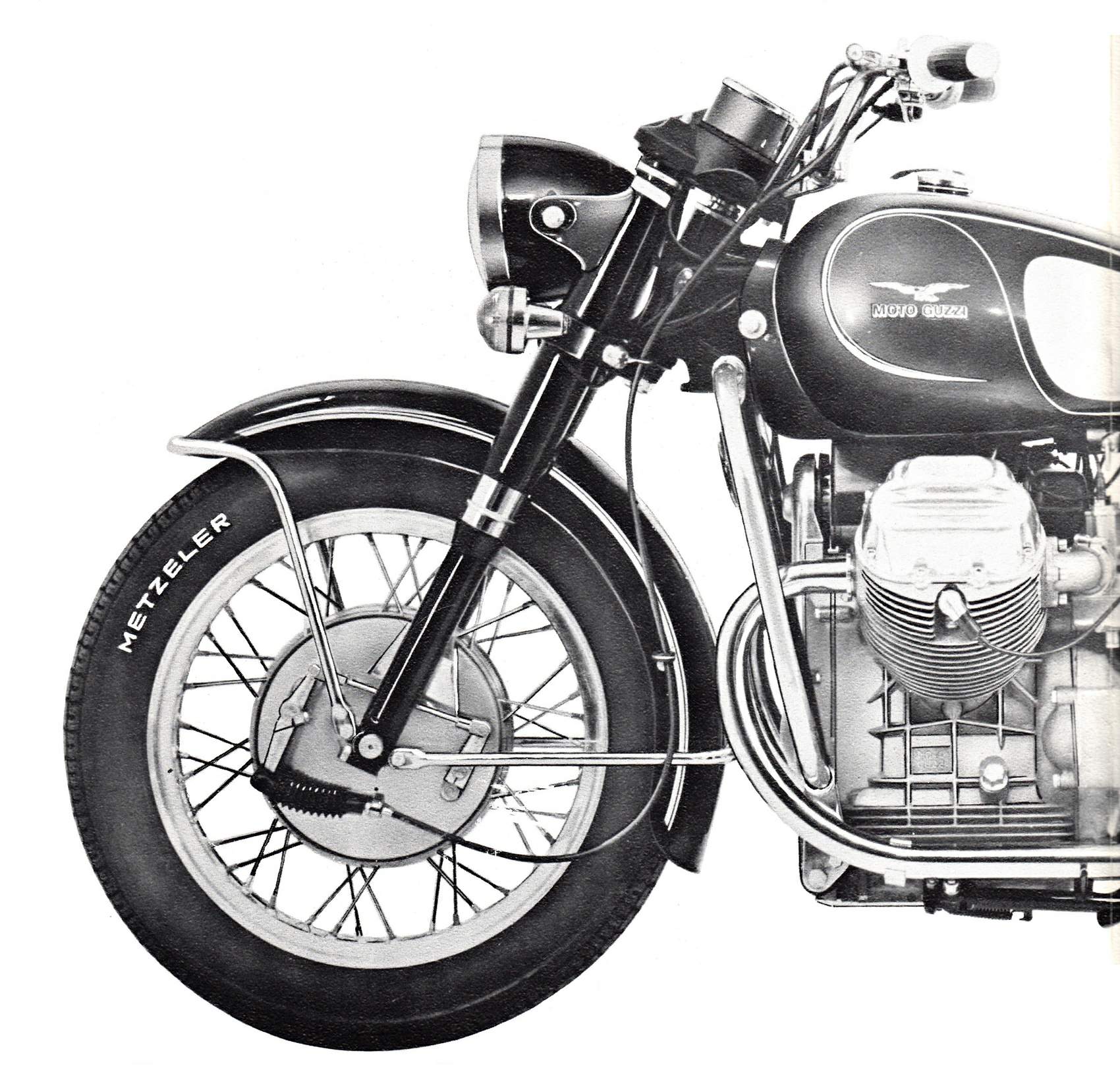
Moto Guzzi 850 Eldorado
Among motorcyclists, there is ;i small group that enjoys riding on long trips. It isn't a group, actually, for you seldom see more than a pair who have covered more than the same thousand miles on a trip at the same time. And more often than not, the long-distance rider is a loner. Alone at times by choice, and in other instances simply because it's awful hard to get any combination of two bikes and riders together that are comfortable with the same pace. Some of these cycling tourists like to break up their trip with social and/or service stops at dealers' shops along the way. Others don't particularly cotton to the hail-fellow-well-met joviality at the dealer's, but are compelled to endure it by their bike's lack of reliability or frequent maintenance schedule. And another kind of rider thoroughly enjoys working on his machine: he totes a full tool kit with all the special oils and greases that his bike continually distributes on him, itself, and the road. There are lots of motorcycles which provide adequate service to the above types. Today, it is rare to find a new big bike that sheds parts steadily along the road, and not too many vibrate so badly that the rider has to rest every hundred miles. A bike as small as a 450 Honda is an adequate tourer for a solo rider who doesn't carry much of a pack.
But for the cycling tourist who wants to be free, there are only two motorcycles to choose from: the big Moto Guzzi V-twin, and the BMW R75/5. Freedom means a lot in this sense. Freedom for a big rider to carry a big passenger and the necessary luggage, even in a side-car if desired. Freedom from the chain which the rider had to stop every 200 miles to lube or adjust or both. And freedom from having to plan a journey route around the business hours and location of dealers which have the special tools or stock the spare parts and special oil that some bikes require. In all, freedom to simply ride wherever and whenever you wish and be able to feel good about the trip. We've tested two models of the big Moto Guzzi 750cc Ambassador: in the Oct. '69 and Apr. '71 issues of Cycle. We knew the character traits, strong points, and drawbacks of these majestic tourers. In the first part of this test, we'll refresh your memory of them and tell you what we think of this year's improvements. In the second part, we look at one of the most unlikely superbikes imaginable, the V750 Sport. At first glance, the V850 Eldorado looks exactly
like last year's centerstand to be operated from either side of the bike.
The Eldorado is a massive looking motorcycle, but the big fend- fenders. We liked the solid black best—it gave the bike a Rolls ers and wide, transversely mounted V-twin engine are deceptive. Royce look of bulky elegance. The other schemes seemed just Its 58-inch wheelbase is a half-inch shorter than the Honda 750 gaudy enough to detract from the stateliness, though the all-while Four and H-D Sportster, and identical to the Norton Commando, wasn't bad. Guzzi is very subtle with the use of chrome and pol-An H-D 74 is 3.5-inches longer and a BMW R-75/5 is 3.5-inches ished aluminum on the Eldorado. The roekerarm covers and gen-shorter, erator-drive belt cover are polished alloy, while the exhaust system, Sitting on the best seat in motorcycling gives you added visual cylinder guard rail, brake and shift levers, seat grab rail, fuel tank impression that the bike is bigger than it is. The fat, gracefully knee pads, shock springs, and front fender guard are the main bulbous fuel tank is 11 inches across where your knees touch the chrome plated parts. All of the bolts and nuts, as well as the oil chrome plated side panels, and it flares out to a width of 14 inches filler and inspection plugs, are chrome or cadmium plated. On one at the widest section. The Guzzi weighs 559 pounds with all its of the first nights we had the 850, it was left outside. Of course it lubricants and a half tank of gas—almost 80 pounds more than a rained like hell. The Guzzi is the first motorcycle we've tested that Honda 750. You can feel some extra heft when you let the tank fall didn't have little rusty places all over it after a good drenching, from side to side between your legs, but the impression isn't over- For some reason, as yet inexplicable to us, sportiness in a motor-whelming. The V850's heavy parts, the crankshaft and gearbox, cycle has been stylistically idealized by abbreviated and mostly are carried very low in the frame, which makes the center of gravi- useless nonstructual parts. Given this theme, the Guzzi is certainly ty correspondingly low. The center stand lifts the bike a full two not sporty. As mentioned before, the tank is large and rotund. But inches at the rear wheel, and we thought that it would be very its volume gives the bike a 200-plus mile cruising range. The fend-difficult to put the stand down. But once you get the knack of ers are very wide and deep and cover a lot of the tires' circumfer-stepping on the stand's end while tugging on the seat rail, it's ence. We rode the 850 about 60 miles on wet roads, during stop-actually a fairly easy, if awkWard, operation. Foot tabs allow the and-go showers: those non-sporty fenders kept nearly all the wheel spray off us. And that big, long, funny-looking, lumpily-contoured seat luxuriously supported one of our staff members and his wife on a day-long tour of Long Island that was the first long passenger ride that the lady had ever enjoyed. The tool boxes are just that: boxes. They are about three-inches deep and have lazily rounded corners. The shape is that of a canned-ham tin: kind of a 3-D triangle that was blown up with an air hose. Stamped steel side covers, just under the front of the seat, hide the huge battery (required by the electric starter), and the air cleaner. In shape, these covers are slight trapezoids, not far from being square. The only thing that keeps them from being nice-looking is the placement of a row of imitation breathing louvers over the portion which covers the air cleaners. Even the chrome plated pads on the sides of the fuel tank are entirely functional: They keep the rider's knees from rubbing the
paint off the tank. Black rubber pads wouldn't look as good and would eventually
deteriorate. Sitting on the saddle again, we gaze at the stamped mini-automotive instrument panel. There's an electric tachometer on the left, opposite a mechanical speedometer. Between these two instruments is the ignition switch and a quartet of indicator lights. A little black plastic hinged cover keeps water and grit out of the key hole when not in use. The key controls power to the ignition and starter only, but serves additionally to control a mechanical fork lock. With the key rotated to its most counter-clockWise position and/or removed, the forks are locked to the left. The first clockWise position unlocks the forks, but all power is off. Another twist of the key lights the little red indicator lamp to tell you the ignition is on and the battery is discharging. If the gearbox is in the neutral position, an orange lamp also lights. If the engine is cold, a lever up near the throttle grip is pulled clockWise to actuate the carburetion enriching system. This system is new to the Guzzi, and is a vast improvement over the pseudo-accelerator pump on last year's 750. With the throttle off, a touch on the dime-sized button down under the en-richer lever actuates the electric starter. The starter groans its complaint at being summoned, but twists the engine over, cha-glunk, cha-glunk. It always started on the second cha-glunk, hot or cold. If we tried to start off before allowing the engine to warm for three minutes, the bike would hiss and pop its rebellion. Upon warming, the lumpy exhaust note tells you it's time to shut off the richener. A smooth but irregular idle develops that sounds exactly like that of a 74 H-D. It's a very deep, hollowish sound which has a soul stirring cadence, much like the drum lead to Song Of India. Without exception, people we encountered during the test liked the sound and said so without being asked or prompted. The rhythm of the sound is common to all V-twins
and is caused by the irregular placement of the cylinders, and consequent
irregular firing. In the case of the Guzzi, the left cylinder fires 270 degrees
after the right, then there is a long pause while the crankshaft rotates 450
degrees and both cylinders breathe for another power cycle.
An easy six pound pull engages the clutch and a
push back with your boot on the rear pedal of the rocker-type gear shift lever
engages low gear. On last year's test bike low gear engagement was accompanied
with a resounding clunk. The clunk is gone, but at times the engaging dogs
inside the gearbox butt instead of meshing. The result is that you push down on
the pedal, and you feel something move not quite far enough. Sure enough, you
let the clutch out and nothing The answer is to roll the bike backWard or
forward a few inches to let things line up. Or just let the clutch out gently
while maintaining pressure on the pedal. Once moving, even very slowly, all feeling of the
torque reaction vanishes, and the bike becomes 550 pounds of rolling grace. It
feels like a much lighter machine and responds quickly to light efforts applied
against the handlebars. You can idle along at an easy walking pace and there is
absolutely no jerking or roughness. It feels like there are fluid couplings and
shock absorbers all through the drive train. Moving out onto the interstate lets you know what the Eldorado is really all about: solid, high-speed, vibrationless comfort. That machine eats miles like no other motorcycle. Side winds and pressure front blasts from passing trucks don't faze it in the least. Ripply pavement and chuck holes go almost unnoticed by your backbone. And there's incredible cruising power. All last year's 750 needed was an extra transmission speed to provide an overdrive situation for cruising. What Guzzi gave its customers was the extra ratio and a lot more torque to boot. The extra lOOcc obtained from lengthening the stroke 8mm (.314-inch) gives the bike a lot more urge. The machine cruises absolutely effortlessly at 80 mph and gets there in a hurry, if you want to. At the drag strip, the 850 ran 94.50 mph in 14.04 seconds: that's as quick as any Triumph Bonneville we've ever tested. In more congested traffic, especially on winding,
curvy roads, a few things gave us a little grief. The turn signal switch is
located near the throttle grip, but just far enough away so that you sometimes
have to take your left hand off the grip and reach over to turn the switch on or
off. It's especially annoying when a hole opens in the traffic, and you can't
signal quickly enough to take advantage of it. And, again this year, cornering
clearance is rather limited. It is easy to scrape the center stand when leaning
into a turn in either direction. And getting stopped is still a hassle: the
brakes are marginal at best. Throughout our test, the big V850 suffered absolutely no mechanical failures and did not leak a drop of oil. We had to replace one of the steel-shrouded spark plug caps that we accidently crushed against the side of our van when we picked the bikes up at the U.S. distributor, Premier Motor Corp., in Hasbrouck Heights, New Jersey. We did remove the tools from one of the locked tool boxes a couple of times to check the oil levels in the engine, gearbox, and rear drive during trips, but that was the extent of trip maintenance. No oil replenishment was required during any of our trips. The only thing we did to the bike in our shop was
to check the tappet clearance. It was spot-on. We rode the bike and enjoyed it
immensely, while taking in a lot of scenery. Our Eldorado was reassuring and
inobtru-sive at the same time. We simply felt that we could depend on it, no
matter what. We had seen pictures of the V750 Sport in the European papers for over a year. The prototypes for the Sport were largely exercises of resentment on the part of Guzzi's design and development engineers. They were tired of the new image, comprised of
staid conservatism, that they projected with producing only the Ambassador.
The Guzzi engineers placed the engine-transmission outline on the drafting paper and drew in the lowest, strongest frame they could within the bounds of lightness and human anatomy. Eighteen-inch wheels were placed at each end, in the right relationship to the frame, to give racing ground clearance. The Italian technicians then went to work on the engine to remove as much weight as possible. First to go was the huge automotive-type 300-watt generator from the crotch between the cylinders, and it was replaced with a small, compact unit that fits right on the front of the crankshaft. A much smaller Spanish-Bosch starter motor replaces the Ambassador's .7 bhp model, but only spots it .3 bhp. The touring model's massive flywheel/ring gear/dual-plate clutch assembly was lightened drastically. The engine still looks practically the same as it
did: like someone had taken an air-cooled V-eight automobile engine and
band-sawed off the front six cylinders. The crankshaft, camshaft, transmission,
and clutch layout is the same as such a car would have. The frame tucks so
closely to the crankcase and between the cylinders that the bottom frame tubes
had to be made removable, so the engine could be installed and replaced. Three-ring pistons with 9.8:1 compression ratio
replace the stock 9.2:1 c.r. pistons which have an additional oil control ring
at the bottom of the skirt. Of course, the camshaft pushes the valves open
farther and keeps them open longer. The Sport's mufflers are larger in volume,
though not noisier than the tourer's, and there are dual cross-over tubes so
that both cylinders share both mufflers during scavenging. Closer-spaced ratios
in the gearbox with a higher rear-end ratio allow useful advantage of the
peakier engine. A complete dual point, condensor, and coil ignition system
replace the single component distributor setup. The'bare, chrome plated stanchion tubes and aluminum sliders and triple clamps hold the same geometry as the touring bike. Koni multi-adjustable shocks control the action of the rear end. A completely new set of dual double-leading shoe brakes are up front, while the standard rear unit has been converted to double-leading-shoe. The long, low, sleek looks of the Sport are very sporty, in the very most Italian sense of the word. The frame is painted silver and an angular, 4-gallon gas tank nestles right down between the cylinders. A quartz-iodide Mar-elli headlight in an abbreviated shell fairly burns a hole in the road at night. Though less posh than the tourer's seat, the one on the Sport is beautifully soft and comfortable. The polished alloy fenders are short and narrow: good for keeping stones from hitting you in the eye, and that's about it. Very special Michelin high-speed tires and
Borrani Record rims complete the visual visceral effect of the Sport. The machine feels and handles like it weighed 200 pounds less than its 500-pound curb weight. It will corner at road-narrowing (in the mind's eye of the rider) racing speeds without dragging anything other than the tip of the footrest rubber. You can't exactly flick it around like a lightweight, but it responds a lot more quickly, with less effort from the rider, than any other machine of its type that we have ridden. The red line for the Sport is 7500 rpm, and we had it at 8500 several times. Even at those revs, the engine, indeed the entire motorcycle, is absolutely smooth. Uncannily so. We're accustomed to bikes that are fast being accompanied by a lot of noise and vibration.
The clutch is soft and positive in operation and
the right-mounted shift lever has a short, crisp throw. We never missed a shift
on the Sport. The power gets much stronger and from there to
7500 rpm in any gear, the bike accelerates voraciously. In the same way it is
frustrating to drive a The only thing that spoils the street manners of
the Sport is the absence of an air filter of any sort. The carburetor bells open
into a rubber boot that points down to, and almost touches, the crankcase. Not
only is the engine susceptible to swallowing grit that might scar its chrome
cylinder bores, but a lot of noise also gets out to bother the rider at cruising
speeds. We'd guess that the production batch of Sports will have filters. Perhaps the Sport is an introduction to a new kind of ultra-performance motorcycling: one without the aggravation of a greasy, clanking engine. For the 300 or so lucky souls who happen to have an extra $2500 in their jeans this year, we do not know of a more potentially satisfying special edition to spend it on. ® Source Cycle 1972
|
|
|
Any corrections or more information on these motorcycles will be kindly appreciated. |