|
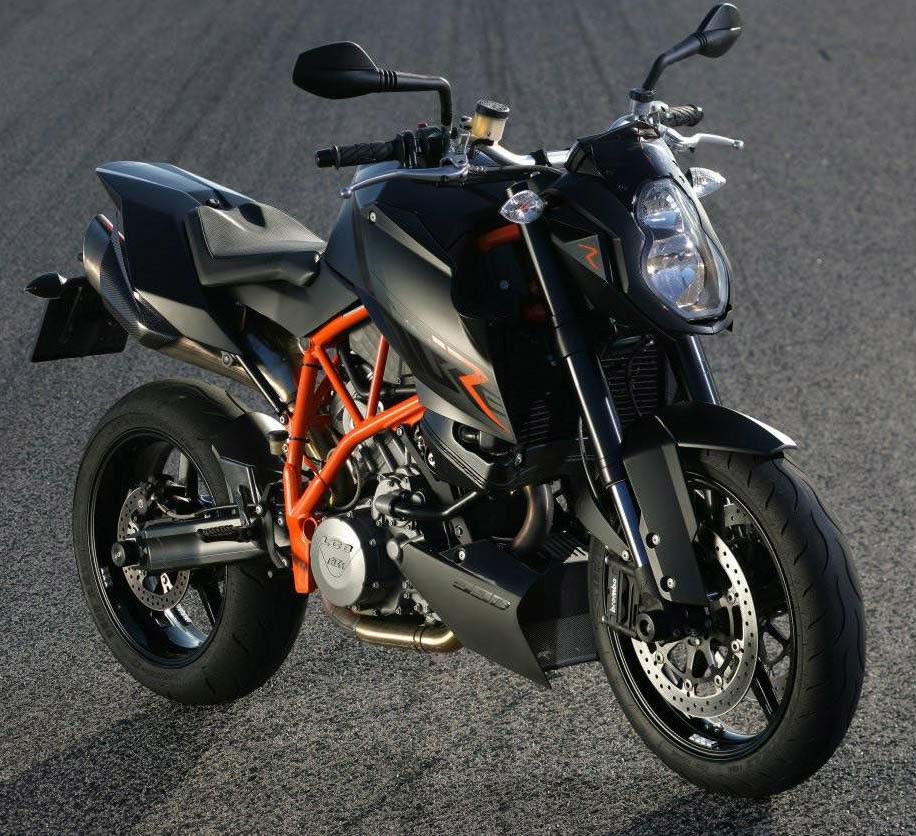
KTM 990 Super Duke R

|
Make Model |
KTM 990 Super Duke R |
|
Year |
2011-12 |
|
Engine |
Liquid
cooling, four stroke, 75°V-twin cylinder, DOHC, 4 valves per cylinder |
|
Capacity |
999.8 |
|
Bore x Stroke |
101 x 62.4mm |
|
Compression Ratio |
11.5:1 |
|
Induction |
Electronic fuel injection / electric |
|
Ignition /
Starting |
- / electric |
|
Clutch |
Wet multi-disc clutch, operated hydraulically
|
|
Max Power |
97 kW @ 10000 rpm |
|
Max Torque |
102 Nm @ 8000 rpm |
|
Transmission /
Drive |
6 Speed / chain |
|
Frame |
Chromium-Molybdenum trellis frame, powder-coated
Subframe Aluminium
Handlebar Aluminium Ø 28/22 mm (1.89"), tapered |
|
Front Suspension |
48mm WP USD adjustable, 160mm wheel travel |
|
Rear Suspension |
WP shock, fully adjustable, 180mm wheel travel |
|
Front Brakes |
2x 305mm discs 4 piston calipers |
|
Rear Brakes |
Single 240mm disc 2 piston caliper |
|
Front Tyre |
120/70 ZR17 |
|
Rear Tyre |
180/55 ZR17 |
|
Seat Height |
865 mm / 34.06 in |
|
Dry-Weight |
186 kg / 410.05 lb |
|
Fuel Capacity |
18.5 Litres / 4.8 gal |
|
Consumption average |
17.1 km/lit |
|
Standing
¼ Mile |
11.1 sec |
|
Top Speed |
236.3 km/h |

THE ALPHA ANIMAL
The totally single-minded "R"
version of the Super Duke is the flagship model of KTM's Naked Bike range in
MY2012. Rated at a plentiful 125hp, the newly homologated LC8 V-twin engine
delivers a solid punch and incomparable liveliness. The sharper trellis frame
makes for maximum agility with its sporting “R” geometry and only nine kilograms
of weight. The special “R” chassis ensures a high-resolution feedback about the
road surface with its precisely adjustable WP steering damper and top quality
suspension components.
First rate equipment like the
machined, black anodized triple clamps, radial brake and clutch levers or the
high quality Brembo brakes with radial four-pot front callipers elevate this
Superbike among the Naked Bikes and ensure intuitive operation. Massive
power and perfect control right up to the limit make the 990 Super Duke R the
ultimate nemesis of hypersport bikes on race tracks. And not just there.
Weightless agility, incisive precision and an optimised suspension set-up let
the "R" score on public roads, too. A
riding experience that can now be shared, thanks to the new dual seat. For a
Duke rarely comes alone.
KTM 990 Duke R Features and Benefits
- Advanced LC8 4-stroke V-Twin,
electronic Keihin fuel injection, multi-functional balancer shaft, 6-speed
gearbox
- Max. output: 92 kW/125 PS,
emissions: Euro 3
- Chrome-molybdenum steel trellis
frame, coated orange, with bolt-on rear aluminium subframe and sharper, “R”
series geometry
WP 48mm USD front forks, lower fork
tubes TiAlN coated
Tapered, extruded aluminium swingarm, fully adjustable, lengthened rear WP
monoshock, piston rod TiAlN coated
Adjustable WP steering damper
Now with dual seat for twice the fun
Review
This is Part One of a two-part report on our recent
test of new KTM bikes for the U.S.
Is a supermoto-a dirtbike with roadrace tires and brakes-the ultimate
motorcycle? If you worked all day in a giant orange shed, you’d think so. “It’s
our heritage,” said KTM P.R. Manager Thomas Kuttruff, referring to KTM’s 20
years in the supermoto business. Of course, riding around on a frantic,
short-geared thumper can be limiting, so adding a second cylinder to a supermoto
makes a versatile, fun and reliable bike you can ride every day, even for long
highway stints.
KTM first treated the world to big supermotos with the 950 SM, which it upgraded
to a 990 a few years ago, adding fuel-injection and some more ponies. You may
think the Supermoto is just a Superduke 990 with less bodywork and more
suspension travel, but you’d be wrong. The Supermoto, Superduke and RC8
Superbikes all have different motors: the 990 Supermoto and 990 Adventure share
the most dirt-oriented motors, with a single-shaft counterbalancer as opposed to
the Superbike’s dual gear-driven balancers. The frame and suspension is
different too.
Americans get two versions of the big supermoto, the sporty R and a more
practical tourer. Both bikes share a liquid-cooled, fuel-injected, four-valve
75-degree 115-hp motor and basic chrome-moly trellis chassis. From that common
ancestor, KTM’s engineers started adding go-fast bits to make the R. Wheels are
forged Marchesinis, saving 4.4 pounds of rotating mass, and it gets those
delicious four-piston Brembo monobloc racing calipers. A supermoto needs a
powerful, sensitive rear stopper as well: the R (and T) is equipped with a
two-piston caliper back there. The minimal plastic bodywork is deceptive: the
low-profile tank holds almost four gallons.
The T is a little more staid, but not much. It gets cast, two-piece calipers,
softer suspension (but still fully adjustable), a larger 5-gallon tank, a
windscreen and easily detachable semi-hard luggage. There’s also a larger, more
passenger-friendly saddle and a luggage rack. Wheels are a little heavier than
the R’s, and the fork doesn’t get the fancy black TiAn coating. That all means
the T is 432 pounds without fuel, compared to the R’s 417-pound claimed weight,
but both bikes are priced the same at $13,998.
Click to learn more...
Since the KTM 2010 model intro I attended was mostly a racetrack event, there
was only a brief street ride to evaluate the T, but there were a few Rs
available for track evaluation. No matter: riding the R on the track may have
been the most fun I had all day. Sure, it’s heavier and (a lot) slower than the
RC8 R, but its wide, flat, high handlebar and torquey motor made it big fun to
snap in and out of turns, and the bike’s balanced nature and slim form made it
feel a lot lighter than it was. No need to move my rapidly disintegrating body
around so much: just roar up to the apex, snap it in, power out, repeat.
Out on a brief street ride, the R inhaled the twisty Laureles Grade, with
more-than-ample power and that same grippy, tenacious feel it exhibited on the
track. Riding a supermoto with this kind of power, brakes and excellent
suspension doesn’t really feel like a fair fight. If I had one, I’d probably
have to make new friends. Power is snappy, with the same excellent
fuel-injection and part-throttle response the RC8 R showed (featured in Part Two
later this week), and the gearing felt about right for fast roadwork. The motor
is more raw and buzzy than the silky, quick-revving RC8 mill, but if you’re used
to a thumper dual-sport, it’s not objectionable. But a touring rig it’s not: the
narrow, hard seat became noticeable after about 30 minutes of riding, and wind
protection is zero. Think of the SM R as your basic inner city commuting/Sunday
backroads thrasher.
For something almost as fun and much more practical, the SM T should work much
better. The seat is more seat-like and the windscreen and handguards offer some
useful wind protection. The seating position keeps the ‘ol knees from bending
too much, and the bars are high. The bags, while small, are unobtrusive (making
for easy lane-splitting) and easy to remove or attach. The larger bags for the
990 Adventure can be fitted, although that would require new brackets.
The main difference between the T and the R-as long as you’re not working the
brakes too hard-is the softer suspension. The T exhibits the same neutral, easy
steering, except with a plusher ride. And “plush” doesn’t just mean soft.
There’s actual controlled damping, and the three-way (compression, rebound and
spring preload) adjustable WP components (with adjustments that actually do
something) should let the rider fine-tune the ride to perfection. It tracks
through corners, keeping the wheels on the ground, and bumps and potholes don’t
jar your spine the way some European bikes would.
I loved scraping up my brand-new Dainese kneepucks in Laguna’s fabled turns on
the RC8s, but street riding is satisfying because you can do it all day long and
the variety of roads is endless. What heightens that experience is having a bike
that handles like a well-set-up racebike in the twisties but is comfortable to
ride on the boring stretches in between. The 990 SM T is one of those bikes, a
real do-it-all machine with tremendous character, performance and reliability.
One bike I didn’t get to ride, which makes its debut in both the USA and Europe,
is the 2010 690 Duke R. It’s based on the excellent 690 Duke, a single-cylinder
supermoto that’s designed to be a fun and reliable streetbike. The R version
takes the 65-hp, 654cc liquid-cooled Single from the standard 690 and (heh, heh)
pumps it up to 70 hp with more compression and another 45cc: it’s an actual 690.
The motor goes into an orange-painted trellis frame, suspended by upgraded front
and rear components. A pound is shaved off the 690’s 327-pound tank-dry weight
with some carbon pieces. I’ve ridden the 690 Duke, and found that bike to be as
light, good-handling and torquey as you’d guess: a 65-hp Single used to be the
realm of cooped-up Scandinavian winter tinkerers, but now anybody can buy one of
these for $10,998, just $500 more than the standard 690 Duke.
Adding the T and R to the lineup gives KTM USA a full range of
large-displacement streetbikes, unimaginable a decade ago. They’re priced out of
the market the Japanese bikes swim in, but are affordable compared to
competition from BMW, Ducati and Aprilia. 2010 will be a great year for
superbike and supermoto comparison tests.
Source
motorcycledaily.com

|