WP monoshock, rebound and compression
adjustment. 320mm wheel travel
Front Brakes
Single disc
Rear Brakes
Single disc
Front Tyre
Rear Tyre
Dry-Weight
137 kg
Fuel Capacity
8.5 Litres
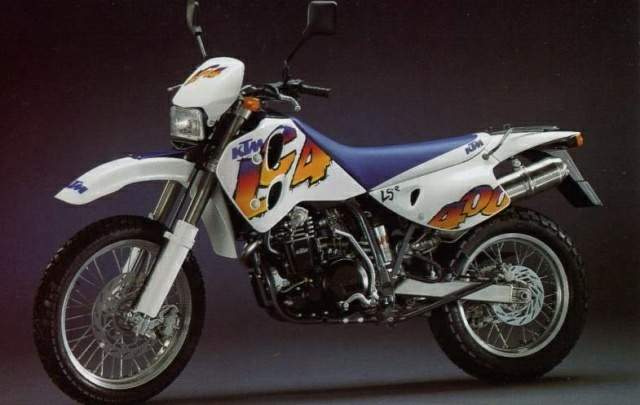
We tried to get a 620 to test this year. Honest
we did, but when the test bikes were all doled out the only thing left was a
lonely 400. It seems that every time we sling a leg over a KTM dual sport,
it's a 400, but on the other hand we're really getting to know the bike. In
truth, the 620 is exactly the same thing with 220 more cc's of displacement.
It's a big difference in power, that's for sure, but KTM's '96 chassis stays
the same between the two.
Why a '96, you might ask. Aren't the '97s coming out soon? Yes and no. KTM has
established the R/XC line for a late spring introduction, so you won't see the
'97 machines until June of next year. What we have here in the '96 will be
current until then, and they've made a number of good little changes on the
bike.
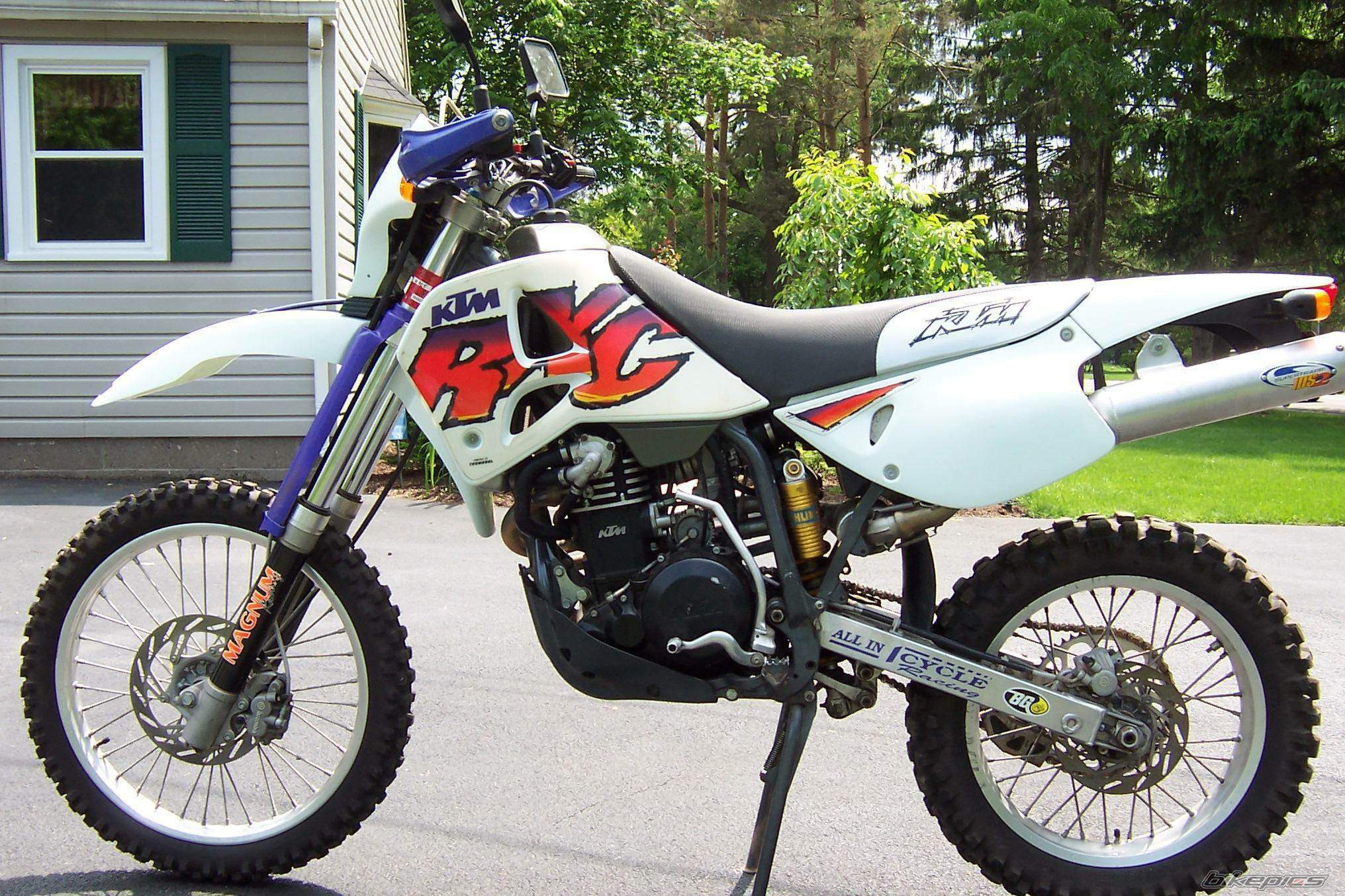
Well, you might not call some of the changes "little." The most striking
change is the inclusion of the E/XC-style racing suspension; the Marzocchi
Magnum 45 forks on the front, and a rear Öhlins shock. These Magnums are the
latest design, not leftovers from 1995. With them you will find the same
sliders with 20mm less underhang, which really helps out when the going gets
rutty or rocky. The forks also have a different compression damping
configuration from the original '95 forks. This is also a plus, in our eyes,
since we never really thought very much of the '95 Marzocchi forks anyhow.
So how do they work? Good; really pretty good. Stock for stock they give a
more plush ride than any of the WP forks of late. They shine best in little
choppy bumps, things that drive WP forks to distraction. The Marzocchis are
damped very loosely for the first four inches of travel or so, and soak every
little stutter bump right up. The rest of the travel is a lot more "racy" than
the old WP forks. The Magnums stiffen up quickly in mid stroke and deliver a
confidence-inspiring ride when the holes in the trail get bigger. If we hadn't
had the bike for only three days we would have changed fork oil and levels to
get them more closely dialed in for the kind of riding we like to do, but we
had no time, so we left them alone.
The rear shock is an Öhlins, and really not much more needs to be said. This
is the shock absorber that nearly every factory shock is compared to, and on
this bike it works extremely well. We noticed no bad traits from the rear end
of this bike, so it does the job. The best we can suggest is to take care of
it; it's a fine piece of equipment, so plan on having the shock oil changed
regularly to keep it in good shape. The forks, just like last year's E/XC,
tend to dirty up the oil fairly quickly, so you're going to have to plan on
changing fork oil often as well.
The other major change on the R/XC is actually a variety of changes, all
adding up to a slimmer profile. The fuel cell has been redesigned to be
narrower, and unfortunately it holds less fuel--down to 2.3 gallons. The seat
is narrower as well, and all the plastic is tucked in tight. The bike actually
feels narrower to ride, and it's a lot more comfortable to move around on
because of this.
The only change we're not entirely thrilled about is the new carburetor, and
we'll admit it's probably through a lack of familiarity. To be honest, when
the R/XC is warmed up and running, it runs really, really well. The
carburetion seems perfect, and the engine feels more responsive, maybe even
more powerful, than the '95 engine (even though everything else is the same).
The trouble with the new carb, made by Qwiksilver, is when you try to start
the bike cold. The Qwiksilver doesn't have a traditional choke circuit in it.
Instead, it has an enrichment lever, which is not much more sophisticated than
the "tickle button" on an old Bing carb.
"The new R/XC is a narrower, better-suspended, different carbureted version of
what we've been riding here at home for the past two seasons, and we enjoyed
the time we spent with it."
When you turn the enrichment lever 45 degrees from horizontal it apparently
dumps fuel right into the intake, and our problem came with not understanding
how to make it work right. It always seemed that one kick with the enrichment
lever up wasn't enough, and two kicks was enough to flood the engine. We've
never seen a manual or instruction sheet for this carb, and the chances are
that with a little bit of knowledge we'd be much happier. The Qwiksilver is
used to ensure the R/XC passes emission requirements in all 50 states, and is
therefore necessary, but we'll admit we're partial to the old Dell'Orto carb.
Our test grounds for this R/XC were fairly tight mountain trails in Washington
state. A lot of the terrain we covered wasn't what most people consider dual
sport. It would have been more suited to an enduro bike. But the
R/XC--although a little big in some of the tighter spots--was overall a joy to
ride. The new slimmer profile makes the bike feel lighter and much more
flickable, even thought the overall weight hasn't changed significantly.
Rarely did the bike stall, but when it did it was a one-kick starter (when
hot), and nothing came loose or fell off.
The stock Michelin DOT dual sport tires are a real compromise in slippery
conditions, and we changed to a real knobby tire in the front just to make the
trail more enjoyable. For a mix of road and casual trail the Michelins will be
fine until you wear them out.
In short, the new R/XC is a narrower, better-suspended, different carbureted
version of what we've been riding here at home for the past two seasons, and
we enjoyed the time we spent with it. Certainly owning one and learning about
the carburetor would help with our only complaint with the bike, and the R/XC
is still the most serious dual sport bike available...if you don't count the
electric-start Husaberg, which isn't really a DOT-approved dual sport anyhow.
We've heard two rumors about the '97 R/XC. One was that it was going to be
slimmed way down and lightened up and made into even more of an enduro bike,
and the other was that the bike was going to get electric start and become
more of a street/trail bike. It's too early to tell which is true, but in the
mean time the existing R/XC is a good compromise between the two.
Source Motorcycle.com
NOTE: Some of the photos on
Motorcycle Specs are owned by somebody. If you see any of your
photos, you can let me know so that I can acknowledge it, or if
you object to it, I can remove it altogether. If any copyright
holder objects to their articles being placed on Motorcycle
Specs, it will be removed upon request. Any correction or more
info on these bikes will kindly beappreciated
Contact MePrivacy
Policy
Website Stats