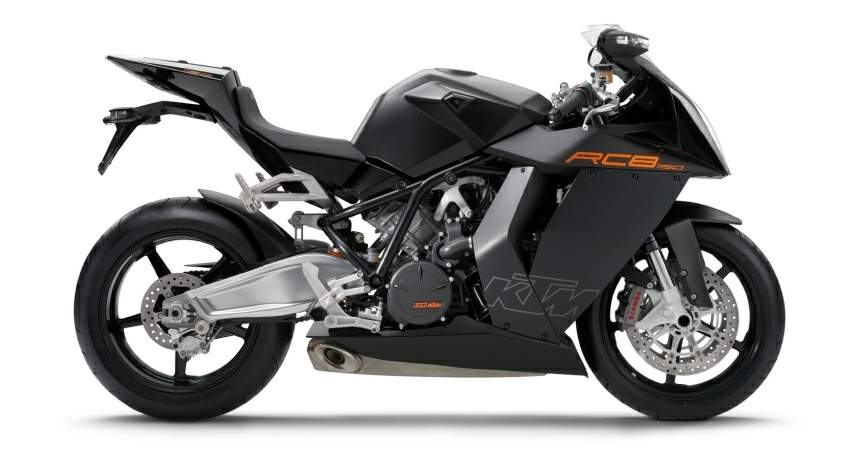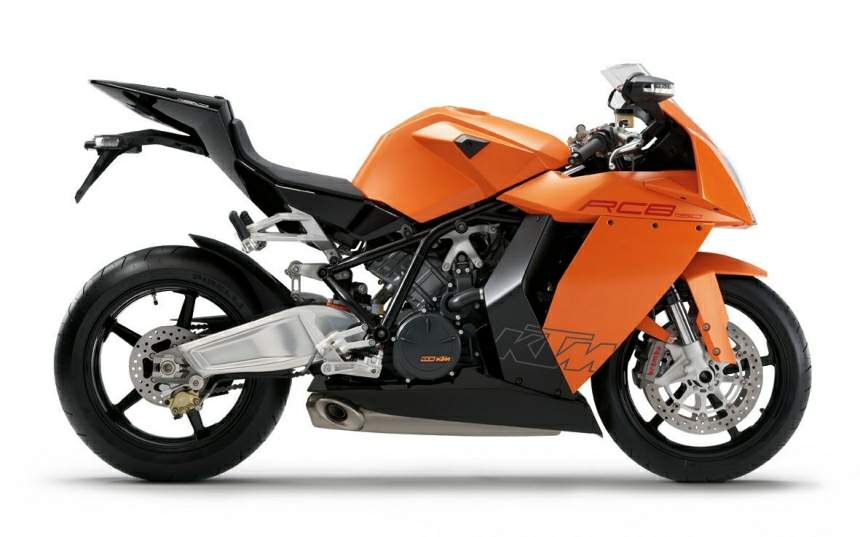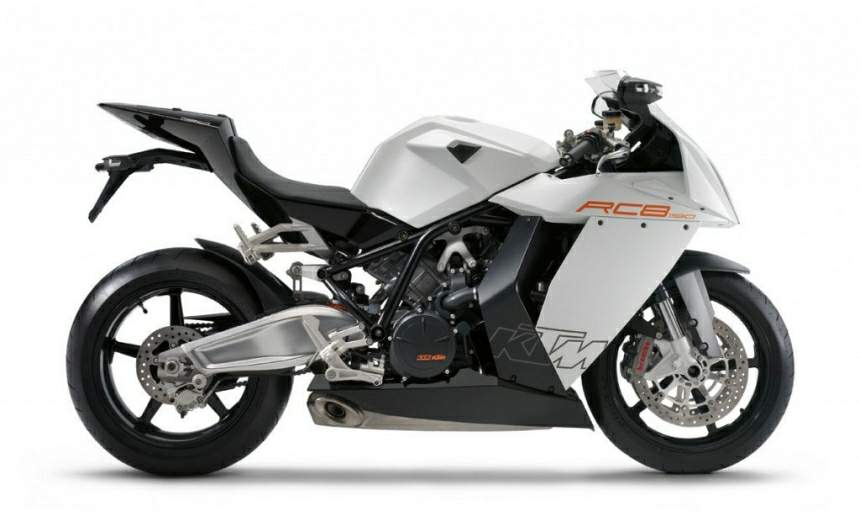
Sharper and lighter than anything that calls itself
competition: 120 Nm torque, 155 HP at 10,000 rpm and withs less than 200 kilos
fully tanked.
Nonetheless, thanks to innovative solutions and meticulous detail work, we've
achieved unsurpassed rideability - on the street and on the racetrack, in every
situation - of life or riding.
The latest generation LC8 two-cylinder, dry sump lubrication, displacement: 1148
cc, power: 155 HP (113.8 kW)
- Underfloor exhaust system, regulated catalytic converter
- Lightweight steel trellis frame with light alloy subframe
- Premium-quality, fully adjustable WP suspension components
- Radially-mounted Brembo four-piston monoblock brake callipers with 320
millimetre brake discs
- Adjustable vehicle and seat ergonomics
- Available ex factory: PowerParts accessories range
2008 marked a milestone in KTM's history as this was the year in which the
company launched the first Superbike to be designed and manufactured in Austria:
the fascinating 1190 RC8. This highly stylised machine highlighted KTM's sporty
abilities on asphalt. The latest generation LC8 twocylinder motorcycle was
designed from scratch. The high-tech drive has a displacement of 1148 cc and
generates 155 HP and a 120 Nm torque. The carburetion is made possible by a fuel
injection system with 52 mm throttle valves. The engineers positioned the
silencer by centralising the masses beneath the engine, further optimising the
nimble handling of the Superbike that weighs less than 200 kg with a full tank.
The ultra-light frame also makes it possible to perfectly position the powerful
yet highly compact engine and is equipped with premium-quality, fully adjustable
WP chassis components. The subframe, footrests and clip-on handlebars are
height-adjustable. A powerful Brembo brake system with four-piston monoblock
brake callipers with 320 millimetre brake discs is used for superior
deceleration.
2008 Bike Review
Our effort at the 2008 KTM RC8 1190 press intro was
a tag team of Tor Sagen (focused on the road) and Jeremy McWilliams (focused on
the Ascari track). Let's start with Tor's report.
KTM showed us the very first concept of the RC8 at the Tokyo Motor Show in 2003.
The Austrians are aggressive in their marketing strategy and choosing Tokyo was
a nice little statement aimed at the Japanese big four. KTM wants to make a big
splash with the RC8. It says in big bold orange letters that if we can beat you
offroad, we can beat you on the road too.
The RC8 started out as a 999cc V-twin, and then it became a 990cc V4. KTM then
scrapped everything done before and developed a brand new V75 1148cc twin from
scratch in 30 months. In the last two years KTM have lobbied with Ducati to get
the current WSB regulation changes through to allow the 1200cc super twins to
compete.
The real competition right now is on the road, where the RC8 1190 is aimed
directly at the mid-level Ducati 1098S, at a lower price than the standard 1098.
As a matter of fact, Mattighofen engineers have aimed very precisely and the RC8
1190 purportedly makes exactly the same rear wheel horsepower as the 1098S. A
source also told me exclusively that KTM have purchased not one, but two brand
new Ducati 1098R's for study (this is not unusual as every manufacturer study
their competition). But both a BMW and an Aprilia 4-cylinder superbike will soon
be playing in this arena, as well. World superbike racing will be extremely
interesting in 2009.
Arriving at Ascari I can see around 50 spanking new RC8's lined up waiting for
the world press. Half of the bikes have got license plates and mirrors, while
the other half are primed for the track test.
Following Jeremy McWilliams advice, I opt to do the road ride first thing in the
morning to allow the sun to warm up the very long Ascari race circuit. It's
February and the weather conditions are not always very warm or dry in this part
of Spain. Ronda is high up in the mountains and it was cold this morning.
Twisting the ignition key for the first time the orange instrument panel fires
up very fast. I push the starter button and cherish the moment which will go
into motorcycle history. The RC8 with its extremely distinct styling is already
iconic. The 1148cc V-twin fires up straight away despite the cold air and . . .
it sounds great!!
My first impression of the seat and riding position
is that of a sportbike slightly less extreme. I have a feeling that I am sitting
more in the middle of the bike rather than on top of the front wheel. I adjust
the mirrors that also house the front blinkers. The mirrors are easily adjusted
and fairly big for a sportbike.
I do my first few miles up into the mountains where the roads are fast at first
before more and more corners keep me entertained. The power delivery feels
completely civilised and the RC8 is easy to ride on the roads. The Pirelli
Diablo Super Corsas provide plenty of grip and feedback through WP's top notch
suspension. WP have just been outsourced from KTM to allow the firm to develop
further and also to offer both Öhlins, Marzocchi and Showa some more competition
in the wider market. Our onsite WP technician recommended three different
settings on the fully adjustable suspension, which were referenced as standard,
medium and sport. All the road bikes were set up as standard.
This worked great for me on the road as even the standard setting allowed me to
extract all the feedback I needed on the day. I can imagine that the bike will
feel quite firm on the road for a rider lighter than me. Austrians are typically
of fairly solid build just like us Scandinavians, and for a 6 foot something
weighing around 90 kilos (198 lbs.) the RC8 is an absolutely lovely superbike on
the roads. Not only is the WP rear mono shock very good, the layout and look
from behind is as tidy as I have ever seen on any bike.
Snaking around the engine is a beefy looking, but light, steel tubular frame.
The V75 heart is shorter than a V90, and this also allows for a shorter chassis
and more space for efficient cooling up front. The trellis frame feels livelier
than on a lazier steering Ducati without compromising stability. Mass
centralisation is key here and a Buell style under-engine stainless steel
exhaust is in place. This contributes to a low center of gravity and a very
flickable motorcycle. The steering lock is so wide that my gloves kept touching
the mirrors when turning around for the photographers on the road. The RC8
steers in a positive and accurate manner. A double-sided aluminium swingarm
takes care of the power put down by the cast aluminium rear wheel.
Wheelies require clutch ups in second gear. The RC8 has more than enough power
to wheelie from here to the moon, but inexperienced riders don't have to worry
about involuntary monos. Doing some wheelies, I also found out that the speed
sensor sits at the front wheel.
The radial Brembo monoblocks are pure overkill on the road and fantastic on
Ascari. Brushing off 200km/h + speeds (124 mph +) into vicious hair bend corners
is child's play and only the 43mm USD WP fork offers any limit to modulation and
feel.
Someone might want to murder me for saying this, but one of my thoughts was that
the RC8 is the perfect merger of a Triumph Sprint ST and Ducati 1098. Much more
1098 than ST of course, but to illustrate the point that the new 1190 is
ergonomically pretty much the perfect road racer. The distance from the foot
pegs to my knees hugging that orange matt fuel tank, and from the roomy seat to
the not-so-extreme handlebar position suited me perfectly.
All motorcycles are different and they all vibrate more or less depending on
engine characteristics and chassis. Sometimes I ride a new bike and hardly
notice any vibration at all. Then I stop for the first time and my hands can
shake violently from exposure to high frequency vibrations. The RC8 1190 hardly
transmits any vibration at all to the handlebar, but some fairly noticeable
vibration reached my boots through the footpegs. Later in the afternoon, I rode
the RC8 on Ascari without noticing any vibration worth mentioning. The likely
reason for this is that KTM had a different set-up on the track bike. The
adjustable foot pegs were mounted higher and on a race track a motorcycle
generally moves around a lot more than on the road. There's a thousand things
happening at the same time and even if there had been some vibration I wouldn't
have bothered to notice.
That brings me over to the cause of those vibrations, the mighty 1148cc V75 twin
engine. If there was one thing about the RC8 1190 project that gave me doubts,
it was the engine. I expected a rather "raw" and "metallic" engine feel and
sound. Nothing like the smooth-running, hearty rumble I was greeted with. I had
expected less from KTM's first ever high performance superbike! The engine is a
stonker and so fabulously useable with generous reserves. The engine produces
more than a claimed 160 horsepower at the crank and KTM engineers told me that
the RC8 1190 produces the same amount of rear wheel horsepower as the benchmark
Ducati 1098S. Peak power is reached at 10,000 rpm and a healthy 120Nm of torque
is swirling through the machine at exactly 8 grand. The fuel injection obeys the
throttle as it should, but drop down to 3,000 rpm in town and it gets a bit
argumentative.
The gear box seems to be a heavy-duty indestructible one . . . but also a bit
crude as the whole bike shook the first time I engaged first from neutral. These
test bikes of ours were still tight with only about 150 miles on the odos, but I
can safely state that the tranny is not of Japanese finesse just yet. Slightly
more positive usage of my toe-tips was required. You can compare it to slicing
through butter with a cold knife rather than a hot knife. The transmission
otherwise worked perfectly, and with such a powerful engine you can use high
gears with excellent drive.
KTM boldly claims that their RC8 1190 is the lightest in its class with 188 kilo
(413 lbs.) ready-to-race weight. That's a claimed weight without the 16.5 litres
of fuel, but with all other fluids and battery included. Ducati's standard 1098
has a claimed 173 kilo (381 lbs.) dry weight. Add about 10 kilos to that for the
battery, oil and coolant and the 1098 should still be slightly lighter on paper,
at least. The difference should be small, and the feel of the KTM RC8 1190 is of
a light enough bike anyway, so the comparison is rather academic.
No manufacturer can afford to launch such a product to the market and get it
wrong. Still, that has happened before and will happen again. But by the looks
of it, it will not happen to KTM. In 2005 Stefan Pierer gave the green light,
two-and-a-half years later this bike that I am riding today is ready in every
sense! That's astonishing considering all the development effort I can
appreciate while riding. I can't fault the RC8 on one single major element, and
the design is so thoughtful. All the road livery has been designed to be removed
easily for track days. Not only are the mirrors and number plate holder easy to
remove (both house blinkers) the bike also looks very tidy when ready to race.
KTM really have worked overtime on this one!
The RC8 1190 has evidently been fitted with a very fast computer. The fire up
routine is over and done with in about a second. If only my laptop were that
quick! The RC8 instrument panel deserves mention and it features a host of
functions. To mention only a few; clock, trip, digital rev counter and speedo,
and an easy to use lap timer. The bikes are delivered with both a pillion seat
and pillion pegs, but in a bag. If you are an egocentric track day fanatic, you
could possibly get away with lying to your girlfriend about the bike being a
monoposto.
Conclusion
Let me begin by congratulating KTM for producing what looks to be a very
competitive package from day 1. This is no small accomplishment in this segment.
The RC8 1190 is a true dream bike that you can stare at for hours. At the same
time, it's very composed and easy to ride despite big horsepower and low weight.
I could easily live with the foot peg vibration and somewhat clunky (but
positive) gear box since the rest is so good. KTM have passed the big test with
an A+.
Neutral and solid handling with minimal muscle needed for directional change
The V75 engine layout with plenty of power and potential
Distinctive European design that shouts KTM
Vibrating foot pegs
Gear box could be smoother
Now, some thoughts from former MotoGP racer Jeremy McWilliams on his Ascari
track test of the RC8 1190.
The KTM RC8 ride in Ascari was another good experience, and a great bike to ride
in my view. I've ridden plenty of twins and all of them have their own special
traits. This one has a character of it's own in the new era of oversized (more
than 1000cc twins).
I like the fact that I believe anyone could ride this bike, whether in anger or
a jaunt through the back roads. It's one of the most well behaved sports bikes
of its generation and not in the typical sport bike fashion. Rather than
ass-in-the-air full race prone position, the ergos seem to be between sports and
sport tourer. The bars are level with the top yoke and not below.
To really understand the KTM RC8 1190 I believe a test should be approached a
bit like you would a qualifying lap on the track and, in contrast, a Sunday run
on the road. I got the qualifying lap end of the stick in Ascari and made the
most of it. To begin with, this bike gives the impression that all the weight is
low. It looks shorter than I'd expected, and the exhaust neatly hangs underneath
giving the impression that much time has been spent making the whole package
compact. When ridden the feeling is of a bike that has most of its mass
centralized but not so low that direction changes are difficult.
When pushed, the RC8 feels like it's stuck to the track like glue. The Pirelli
Super Corsas seem to suit the geometry of this bike perfectly, but don't
compromise handling in any way. On corner entry this 1190 (actually 1148 and
188kg's) is razor sharp . . . enough so that I find myself turning in a little
early. Given that the bike turned so accurately on corner entry with minimal
physical input, my expectations of stability weren't high . . . how wrong. As
hard as I pushed I couldn't get a weave or a protest, and even jumping the
not-so-flat kerbs in Ascari didn't give any indication of impending disaster. I
checked the neat WP steering damper to see what setting the tech's had decided
might help save the gaggle of mad journos. The damper was on zero and never
needed adjustment all day -- this chassis is very good. The suspension options
(Standard, Medium and Sport) were nice,but it would take a very fast or fussy
rider to feel that the standard or medium setting wasn't for them. My preference
was medium rear and sport front, just to help in the hard braking areas.
Another feature I appreciated was the anti-hop system derived from KTM's MotoGP
experience, where on hard downshifting the back doesn't come around to greet the
front. Handy if you've stepped into panic mode involuntarily and backed into
first when third would've been adequate. The wheel speed differences are
calculated super quick, and when the back wants to lock up a servo motor on one
of the butterflies opens and adds just enough fuel to get you out of trouble.
The digital dash is easy to get on with; the change light is there only to
remind that the optimum change was probably 500rpm back. The motor does not need
to be screwed to the red line in any gear. It worked best for me changing at
approximately 9,750 as the spread of torque is best from about 7,000 all the way
to 10,000 rpm. Transmission ratios are spot on, but with only about 150 miles on
the bikes a positive effort is needed. Despite that, this box feels like its
bullet proof.
As this RC8 1190 is KTM's first venture into the sport bike market it would be
fair to say this is a seriously good effort. The lines are very KTM . . . sharp,
angular and aggressive. This bike rides and feels a lot like its looks . . .
NOTE: Some of the photos on
Motorcycle Specs are owned by somebody. If you see any of your
photos, you can let me know so that I can acknowledge it, or if
you object to it, I can remove it altogether. If any copyright
holder objects to their articles being placed on Motorcycle
Specs, it will be removed upon request. Any correction or more
info on these bikes will kindly beappreciated
Contact MePrivacy
Policy
Website Stats