|
|

|
|
|
|
Classic Bikes
Custom Bikes
Individual
Racing Bikes AJP
AJS
Aprilia
Ariel
Avinton / Wakan
Bajaj
Benelli
Beta
Bimota
BMW
Brough Superior
BRP Cam-Am
BSA
Buell / EBR
Bultaco
Cagiva
Campagna
CCM
CF Moto
Combat Motors
Derbi
Deus
Ducati
Excelsior
GASGAS
Ghezzi Brian
Gilera
GIMA
Harley Davidson
Hero
Highland
Honda
Horex
Husaberg
Husqvarna
Hyosung
Indian
Jawa
Kawasaki
KTM
KYMCO
Laverda
Lazareth
Magni
Maico
Mash
Matchless
Mondial
Moto Guzzi
Moto Morini
MV Agusta
MZ / MuZ
NCR
Norton
NSU
Paton
Peugeot
Piaggio
Revival Cycles
Roland Sands
Royal Enfield
Sachs
Sherco
Sunbeam
Suzuki
SWM
SYM
Triumph
TVS
Ural
Velocette
Vespa
Victory
Vincent
VOR
Voxan
Vyrus
Walt Siegl
Walz
Wrenchmonkees
Wunderlich
XTR / Radical
Yamaha
Zero
Video
Technical
Complete Manufacturer List
|
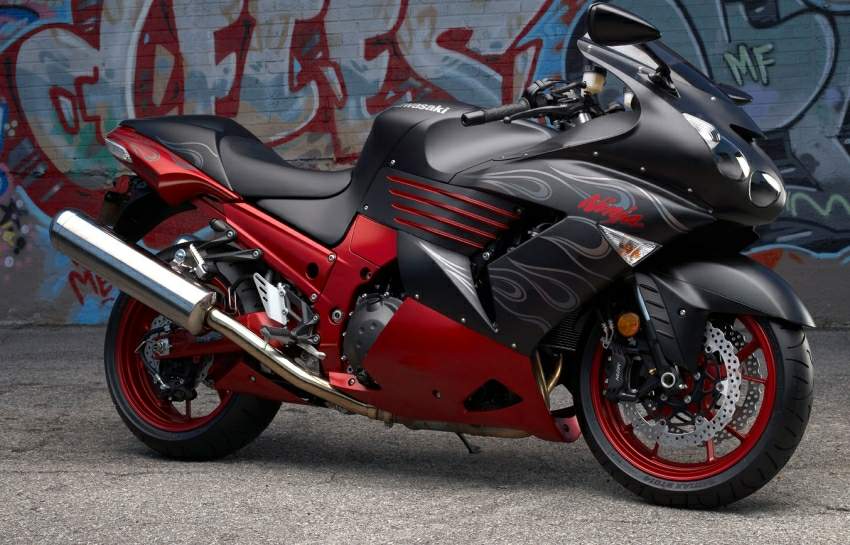
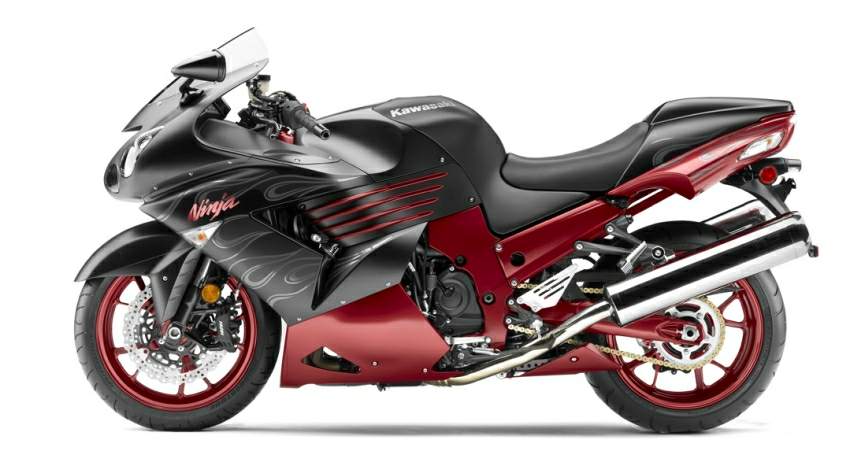
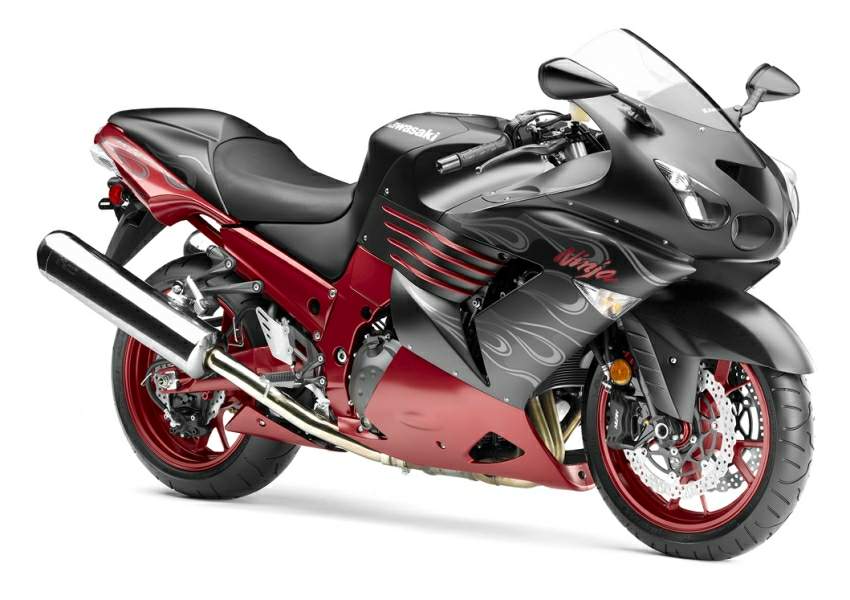
Kawasaki ZZ-R 1400 Special Edition
The US only ZZR1400 gets a red-and-black theme but with flame-effect graphics and a red anodized finish on the entire frame, subframe and swingarm as well as the wheels.
KAWASAKI’S FORMIDABLE FLAGSHIP, THE 2008 NINJA® ZX™-14 FINE-TUNED FOR EXTRA FIREPOWER Every champion knows sustained dominance is only possible with constant improvement. Such is the case with Kawasaki’s Ninja® ZX™-14. Since its debut in March of 2006, this motorcycle has ruled the open class sportbike roost with nearly non-stop magazine comparison victories. Even though the 1352cc Ninja ZX-14 won lavish praise for its massive torque, effortless power, agile handling and comfortable ergonomics, Kawasaki engineers were not willing to leave the door open to potential challengers.
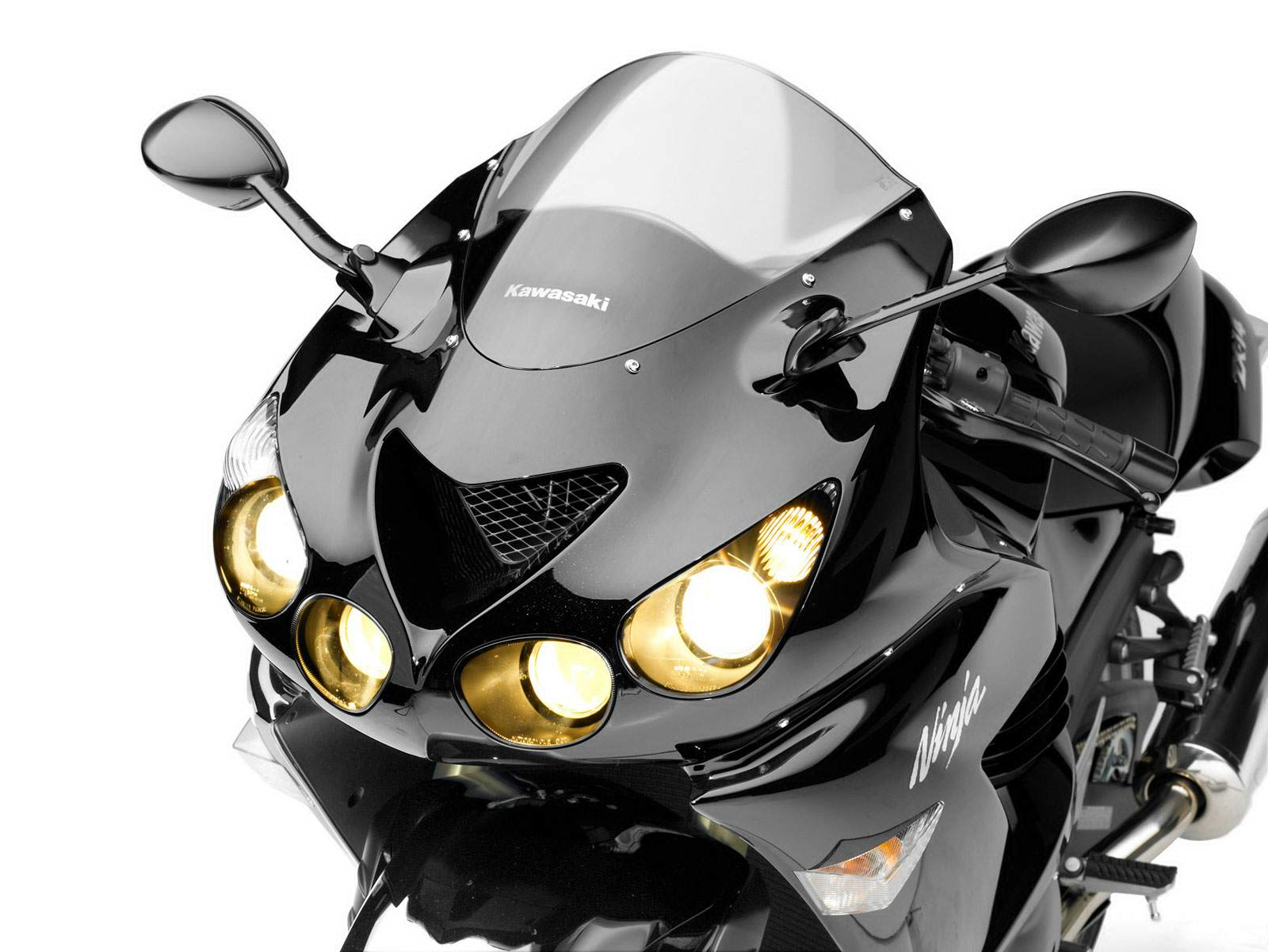
The 2008 ZX-14 retains all the great features that made it a legend, plus more bottom, mid and top-end power. Changes to the engine and exhaust system allow it to comply with strict Euro-III emissions and tightening noise regulations. To meet noise standards, the engineers focused on reducing internal mechanical noise instead of muzzling the exhaust system. The result wasn’t a power loss, but an overall improvement of the engine character and an actual increase in the ZX-14’s legendary peak power! Yes, you read that correctly. Emissions and noise levels are lower, peak power is higher, the mid-range hit is stronger and smoother and low-end torque has been increased. A win-win solution for all, in our books. To achieve those stringent emission levels, a third honeycomb catalyzer was added in the collector, joining the two honeycomb catalyzers already in each silencer. The secondary air ports in the cylinder head and its cover were made approximately 20 percent larger to permit an easier air flow into the exhaust system. A new Air Switching Valve (ASV) caps off the low emission updates and can handle approximately five percent more flow than the last year’s version. Conquering the challenging Euro-III regulations is admirable, but Kawasaki took it to the next level on the ZX-14 with changes to its 1352cc engine which improve the power characteristics while meeting noise regulations. The injection system was first to receive attention in an effort to boost peak power, give a more linear mid-range and stronger low end torque with the same user-friendly personality. The fine-atomizing fuel injectors had their lateral spray angle increased from 15 to 20 degrees to disperse the atomized fuel over a wider area and the intake porting was revised to provide optimum flow characteristics. Outside of the engine, the exhaust silencers feature refinements to the capacity of the first and third chambers and the lengths of the pipes projecting from the baffle plates have been adjusted. Next the entrances to the connecting tubes (joining header pipes 1-4 and 2-3) were enlarged approximately 75 percent to compensate for the new collector shape, which was altered to allow the inclusion of a third honeycomb catalyzer. These changes were a major component of the enhanced the torque characteristics, especially in the low rpm range. Reducing internal mechanical noise allowed for the engineers to employ comparatively little exhaust modification to meet noise mandates and consequently the exhaust system could remain free flowing for greater power. Lower mechanical noise was attained by revising the piston profiles and adding a urethane insulation sheet to the inside of the magnesium chain cover. The engine and exhaust system weren’t the only areas updated for 2008. The ZX-14’s chassis design is every bit the equal of its power plant. Using an advanced version of Kawasaki’s unique aluminum monocoque design, its frame is lightweight and very strong. Switching to die instead of gravity casting for the cast aluminum sections of the main frame resulted in lighter parts, allowing the Kawasaki engineers to shave weight on the already slim and compact frame. Featuring a relaxed sport riding position, the ZX-14 is compact without being cramped, with its bars positioned within easy reach. The narrow engine, monocoque frame, and fuel tank provide a slim rider interface. Footpegs are low-set to give ample legroom and the low seat height and narrow seat front make it easy to plant both feet on the ground when stopped. Comfort levels are high enough that riders might think they’re on a dedicated sport tourer, but one twist of the ZX-14’s throttle is all it takes to remind anyone this is the world’s quickest and most powerful production motorcycle. Uninterrupted fairing lines give the ZX-14 a smooth, flowing appearance from front to rear due in part to the monocoque frame that goes over the engine and doesn’t protrude through the cowling. Quadruple projector beam headlights adorn the ZX-14’s front, with low beams in the two center lenses and the outer lenses containing the high beams and position lamps. The turn signals are cleanly integrated into the fairing and rear cowl with a unique “V” design LED tail lamp capping off the sleek aerodynamics of the ZX-14 that reinforces Kawasaki’s aircraft heritage. This blending of form, power, and handling characteristics yields a motorcycle with appeal that extends far outside of its high performance audience. The Ninja ZX-14 lives up to its Ninja heritage, by surpassing the competition.
Key Features: - Reduced emissions and mechanical noise with more peak power and low-end torque for 2008 - Well-balanced aluminum monocoque frame provides superb stability and reflexive handling - Flagship ride quality with rider friendly ergonomics and that distinctive Ninja styling - Excellent control and feedback from the 43mm inverted fork and fully adjustable Uni-Trak rear suspension 1,352cc Four-Cylinder, DOHC Engine - Tuned to provide smooth power across a very wide rev range while raising Kawasaki’s legendary horsepower standards to a new level - Revised cylinder head and head cover with 20% larger secondary air ports to flow more air into the exhaust - Carefully planned engine design keeps it compact and narrow - Chrome composite plated aluminum cylinder bores are lightweight, durable, and quickly carry heat away from the combustion chamber and piston for supreme durability at high power outputs Reduced Mechanical Noise - Revised piston profile produces less noise for 2008 - New urethane insulation sheet added to the inside of the magnesium chain cover to aid in reducing mechanical noise Exhaust - Third honeycomb catalyzer added to the collector help meet strict Euro III emissions standards - Revised internal silencer construction minimized impact of emissions regulations, preserving top-end power - Exhaust connecting tube entrances enlarged approximately 75% to compensate for new collector shape (revised for the third catalyzer) for enhanced low rpm torque characteristics Gear-Driven Dual Engine Balancers - Already in perfect primary balance, dual secondary balancers virtually eliminate unwanted vibrations for extremely smooth engine operation and reduced rider fatigue Ram Air Induction - Central Ram Air duct produces a straighter path to the airbox for maximum intake efficiency - Takes cooler, high-pressure air from in front of the fairing and guides it through the air cleaner and into the engine for maximum power output Digital Fuel Injection - New intake porting optimizes flow characteristics - New injectors feature an increased lateral spray angle from 15 to 20 degrees to disperse the finely-atomized fuel over a wider area - Fine-atomizing injectors produce 75µ droplet size - 44mm Mikuni throttle bodies are fitted with sub-throttle valves, controlled by the ECU to provide precise response, make DFI® performance smoother, and met Euro III emission requirements - 32-bit ECU works with dual throttle valve system to further enhance throttle response and control Digital Ignition - Digital Timing Advance enhances low-and mid-range power - Four individual spark plug-mounted ignition coils fire each spark plug independently to achieve the optimum timing for that cylinder at that instant - ECU includes an idle speed control system for easier starting and warm-up Radial Pump Clutch Master Cylinder - Hydraulic clutch features a radial-pump clutch master cylinder for smooth and precise clutch engagement Next-Generation Monocoque Aluminum Frame - Lightweight, monocoque frame is a hollow aluminum box that arches over the engine from the steering head to the swing arm pivot. It is narrow, strong, rigid and very light - New for 2008, the frame’s cast aluminum sections - steering head and swing arm pivot areas –are now produced with a die casting process instead of gravity casting resulting in further weight savings - Engine is rigidly mounted to the frame to increase its torsional rigidity. Using the engine as a stressed frame member also saves approximately four pounds - Engine positioned forward in the frame, and the wheelbase and front/rear weight balance were carefully designed to achieve high-speed stability and responsive handling - Massive head pipe casting contributes to frame rigidity - Houses the air box and air filter in a space-saving design that actually simplifies air cleaner maintenance. Two screws hold a plate on the left side of the frame that allows air cleaner access - Battery is also housed within the frame and has simple access through the back side of the frame Inverted 43mm Cartridge Type Front Fork - Damping rates offer stiff initial action to resist front-end dive when braking - Stepless damping adjustment improves suspension performance Bottom-Link Uni-Trak® Rear Suspension - Linkage rates provide linear suspension action - Bottom-link design concentrates the weight lower in the chassis for a lower center of gravity, which makes the motorcycle more nimble Radial Mounted Petal Front Disc Brakes - Radial mounted four-piston front brake calipers utilize integrated mounting points at both the top and bottom of the caliper, with the mounting bolts inserted through the rear of the caliper instead of the side/front. This makes the caliper more rigid, which improves brake feel over a wider range of operation - A separate brake pad is used for each piston. Individual pads provide increased cooling efficiency and can absorb more heat without deforming so they maintain consistent brake feel stop after stop - Petal design brake discs provide better cooling and warp resistance - Radial-pump front brake master cylinder improves brake performance and lever feel - Wheel rims feature center ribs which are slightly offset so tire balance weights can be located precisely along the wheel’s centerline. Wind Tunnel-Designed Bodywork - Monocoque frame goes over the engine the fairing is uninterrupted by protruding frame spars, adding to the extremely long and low styling. - Both the front and rear turn signals are integrated into the bodywork and have clear lenses to enhance the appearance - Quadruple projector beam headlights give the ZX-14 a distinctive upper fairing. The outer lights contain position lamps and the high beams, while the low beams are in the center lamps - Lightweight Denso radiator with high-density cores provides maximum cooling efficiency Full Instrumentation - Dual analog speedometer and tachometer with white faces are easy to read - Multi-function LCD digital display includes an odometer, two trip meters, fuel gauge, gear position indicator and a clock - Programmable shift indicator lamp illuminates at pre-set rpm to signal rider upshift - Programmable clutch engagement lamp illuminates at pre-set rpm to signal the rider to engage the clutch - CAN (Controller Area Network) interface between the gauges uses fewer wires while allowing a greater volume of information, such as estimated fuel mileage, to be exchanged
|
|
|
Any corrections or more information on these motorcycles will be kindly appreciated. |