1,352cc Four-Cylinder, DOHC Engine
- Tuned to provide smooth power across a very wide rev range, while producing
impressive horsepower numbers
- Chrome composite plated aluminum cylinder bores are lightweight, durable, and
quickly carry heat away from the combustion chamber and piston for supreme
durability at high power outputs
- Carefully planned engine design is compact and narrow
Low mechanical noise via special piston profile and urethane insulation sheet on
the inside of the magnesium chain cover-
Exhaust
- Airflow into the exhaust from the large secondary air ports in the cylinder
head and head cover, plus a third honeycomb catalyzer in the collector help meet
strict Euro III emissions standards
- Internal silencer construction minimizes impact of emissions regulations while
maintaining impressive top-end power
- Exhaust connecting tube entrances are designed to enhance low rpm torque
characteristics
Gear-Driven Dual Engine Balancers
- Already in perfect primary balance, dual secondary balancers virtually
eliminate unwanted vibrations for extremely smooth engine operation and reduced
rider fatigue
Ram Air Induction
- Central ram air duct draws the cooler, higher-pressure air from the face of
the fairing and efficiently guides it through the air cleaner and into the
engine for maximum power output
Digital Fuel Injection
- 44mm Mikuni throttle bodies are fitted with sub-throttle valves, controlled by
the ECU to provide precise response, make DFI® performance smoother, and help
meet Euro III emission requirements
- Intake porting optimizes flow characteristics
- Injectors deliver lateral spray at a 20 degree angle to disperse the
finely-atomized fuel over a wider area
- Fine-atomizing injectors produce 75µ droplet size
- 32-bit ECU works with dual throttle valve system to further enhance throttle
response and control
Digital Ignition
- Digital Timing Advance enhances low-and mid-range power
- Individual spark plug-mounted ignition coils fire each of the four sparkplugs
independently to achieve the optimum timing for that cylinder at that instant
- ECU includes an idle speed control system for easier starting and warm-up
Radial Pump Clutch Master Cylinder
- Hydraulic clutch features a radial-pump clutch master cylinder for smooth and
precise clutch engagement and feel
Next-Generation Monocoque Aluminum Frame
- Lightweight, monocoque frame is a hollow aluminum box that arches over the
engine from the steering head to the swing arm pivot. It is narrow, strong,
rigid and very light
- Frame’s cast aluminum sections - steering head and swing arm pivot areas – are
produced with a die casting process for further weight savings
- Rigidly mounted engine is a stressed frame member, which increases the frame’s
torsional rigidity and saves approximately four pounds
- Engine positioned forward in the frame, with the wheelbase and front/rear
weight balance carefully designed to achieve high-speed stability and responsive
handling
- Massive head pipe casting contributes to frame rigidity
- Frame houses the air box and air filter in a space-saving design that
simplifies air cleaner maintenance
- Battery is also housed within the frame and has simple access through the back
side of the frame
Suspension
- Inverted 43mm cartridge type front fork utilizes damping rates that offer
stiff initial action to resist front-end dive when braking
- Stepless damping adjustment improves suspension performance
- Excellent control and feedback from fully adjustable bottom-link Uni-Trak®
rear suspension
- Linkage rates provide linear suspension action
- Bottom-link design concentrates helps create a lower center of gravity, which
makes the motorcycle more nimble
- Wheel rim center ribs are slightly offset so tire balance weights can be
located precisely along the wheel’s centerline
Radial Mounted Petal Front Disc Brakes
- Radial mounted four-piston front brake calipers offer greater rigidity than
traditional caliper mounting, to improve brake feel
- A separate brake pad is used for each piston. Individual pads provide
increased cooling efficiency and can absorb more heat without deforming, so they
maintain a consistent brake feel longer
- Petal design brake discs provide better cooling and warp resistance
- Radial-pump front brake master cylinder improves brake performance and lever
feel
Wind Tunnel-Designed Bodywork
- Monocoque frame goes over the engine so the sleek fairing is uninterrupted by
protruding frame spars, adding to the extremely long and low styling
- Both the front and rear turn signals are integrated into the bodywork and have
clear lenses to enhance the appearance
- Quadruple projector beam headlights give the ZX-14 a distinctive front
fairing. The outer lights contain position lamps and the high beams, while the
low beams are in the center lamps
- Lightweight Denso radiator with high-density cores provides maximum cooling
efficiency
Full Instrumentation
- White faced dual analog speedometer and tachometer are easy to read
- Multi-function LCD digital display includes an odometer, two trip meters, fuel
gauge, gear position indicator and a clock
- Programmable shift indicator lamp illuminates at pre-set rpm to signal rider
upshift
- Programmable clutch engagement lamp illuminates at pre-set rpm to signal the
rider to engage the clutch
- Controller Area Network (CAN) interface between the gauges uses fewer wires
yet allows a greater volume of information, such as estimated fuel mileage, to
be exchanged
lo-band | hi-bandIt was a little over a year ago
when the rumors surfaced about a more powerful Suzuki Hayabusa being in the
pipeline. Now hitting dealers, the reborn ’Busa packs larger, 1340cc brass
knuckles, and this was going to be a threat at usurping the 2006
king-of-the-mountain 1352cc ZX-14.
The ZX-14, introduced in early ’06, was a worthy competitor to the legendary
Hayabusa. Its turbine-like motor out-muscled the Suzuki – no mean feat – and, as
a whole, the big Ninja proved to be a smoother, more polished road burner.
In an effort to keep pace with the new threat from Team S, Kawasaki engineers
have tweaked the ’08 ZX-14 to produce more power while meeting stringent Euro 3
emissions standards. Press materials state that Kawi engineers “were not willing
to leave the door open to potential challengers,” a thinly veiled reference to
the ’Busa. As a result, they’ve now delivered this mid-cycle freshening that we
were recently able to sample on some twisty SoCal roads and at California
Speedway’s dragstrip.
Kawasaki has tweaked its ZX-14 to offer more power from the bottom end to the
top.
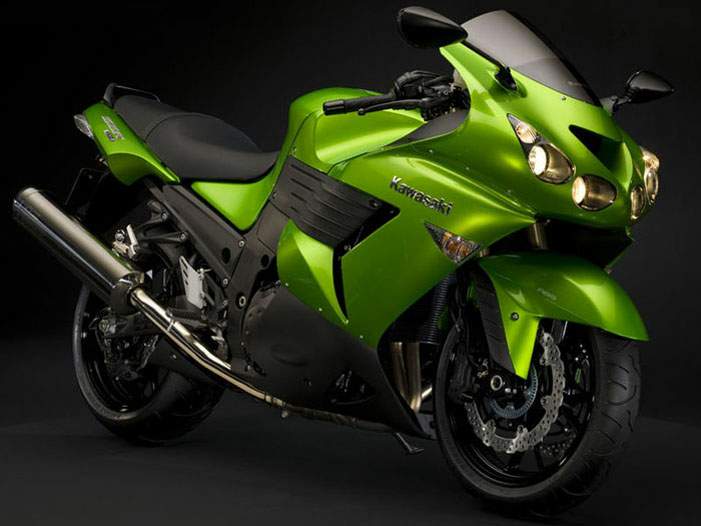
Atomic Silver is a new color for the revised ZX-14. Underneath is a new frame
“Enhance the bottom-end,” said Kawi Product Manager Karl Edmondson at the event.
“That was the whole goal.”
The mega-Ninja’s new cylinder head is the biggest mechanical change. Revised
intake porting is teamed with 20% larger secondary air ports for a less
restrictive passage into the exhaust. A new air-switching valve is able to
handle a bit more flow. The sub-throttle injectors were tweaked to provide a
wider spray angle for improved atomization, part of what boosts the lower-end
and midrange power. A new ECU monitors and controls the electronics, offering
revised fuel and ignition mapping.
To comply with tightening noise regulations, Kawasaki made a few changes to
reduce mechanical noise so they could keep the exhaust note relatively burly and
the system as unrestrictive as possible. A urethane coating is used on the valve
cover to keep mechanical noise inside, and revised piston profiles generate less
racket. A host of changes to the exhaust system include 75%-larger balance tubes
between the headers and the accumulation of a third catalyst to clean up
tailpipe discharge.
In addition to more low-end and midrange power, Kawi claims to have whipped up
three extra ponies up top, now a claimed 190 horsepower at the crankshaft. Peak
torque of 113.5 ft-lbs is reached at 7500 rpm. Another 10 horses are gained with
the benefit of ram-air induction at top speed, which is still electronically
limited to 186 mph as per a gentlemen’s agreement among manufacturers.
“We might reasonably expect nearly 175 hp out of this new one.”
Last year’s ZX pumped out a whopping 171 horsepower at the rear wheel, so we
might reasonably expect nearly 175 out of this new one. The new ’Busas are
regularly topping the 170-hp mark on the dyno, so we’re anticipating an
ultra-competitive shootout when we get the two bikes together for comparison.
Anyway, kudos to Kawasaki for making a bike that produces fewer emissions while
making more and better power.
The ZX-14 is capable in the twisties thanks to sportbike steering geometry
balanced by a stability-inducing 57.5-inch wheelbase.
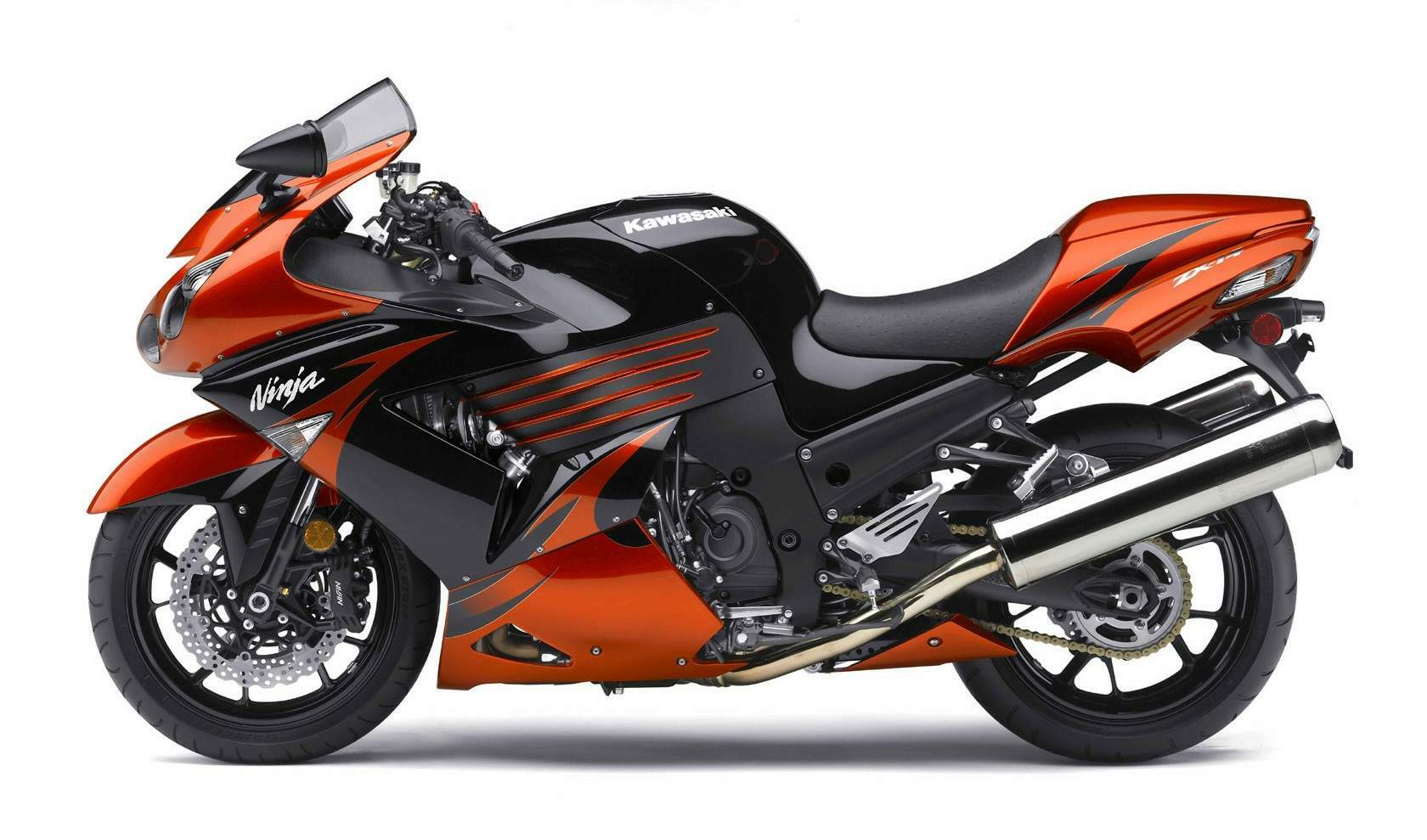
This view depicts the ZX-14’s swoopy curves and elongated length
While the bike’s outward appearance is unchanged, the skeletal structure
underneath has been modified. The aluminum monocoque-style frame is now formed
by a die-cast method rather than a gravity-cast design to slightly reduce
weight. Despite this, the ZX’s claimed dry weight is up from 474 lbs to 485 lbs,
a result of the heavier exhaust system. The flowing aero design of the original
bike remain, with its distinctive quadruple projector beam headlights and
turnsignals neatly integrated into the fairing and rear tailsection.
Our day on the updated ZX began with a street ride into the San Bernardino
Mountains that were recently hit hard by wildfires. I’d like to make a clever
analogy about the big Ninja ravaging the roads like the marauding flames, but
the massive damage from the fires wasn’t very evident on the main roads on which
we traveled. Moreover, the ZX proved to be pleasantly docile, not the beast you
might expect. In fact, the 14 could easily be managed by a relative newbie if
the tach was kept below 6000 rpm, such is its liquid-smooth power delivery that
is unintimidating at low revs.
But if given a handful, the ZX-14 responds like a beast from the netherworld.
Pine trees quickly become blurred, and that corner which a second ago seemed so
far away is rapidly looming in the foreground. Good thing for the longish
57.5-inch wheelbase that keeps wheelies to a minimum, because this road missile
romps through 100 mph harder than a 600 can at 60.
Dragracing is kind of like gunfighting. Lucky for Duke, the left lane was empty.
Which isn’t to say I really noticed the extra power harvested in the revised
motor. The old bike already smashed your eyeballs against the back of your
cranium under its wicked acceleration, so any added power was just another
degree of flattened retinas. The sheer ferocity of the way this thing gains
speed can frighten even a self-confessed speed freak.
But it’s no secret the super-Ninja is outrageously fast. Buried under that
headline is how this wonderfully silky GT comports itself during typical street
sorties. The riding position is sporting but not punishing, and its longish
wheelbase handily sucks up mid-corner bumps. Its cockpit is quite inviting, with
a reasonable amount of wind protection and a clean set of gauges including a
gear-position indicator that is referred to more often than you might imagine. A
low seat height inspires confidence in dwarfs like myself.
A relatively steep 23.0-degree rake angle and a short 94mm of trail results in a
fairly sharp-handling machine for its size. On/off throttle response isn’t
abrupt, and its radial-mount caliper twin discs up front have a potent squeeze
that’s quite appropriate for a rocket like this.
Source Motorcycle.com 2008
NOTE: Some of the photos on
Motorcycle Specs are owned by somebody. If you see any of your
photos, you can let me know so that I can acknowledge it, or if
you object to it, I can remove it altogether. If any copyright
holder objects to their articles being placed on Motorcycle
Specs, it will be removed upon request. Any correction or more
info on these bikes will kindly beappreciated
Contact MePrivacy
Policy
Website Stats