|
|
|
|
Classic Bikes
Custom Bikes
Individual
Racing Bikes AJP
AJS
Aprilia
Ariel
Avinton / Wakan
Bajaj
Benelli
Beta
Bimota
BMW
Brough Superior
BRP Cam-Am
BSA
Buell / EBR
Bultaco
Cagiva
Campagna
CCM
CF Moto
Combat Motors
Derbi
Deus
Ducati
Excelsior
GASGAS
Ghezzi Brian
Gilera
GIMA
Harley Davidson
Hero
Highland
Honda
Horex
Husaberg
Husqvarna
Hyosung
Indian
Jawa
Kawasaki
KTM
KYMCO
Laverda
Lazareth
Magni
Maico
Mash
Matchless
Mondial
Moto Guzzi
Moto Morini
MV Agusta
MZ / MuZ
NCR
Norton
NSU
Paton
Peugeot
Piaggio
Revival Cycles
Roland Sands
Royal Enfield
Sachs
Sherco
Sunbeam
Suzuki
SWM
SYM
Triumph
TVS
Ural
Velocette
Vespa
Victory
Vincent
VOR
Voxan
Vyrus
Walt Siegl
Walz
Wrenchmonkees
Wunderlich
XTR / Radical
Yamaha
Zero
Video
Technical
Complete Manufacturer List
|
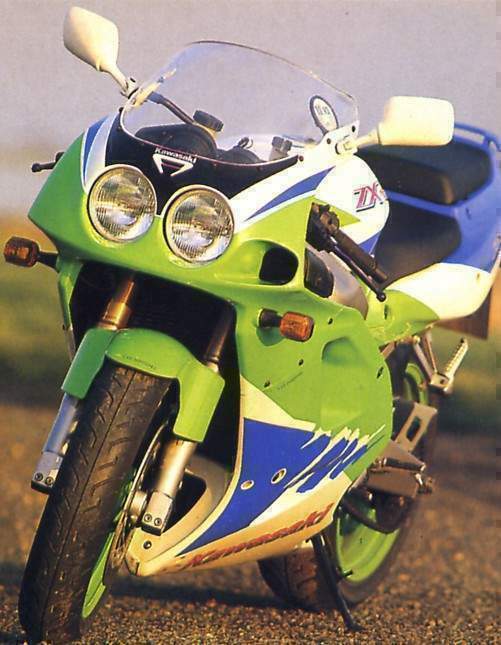
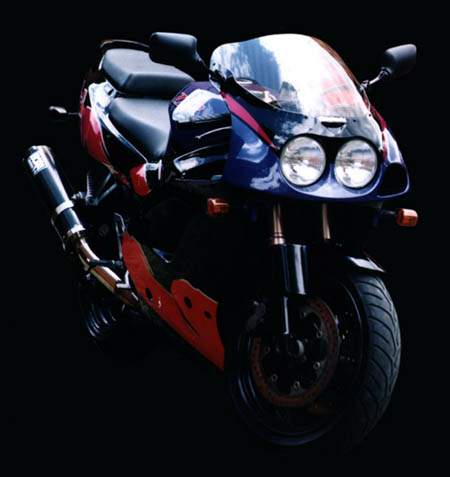
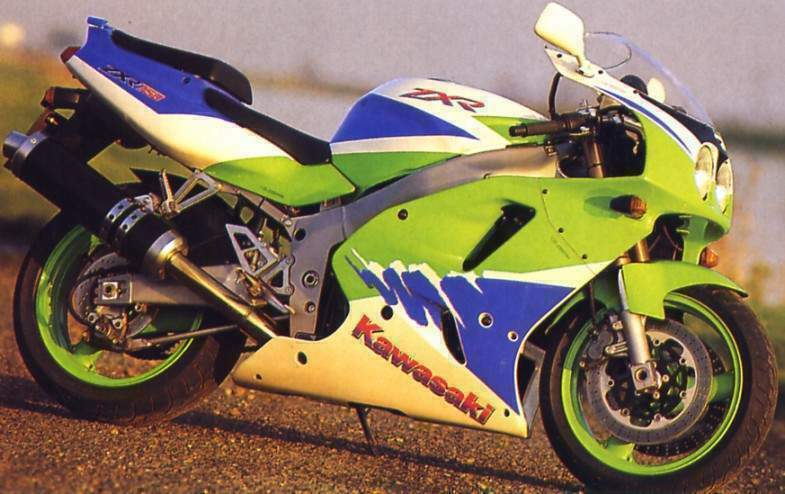
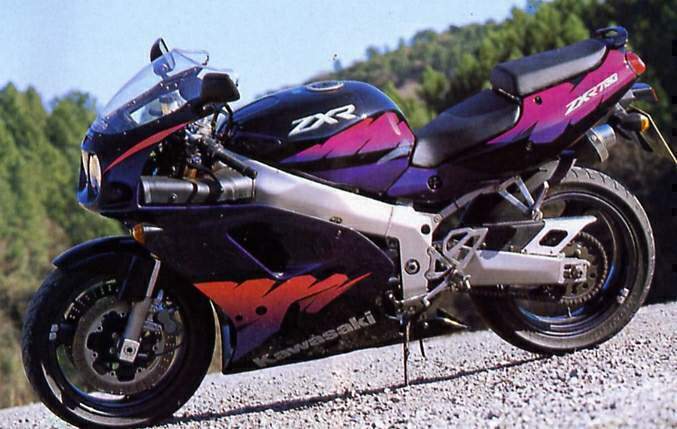
Kawasaki ZX-R 750-L
Flawed genius? That's a widely-held view of
the Kawasaki ZXR750. Who better then than ROB SMITH to give us all we need
to know to purchase the bike..?
Source Bikepoint
Review You have to admire Kawasaki's humility. They have what is probably the second best bike in the world; they improve it considerably; they modestly shy away from perfection by continuing to use the most awkWard fuel tap known to man. Everyone must be tired of hearing about the J's rear suspension by now; the handling and ride position were superb; its engine had an enormous midrange and an indifferent top end. Most of that is changed. A new rocker linkage makes the ride as smooth and slinky as something which I suspect I'm not allowed to mention. Or even know about, come to that. The steering and handling are still superb, the more so in the knowledge that you are no longer likely to be kicked out of the seat at a mere millisecond's notice. The midrange has been traded for a powerful top end, leaving a fairly lumpy torque curve in its place. The result is a top speed approaching 160mph but standing starts which are worse than before, and everything in between is in between. Like most other Kawasaki four-strokes, the ZXR is a bit cold-blooded when it is first fired up. It races on choke and the fast idle is not easy to control. Many riders complain about this, but I would have thought that if the carburation was clean and crisp when the motor was fully warmed, you'd expect it to be obnoxious when it was stone cold, so in a way this might be a good sign. For normal riding the motor is perfectly flexible, not as strong in top gear as the Jl but not exactly limp wristed either. Getting away briskly is no problem. Finding the absolute best drive is. Give it too much and the short, light bike wheelies. Give it less and it bogs down. Somewhere between the two there is a perfect, clean launch but on an unenthusiastically cold day at Bruntingthorpe the best I could find was an 11.56-second standing quarter, a tenth of a second worse than last year's J, all lost in the first fifty yards. Later, I was surprised to find that the computer agreed, in fact it thought the initial acceleration would be even worse. It reckoned the 157mph top speed was about right. They've made it as fast as the GSX-R and ironically they have made it nearly as heavy, where once the ZXR had a 13kg advantage.
But the Suzuki, with less torque (and presumably lower gearing) gets better drive, You'd only notice it at a drag strip, though. Once moving, the ZXR feels stronger and longer legged, happier to pull top gear for sudden overtaking, equally happy to buzz down through the gears for serious acceleration. Where the ZXR really scores, is still the same as the J: the combination of riding position, steering and handling is perfect. It is not only ideal for shifting your weight from footrest to footrest when flicking through tight chicanes, it is just right for finding maximum traction in fast corners, slow corners and wet corners. It feels right in all conditions, it's even comfortable on long motorway journeys. Kawasaki say they have changed this aspect slightly. Euro-spec bikes have fractionally slower geometry and a taller seat height, but to be honest, I couldn't feel the difference. Except over the office steps, which our J clears with inches to spare and upon which the L scraped its bellypan. I suspect that there are two reasons why the handling didn't seem noticeably different. One, when the frame is stiff and the riding position is good, small changes in geometry and suspension settings aren't critical. Two, the bike was more limited by its tyres — Sportmaxes — which are very stable and seem to wear quite well, but are not as good in other respects as the Bridgestone, Michelin and Metzeler alternatives, especially on cold, December tarmac. In the wet, the Dunlops gave a reassuringly steady feel and the braking was nicely balanced for all conditions. On slippery roads, the tiny rear brake has just enough bite to be useful without being a liability. On dry roads the front has so much power that it can lift the back of the bike, so the rear brake becomes unnecessary. Again, the riding position lets you make the most of whatever grip is going. It is easy to shift weight quickly and it becomes automatic to move around, feeling for maximum traction. It is more than just the dimensions between footrest, seat and handlebar, the shape of the seat and tank also contribute. There are small changes here, too. The tank and under-seat layout are different, to accommodate the new intake arrangement. There are subtle changes to the bodywork, too, mostly making it easier to remove and replace. Kawasaki say the aerodynamics are better, which may be true because the flat-on-the-tank top speed was 8.5mph better than the J2 (May '92 issue) while the sitting-up maximum was only 4.5mph better. So if 5mph is due to more power, the remaining 3 or 4mph is probably due to a reduction in drag. The snag is that in normal riding there seemed to be more wind buffeting at shoulder height compared to the J. Other real world performance includes 40 to 45mpg, which gave a too-short 120-mile tank range before reserve and the useless, bordering on dangerous, reserve tap. The only saving grace is that you could usually feel the motor leaning off half a mile before running on to reserve, but that didn't stop it happening in the middle of a greasy roundabout or somewhere equally embarrassing. A couple of other design errors appeared. The J would cheerfully knock out the rear wheel cush drive between services and the L was showing half an inch of play after 1000 miles. And they may have found an extra 15mm of rear wheel travel but when front and rear suspension bottoms, the bellypan now hits the floor. Misjudging a hump-back bridge could become an expensive mistake, as Simon has recently discovered. I think they could afford to rectify a few of these imperfections without offending too many gods, but at least they have pitched the price in the right place. At £6300 it is level with the GSX-R and well ahead of the CBR900 and the YZF — which I see as its closest competitors. And for £6020 you can still buy the J2, leaving enough change for a rear suspension rocker and a very good Facts Another 8 or 9 horsepower and suspension that actually works... just what the ZXR needed. And we can smugly point out that KHI have done almost exactly what we did to our long-term test J1 (as a matter of fact, ours is 3mph quicker and has a fuel tap which works in a more ergonomic way). the engine gets K cams and new pistons which take the compression up to 11.5:1 from the original 10.8. When we were playing with the J1 on TTS's dyno we found that we needed to get it burning properly before it would respond fully to other steps like changing the cams or the exhaust system. We did it by increasing the squish band, raising the compression and advancing the ignition timing by a fairly arbitrary 4°. The factory had rather more choice in the matter and the new pistons are accompanied by a head redesign which gives more compact chambers and more valve area. They did this by reducing the included angle between the valves, down to 20°, which is the usual way to improve combustion chambers. It makes an interesting comparison with the YZF (see page 50) in which Yamaha say they've increased the angle between the valves. I suspect that they had a different motive — with the cams operating the valves directly through buckets and shims, a steeper valve angle makes the engine taller, which was the last thing Yamaha wanted to do. Having tipped the cylinder block upwards to suit the shorter frame, they needed to minimize height in order to keep the bike's frontal area as low as possible. Kawasaki operate their valves through a neat finger rocker which slides to one side so that the adjusting shims can be changed. It's a bit heavier, but it gives the designer more freedom, it is easy to maintain and it's safe to 14,000. The valves are 0.5mm bigger, the ports smoother but the carbs stay the same at 38mm. A digital ignition system has a new advance curve, going up to 50° at 7000rpm, compared to the old one which gave 42.5° at 6200. Air reaches the carbs by a new route, namely a huge, 12-litre air box which is force fed from the large duct in the front of the fairing. The pressure increase isn't as big as you might think; two or three years ago I helped do some tests on racing OW01 s and even at 170mph the pressure increase was only about 0.5psi. This agrees closely enough with theory and is worth a few per cent more power. However, half a psi is more than enough to seriously screw up the carburation, especially as the full pressure will only be there in top gear; as road speeds drop, the pressure will also drop. In first and second gears it will be negligible. Any gain is worth having and in this case it may prevent losses. High speed air blasting past the sides of the bike creates low pressure which will bleed air out from inside the fairing, or under the tank and seat area, ie where the air box (or open carbs) normally get their air from. So conventional layouts may experience the opposite effect — decreasing intake pressure as the bike speed goes up. This will reduce power output slightly at high speed and will have just as many bad effects on the carburation. At least Kawasaki are putting the air exactly where it is needed (helping to improve the aerodynamics generally and reduce internal drag) and they have solved the speed-sensitivity problem by venting the carb float bowls into a carefully chosen part of the air box. The box has one chamber ahead of the frame, a narrowed section where it goes through the frame member and the main box itself. Where the air is travelling slowest — in the biggest part of the box — its pressure will be highest. In the narrow venturi section it will be travelling faster and exerting less pressure. If the effect of increasing air pressure at high speed is to make the carbs lean off, then venting them to a high pressure region would make them richen up again. If the increased air supply makes the mixture go rich, then the vents need to get low pressure to weaken it off. By far the nicest thing about this induction system is the way it growls when the throttles are opened from the low midrange. The overall result is 103bhp on the TTS Dynojet, compared to 95bhp for the standard J. It is quite a bumpy curve, suggesting that the fuelling might wander about a bit or, more likely, that the longer duration cams are more sensitive to intake and exhaust resonances and they've deliberately created a mismatch somewhere in order to prop up the midrange. Imagine if whatever created that peak just above 8000 had done its particular business to reinforce the other peak at 10,000: no midrange at all and an immense rush of power that comes in with a smack at 9500. It will be interesting to see what the R version (with 39mm slide carbs) does between 8000 and l1000rpm. The main change to the chassis is, not unnaturally, to the rear suspension. After reducing the spring rate and the damping force on the J2, they have modified the rocker arm for the L1, in more or less the same proportions as NWS made their linkage for the J. It gives 135mm of wheel travel instead of 120, using the same shock unit. This not only gives some 12% better leverage over the spring but reduces the damper speed by the same amount and as the damper force is proportional to speed-squared, bump damping will be reduced by about 22% for the same amount of wheel travel. The result is a soft, compliant ride that absolutely refuses to buck you out of the seat. Other changes include reducing the fork diameter down from 43 to 41 mm (to save weight, which is otherwise 10kg up on the J); the swing arm is stiffer and there are gussets on the main frame, behind the headstock. In anticipation of the extra speed, the castor is raked out by half a degree and there is 4mm more trail and 10mm more wheelbase. This only applies to European specs, so you'll need a rest of the world spec bike for racing. Kawasaki already had the best riding position (see also the YZF report) and they have made the wise move of raising the seat height by 20mm they say, although it doesn't feel like it and it is nowhere near as high tailed as our J1. Finally, the exhaust. Still stainless where it emerges from the fairing, still rusty underneath the fairing and the silencer is anodised aluminium coated with a carbon fibre look. Next year: brick pattern wallpaper.
|
|
|
Any corrections or more information on these motorcycles will be kindly appreciated. |