|
|
|
|
Classic Bikes
Custom Bikes
Individual
Racing Bikes AJP
AJS
Aprilia
Ariel
Avinton / Wakan
Bajaj
Benelli
Beta
Bimota
BMW
Brough Superior
BRP Cam-Am
BSA
Buell / EBR BullitBultaco
Cagiva
Campagna
CCM
CF Moto
Combat Motors
Derbi
Deus
Ducati
ExcelsiorFantic
GASGAS
Ghezzi Brian
Gilera
GIMA
Harley Davidson
Hero
Highland
Honda
Horex
Husaberg
Husqvarna
Hyosung
Indian
Jawa
Kawasaki
KTM
KYMCO
Laverda
Lazareth
Magni
Maico
Mash
Matchless
Mondial
Moto Guzzi
Moto Morini
MV Agusta
MZ / MuZ
NCR
Norton
NSU
Paton
Peugeot
Piaggio
Revival Cycles
Roland Sands
Royal Enfield
Sachs
Sherco
Sunbeam
Suzuki
SWM
SYM
Triumph
TVS
Ural
Velocette
Vespa
Victory
Vincent
VOR
Voxan
Vyrus
Walt Siegl
Walz
Wrenchmonkees
Wunderlich
XTR / Radical
Yamaha
Zero
Video
TechnicalManufacturer ListContact
|
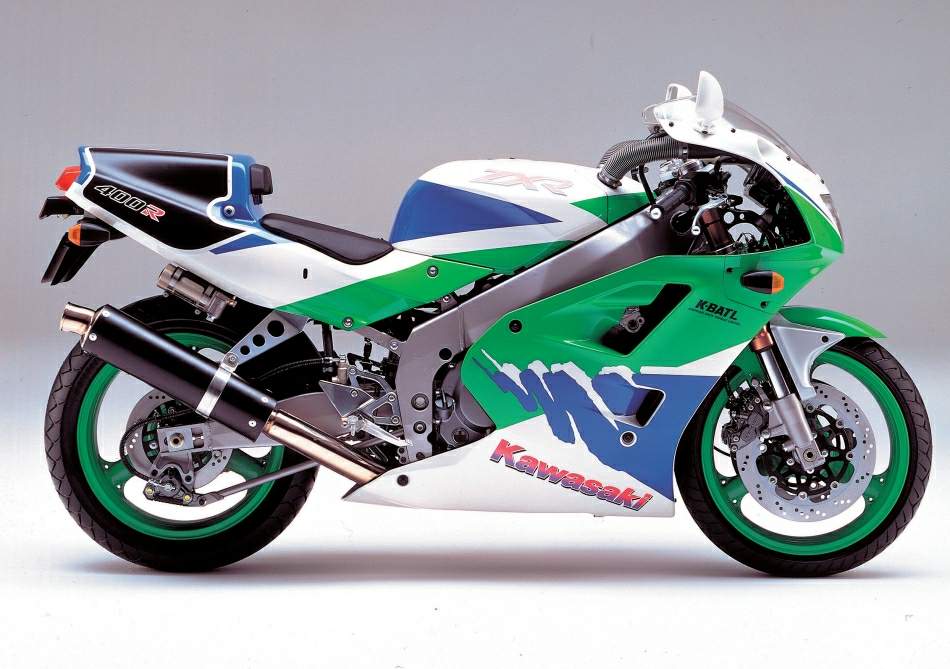
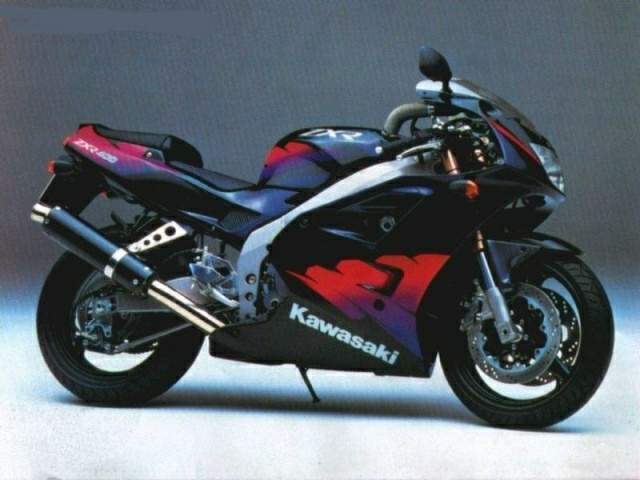
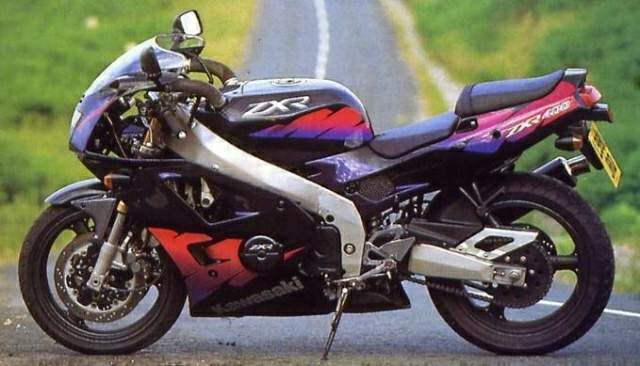
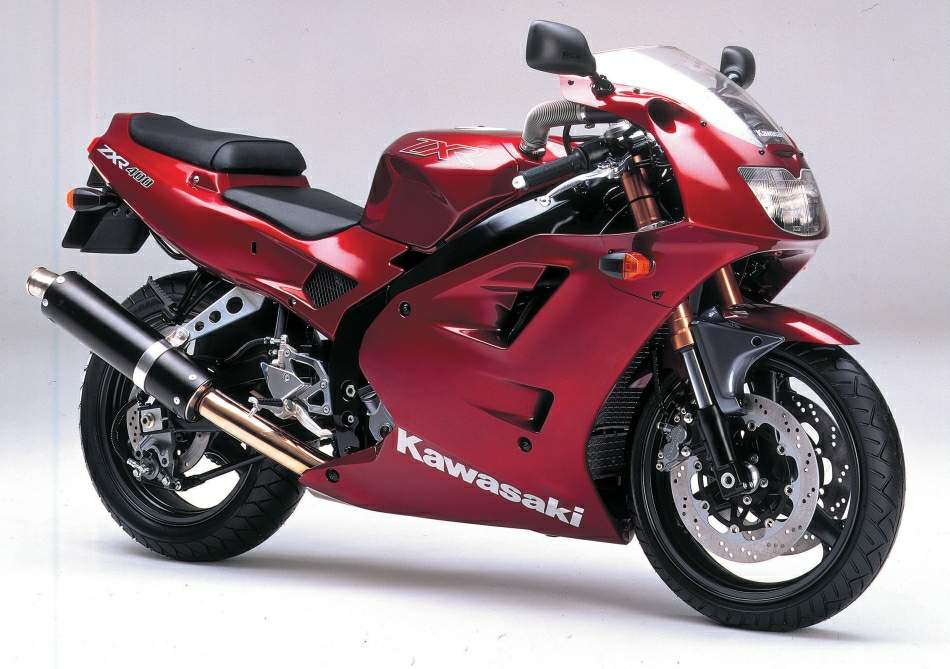
Kawasaki ZX-R 400
ZXR facts The ZX400-L appeared officially in the UK for 1991 but the H model had been grey-imported in 1990 (November issue) and available in Japan since '89. In this time (we're now on the L4) little has changed. Some 6lb has been lost, together with a shrinkage of 10mm in the wheelbase, half a degree steeper castor and 2mm less trail... fine tuning or what? Second, third, fourth and fifth gear ratios have been revised but, as the H model was the fastest of the 400 variants which we've tested, not much else of significance has been done. The fact that later bikes have been slower doesn't mean too much, except that the long, flat torque curve allows the bike to take advantage of a tailwind and 1990 (139mph) might have been more blusty than 1991 (135) and 1992 (130, when it was still the fastest on the day, out of FZR400, VFR400, KR-1S and RGV)). The 1991 L1 gave 59.1 bhp at 13,450rpm: the L4 last week produced 59.4bhp at 13,000rpm. So they've made it a bit torquier, then? Any 400 which consistently tops 130 isn't too bad but the ZXR can be improved quite easily. For road use, careful rejetting with Dynojet bits, can make the response crisp enough to transform the bike's apparent performance. Chassis-wise, it doesn't really need much. There is enough adjustment to get the steering and ride roughly where you need them and while weight reduction and suspension improvement are possible, the best investment has to be tyres.
ZXR Power wise this is the minimum acceptable level. Both bikes will just about pull top gear at any road speed and still be able to accelerate away. They will cruise at 80 to 90mph without protesting. Through the gears they have reasonable acceleration. The RGV seems to have more power: in fact it has less, but it comes with a proper power band. You can feel it start and you can feel it stop. The ZXR's power appears from nowhere at revs so low that nobody notices; like the first trickle of water under the door of a flooding bathroom. But when you open the door, bracing yourself against the anticipated torrent, it has all dribbled away. By this time the engine is turning at 14,000 and the exhaust note has gone up almost three octaves. It fades away as quietly as it comes in but, unnoticed in this non-torrent, there is a rush of 59bhp — three more than the RGV. And there is reason to believe that the ZXR — this one — is not the best example of its kind, while the RGV is probably above-average. The Kawasaki was running rich (5% CO at idle, anything up to 8% CO on full throttle during the dyno tests, when 2 to 4% is as much as you normally wish to see). It was probably the result of a mistake during servicing but it made the motor woolly in its response, it didn't like starting unless the throttle was nearly wide open, never needed the cold start and possibly lost the final tip to its power peak. There is a large dip in the torque curve at 4000 and the richness here really made the ZXR stagger. Regrettably it coincided with the useful speed range for town traffic. ZXRs are inclined to run this way in any case; this one just went a bit further than most. For some riders, this was enough to ruin the whole bike. I have to say it didn't bother me half as much as the RGV's tendency to run onto reserve every 85 miles and it was the Kawasaki's only bad point. Everything else particularly the handling, ride position and controls was as perfect as mass production ever gets. If I had built a special and it turned out as good as this, I would be very happy. It adds up to a bike that is easy to use, forgiving and comfortable... well, a bit heavy on the wrists below 30mph, but the first roundabout/glimpse of mountain road more than makes up for that. If you really want to fly into corners too fast and depend on the bike to get you round, then this is as good a place to start as any. And the tyre options only get stickier (see separate panel). Compared to the RGV, the ZXR made up ground in initial acceleration (it's got quite a lot more torque below 8,000 and uses it while the Suzuki is furiously clutch-slipping) and it has a beautifully slick gear change. Both the suspension and the seat are a bit softer and squashier, it had a better balance of tyres and suspension and most of all, in the real world of wet gloves, soggy wallets and drafts down the back of your neck, it only had to stop for fuel three times for every four stops the Suzuki had to make. After I'd been doing this job for a few years it began to dawn on me that the power, suspension and even gearboxes of different examples of the same model can vary hugely—just look at our '92 Fireblade (106bhp) and this year's (122bhp). Same dyno, same engine spec, 18% difference. The ZXR400 is probably the most variable of the lot. We've ridden five, all suffering to a greater or lesser degree from Kawasaki's woolly carburation. One was good low down, with a flat top end; another only felt responsive above 10,000. This year's was the most horrible of the lot. No matter how hard you revved it, or how many gears you trod down, the rear wheel took an age to respond to your right wrist. But on a bike that costs are you ready for this six grand, few things could be more irritating. Every time we came to the end of a 30 limit the £750 cheaper RGV just cleared off.
I guess any five ZXR400s, from any year, might be as different but if I'd bought one as gutless as this, I'd ask for my money back. In fact, all it needs is a few hours on the dyno. Last year's ZZ-R600, also a candidate for the Elastic Throttle Cable award, was transformed by a simple stage 1 Dynojet kit (Oct '93). The best ZXR400 we've tried (our 65bhp Snetterton six hour racer loud pipe, skimmed head, optimized ignition and carburation) felt gorgeously sweet and crisp everywhere and stayed with standard CBR600s all the way up Snetterton's back straight. This one had trouble staying with the RGV. On a 130 mile trip to Birmingham and back with my neighbour, who'd never been on a bike before, the ZXR might as well have been a 125. Getting smooth, passenger-reassuring progress meant overtaking opportunities were few and far between. The same journey on the RGV a few days later was swifter and more bearable despite the Suzuki's lightswitch power delivery and Spanish Inquisition pillion arrangements. Long solo trips on the ZXR are little better. It's pretty comfortable for a 400, with a wide, slightly padded seat, excellent riding position and rear suspension which feels softer than in previous years. But by the time I'd got to Wales my hands were half numb with vibration and the sludgy engine had bored me near to death. It's all the more annoying because the chassis is so good. People who say upside down forks are wasted on the road are living in the past. There's so much feedback and confidence under braking you could hardly imagine more. For late brakers, hooligans and people about to have accidents, the ZXR's behaviour with the anchors on is a major contribution to road safety. The same cannot be said for the rear shock. ZXR400s are normally rock-solid but this one felt so bouncy, like a ZZ-R600, that the wheel was hardly on the ground on flat-out, local B-roads — enough to make the revs rise and fall 500rpm.
The ZXR400 doesn't deserve a slagging. It's just two grand too expensive and the factory ought to clean up the carburation. As a secondhand buy, it takes some beating: small enough to insure and keep in sticky rubber; big enough to do 135mph; sweet-handling enough to keep you interested for a couple of years, particularly if you tuned the bollocks off it and painted it a decent colour. Under those circumstances I'd love one. RGV Most demonstrator from the importers are will prepared and the RGV was a fine example of the enthusiastic fettling of the irrepressible Roger Simmons. An average RGV gives 53-54bhp. This one gave a steady 56 with all the crispness of a new £50 note. This was, however, a double-edged weapon. It made the RGV well-equipped to impress the editorial inquisitor but less able to withstand the ordeal by Marlow which followed. As a test of the tacho's ability to go from nothing to redline in a matter of nanoseconds, Stephen's riding is rarely equalled. In their attempts to keep up with the tacho, at least one of the pistons appears to have suffered something fairly terminal. I Jntil then, even if it was only providing 29mpg, it was a good engine. Its 56bhp managed to feel stronger than the ZXR's 59. Better still, it crackled and sang when it got to 7,000 and decided to fly — an exhilarating and satisfying experience. The most obvious difference between the two bikes is this harshness, and not only in exhaust note. The RGV's seat is flatter and harder, the gearshift is heavy and clunks. When it finds stutter bumps on the apex of a corner there is a hardness between the suspension and the tyres which makes it skate across the surface as chatter progresses into slide. Fortunately the rest of the Suzuki's makeup keeps it very controllable: it is so natural to use that you don't think about doing something, you merely think about where you want the bike to be and it goes there. The tyres weren't as good as the rest of the bike. It spoiled the balance: under heavy braking the RGV needed a lot of rear brake, even on surfaces that were dry and hot enough to have the back wheel hovering on most sports bikes. This made the bike less forgiving than it might have been — but there are plenty of tyres which would give it all the grip it could use. Considering the size and the overall harshness of the bike, it is surprisingly comfortable even on motorways, mainly because the riding position is so good. It's more severe than the ZXR and starts to get a bit wrist-straining below 50mph but both bikes were coping with 200-mile journeys well below the threshold of pain. For track performance the RGV probably has the edge, but on real roads these fine differences don't show up. My average speeds (I rarely go over 85-90mph on long journeys) were pretty well identical on each bike (and probably would have been the same on a 600 or 750) for the same level of effort. But where the ZXR managed over 120 miles before needing reserve, the RGV usually went 85 to 90 miles. This was a nuisance; it also required a lot of planning. A couple of times we had to leave the motorway to go in search of fuel and anyone who strayed too far after dark would need a support crew. The RGV250 belongs in the Tate because of its gorgeous looks, light weight, high power (before it went bleaurggghhhh) and superb chassis. No meaningful future discussion of late 20th century personal transport could take place without some reference to Suzuki's classic V-twin. It's cramped and awkWard to kickstart but once you're rolling the excellent control layout allows the lightness of touch you need to get a featherweight bundle of metal and plastic round corners. Initially you feel twice as heavy as the bike as it wobbles around underneath you. Then you get used to it: a well-ridden RGV takes as much steering input through the footrests and tank sides as the bars. It responds best to a gentle, confident touch: look to the furthest point you can see on the road ahead, set the bike up to follow the smoothest line to get there and freeze your body while the buzz saw engine sings through the gears. It's a precise riding style; you can be much sloppier on a 600. None of this counted for diddly when, 500 miles into a 600 mile day, I got lost in Oxford and ended up on unlit backroads. It was the kind of warm July evening when your visor needs a de-splat every ten miles and, as darkness falls, your weary eyes fade to mole rat vision. I stopped at a pub with a couple of bikes outside it to ask the way. "No problem, mate. Aylesbury, Buckingham, then pick up the signs for Northampton. It's all back lanes. You'll love it." I hated it. The last thing you want when you're delirious with tiredness is a race replica with featherlight steering, an on/off engine and a Christmas cracker alternator. Weedy at the best of times, and reduced to candle power by a thick fur of dead flies, the headlight was further enfeebled every time I braked, creating a vicious cycle of being unable to see, having to slow down, feeling the engine stutter and hesitate under part throttle and trying to speed up again to avoid it. Up until Oxford, of course, the RGV had made a nice little tourer, holding 130 at 12,000rpm in top for mile after mile on the deserted A40. On something this small and light it's like riding on air. But when I eventually hit familiar roads again I could hardly summon the concentration to do 90. If you don't feel fit and alert you just can't do the 250 justice. An extra notch of front preload and, say, 25cc more oil in each fork leg would be a cheap way to cure the RGV's one fault — using up all the wheel travel on the way into bends — but it's still a magical chassis on a magical roadbike. All the same I have to say that owning an RGV would drive me nuts. It's not that the power delivery is too frantic — one look at the ZXR proves it's not. It's just that, being a true lunatic, the Suzuki is utterly unable to cope with the mundanities of life. It can't even carry its own two stroke oil under the seat and a baggy oversuit has as much effect on stability as it does on acceleration and top end. Cruising at 80 on a motorway; going shopping; tootling along when you can't be bothered to go for it: a 220bhp/litre two stroke on part throttle is like a mongoose on Valium. Naturally I would be prepared to overlook this if Suzuki made an RGV5(X). Source PERFORMANCE BIKE 1994
|
|
|
Any corrections or more information on these motorcycles will be kindly appreciated. |