|
|
|
|
Classic Bikes
Custom Bikes
Individual
Racing Bikes AJP
AJS
Aprilia
Ariel
Avinton / Wakan
Bajaj
Benelli
Beta
Bimota
BMW
Brough Superior
BRP Cam-Am
BSA
Buell / EBR
Bultaco
Cagiva
Campagna
CCM
CF Moto
Combat Motors
Derbi
Deus
Ducati
Excelsior
GASGAS
Ghezzi Brian
Gilera
GIMA
Harley Davidson
Hero
Highland
Honda
Horex
Husaberg
Husqvarna
Hyosung
Indian
Jawa
Kawasaki
KTM
KYMCO
Laverda
Lazareth
Magni
Maico
Mash
Matchless
Mondial
Moto Guzzi
Moto Morini
MV Agusta
MZ / MuZ
NCR
Norton
NSU
Paton
Peugeot
Piaggio
Revival Cycles
Roland Sands
Royal Enfield
Sachs
Sherco
Sunbeam
Suzuki
SWM
SYM
Triumph
TVS
Ural
Velocette
Vespa
Victory
Vincent
VOR
Voxan
Vyrus
Walt Siegl
Walz
Wrenchmonkees
Wunderlich
XTR / Radical
Yamaha
Zero
Video
Technical
Complete Manufacturer List
|
Kawasaki ZX-9R Ninja
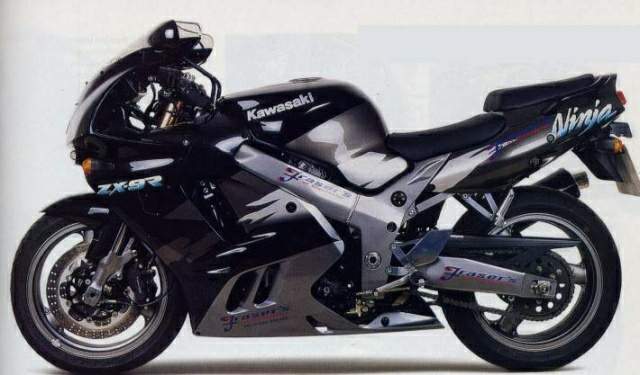
Kawasaki's tradition of building outstanding 900cc superbikes suggested that a hot new contender would appear in the mid-1990s. The z1 of 1973 and the GPZ900R Ninja of 1984 had firmly established the Big K's reputation for powerful, rapid and bullet-proof 900cc fours. And in 1994 came the model that was intended to maintain that reputation for another decade: the ZX-9R. The superbike world had become increasingly specialized since the days of the Z1 and Ninja, when a single brilliant new machine could outperform all opposition and be a top all-rounder at the same time. Nevertheless, Kawasaki designed the ZX-9R to fit between the firm's race-replica ZXR750 and sports-touring ZZ-R1100. Its style and emphasis were on performance, but the 9R was less extreme than some super-sports rivals. It was certainly one very rapid motorcycle, for all that. The Kawasaki's engine was an enlarged, 899cc version of the 749cc, liquid-cooled powerplant from the ZXR750. It had a ZZ-R1100 type ram-air system, big 40mm carburettors plus detailed smoothing of the induction and exhaust systems. The result was a peak output of 137bhp at 10,500rpm, and thrillingly strong power right through the rev range.
Strong but heavy chassis The motor was held by a large, aluminium twin-beam frame similar to that of the ZZ-R1100, backed-up by an equally sturdy box-section alloy swingarm, with multi-adjustable suspension at each end. Chassis geometry was sporty, with forks set at 24 degrees. But the Kawasaki weighed 4741b (215kg), considerably more than several of its rivals, and 661b (30kg) more than Honda's FireBlade. Styling was very sharp and aggressive, owing much to Kawasaki's World Superbike racer. But by sports bike standards the ZX-9R was a fairly big machine, with a broad fuel tank and a long stretch forward to the handlebars. The roomy riding position and wide seat helped make the Kawasaki comfortable while emphasizing that it was no ultralight race replica. The ZX-9R was at its best on a fast, open road where its motor's phenomenal power never failed to impress. At low revs the 16-valve four growled impatiently; straining at the leash. By 7000rpm the Kawasaki was storming forward with real conviction, and around 10,000rpm it kicked again, howling towards the 12,500rpm rev-limiter with a gloriously smooth, free-revving feel that took the 9R to a top speed of 165mph (266km/h). Handling was superb on sweeping main roads where the Kawasaki's stability and neutral steering allowed its rider to exploit the engine's power to the full. On twistier roads the bike was less impressive, as its weight and relatively slow steering made it cumbersome in comparison with racier rivals. There was no doubt that the ZX-9R failed to raise the superbike stakes in the way that its Z1 and GPZ900R predecessors had done. By race-replica standards it was too big and heavy; and as a longdistance bike its lack of features such as centre-stand and grabrail told against it. But for riders looking for a genuine super-sports bike with a fair degree of practicality, the ZX-9R was arguably the pick of the bunch. Source Fast Bikes by Roland Brown 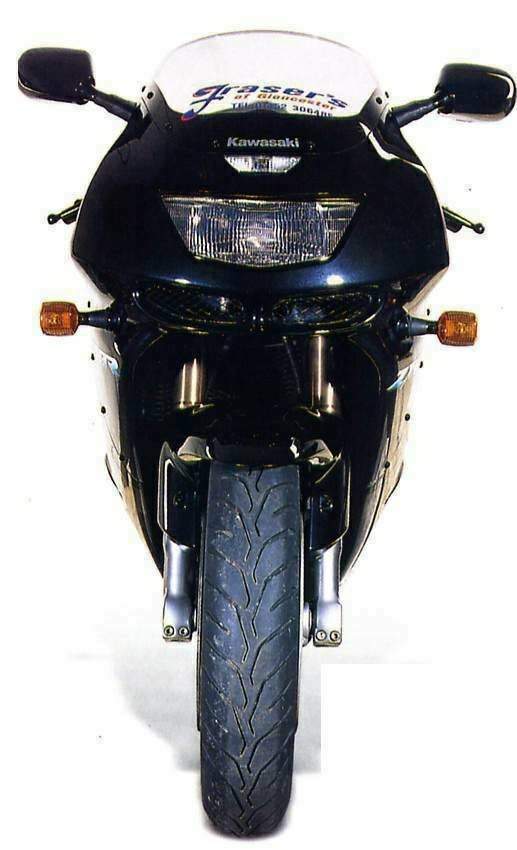
|
|
|
Any corrections or more information on these motorcycles will be kindly appreciated. |