Aluminum perimeter, Rake / trail: 24 deg / 4.0
in.
Front Suspension
41 mm inverted Showa Big Piston Front fork with
top-out springs, stepless compression and rebound damping, fully-adjustable
spring preload,120mm 4.7 in.wheel travel
Rear Suspension
Bottom-Link Uni-Trak® with
gas-charged shock, top-out spring and pillow ball upper mount, dual-range
(high/low-speed) stepless compression damping, 25-way adjustable rebound
damping, fully-adjustable spring preload 134mm 5.2 in. wheel travel
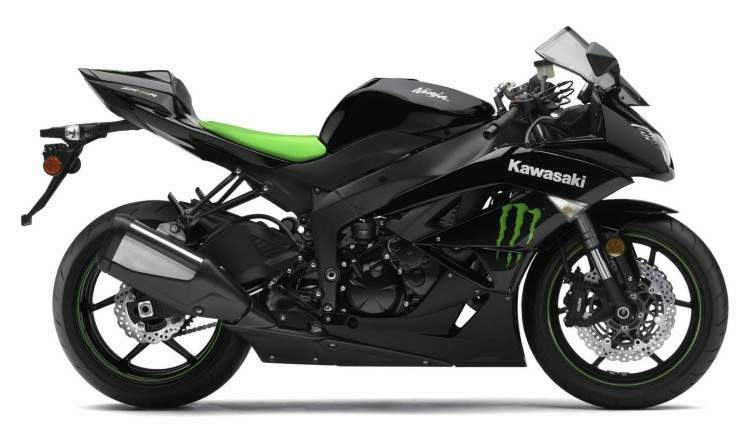
Ominous look and custom graphics contribute to
this Ninja’s exciting personality
For riders looking to shock and awe their rivals, Kawasaki’s sinister looking
2009 Ninja® ZX™-6R Monster Energy® Special Edition motorcycle is the weapon of
choice. Dressed in all black, it promises a cranked-up heart rate for anyone
with a pulse, thanks to the black bodywork, frame and wheels; highlighted by an
aggressive Monster Energy graphics package.
To truly push the envelope, a rider needs a calm yet responsive sportbike with
precision control feel and confidence-inspiring manners. That machine is
perfectly embodied by the new 2009 Ninja® ZX™-6R. Thanks to an extensive
overhaul by the Kawasaki engineers; weight shaving, improving mass
centralization, refining engine and chassis behavior, adding a revolutionary
front fork design; the new leaner, more precise Ninja ZX-6R delivers the elusive
calm and confident handling that top racers need.
Fine-tuning the chassis and tightening its mass centralization resulted in
lighter handling to make it even easier to tip this ZX-6R into a corner. To
optimize front-rear rigidity balance, the engineers revised frame stiffness
around the swingarm pivot and the rear engine mounts. The engine was rotated
around the output shaft to offer a steeper cylinder bank angle and raise its CG
by 16mm. A new exhaust layout with a short side muffler lowers the weight
previously located under the seat and an exhaust pre-chamber further contributes
to the new ZX-6R’s mass centralization
The new Ninja ZX-6R’s leaner physique is fundamental to its lighter handling.
Both the engine and chassis were evaluated to reduce weight. The intake
resonator box and supports for the instrument panel and mirrors are now unitized
with the enlarged –to optimize intake volume – Ram Air duct, contributing to
weight savings and improving rigidity. New camshafts are now made of lighter SCM,
and lightweight magnesium replaces aluminum for the engine covers. Revised
internal gears – transmission, oil pump and starter – are lighter without
compromising strength. Adjusting several mounting plates and the coolant
reservoir locations helped shave additional weight.
Handling wasn’t the only area of improvement on the new Ninja ZX-6R; its lighter
engine received a host of changes focused on delivering precise throttle control
and increased performance, particularly in the mid-range. A smoother power
delivery was achieved through better combustion efficiency. The changes include;
adding cylindrical guides to the top of the airbox to better guide the fuel
charge into the intake funnels, increasing the distance between the main and
sub-throttles by 10mm to reduce inlet turbulence, revised cylinder porting to
improve cylinder filling and increasing secondary coil current in the ignition
coils.
In addition to healthier bottom-end torque and smoother throttle response, the
engine’s mid-range performance was increased via a similar number of
refinements, including; new double-bore velocity stacks with inlets at two
different heights, pistons with new profiles and improved crown finishing, and
reduced mechanical loss by decreasing piston ring tension and revising the cam
chain guides to better stabilize the motion of the chain. A new exhaust
collector layout rounds out the major changes.
The stronger mid-range torque provides greater drive out of corners and is
harmonized with the engine’s silky smooth high-rpm performance. This linear
throttle torque delivery results in improved controllability and offers the
rider precise throttle control at all rpm. This predictability pays dividends
when making mid-corner power adjustments. When combined with the reduced need to
downshift provided by its healthy mid-range performance, the predictable
throttle response makes it easier for riders to maintain their rhythm when
stringing corners together.
In keeping with its racing heritage, the ZX-6R employs a cassette-type
transmission that simplifies gearing changes at the track, reducing set-up time
and allowing more time for riding. A slipper clutch allows quick downshifts
without upsetting the rest of the chassis when reducing speed on corner entry.
Corner-entry controllability receives a major performance boost, thanks to the
first production-use of Showa’s revolutionary new BPF (Big Piston Front fork).
The BPF utilizes a large-diameter internal piston, which permits a reduction in
damping pressure, for smoother action and better front end feedback – especially
under braking and initial corner turn-in. Additionally, the BPF eliminates many
of the internal components used in a cartridge-type fork, simplifying
construction and resulting in a lighter overall fork weight.
Having already designed a lighter and more rigid swingarm for the Ninja ZX-10R,
the Kawasaki engineers utilized many of the same design components for the new
ZX-6R’s swingarm. Shared swingarm parts include both left and right inner
plates, the left outer plate, rear stand bosses, brake caliper stopper, chain
guard and swingarm pivot shaft.
The response from Kawasaki’s acclaimed triple petal disc brake package with
radial calipers was improved as well. The 220mm rear petal disc is now 10mm
larger and features a revised brake lever that’s now coaxially mounted with the
footpeg for increased mid-stroke braking efficiency and improved feeling. Its
master cylinder reservoir was relocated forward of the swingarm – freeing up
space around the footpeg, reducing parts and contributing to weight savings.
Trackside maintenance is easier too, thanks to the revised front brake hose
routing with a three-way joint at the lower triple-clamp to simplify bleeding
the brake lines.
All of these revisions give the Ninja ZX-6R unflappable composure under braking
and help provide the precise control and feel that allows Supersport racers to
enter corners harder. To better capitalize on this lighter machine and its
precise control response, the rider interface was appropriately fine-tuned to
enhance feedback from the bike to the rider.
The relationship of the seat-to-pegs-to-bar “rider triangle” was adjusted
slightly, with the handlebars moved closer to the rider and turned in slightly
for a more intuitive riding position. The fuel tank cover is more flared around
its top edge, providing a larger contact patch and contributing to improved
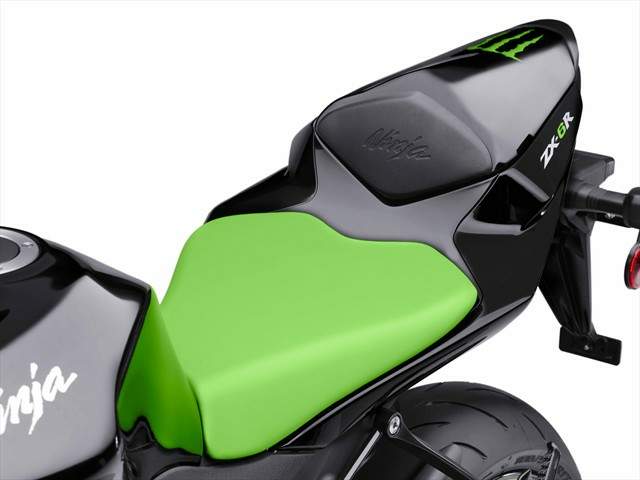
rider feedback – similar to the ZX-10R. A new narrower rear sub-frame and seat
leading edge, plus a 10mm lower seat height provide a slimmer riding position
and a shorter reach to the pavement.
A new fairing and a less-complex one-piece front fender – previously a
three-piece unit – offer improved aerodynamics and airflow to the radiator,
better wind protection and help minimize the effect of crosswinds. The new inner
rear fender, mounted above the swingarm, reduces turbulence and helps keep the
tail clean. Like its bigger ZX-10R sibling, the ZX-6R received a new instrument
panel that provides information at-a-glance and a race-quality adjustable Öhlins
steering damper with relief valve and twin-tube design.
Highly confidence inspiring, the precise engine and chassis control offered by
the new Ninja ZX-6R enables riders to push harder and maximize the excitement
that comes from actively controlling such a high-performance track-focused
machine.
Moto Caradisiac
Impressions
This time around, Kawasaki seem to be truly
serious about hunting down the R6, CBR 600RR, GSX-R600 and even the
Daytona 675. The 2009 ZX-6R is indeed an all-new bike – it shares nothing
with its predecessor. And to begin with, the new bike looks really good –
a perfect mix of aggression and sobriety.
The engine sounds relatively subdued when you start the bike, though the
sound is still pleasant. And the riding position and ergonomics feel just
right you immediately feel comfortable on this bike.
On the move, the new engine is docile and smooth at low revs – if you
insist, it will even putter along at 2,000rpm, in sixth gear, at 30km/h.
But, of course, that’s not what the ZX-6R is meant to do. The bike really
comes alive between 8,000-16,000rpm and in that rev range, a handful of
throttle instantly translates into hard acceleration and insane speeds.
With ram-air, the ZX-6R’s 599cc inline-four makes 134 horsepower at
14,100rpm and, yes, the bike feels very responsive – the throttle
twist-grip seems to be directly connected to the rear wheel. And it
averages about 17.5km per litre of petrol, which is not too bad.
The new, fully-adjustable big-piston fork (BPF) from Showa is quite a
revelation – the Kawasaki’s nose is always absolutely glued to the tarmac
and the ride quality is not bad either. And the Nissin bakes, with radial
mount callipers at the front, are very powerful – just two fingers on the
brake lever are quite enough to bring the bike to a super-quick halt – but
you’d better be careful while braking hard in wet weather conditions
and/or during an emergency.
The good:
Poise, steering accuracy
Powerful brakes
Riding position
High speed handling
Engine performance
The not-so-good:
Styling too similar to the ZX-10R
Readability of the instruments
Wind protection provided by the fairing is inadequate
NOTE: Some of the photos on
Motorcycle Specs are owned by somebody. If you see any of your
photos, you can let me know so that I can acknowledge it, or if
you object to it, I can remove it altogether. If any copyright
holder objects to their articles being placed on Motorcycle
Specs, it will be removed upon request. Any correction or more
info on these bikes will kindly beappreciated
Contact MePrivacy
Policy
Website Stats