|
|

|
|
|
|
Classic Bikes
Custom Bikes
Individual
Racing Bikes AJP
AJS
Aprilia
Ariel
Avinton / Wakan
Bajaj
Benelli
Beta
Bimota
BMW
Brough Superior
BRP Cam-Am
BSA
Buell / EBR
Bultaco
Cagiva
Campagna
CCM
CF Moto
Combat Motors
Derbi
Deus
Ducati
Excelsior
GASGAS
Ghezzi Brian
Gilera
GIMA
Harley Davidson
Hero
Highland
Honda
Horex
Husaberg
Husqvarna
Hyosung
Indian
Jawa
Kawasaki
KTM
KYMCO
Laverda
Lazareth
Magni
Maico
Mash
Matchless
Mondial
Moto Guzzi
Moto Morini
MV Agusta
MZ / MuZ
NCR
Norton
NSU
Paton
Peugeot
Piaggio
Revival Cycles
Roland Sands
Royal Enfield
Sachs
Sherco
Sunbeam
Suzuki
SWM
SYM
Triumph
TVS
Ural
Velocette
Vespa
Victory
Vincent
VOR
Voxan
Vyrus
Walt Siegl
Walz
Wrenchmonkees
Wunderlich
XTR / Radical
Yamaha
Zero
Video
Technical
Complete Manufacturer List
|
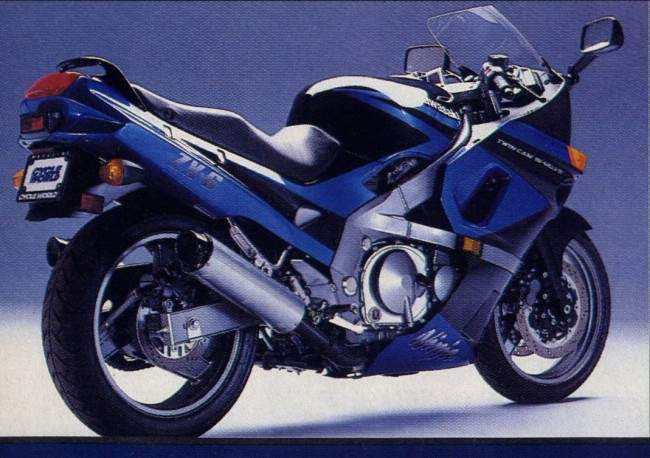
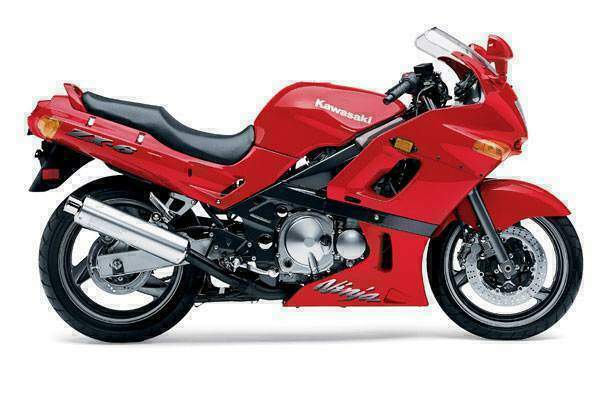
Kawasaki ZX 600R Ninja
Certain rules should never be broken. If you're a heavyweight boxer, you don't mention Mike Tyson's lisp. If you're a home-run slugger, you don't joke that Nolan Ryan is over the hill. And now, if you ride a 750cc or larger sportbike, and a Kawasaki ZX-6 pulls up beside you at a stoplight, you don't say, "That's a nice little bike you've got there." Two or three heartbeats later, the ZX will smoke away from the line, and you'll never again think of a 600 as a "little bike." Motorcycles like the ZX-6 come along every so often and just mess up all the rules. First of all, the new Kawasaki forces a re-think of the idea that middleweight sport-bikes are something less than full-size machines. The ZX-6—officially known as the ZX600D1 Ninja ZX-6—is a big motorcycle; big in stature, big in performance and big in its impact on the sport. The ZX-6 messes up such fundamental principles as the one that says 600s don't go as fast as 750s. That principle, while largely still true, now has its credibility in a high-speed wobble. The ZX-6 goes 147 miles per hour, while Kawasaki's own 750cc ZX-7 (the 1989 model, at least) can just barely top that, with a 148. In fact, the ZX-6 is 4 miles an hour faster than last year's Suzuki Katana 750. The ZX-6 will chew up a quarter-mile in 11.36 seconds; last year's ZX-7 took 11.20. The new ZX-6 even messes up the tidy little notion that says any bike that is a big performer on the racetrack doesn't make a good all-around streetbike. That notion further stipulates that serious sportbikes must be uncomfortable, have narrow powerbands and be devotedly single-purposed before they achieve true success. Nonsense. The ZX-6 is a better streetbike than anything this side of a Suzuki Katana 750. It has a centerstand, mirrors that are usable and a comfortable riding position. Yet, we'll go on record as saying that the ZX-6 will give the Yamaha FZR—last year's all-conquering 600 absolute fits in 600 Supersport racing in 1990. The reason is as simple and straightforward as reasons come: horsepower. Reputedly, the ZX puts out 100 horsepower, 9 more than the FZR600 and 7 more than the 1990 Honda CBR600, though Kawasaki isn't making any official mention of power. To get that kind of horsepower, Kawasaki started with a clean sheet of paper; the ZX isn't an overbored 400 or a revamped 1989 Ninja 600. In fact, exactly nothing was taken from the Ninja 600, which had been a good seller but a rather unspectacular performer since 1988.
Where, then, did Kawasaki find all that horsepower? Everywhere in general, but nowhere in particular. While you'll find up-to-date thinking and all the popular do-dads on the ZX, there's nothing that's going to set the engineering community on fire, and no tricks that will make the Rob Muzzys and Erv Kanemotos of the world sit up and take notice. The ZX is the result of sound design and careful attention to detail. Like the 750, the new 600 has a very narrow included valve angle (30 degrees), resulting in relatively flat-topped combustion chambers. And the carburetors are semi-downdraft, 36mm Keihins tucked way under the fuel tank so the intake mixture has a relatively straight path into the combustion chambers. The valves are very large, only a half-millimeter smaller in diameter than those of the ZX-7. That left little room for the sparkplugs, so the Kawasaki uses 10mm plugs this year, instead of the 12mm plugs that used to be standard fare. More details: The valve stems are unusually thin (4.5mm) to achieve less reciprocating weight. The piston rings are rather thin, too (0.8mm), to reduce friction and high-rpm ring flutter. And each camshaft has only four journals (the old Ninja's had five) to minimize surface friction area. Perhaps the closest thing to a mysterious black box that musters extra performance for the ZX-6 is its digital ignition, which is similar to the system used on the ZX-7. Instead of using voltage build-up to determine when the ignition fires, as traditional CDIs do, digital systems fire at whatever point they are programmed to. The engine's designers spent a lot of dyno time determining the exact amount of spark advance needed to produce the best combination of high power and low emissions at each rpm level, and that data was fed into the ignition's microprocessor. But, taken as a whole, there just isn't any magical technology that can explain why the ZX-6 performs like it does. The plain truth is that Kawasaki got that power though an awful lot of hard work, by thinking about every single part in the engine and carefully considering how to make them better. The result is, without doubt, the most-powerful, best-performing production 600 ever made. It has the highest redline of any 600 on this or any other planet: 14,000 rpm. Indeed, the ZX-6's rev ceiling is as high as that of any production motorcycle ever bought into the U.S. The only other machines currently available that will spin to 14,000 are the Yamaha FZR400 and the Kawasaki 250 Ninja. But the ZX doesn't need all those revs to make its power. If you never wound the tach needle past 12, the ZX-6 still would be a very powerful 600. So, the rule that says a high redline means a narrow powerband is yet another one left in shambles by the ZX. In addition to producing more peak power than anything in its class, and in addition to having a higher redline than anything in its class, the Kawasaki also has a much broader powerband than anything in its class. You could spend all day short-shifting the ZX engine and still have a great time. On the other hand, you could choose to keep the tach needle dancing all the way to the right and go FZR/GSX-R hunting. It really is an amazing middleweight powerplant. But while any reasonable description of the ZX's engine might include the words "torquey," "high-revving" and "powerful," the word "smooth" will be nowhere in sight. That's because it isn't. Not that the new Kawasaki is afflicted with vibration; it is the most vibe-free of all the 600-class sportbikes. Indeed, neither handlebars nor footpegs nor seat suffer from any significant buzzing. What isn't so smooth is the engine's throttle response: When you open the Kawasaki's twistgrip, no matter how little, the bike lurches forward abruptly. Always. At any rpm. That's no big deal until you don't want the bike to lurch you know, places like downhill corners or long, medium-speed sweepers. On the ZX-6, there's no such thing as neutral throttle: Either you're accelerating or you're decelerating. And when an engine responds in that go/no-go fashion, it's almost impossible for a rider to be smooth. Most of the fault is in excessive driveline lash. For one thing, the cush-drive in the Kawasaki's rear hub is very soft, allowing the rear sprocket to turn nearly an eighth of a revolution before the wheel even starts rotating. The clutch hub also has a rather elaborate, three-stage damper, adding even more to the lash effect. On top of that, you have a very powerful engine that's really loo responsive off the bottom. The cumulative result is a bike that hits hard even when you don't want it to. You quickly learn to be very gentle with the ZX-6's throttle. But, unless you have a garageful of other sport-bikes, chances are you'll adapt to this annoyance after a few rides and rarely think about it again. Still, it would be nice to see Kawasaki's engineers refine this trait out of next year's ZX-6. At least at a full-on race pace, the driveline slop is barely noticeable. Riders who take the ZX out on the racetrack will instead have other, more-positive things to think about—like the bike's very solid chassis. It's the only 600 that uses an aluminum frame, a fact that is inexplicably covered up by a coat of boring-looking gray paint. The frame is very similar to the ZX-7's, which has proven itself in national Superbike races in the hands of tuner Rob Muzzy and rider Doug Chandler. But again, there's nothing magic or even unusual about the ZX's chassis. The twin-spar aluminum perimeter frame won't sent competing companies' chassis guys back to their drawing boards. Overall, the Kawasaki is a very stable-handling package that stays put wherever the rider puts it, and willingly leans whenever the rider leans it. When the bike gets leaned way over, though, as it would on a racetrack, it's obvious that cornering clearance isn't exceptional, primarily because the sidestand and centerstand—which will be taken off before the bike sees a racetrack—touch down. On the street, neither caused any problems. What was slightly bothersome, both on the track and during fast backroad riding, were the fork springs, which are rather soft for aggressive cornering, and caused the front end to feel vague in turns. Racers and street scratchers will definitely want stiffer fork springs. The rear suspension got higher marks on the track but still didn't get the official stamp of approval on the street. On really rough roads, an occasional bump would get though all the ZX's defenses and jar the rider more than slightly, even though the shock's spring rate felt basically correct. Our first course of action would have been to decrease high-speed compression damping, but the Showa shock offers only adjustable rebound. On or off the racetrack, something else is noticeable, too. The ZX is a big motorcycle. Even though its weight, at 461 pounds dry, isn't too far out of line for a 600 (it's heavier than the CBR and FZR, 5 pounds lighter than the Katana 600), the bike still has a rather large, sometimes cumbersome feel. In truth, the machine's vital stats are all about the same as the other 600s, but its large fuel tank and wide seat give off a feeling of massiveness. On the flip side, the ZX is roomier and more spread-out than any of the other 600s with the exception of the 750-sized Katana 600. It's a machine that a rider could spend days on end riding, easily running with sport-tourers across mountain ranges and fruited plains. That's a fine trade-off. For that matter, if any bike is going to deliver 750-class performance, it's okay with us if it feels bigger than a 600. The Kawasaki ZX-6 is a motorcycle that could get away with a whole lot of evil if it had to, just on the merits of its incredible motor. But it doesn't ask to get away with much of anything. Sure, it has some strange characteristics, such as excessive driveline slop and a squishy fork. But just consider what the bike offers. It's a motorcycle designed for the racetrack that street riders will love. It's a hardcore sportbike that's comfortable and versatile. It's a motorcycle that will likely dominate production racing and surely dominate the streets. It's more than a motorcycle that breaks all the rules. The ZX-6 is a bike that makes its own rules. Rules that the rest of the 600 class will soon have to live by. Source Cycle World 1990
|
|
|
Any corrections or more information on these motorcycles will be kindly appreciated. |