2x 310 mm petal discs, radial-mount
4-piston calliper
Rear Brakes
Single Single 220mm petal disc
Front Tyre
120/70 ZR17
Rear Tyre
190/55 ZR17
Seat Height
812 mm / 32 in
Weight
198 kg
Fuel Capacity
17 Litres / 4.5 gal
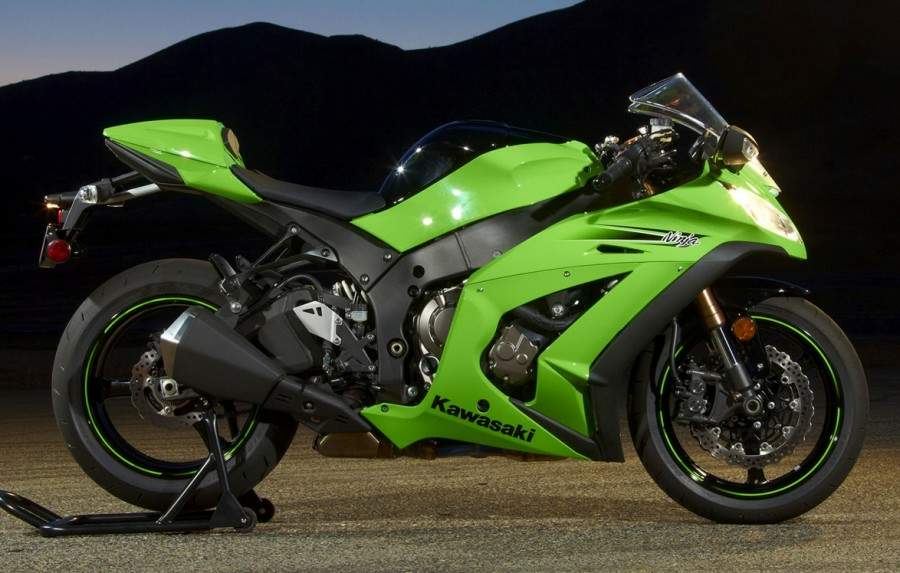
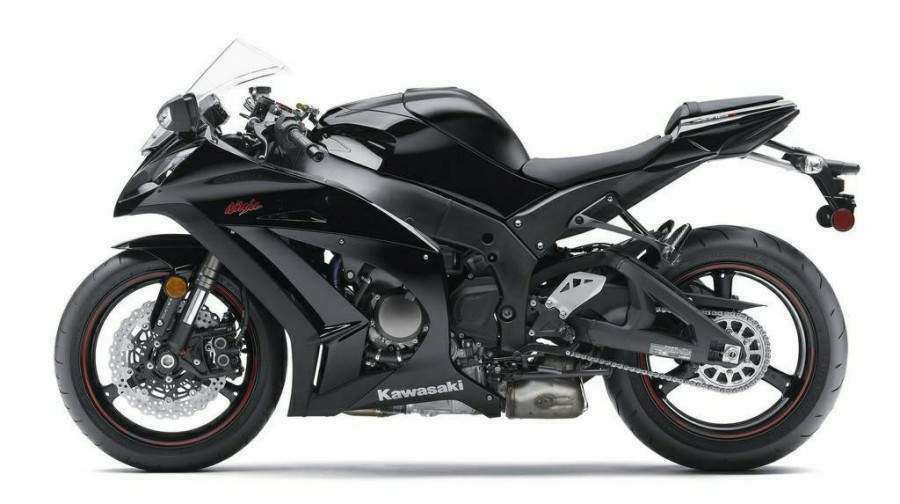
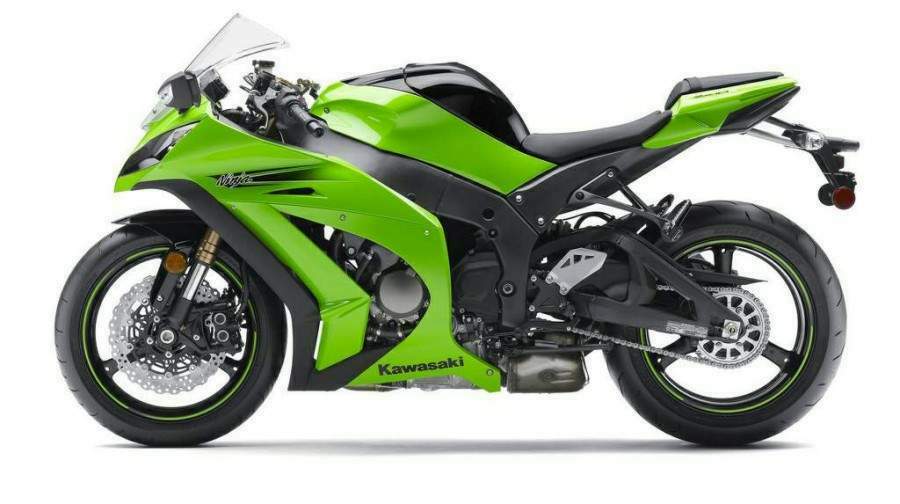
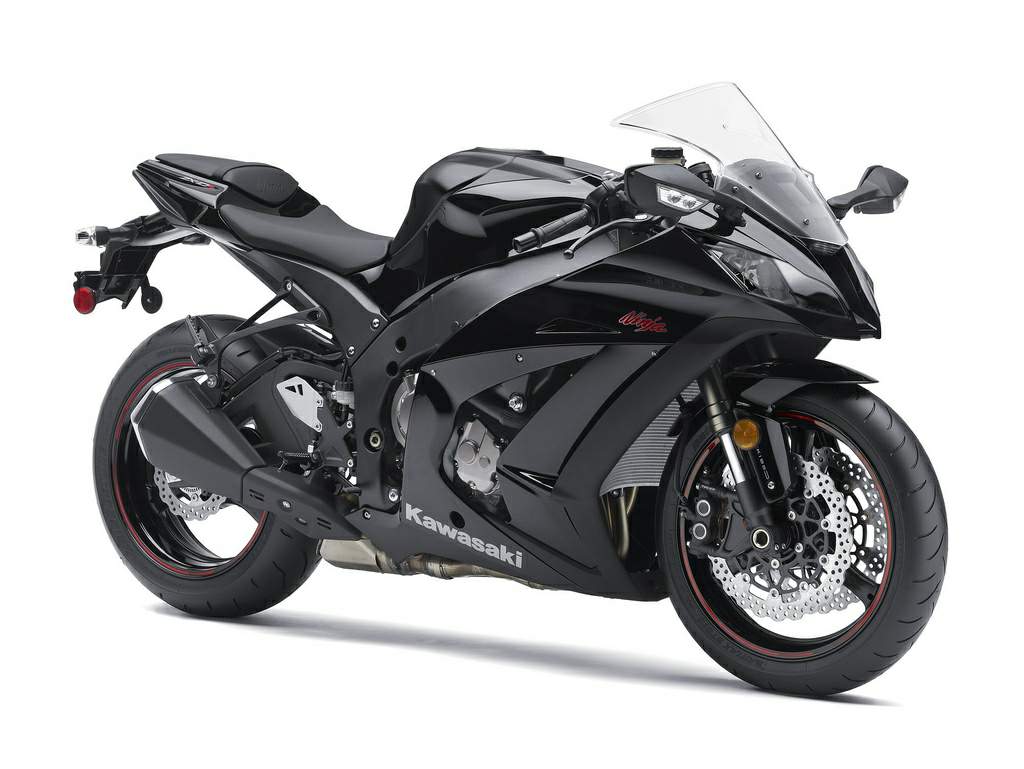
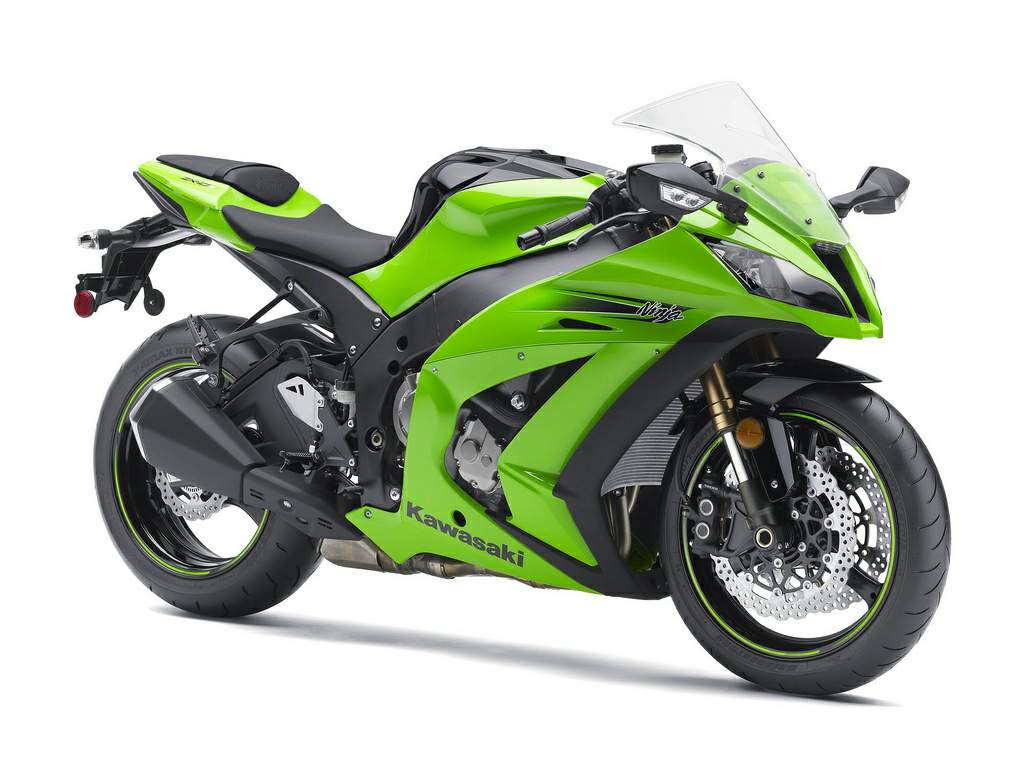
Besides totally redesigning the Ninja ZX-10R for
2011, which includes the most advanced traction-control system in motorcycle
production history, Kawasaki also offers the new sportbike with anti-lock
braking (ABS).
The anti-lock braking system, named the Kawasaki Intelligent anti-lock Brake
System (KIBS), was designed to provide maximum traction under various braking
conditions. The new KIBS was designed by Bosch specifically for sportbikes, and
is one of the smallest and lightest ABS units ever produced for a motorcycle.
Kawasaki says it's nearly 50 percent smaller than current motorcycle ABS units,
and 800 grams lighter, adding only about 7 pounds of weight compared to the
non-ABS machine, a pound of which is accounted for by the larger battery.
The KIBS collects and monitors a wide range of information gathered from wheel
sensors (the same ones collecting data on the standard ZX-10R for its S-KTRC
traction control system) and the bike's ECU, including wheel speed, caliper
pressure, engine rpm, throttle position, clutch actuation and gear position,
Kawasaki says.
The KIBS's ECU actually communicates with the bike's engine ECU and crunches the
numbers, and when it notes a potential lock-up situation, it tells the Bosch
unit to release caliper pressure, allowing the wheel to once again regain
traction.
Aside from this system's ultra-fast response time, it offers a number of
additional sport-riding and race track benefits, including rear-end lift
suppression during hard braking, minimal kickback during ABS intervention, and
increased rear brake control during downshifts.
The high-precision pressure control enables the
system to avoid reduced brake performance (sometimes seen on less advanced
systems), maintain proper lever feel and help ensure the ABS pulses are
minimized, Kawasaki says.
The ABS unit arrives on a new-from-the-ground-up Kawasaki ZX-10R. For 2011,
Kawasaki has completely redesigned the Ninja ZX-10R Sportbike to not only be
faster and lighter than the competition, but also more technically evolved by
offering the most advanced traction-control system in all of production
motorcycling.
The faster and lighter elements of the 2011 ninja motorcycle can be attributed
to a redesign of the ZX-10R's engine, frame, suspension, bodywork,
instrumentation and wheels. But the advancement in electronics comes from the
MotoGP-derived Sport-Kawasaki Traction Control, or S-KTRC.
Kawasaki says: "(S-KTRC) represents a whole new
dimension in motorcycle performance, and the ZX-10R is the only production sport
bike that can take you there. Motorcyclists have forever been challenged by
traction-related issues, whether on dirt, street or track."
"Riders that can keep a rear tire from spinning excessively or sliding
unpredictably are both faster and safer, a tough combination to beat on the
racetrack. And when talking about the absolute leading edge of open-class sport
bike technology, where production street bikes are actually more capable than
full-on race bikes from just a couple years ago, more consistent traction and
enhanced confidence is a major plus."
S-KTRC crunches numbers from a "variety of parameters and sensors - wheel speed
and slip, engine rpm, throttle position, acceleration, etc." Kawasaki says the
S-KTRC system relies on complex software buried in the new ZX-10R's Electronic
Control Unit (ECU), the only additional hardware is the lightweight speed
sensors located on each wheel.
Unlike the KTRC system on Kawasaki's Concours 14 ABS sport tourer, which
primarily minimizes wheel slip on slick or broken surfaces as a safety feature,
the S-KTRC system is designed to maximize performance by using complex analysis
to predict when traction conditions are about to become unfavorable, Kawasaki
says.
By quickly, but subtly reducing power just before the amount of slippage exceeds
the optimal traction zone, the system - which processes every data point 200
times per second - maintains the optimum level of tire grip to maximize forward
motion. The result is significantly better lap times and enhanced rider
confidence -exactly what one needs when piloting a machine of this caliber.
Kawasaki says the S-KTRC system offers three different modes of operation, which
riders can select according to surface conditions, rider preference and skill
level: Level 1 for max-grip track use, Level 2 for intermediate use, and Level 3
for slippery conditions. An LCD graph in the newly designed instrument cluster
displays how much electronic intervention is occurring in real time and a thumb
switch on the left handlebar pod allows simple, on-the-go mode changes.
The system also incorporates an advanced Power Mode
system that allows riders to choose the amount of power - and the character of
delivery - available from the engine. Besides the standard Full-power mode are
Medium and Low settings.
In Medium mode, performance varies according to throttle position and engine
rpm; at anything less than 50 percent throttle opening, performance is
essentially the same as in Low mode; at more than 50 percent, riders can access
additional engine performance. All three S-KTRC settings are available in each
of the three Power Mode settings, Kawasaki says.
2011 Kawasaki Ninja ZX-10R: Redesigned Powerplant
As for the engine in the 2011 ZX-10R, Kawasaki starts with the 2010 engine
platform: a 16-valve, DOHC, liquid-cooled inline-four displacing 998cc via 76 x
55mm bore and stroke dimensions. Then the changes start, which are designed to
"optimize power, power delivery, center of gravity and actual engine placement
within the chassis."
Kawasaki says a primary goal of Kawasaki engineers was linear power delivery and
engine manageability throughout all elements of a corner: the entry, getting
back to neutral throttle at mid-corner, and heady, controllable acceleration at
the exit. Peak torque was moved to a higher rpm range, which eliminates the
power peaks and valleys that make it difficult for racers and track-day riders
to open the throttle with confidence.
Larger intake valves (31mm vs. 30mm), wider- and polished - intake ports, and
completely revised exhaust porting all allow better breathing, more controllable
power delivery and less engine braking, just the thing to smooth those racetrack
corner entries and exits. Higher-lift camshafts built from lighter-yet-stronger
chromoly steel (instead of cast iron) and featuring revised overlap further
contribute to optimized engine braking and more controllable power delivery.
Newly designed lightweight pistons feature shorter skirts and mount to lighter
and stronger connecting rods, each of which spin a revised crankshaft made of a
harder material and featuring stronger pins and journal fillets. Compression
moves to a full 13.0:1, Kawasaki says
There's more, including a totally revamped crankshaft/transmission shaft layout
that contributes to a higher center of mass - and improved handling via better
mass centralization - by locating the crankshaft approximately 10 degrees higher
relative to the output shaft.
There's even a secondary engine balancer assembly this year, which allows a
number of vibration-damping parts to be simplified, contributing to weight
savings. A smaller and dramatically lighter battery helps drop even more weight,
as does a lighter ECU and fuel pump.
Kawasaki says a race-style cassette transmission allows simple trackside ratio
changes and offers a host of improvements for 2011. These include closer spacing
for 4th, 5th and 6th gears and the fine-tuning of the primary and final
reduction ratios for less squat/lift during acceleration and deceleration, which
allows more precise suspension tuning in back. An adjustable back-torque
limiting clutch assembly is fitted, which allows worry-free downshifts and an
even higher level of corner-entry calmness.
Cramming all that fuel and air into this amazing new engine is a ram
air-assisted fuel injection system featuring larger throttle bodies (47 vs.
43mm) and sub-throttle valves, a larger-capacity airbox (9 vs. 8 liters),
secondary injectors that improve top-end power characteristics, and a large,
redesigned ram-air intake that's positioned closer to the front of the bike for
more efficient airbox filling and increased power, Kawasaki says.
The final piece of the ZX-10R's power-production formula is a race-spec exhaust
system featuring a titanium header assembly, hydroformed collectors, a
large-volume pre-chamber containing two catalyzers and a highly compact
silencer. Due to the header's race-spec design, riders and racers looking for
more closed-course performance need only replace the slip-on muffler assembly,
Kawasaki says.
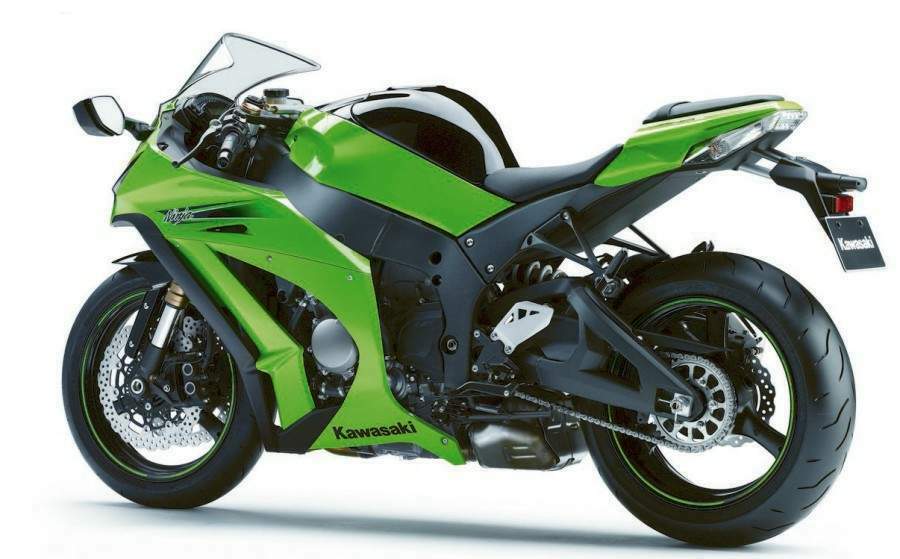
To manage this power effectively in the 2011 Ninja ZX-10R, Kawasaki redesigned
the chassis. They first began with an all-new aluminum twin-spar frame, which
was designed with an "all-cast assemblage of just seven pieces that features
optimized flex characteristics for ideal rider feedback, cornering performance
and lighter weight than last year's cage."
Fewer pieces mean fewer welds, which contributes to a cleaner, more
aesthetically pleasing look. Like the frame, the new alloy swingarm is an
all-cast assembly, with idealized rigidity matching that of the frame itself.
Kawasaki says chassis geometry was juggled to offer the best possible stability
and handling quickness. Rake, at 25 degrees, is a half-degree steeper than on
the 2010 machine, while trail has been reduced from 110 to 107mm.
This slightly more radical front end geometry, and the quicker, lighter handling
it allows, was made possible largely by the new engine's more controllable
power, engine placement and the CG differences it generated, and the frame and
swingarm's newfound flex characteristics.
Highly advanced suspension at both ends helped as well. Up front is a 43mm
open-class version of the Big Piston Fork (BPF) found on last year's comparo-dominating
Ninja ZX-6R. Featuring a piston design nearly twice the size of a conventional
cartridge fork, the BPF offers smoother action, less stiction, lighter overall
weight and enhanced damping performance on the compression and rebound circuits.
This added compliance results in more control and feedback for the rider - just
what you need when carving through a rippled sweeper at your local track or
negotiating a decreasing-radius corner on your favorite backroad, Kawasaki says.
There's big suspension news in back, too. Replacing the vertical Uni-Trak®
system of the 2010 ZX-10R is a Horizontal Back-Link suspension design that
positions the shock and linkage above the swingarm. Benefits include better mass
centralization, improved road holding, compliance and stability, smoother action
in the mid-stroke (even with firmer settings), better overall feedback and
cooler running.
The design also frees space previously taken by the linkage assembly below the
swingarm, space now used for the exhaust pre-chamber, which allows a shorter
muffler and, again, better mass centralization. The fully adjustable shock
features a piggyback reservoir and dual-range (low- and high-speed) compression
damping.
All-new gravity-cast three-spoke wheels are significantly lighter than the hoops
fitted to the 2010 bike. Up front, Tokico radial-mount calipers grasp 310mm
petal discs and a 220mm disc is squeezed by a lightweight single-piston caliper
in back. The result is powerful, responsive braking plenty of rider feedback.
2011 Kawasaki Ninja ZX-10R Appearance
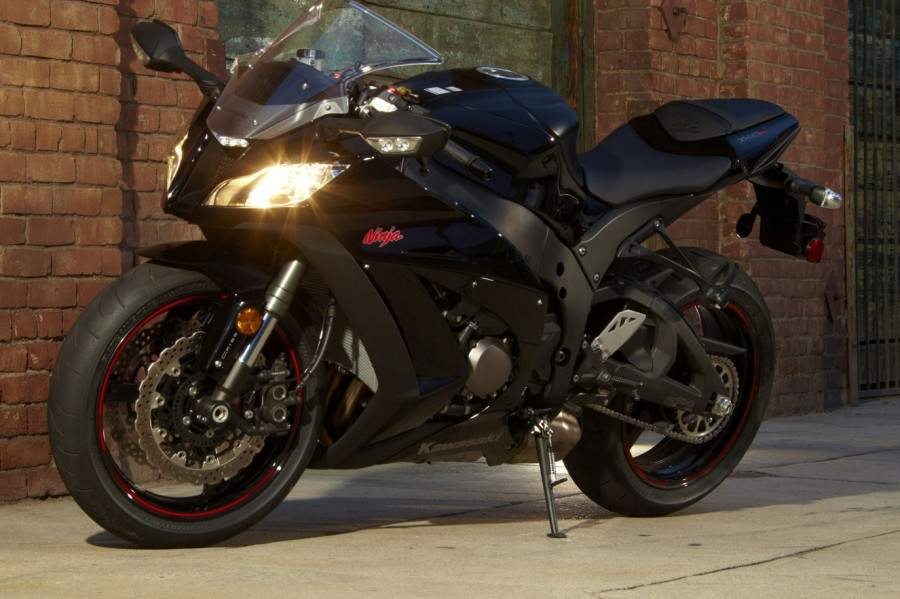
Kawasaki engineers wrapped all this new technology in bodywork as advanced and
stylish as anything on this side of a MotoGP grid. Shapes are more curved than
edged this year, and the contrasting colored and black parts create a sharp,
aggressive image.
Line-beam headlights enable the fairing to be made shorter, while LED turn
signals are integrated into the mirror assemblies and convenient turn-signal
couplers allow easy mirror removal for track-day use. The rear fender assembly
holding the rear signal stalks and license plate frame is also easily removable
for track days. High-visibility LED lamps are also used for the taillight and
position marker.
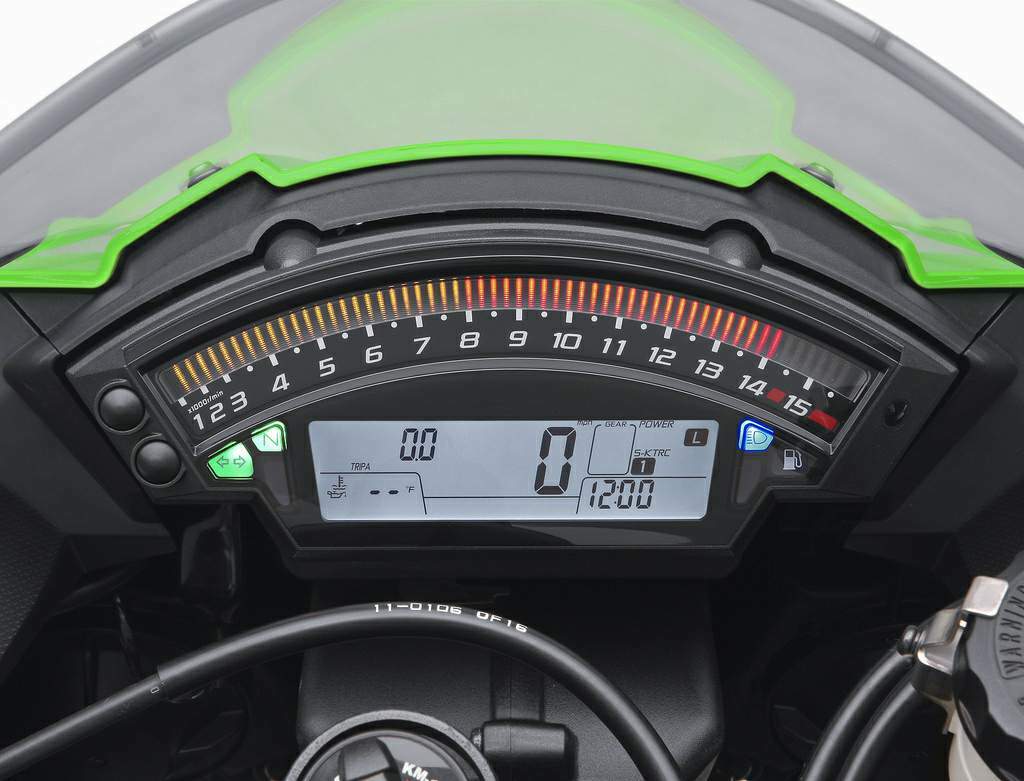
Instrumentation is totally new as well, the unit highlighted by an LED-backlit
bar-graph tachometer set above a multi-featured LCD info screen with numerous
sections and data panels. A wide range of information is presented, including
vehicle speed, odometer, dual trip meters, fuel consumption, Power Mode and S-KTRC
level, low fuel, water temperature and much more. For track use, the LCD display
can be set to "race" mode which moves the gear display to the center of the
screen.
The new ZX-10R's ergonomics have been fine tuned for optimum comfort and
control, with a slightly lower saddle, adjustable footpegs positioned slightly
lower and more forward relative to last year, and clip-ons with a bit less
downward angle.
This is a hard-core sportbike you can actually take on an extended sport ride -
and still be reasonably comfortable doing so. And because it's 22 pounds lighter
than last year's bike, the new ZX-10R will be quicker and more nimble in any
environment you choose to ride it in.
The old saying, "power is nothing without control" is certainly apt where
open-class sport bikes are concerned. But when you factor in all the engine,
chassis and ergonomic control designed into the 2011 Ninja ZX-10R, you begin to
realize you're looking at one very special motorcycle - one that can take you
places you've never been before.
2011 Kawasaki Ninja ZX-10R ABS Features and Benefits
New for 2011
- Totally redesigned DOHC 16-valve inline-four engine makes more - and more
controllable - power than ever before
- Stronger camshafts, pistons and crankshaft maintain legendary Kawasaki
reliability in the face of additional horsepower
- Ultra-advanced Kawasaki Intelligent anti-lock Braking System (KIBS) monitors a
wide range of data to help ensure no-lock stops
- All-new S-KTRC electronic traction control system comes directly from MotoGP
and allows riders to explore the edge of traction more successfully for faster
laps and maximum cornering speeds
- All-new ECU electronics also include a Power Mode system, which allows riders
to pick between three power modes for changing conditions
- Revised transmission shaft layout raises the engine's center of mass slightly
for better mass centralization
- Newly designed titanium-header exhaust system has nearly identical specs to
its roadracing counterpart
- Revised fuel injection system features larger throttle bodies and dual
injectors
- All-new aluminum twin-spar frame is lighter and offers optimal flex
characteristics for the best possible handling
- 43mm Big Piston Fork (BPF) is lighter than a conventional design and offers
improved action and response
- Redesigned Horizontal Back-link rear suspension offers better wheel control
and improved mass centralization, all of which improves stability and overall
handling
- Shock and linkage assemblies are now positioned above the swingarm, which
frees space below it for a large exhaust sub-chamber, which allows a shorter
(and lighter) muffler
- Lighter and stronger 3-spoke gravity-cast wheels minimize unsprung weight for
exceptional handling quickness
- Revised ergonomics offer a slightly roomier cockpit, a slightly lower seat and
adjustable footpegs
- Revised chassis geometry - steeper rake, less trail, slightly raised CG -
allows even sharper handling characteristics
- Significant weight reduction compared to the 2010 machine
- Radical new bodywork features more rounded edges and a revised ram-air intake
- Mirrors integrate trick, LED turn signals and remove easily for track-day use
- Revised transmission gear ratios for better on-track performance
- High visibility instrumentation includes an LED bar-graph tachometer and a
full complement of LCD readouts to keep riders fully informed
Key Features
- All-new engine and chassis add up to more power and more control
- Kawasaki Intelligent anti-lock Braking System (KIBS) monitors a wide range of
data to help ensure no-lock stops
- All-new Sport-Kawasaki Traction Control (S-KTRC) continuously monitors wheel
speed, throttle position, engine rpm and a host of other data to help ensure the
optimal amount of traction
- All-new Power Mode selector allows riders to select power level and power
delivery on the fly
- All-new aluminum frame has ideal strength and rigidity
- All-new Big Piston Fork helps maintain composure under braking
- All-new Horizontal Back-link rear suspension helps improve road holding, and
helps deliver smoother suspension action
- 2011 ZX-10R ABS is significantly lighter than the 2010 model
- Improved mass centralization
- Slipper-type back-torque limiting clutch helps improve corner entry handling
- All-new race-oriented instrumentation offers riders a wealth of information
New-generation Liquid-cooled DOHC 998cc Inline-four Engine
- All-new design is compact, narrow and lightweight, and features a revised
internal transmission shaft layout that optimizes CG and engine placement in the
frame
- Stronger camshafts, crankshaft and pistons increase durability and are able to
withstand the new engine's prodigious power production
- Larger intake valves (now 31mm), revised camshaft profiles and optimized port
shapes help maximize power production and smooth power delivery
- Cylinder bores are machined with a "dummy" head bolted in place, yielding
improved bore circularity and precision; thusly, lower-tension piston rings can
be used, reducing mechanical losses
- Offset cylinder bores (relative to the crankshaft) are positioned 2mm toward
the exhaust side of the engine, resulting in reduced lateral piston force at the
point of maximum combustion pressure and lower piston loads - which allows the
use of lighter pistons
- Larger-diameter intake tappets (now 29mm) suit the higher-lift camshafts
- New, chromoly camshafts (previously cast iron) receive a new nitriding process
and lapping treatment to help cope with heavier valve spring pressure and
enhance durability
- New, harder crankshaft features stronger pins and journal fillets; gear teeth
durability was also increased
- Single-shaft secondary balancer was added to help reduce vibration, and its
use allowed several vibration-damping parts to be simplified and lightened
- Connecting rods are stronger overall to suit the increase in power
- New ECU is dramatically lighter than the old unit and is small enough to be
tucked away in a slot in the airbox assembly
- A lighter battery replaces the old unit for even more weight savings
- One-piece upper crankcase and cylinder casting saves weight and offers maximum
rigidity
- Low friction oil pump reduces parasitic power loss
- A lightweight radiator with tightly packed cores provides efficient engine
cooling
- A liquid-cooled aluminum oil cooler promotes high-efficiency heat dissipation
- Intake and exhaust valves are titanium for reduced reciprocating weight and
higher rpm capabilities
Dual-injector Digital Fuel Injection
- Larger throttle bodies (47mm vs. 43mm) help produce more power and improved
throttle control
- Secondary fuel injectors improve top-end power output and power
characteristics at high rpm; the lower injectors are always on, while upper
injectors come on as needed according to degree of throttle opening and engine
rpm
- Oval-shaped throttle bodies - larger for 2011 - allow precise throttle control
and instant response
- An Idle Speed Control (ISC) valve on the throttle body unit automatically
adjusts idle speed for more stable operation; also contributes to easier starts
and better off-idle throttle response
Sport-Kawasaki Traction Control - S-KTRC
- A highly sophisticated electronic system based on actual Kawasaki MotoGP
experience that's designed to maximize forward motion by allowing riders to more
easily ride at the very edge of traction
- The system, anchored by an all-new Electronic Control Unit (ECU), crunches a
wide range of data, including throttle position, wheel speed, engine rpm, wheel
slippage, acceleration, etc. with help from a speed sensor fitted to each wheel
- The quickest acceleration requires a certain amount of wheel slippage, so to
optimize traction, S-KTRC actually allows a slight bit of wheelspin
- Using complex analysis, the system is able to predict when traction conditions
are about to become unfavorable. By acting before slippage exceeds the range for
optimal traction, the system can quickly and smoothly reduce power slightly so
the wheel regains traction
- S-KTRC confirms conditions 200 times per second and governs ignition, which
allows extremely quick reaction
- Riders can choose between three operational modes, depending on skill level
and conditions
- A level meter on the LCD instrument panel lets the rider know when the system
is operating
Kawasaki Intelligent Anti-lock Braking System (KIBS)
- The most advanced anti-lock braking system ever utilized on a production
motorcycle
- Utilizes the smallest and lightest ABS unit available - a Bosch-built unit
that's half the size of a standard unit and considerably lighter
- KIBS monitors a wide range of data, including front and rear wheel speed,
throttle position, gear selection, engine rpm, caliper pressure, clutch
actuation and more to help prevent wheel locking
- High-precision brake pressure control offers a number of sport riding
benefits, including rear-end lift suppression, minimal kickback during operation
and consistent lever feel
- ABS unit is located close to the bike's center of mass, behind the left engine
cylinder, which minimizes the effects of the added weight
- System uses wheel speed sensors already fitted to the non-ABS ZX-10R (used for
S-KTRC traction control system)
- A radial-pump front master cylinder provides the ultimate in front brake feel
and feedback
- Tokico radial-mount brake calipers use dual pads and offer a superb initial
bite, increased control, progressive feel and a high degree of feedback to the
rider
- A pair of 5.5mm thick, 310mm petal discs provides the heat dissipation needed
to maintain brake feel and responsiveness during extended heavy use
- A 220mm rear petal disc gripped by a single-piston caliper provides excellent
feel and feedback
Ram-air Intake
- A highly efficient and more forward-positioned ram air intake is designed for
lower intake noise, higher intake efficiency and thusly more power
- Redesigned and larger airbox (now 9 liters instead of 8) with a new filter
element improves breathing and power
- Oval-section intake funnels promote non-turbulent flow at all rpm
Titanium Exhaust System
- All-new titanium-header exhaust system with hydroformed header pipes and
small, lightweight muffler assembly uses a larger-volume pre-chamber that houses
two catalyzers for reduced emissions and sound
- Headers have nearly identical specs to their roadracing counterparts, which
makes it easier for riders to increase track performance with the simple
addition of a less-restrictive muffler; now there's no need to replace the
lightweight and race-spec header assembly
- Dual catalyzers help the 2011 ZX-10R meet strict U.S. and Euro III exhaust
emissions standards
Six-speed Transmission
- Race-style cassette transmission allows simple trackside gearing changes to
suit individual circuits
- With the revised engine shaft layout, the "cassette" is located high enough
that it can be accessed without having to drain engine oil
- Fine-tuned primary and final reduction ratios minimize rear end movement
(squat/lift) during acceleration and deceleration. The more composed rear end
action allows more freedom with suspension settings
- Closer-ratio 4th, 5th and 6th gears complement the new ZX-10R's circuit
performance
- Overall gear ratios suit the power characteristics for ideal power delivery in
all rpm ranges
- An adjustable back-torque limiting clutch facilitates smooth downshifts, a
main contributor to stability under heavy braking
Chassis / Frame
- All-new aluminum-alloy frame connects the swingarm pivot with the steering
head more directly, and offers optimal flex and rigidity characteristics for
balanced handling on street or track
- Revised chassis geometry incorporates slightly steeper rake (0.5 degree) and a
bit less trail (3mm). The result is more weight on the front wheel, which allows
sharper steering characteristics and crisper handling with no corresponding
tradeoff in chassis stability at speed
- Frame is an all-cast construction of only seven pieces, which allowed
engineers much design freedom, including minimizing wall thicknesses while
providing adequate strength and ideal rigidity
- Fewer frame pieces mean fewer welds, which contributes to more pleasing
aesthetics
- More front end weight also aids aggressive, on-the-gas corner exits, as there
is less tendency to wheelie
- Modifying or removing the exhaust pre-chamber (for racetrack applications
only) enables two chain links to be removed, which offers riders the opportunity
to alter chassis geometry even further by shortening the wheelbase by 16mm
- Like the frame, the alloy swingarm is an all-cast design, with just three
pieces
- Narrow subframe layout contributes to the compact and slim tail section
Horizontal Back-link Rear Suspension
- All-new design positions the shock and linkage above the swingarm
- The new design offers a host of benefits, including improved road-holding,
smoother suspension action (especially in the final third of the stroke range),
increased stability and feedback when cornering, and improved mass
centralization
- The design also frees space under the swingarm for a larger exhaust
pre-chamber, which allows the use of a shorter and lighter muffler assembly
- The design also positions the shock's upper link (mounted to the frame's upper
cross member) further from the swingarm pivot, helping to spread out the load
and contribute to enhanced overall frame rigidity and chassis balance
- The fully adjustable shock features a piggyback reservoir and dual (high- and
low-speed) compression damping, which enables fine tuning for racing or track
day use
- Between the Big Piston Fork (BPF) and new Back-link suspension system, pitch
control during aggressive riding is minimized, which contributes to added rider
control and faster lap times
- Minimal effect from exhaust heat due to the new design translates to more
stable damping performance
Big Piston Fork (BPF)
- The Big Piston Fork (BPF) fitted to the 2011 Ninja ZX-10R features 43mm inner
tubes and is one of the contributing factors to the new bike's enhanced
composure under braking
- Compared to a cartridge-type fork of the same size, the BPF features a main
piston almost twice the size as the piston on the previous ZX-10R: 39.6mm vs.
20mm
- Oil inside the BPF acts on a surface area almost four times the size of a
conventional fork's. The larger surface area allows damping pressure to be
reduced while ensuring that damping force remains the same
- Reducing damping pressure allows the slide pipe to move more smoothly, which
is especially noticeable at the initial part of the stroke. The result is
greater control as the fork compresses and very calm attitude change as vehicle
weight shifts forward under braking, and thus greater chassis stability on
corner entry
- Because the BPF eliminates many of the internal components of a traditional
cartridge fork, construction is simplified and overall fork weight is reduced
- Compression and rebound damping adjustments are located at the top of each
fork tube, while preload is now at the bottom
Race-spec Steering Damper
- An adjustable twin-tube Öhlins steering damper is standard. The second tube
acts like a reservoir, allowing the internals to help ensure stable damping and
excellent feedback even under racing conditions
Three-spoke Cast Aluminum Wheels
- New gravity-cast alloy wheels feature a three-spoke design that's lighter than
previous hoops by 330 grams (0.73 pound) up front and nearly 500 grams (1.1
pounds) in back
- Lighter wheels reduce unsprung weight, which allows the suspension system to
work more efficiently
Ergonomics
- Fine-tuned rider accommodations feature a lower seat (by 17mm), adjustable
footpegs moved slightly lower (by 5mm) and forward (by 2mm), and clip-ons with a
bit less downward angle
- Lower seat makes it easier to reach the ground
- Newly shaped fuel tank offers an even better ergonomic fit with the rider's
forearms and inner thighs when riding
- Adjustable foot pegs can be lowered an additional 15mm when street riding or
touring
Advanced Aerodynamic Bodywork
- A total body redesign results in a lighter, more compact and even sexier
shape, with more curved - instead of "edged" - surfaces
- High-quality fit and finish, and superb attention to detail, are evident front
to back
- Larger ducting aids engine heat dissipation
- Line-beam headlights enable the fairing to be shorter, which furthers the
compact, aggressive styling
- LED three-bulb position lamp at the top of the new ram air duct is highly
visible to drivers and pedestrians
- Fairing-mounted mirrors feature integrated, LED-type turn signals
- Turn signals are electrically connected via couplers, which allows easy mirror
removal for track day riding
- Compact tail section includes an elegant, nine-bulb taillight
- Taillight and turn-signal stalks are mounted on a rear fender assembly that's
easily removable for track day riding
Advanced Electronic Instrumentation
- All-new instruments feature a high-visibility bar-graph LED tachometer
positioned above a multi-window LCD info panel that offers riders a massive
quantity of information
- The tachometer also functions as a shift indicator: LEDs flash when the
pre-set rpm is reached, and riders can set shift rpm according to preference
- The multi-function LCD features two display modes: Standard and Race.
Switching to Race Mode alters the Speed display by changing it to Gear Position,
and by changing the Clock display to Speed
- Additional functions include odometer, dual trip meters, average fuel
consumption, instant fuel consumption, Power Mode (x3), S-KTRC (x4), S-KTRC
level indicator, low fuel indicator, Economical Riding indicator (shows most
favorable fuel consumption), water temperature and a host of indicator lamps
NOTE: Some of the photos on
Motorcycle Specs are owned by somebody. If you see any of your
photos, you can let me know so that I can acknowledge it, or if
you object to it, I can remove it altogether. If any copyright
holder objects to their articles being placed on Motorcycle
Specs, it will be removed upon request. Any correction or more
info on these bikes will kindly beappreciated
Contact MePrivacy
Policy
Website Stats