|
|
|
|
Classic Bikes
Custom Bikes
Individual
Racing Bikes AJP
AJS
Aprilia
Ariel
Avinton / Wakan
Bajaj
Benelli
Beta
Bimota
BMW
Brough Superior
BRP Cam-Am
BSA
Buell / EBR
Bullit
Bultaco
Cagiva
Campagna
CCM
CF Moto
Combat Motors
Derbi
Deus
Ducati
Excelsior
Fantic
GASGAS
Ghezzi Brian
Gilera
GIMA
Harley Davidson
Hero
Highland
Honda
Horex
Husaberg
Husqvarna
Hyosung
Indian
Jawa
Kawasaki
KTM
KYMCO
Laverda
Lazareth
Magni
Maico
Mash
Matchless
Mondial
Moto Guzzi
Moto Morini
MV Agusta
MZ / MuZ
NCR
Norton
NSU
Paton
Peugeot
Piaggio
Revival Cycles
Roland Sands
Royal Enfield
Sachs
Sherco
Sunbeam
Suzuki
SWM
SYM
Triumph
TVS
Ural
Velocette
Vespa
Victory
Vincent
VOR
Voxan
Vyrus
Walt Siegl
Walz
Wrenchmonkees
Wunderlich
XTR / Radical
Yamaha
Zero
Video
Technical
Manufacturer List Contact
|
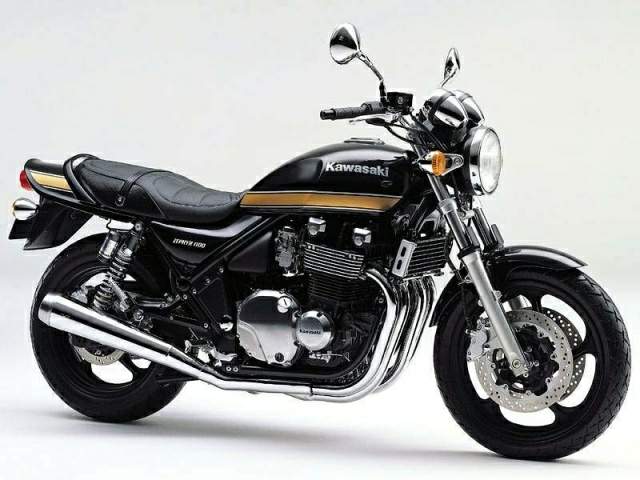
Kawasaki Zephyr 1100
Kawasaki were the first Japanese company to look back on their own history for inspiration when designing new bikes. The result was the Zephyr range, introduced in 1991. The 550 and 750 Zephyrs, both styled like Kawasaki's muscle bikes of the 'seventies, sold well to people who were attracted to the simplicity and spirit of a 'seventies bike, but who wanted 'nineties reliability and a warranty. The 'retro' movement was born. But what real muscle bike fans wanted was the true successor to the hairy-chested Zl and the later Z1000.
They got it in 1992, with the Zephyr 1100. In stark contrast to the firm's other flagship 1100, the ZZ-R, the Zephyr is a model of simplicity, consisting of little more than an engine, two wheels and just enough other equipment to hold them together. Visually, the Zephyr takes its styling cues from the Zl. But not a standard Zl. What Kawasaki did was to build a bike that incorporated all the modifications people made to their old Zeds as technology moved on and parts from later bikes became available.
So, the Zephyr has an alloy box-section swinging arm at the rear, operating remote reservoir twin shocks with adjustable damping. At the front, huge twin brake discs and four-piston calipers from the ZZ-R1100 are a far cry from the Zl's single front disc and single-piston caliper. Alloy wheels fitted with wide, sticky tyres complete the picture. The result of all this attention to the running gear is a bike that's superbly balanced, with plenty of ground clearance for fast back-road riding, and impeccable low-speed manners. The Zephyr is a heavy bike, but it carries its weight low, making for good manoeuvrability The low seat and upright riding position help here, too - a relief for many after the race crouch of most modern sports bikes.
But it's the engine that gives the Zephyr its real character. The air-cooled unit is based on the old GPzllOO - strong, almost over-engineered, and still a favourite with drag racers and tuners. Freed from the need to produce awesome peak power figures for maximum speed, the engine designers were able to concentrate on getting smooth, strong, useable power from as little as 2,000rpm all the way up to the relatively lowly 9,500rpm red line. The only concession to the technological advances made since the 'seventies is the air-cooled motor's twin plug set-up. The use of two spark plugs per cylinder helps improve combustion efficiency and beefs up an already fearsome midrange power curve -there are few bikes that give the same impression of arm-tugging acceleration as an 1100 Zephyr. In the real world, the Zephyr's power characteristics make it easy to drive off the line fast, or power hard out of turns without worrying what gear you're in. If the midrange is impressive, the Zephyr's high speed manners are less so. Flat out at around 140mph, the combination of old-tech chassis and suspension components, and a riding position that turns you into a sail, means the Zephyr weaves and wobbles along seemingly on the very edge of control. Unless you want to lie flat on the tank, 130mph is a more realistic top speed, and the lack of a fairing means anything over 90mph is uncomfortable for long distances.
But paradoxically, it's this very aspect that makes the Zephyr so popular. Not everyone wants a bike that can do 170mph and handles so well you have to be a budding racer to take it to its limits. There's definitely a place for the Zephyr's low tech, low cost, high fun factor approach, as Honda, Suzuki and Yamaha have since proved by following Kawasaki's lead and producing their own contributions to the retro revolution.
Source of overview: Super Bikes by Mac McDiarmid
|
|
|
Any corrections or more information on these motorcycles will be kindly appreciated. |