|
|
|
|
Classic Bikes
Custom Bikes
Individual
Racing Bikes AJP
AJS
Aprilia
Ariel
Avinton / Wakan
Bajaj
Benelli
Beta
Bimota
BMW
Brough Superior
BRP Cam-Am
BSA
Buell / EBR
Bullit
Bultaco
Cagiva
Campagna
CCM
CF Moto
Combat Motors
Derbi
Deus
Ducati
Excelsior
Fantic
GASGAS
Ghezzi Brian
Gilera
GIMA
Harley Davidson
Hero
Highland
Honda
Horex
Husaberg
Husqvarna
Hyosung
Indian
Jawa
Kawasaki
KTM
KYMCO
Laverda
Lazareth
Magni
Maico
Mash
Matchless
Mondial
Moto Guzzi
Moto Morini
MV Agusta
MZ / MuZ
NCR
Norton
NSU
Paton
Peugeot
Piaggio
Revival Cycles
Roland Sands
Royal Enfield
Sachs
Sherco
Sunbeam
Suzuki
SWM
SYM
Triumph
TVS
Ural
Velocette
Vespa
Victory
Vincent
VOR
Voxan
Vyrus
Walt Siegl
Walz
Wrenchmonkees
Wunderlich
XTR / Radical
Yamaha
Zero
Video
Technical
Manufacturer List Contact
|
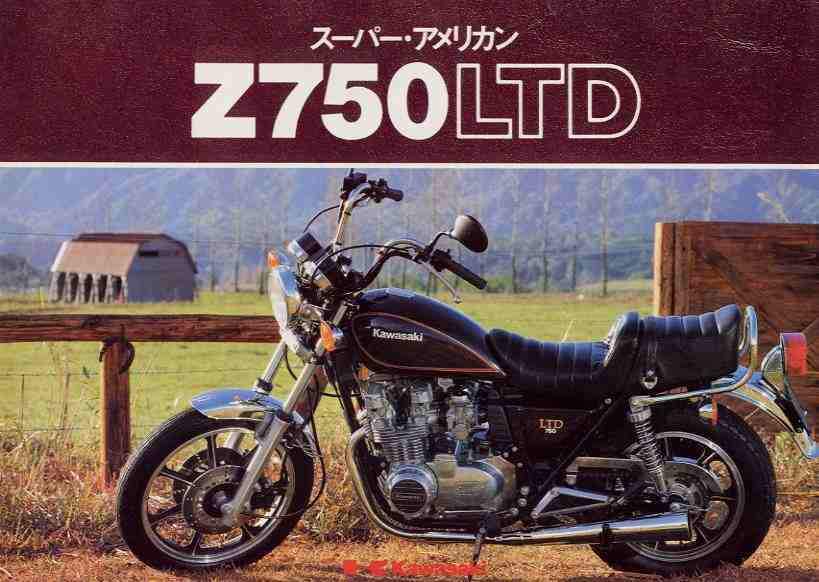
Kawasaki Z 750LTD
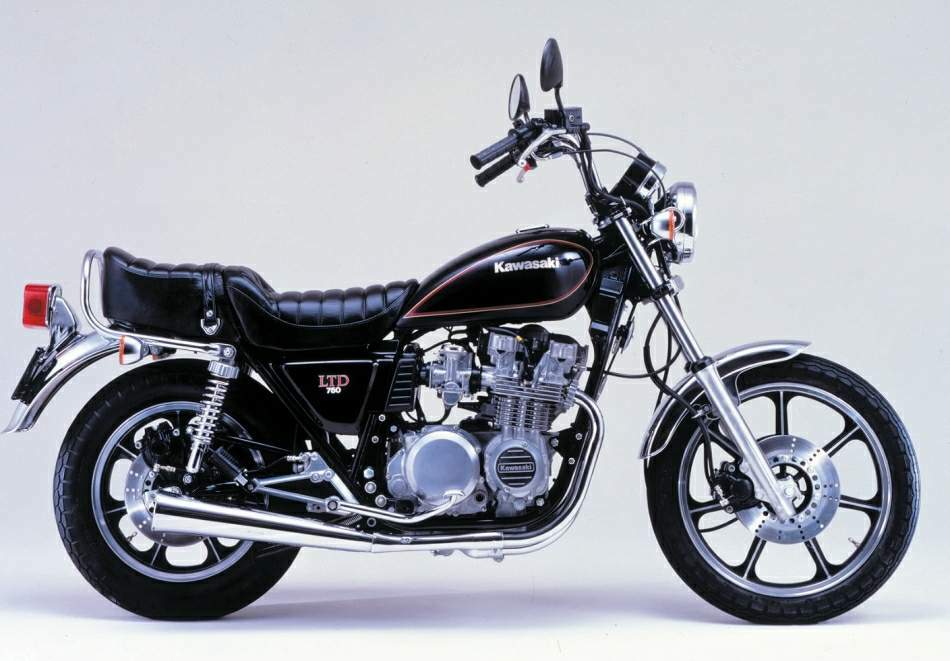
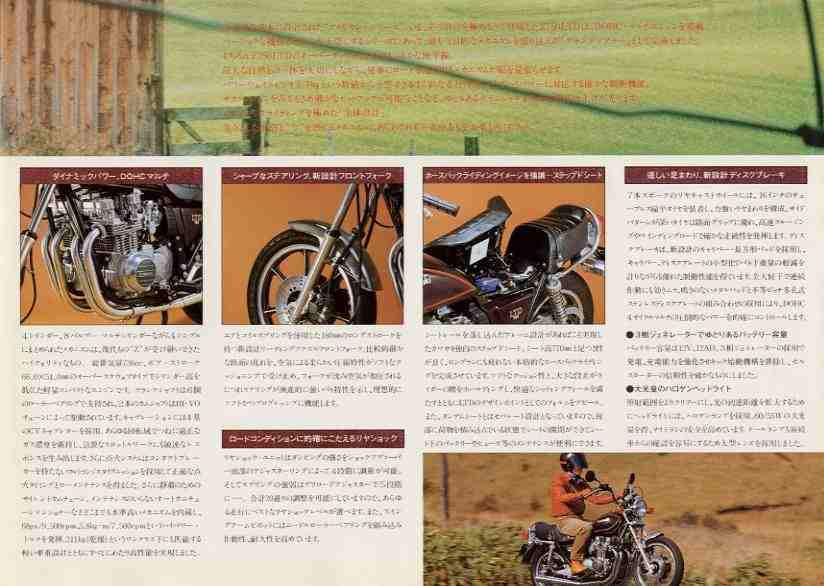
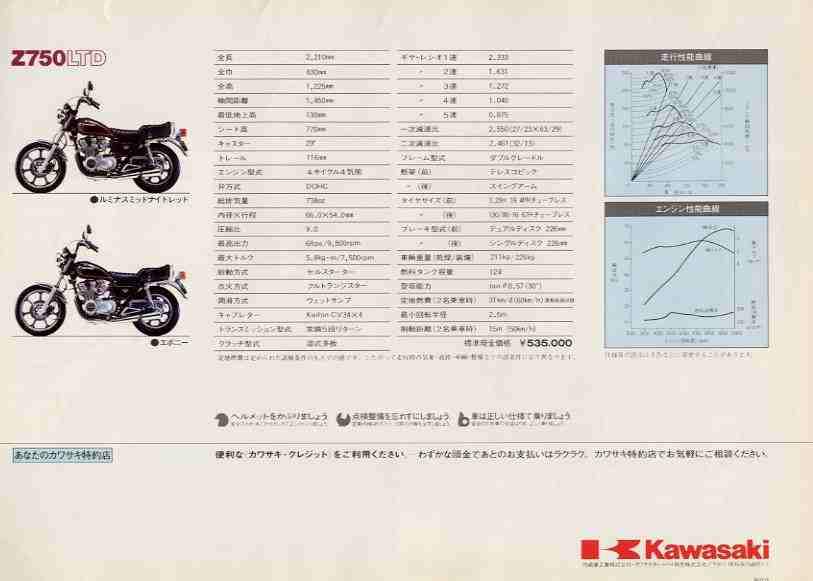
Like that mild mannered reporter for the Daily Planet, Kawasaki's KZ750 LTD doesn't look like the sort of motorcycle that's faster than a speeding bullet and more powerful than a locomotive. After all the LTD, like Customs and Specials and L models, is assumed to be more for show with its stylish small gas tank and stepped two-piece seat and handlebars that say you're not going to Daytona to ride in the Superbike race. But the LTD is only part of this bike's heritage. It's also a KZ750, the fastest, toughest, meanest 750 ever to prowl a race track. Is this bike more KZ750 or LTD? It depends on how it's ridden, and who's riding it. Ridden aggressively, the KZ750 comes out. A 74 horsepower 750 is, after all, a thrilling piece of machinery. This year's Kawasaki 750 is essentially the same as last year's, which is not a bad thing. It's a dohc, inline Four with a bank of four 34mm Keihin CV carbs. Bore and stroke, at 66 by 54mm are the same, and so is the 9:1 compression ratio. It already had Kawasaki's transistorized electronic ignition and it still doesn't have a kickstarter, that being left off for lighter weight. Cam profile was changed slightly after the first KZ750s were produced. Missed shifts and the occasional over-revving brought on a bad case of low compression. That, according to Kawasaki, should be a problem of the past. Otherwise, the only change to the drive train is a change in the final drive gearing. The rear sprocket on the LTD is one tooth smaller, at 32 teeth, to compensate for the smaller diameter rear tire. Overall gearing is nearly identical on the standard and LTD versions. Tires on the LTD are a 3.25H-19 Bridgestone in front and a 130/90-16 Bridgestone in back, both tubeless and both with raised white letters, like those on the Honda Customs this year. Some handling ability is sacrificed any time a 16 in. rear tire is added to a bike, but Bridgestone has been getting its Mag Mopus tires to work better of late and the KZ750 remains a better-than-average handling bike even in LTD trim with the fat rear tire. Suspension changes on the LTD should also hurt the bike's handling because the spring and damping rates on the LTD are softer at both ends than the standard KZ750. Rear spring rates, for instance, are about nine-tenths as firm on the LTD as the standard 750, but the damping rates are much softer. Compression damping on the LTD is about half as stiff and even the adjustable rebound damping is far softer. Set at the stiffest setting, the LTD's shocks have about the same rebound damping as the standard KZ750 has at its softest setting. Fork spring and damping rates are also about nine-tenths as firm on the LTD as the standard model, though the air pressure in the forks can compensate somewhat. Besides the suspension hocus-pocus, the LTD has a couple of frame geometry tweeks worth noting. Naturally an LTD must be equipped with leading axle forks. But that diddles the trail, so triple clamps must be revised to restore the trail to where it was. The LTD gets more than that, though. The steering rake has been extended to 30° while the standard model makes do with a 27 ° head angle. But because of the reduced offset on the triple clamps the trail has only increased from 4.2 in. to 4.8 in. Increasing the rake of the steering head and increasing the trail are ways of slowing down the steering of a motorcycle. Worse things could be done to the KZ750. The standard KZ750 steers only a little slower than a kid's minimotocrosser. Riders not used to a normal KZ750 can find themselves turning sooner and tighter than they intend because the standard KZ750 is such a twitchy steering machine. For roadracing that can be a good thing because the Kawasaki can help a rider change directions going through esses or use its abundant cornering clearance to stuff a wheel on a hapless Honda rider, for instance, but in the world of commuting and riding along open roads the Kawasaki in standard form might turn quicker than is desirable. Enter the LTD. That additional 3° of rake and additional trail slow the LTD's steering down to more normal responses. Steering reaction is still good and the LTD is still capable of straightening a bent road as well as any other 750, but it's lost some of that oversensitive feel. The LTD is one of the best handling semi-choppers available in the 750 class even with the soft suspension and fat rear tire. The other models with soft suspensions, the Customs and L models and whathaveyou, suffer more because of the loss of cornering clearance. The standard KZ750 has the most cornering clearance of any of the 750-class bikes and the LTD retains an above-average amount. Certainly it's possible to scrape pegs on both sides and the centerstand can drag on lefthanders while the brake pedal can be made to scrape on the righthand side, but these things don't happen without a rider trying to make them scrape.
Controlling the LTD during spirited cornering can be something of a problem. It's the handlebars. Turns out not all of the luxo models do the bucko bars in the same shape. Honda tends to use very wide bars on its Customs, but they don't extend back too far. Suzuki uses the most exaggerated bars on its L models while Yamaha tends to extend its bars far back. Kawasaki uses narrower bars but on the 750LTD there's more rise than other LTDs have. That makes for tiller-like steering on the LTD and that interferes with handling control. Other parts of the LTD package may or may not suit all riders. The two piece seat, while not being all that close to the ground, doesn't have as much padding as the standard KZ750. That makes the ride feel harder than it is, even with the soft suspension. Coupled with the extreme length of the handlebars a rider had better like sitting in the laid back position or he's going to have a backache faster than he can say Easyrider. The rear portion of the double seat isn't as uncomfortable because it's relatively flat and has enough room for most passengers of our acquaintance. The plush suspension does its part to keep rider comfort high. Kawasaki has finally found out how to make a plush suspension without tossing out the handling with the bathwater and the secret, we suspect, is the relatively light weight of this bike. Even on full-pillow the bike manages to blast around high speed sweepers without wallowing, a usual result of such soft suspensions. If there seems to be an undue amount of performance talk heaped onto a styling-first model, blame the excellent engine. With a 74 horsepower engine powering a 492 lb. motorcycle performance is a natural result. By the numbers the 750 LTD doesn't perform as well as we would expect. Our last Kawasaki 750 turned the quarter mile in 12.26 sec. at 107.78 mph. It was the fastest 750 we'd ever tested. The LTD wasn't nearly so quick with a 12.62 sec and 104.19 mph quarter mile performance. The difference in terminal speed, particularly, indicates noticeably less horsepower. Exactly why may have something to do with the cams. Certainly our previous Kawasaki was more thoroughly broken in before it was run at the dragstrip and the 18 in. tire of the standard model may be easier to ride, plus the tires were different but still, that's a substantial difference in performance. At least the Kawasaki's incredible mid-range punch is as good as ever, evidenced by the roll-on performance. Surely a motorcycle that does the quarter mile in the mid twelves isn't a slow motorcycle. Just a couple of years ago it would have been an extremely fast 750. And that's how the LTD feels. Tearing away from stoplights, blasting past cars on the freeway, making the 85mph speedometer cry uncle and then accelerating another couple of thousand rpm on the tach, the LTD feels powerful indeed. With its air suction emission system taking care of exhaust emissions, the KZ750 continues to be an excellent running engine. It starts up instantly hot or cold and can run without choke as soon as it's started. There's no hesitation in acceleration even when the bike's cold. Throttle response is everything it should be. Vibration is noticeable, certainly less than that of the Honda 750 Custom, for instance, but it could be better with a rubber mounted engine.
Although carb jetting is supposed to be the same and therefore power and economy should be unchanged, our mileage worked out to 47 mpg on this year's 750, a couple of mpg better than last year's standard model returned. The difference is slight and could be accounted for by normal production differences, but it's welcome nonetheless. Equipped with a 3.25 gal. gas tank the LTD needs all the mileage it can get. Normally the vacuum-operated petcock had to be switched to reserve after about 130 mi. Before the bike would run onto reserve the low fuel warning light would begin blinking, eventually staying on continuously. At that point the order of the day was Get thee to a gassery. A bigger gas tank is in order even when the Arabs aren't playing war. As for the ease of riding the Kawasaki, it could hardly be nicer. Throttle and clutch pull are within reason and if the clutch is maybe a little stiff at least the KZ750 clutch will never break. Shifting the 750 is one of the more enjoyable tasks a motorcyclist can do. Shifts are positive, swift and take little effort. The brakes are good, but with a reservation. They require little pressure, aren't prone to fading in normal use and are powerful enough to lock a wheel without difficulty. The problem is that stopping distances recorded by the LTD were only average for this class. True, a 141 ft. stopping distance from 60 mph and a 36 ft. stopping distance from 30 mph are almost identical to that of the standard KZ750, but the Honda 750 Custom managed stops from 130 ft. at 60 mph and 33 ft. from 30 mph using the same tires. The problem is control. The rear brake will lock too easily, making control difficult. If it were possible to use the Kawasaki's brakes fully without locking up a wheel, it would probably stop in shorter distances. And if elephants could fly statues would be in trouble.
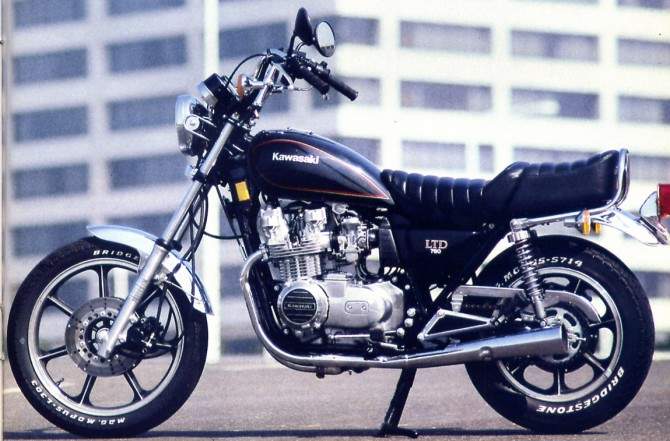
Being reasonably powerful, generally good handling and having most of the makings of a comfortable bike, the styling shouldn't let the bike down, and it doesn't. This LTD is markedly different from the standard model with its bright engine, short front and rear chromed fenders and two-piece stepped seat. Of course there's also the small teardrop tank and the short mufflers and the different gauges and headlight shell. Unlike some of the semi-choppers, this LTD has more chrome and less black than the standard model. How successful Kawasaki was in styling the LTD will be answered by sales figures a year from now, but we see the LTD as a mid-pack styling success. There are both better and worse luxo models. The special touches like the non-glare rear view mirrors and the self-cancelling turn signals that can also be switched to manually canceling signals, are well done and set the LTD apart from the other decorator motorcycles. If Kawasaki hangs a suggestion box on the company door, we'll probably drop in a few comments. Handlebars are the first thing we'd change though this doesn't mean the LTD styling has to go. Bars like those used on the old KZ650SR had a shape that fit the LTD style, were comfortable and fit the bike. There was even enough room for the front signal lights to be mounted on the handlebars, just like the 750LTD has. Next we'd make the LTD tank a little larger. Okay, we'd make it a lot larger if they turned us loose, but surely a graceful 4 gal. gas tank is possible. The seat could use a little more padding and with the two-piece design it's possible to retain the stepped look while raising the front of the seat. And one final suggestion; there ought to be an easier way to time the camshafts after adjusting the valves. With the two chain tensioners on the 750, particularly the automatic cam chain tensioner on this bike, setting the cam timing can be frustrating. Fortunately this bike's good points outweigh the bad. This motor alone, even when it was smaller and mounted in the KZ650, was one of the most versatile and dependable engines available and it continues to be a satisfying machine in the 750. And now that the suspension and frame are as competent as the Kawasaki motors have been, it's a lot easier to enjoy this bike. fflSource CYCLE WORLD 1981
|
|
|
Any corrections or more information on these motorcycles will be kindly appreciated. |