|
|

|
|
|
|
Classic Bikes
Custom Bikes
Individual
Racing Bikes AJP
AJS
Aprilia
Ariel
Avinton / Wakan
Bajaj
Benelli
Beta
Bimota
BMW
Brough Superior
BRP Cam-Am
BSA
Buell / EBR
Bultaco
Cagiva
Campagna
CCM
CF Moto
Combat Motors
Derbi
Deus
Ducati
Excelsior
GASGAS
Ghezzi Brian
Gilera
GIMA
Harley Davidson
Hero
Highland
Honda
Horex
Husaberg
Husqvarna
Hyosung
Indian
Jawa
Kawasaki
KTM
KYMCO
Laverda
Lazareth
Magni
Maico
Mash
Matchless
Mondial
Moto Guzzi
Moto Morini
MV Agusta
MZ / MuZ
NCR
Norton
NSU
Paton
Peugeot
Piaggio
Revival Cycles
Roland Sands
Royal Enfield
Sachs
Sherco
Sunbeam
Suzuki
SWM
SYM
Triumph
TVS
Ural
Velocette
Vespa
Victory
Vincent
VOR
Voxan
Vyrus
Walt Siegl
Walz
Wrenchmonkees
Wunderlich
XTR / Radical
Yamaha
Zero
Video
Technical
Complete Manufacturer List
|
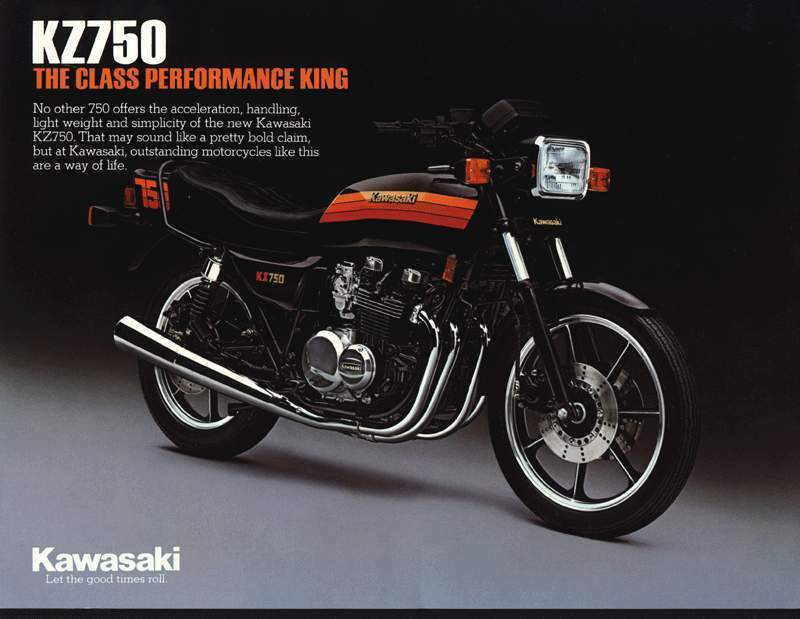
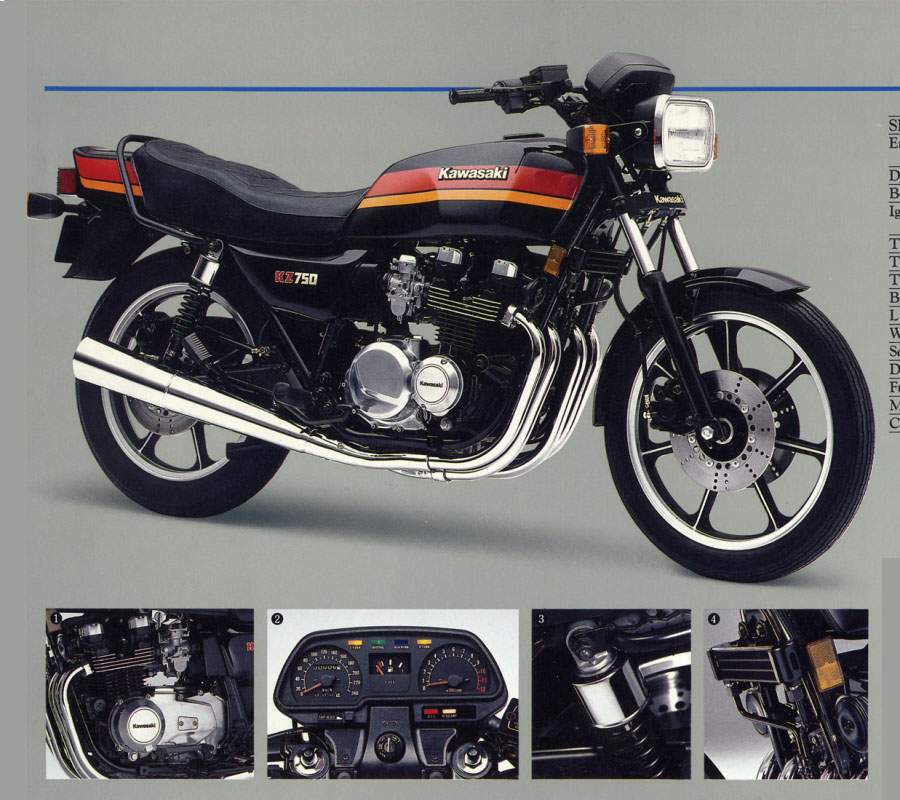
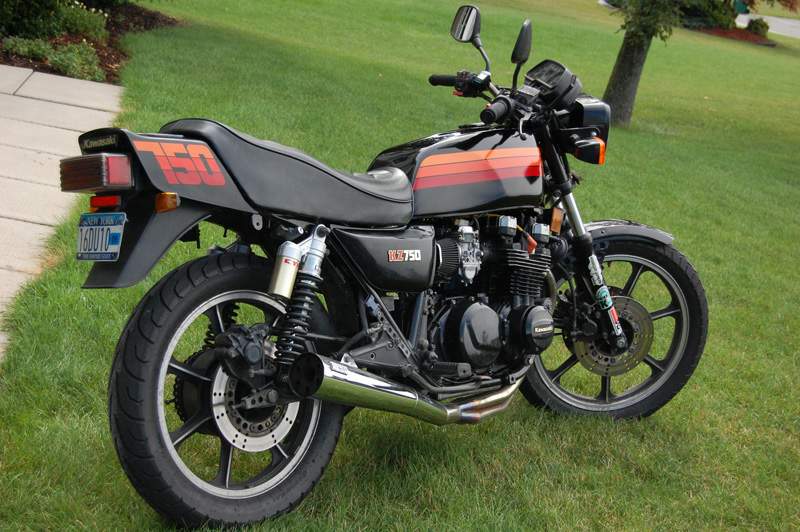
Kawasaki Z 750L3
KZ750/KZ550 First tested in September 1980, when we compared it with Honda's CB750 and Suzuki's GS750, the KZ750 came out way ahead. It brought the smaller, lighter design concept to the 750 class; the bike weighed 50 pounds less than the others. It was also faster, more nimble, and—best of all—cheaper. Two years later, in June of 1982, the KZ went up against four rival 750s—and again came out on top: fastest, best handling, and still the cheapest. Obviously, as in the case of the KZ550, encroaching technology wasn't dumping much on the KZ's sporting parade. Enter 1983. Faced with what's now a four-year-old design, Kawasaki decides that it's time for the KZ to undergo a metamorphosis. It becomes last year's GPz, sans blood-red paint, fairing, instruments, black engine cases, and black-chrome pipes. In short, Kawasaki replaced a two-time winner, a class leader, a bike we loved, with a machine that was a bit disappointing. Last year's GPz, you should recall, had a few problems made even more frustrating by our anticipation of a wonderful machine. The front brake was frighteningly sensitive, the adjustable aluminum handlebars adjusted in all the wrong places and never stayed tight, and the bike had a generally weird feeling to it. It wobbled and felt otherwise unpredictable at speed and oversteered something fierce at low speeds. But it had a great engine. As the year unfolded, we heard more and more about GPz buyers discovering bent swingarms, misaligned wheels, even bent frames. We received enough letters from readers to suspect that Kawasaki had a quality-control problem with the GPz750, which would explain many of the handling problems with our bike and negate the possibility of our GPz being a lone lemon. The 1983 KZ750 (i.e., 1982 GPz) that we tested this month, however, is a much better example of what Kawasaki intended the GPz to be. It's still fast and now doesn't demonstrate any strange handling problems. So it is probably safe to say that this is a good example of last year's GPz. The wheelbase is over two inches longer than the old-style KZ, which translates to rather slow, high-effort steering. It's also now 16 pounds heavier. What about that great engine? Well, the '82 KZ went a bit faster in the quarter-mile, 12.22 seconds compared to the '83 KZ time of 12.26, but that doesn't amount to much, since the terminal speed of 108 mph is the same for both bikes. So they make about the same amount of horsepower. But in our roll-on tests, performed at full throttle in top gear at 50 mph 200 yards from the clocks, the old-style KZ engine romped through at 77.7 mph, faster than any 750 Motorcyclist has ever tested. The '83 KZ posted a terminal speed of 75.8 mph, nearly two mph slower than last year's KZ750. Engine differences between this year's KZ and the '82 KZ are relatively minor and aimed at passing more fuel through the combustion chamber at a faster rate of speed. Starting at the airbox, there is a less restrictive filter that passes clean air to the four Mikuni carbs, which have smoother bores than the old Keihin carbs. The intake ports have been smoothed out, and the intake and exhaust cams, though identical in lift and duration, have steeper opening ramps to speed things up a bit. The exhaust system was also increased in volume to handle more exhaust gases. The '83 KZ has a bit more off-idle snap than the '82 KZ, and it is far more comfortable to ride. Kawasaki jettisoned the two-piece GPz aluminum handlebars and installed a conventional bar of much the same bend as the excellent Eddie Law-son Replica bar found on the KZ1000R. Like last year's GPz, the saddle on the '83 KZ is one of the best we've ever in- dented, and the overall seating position is second to none. With rubber mounts isolating the rider from engine vibration, there is nothing to keep you from spending all day behind the new instrument panel. Last year's GPz instrument pod housed an LCD fuel gauge and checklist, along with a tachometer that did double duty as a voltmeter at the push of a button. None of that gimmickry is present on the KZ. Now, although the tachometer is electronically driven, the instruments feature more conventional functions. Aside from the aforementioned changes, the '83 KZ750 differs from the '82 GPz in a few other areas. The seat-cover pattern is different, the mufflers are chrome, the brake-pad material is changed, the fork is fitted with separate air-filler caps instead of the previous common filler, and the suspension's spring and rebound-damping rates have been altered. As we've said, there were oversensitiv-ity problems with the front brake on last year's GPz. The pads, perhaps containing very little metal, also wore out rapidly. For '83, we suspect that the material contains more metal, since the pads do not wear as quickly and it's easier to modulate the amount of braking you want up comes with Showa components. Though spring rates, damping, and travel figures remain the same, the new suspenders should last a bit longer. It only took about 1800 miles for the rear shocks to fade into uselessness on the original KZ, but the new Showa dampers seem to hold up better. Up front, the 36mm legs are air-assist-ed and provide a great range of adjustment. Though the overall ride of the KZ is something less than plush, it is still comfortable enough for full days in the saddle. Only the rear end fails to respond to sharp bumps as well as we have come to expect from the best OEM suspension systems. With the preload backed all the way down on the rear shocks, the KZ responds to small bumps as well as most bikes. But the springs are a bit too stiff to handle the real whoppers without pounding the haunches. Still, the rear suspension does an admirable job of keeping he rear tire on the ground. Despite the four possibilities in rebound damping, only two are effective in controlling the stiff springs. On the number one and two positions, the rear end bounces up much too quickly. On continuous bumps, like freeway expansion joints, the KZ tends to porpoise, unsettling your lunch. But the number three setting smooths the freeway ride, while the stiffest, number four position controls spring rebound during high-speed riding. A fast spin on a twisty road is an edifying experience on the KZ. Rev the engine into the red zone, and then dare to go farard. The seat, however, is not all that conducive to day-long touring sessions. It feels a bit more supple than the original seat, though Kawasaki makes no note of any construction change. Perhaps somebody slid dual-density foam under the vinyl cover and forgot to tell everybody. If you can fight the rapscallion urges and stay on the open highway, the KZ will deliver at least 46 mph. Give in to the bored tach needle, and mileage dips to 35. The old 22mm carbs delivered better mileage than the new 26mm carbs. Some of that lost mpg, though, was probably brought on by our continual yielding to temptation and can no doubt be bettered with more frugal riding habits. While it's probably true that the KZ550 won't last much longer with all the advances going on around it, it remains on our collective list of Favorite Bikes. We hope Kawasaki continues to refine it without pricing it out of the bargain range in which it currently exists. We would love to see it become The seat, however, is not all that conducive to day-long touring sessions. It feels a bit more supple than the original seat, though Kawasaki makes no note of any construction change. Perhaps somebody slid dual-density foam under the vinyl cover and forgot to tell everybody. If you can fight the rapscallion urges and stay on the open highway, the KZ will deliver at least 46 mph. Give in to the bored tach needle, and mileage dips to 35. The old 22mm carbs delivered better mileage than the new 26mm carbs. Some of that lost mpg, though, was probably brought on by our continual yielding to temptation and can no doubt be bettered with more frugal riding habits. While it's probably true that the KZ550 won't last much longer with all the advances going on around it, it remains on our collective list of Favorite Bikes. We hope Kawasaki continues to refine it without pricing it out of the bargain range in which it currently exists. We would love to see it become The Best OFF THE RECORD The KZ550 was a tremendous motorcycle when it first came out. It was a bunch faster than anything its size, and even quicker than a lot ot bigger bikes. I went roadracing with our original test bike; it turned out to be my winningest day ever. I took two firsts and a second on a virtually stock motorcycle. In the three years since then, the KZ has barely changed, but only now is it starting to get a little dated. Though still the best buy in the class, several new bikes will probably be quicker; some will handle better too. As the first truly high-performance middleweight, the KZ550 provoked a technological wildfire in the 550 class. Now it's about to be consumed in the flames it ignited. -Jeff Karr Like Jeff, I racked up a lot of racing miles on the original KZ550. And despite a lot of tuning advice from the staff, the bike never failed to finish a race. By the end of a season riddled with fiddling of every sort (except the routine maintenance type), the bike was still running like a clock. I gave it up when the GPz550 was introduced. Keith Code, roadracing trainer to Wayne Rainey and tutor of many hopefuls at his Su-perbike school, used the original KZ550 to train students. Now, if there is anyone who can heap more abuse on a motorcycle than a magazine staff, it must be a pack of half-crazed roadracing zealots out for that first thrilling spin on sombody else's bike. Yet, at the end of the season, those KZs, bashed and battered, were still running strong. The KZ hasn't changed much since those early days. It's still just as bulletproof and fun as ever. I don't think I'd even want another disc up front, though the bike could use it. As is, for $2399, the KZ550 buyer gets what I feel is the best entry-level machine on the market. Not only can you learn the basics on it, but, like Code's students, you're going to need a lot of practice before you find yourself in need of more. —Ken Vreeke The Kawasaki 550's jetting is horrendously lean, and that makes it a little hard to love without reservation; a few well placed shims under the needles should do wonders, if you keep an eye out for the Smog Police. I've loved the KZ/GPz 550 series since Kawasaki invented it, and this KZ gave me all the 550 giggles I expected: spontaneous whee-lies away from lights, effortless (and gratify-ingly quick) steering, and the overall aura of competent irresponsibility that has made all the Kawa 550s so much fun to play with. I've got a friend who's interested in a bike in the 550/650 class, who doesn't want to spend to much money, and who wants a fast, sharp-looking, all-around street bike. I have a feeling the KZ is going to get my endorsement as his bike of the year. —Dexter Ford, I can hardly claim an objective view of the KZ550, since I bought one two years ago. However, since this Off The Record section offers the opportunity to flaunt your preju- dices under the guise of candor, it's probably best that I trot mine out of the closet right away and set them down here: I like the middleweight motorcycles. I admire them. Only on 500-mile days or during long straight-line running (which is perhaps two percent of my riding) does the whole big-bike concept make any sense to me. They lumber like leg irons through city traffic and careen down canyon roads a little like Mac-beth's view of life—a lot of sound and fury signifying not a whole lot of anything. Meanwhile, the hot 550s are insolently nipping at their heels. Contemporary motorcycles seem to come smack up against the wall of diminishing returns somewhere around 750cc: engines swell sideways, frames get gusseted up to handle the load, gigantic fork legs and swingarms are fashioned to steady the thing, then more motor is added to keep the weight ahead of itself, which requires a stronger frame, and on and on ad gigantum. Sadists like Vreeke seem to glean exquisite pleasure out of wringing some behemoth's hairy neck. But to me the middle-weights appear to be perched at the apogee of the performance curve; they're light, fast, smooth, and cheap to run. The KZ550 was the first of the really potent middleweights when it appeared in 1980, and its sporting character seems to sharpen with each passing season. This year's KZ is substantially quicker than its forebears, making it even more fun to ride. I can't help it. I love the bike.
—Paul Go front. Though the brakes have a tendency to squeal when used moderately, there is much better communication between the handlebar lever and calipers. Now you know how much braking is going on at the contact patch before it's too late. Some of this better feel is perhaps due to an improvement in tire compounds. Last year's tires were slippery devils that made both braking and hard cornering an exercise bordering on terror. Though the very narrow tire sizes remain the same, the compounds seem a bit softer. Now you don't have to heat your tire in a blast furnace before you dare to ride hard. A few warm-up miles down your favorite road and the tires become fairly sticky. Stopping ability, both front and rear, has improved tremendously, though we wouldn't say it's anywhere near the best we've experienced. Why Kawasaki went from a common air filler up front to separate fillers, we'll never know. Granted, it's now easier to remove fork tubes from the triple-clamps, but we do far more adjusting of air pressure than we do removing of front ends. A common filler is simply easier to operate, and it ensures that an equal amount of air finds its way into each leg. When we tested the GPz in August '82, we gave the suspension high marks. With the air pressure set at 18 psi up front, the rear suspension's seven-position preload cams set in the middle positions, and the five-position rebound-damping adjusters set on number three, suspension compliance was excellent. It isolated the rider from highway judders and did an admirable job of keeping the slippery tires on the ground. This year, Kawasaki changed all that. Stiffer springs were fitted to each end, and rebound damping was increased in the rear. The front end actually works a little better than it did. With a stiffer spring, less preload is required to handle the big bumps, and with less preload, the initial few inches of travel are more compliant than ever. But more spring out back has made the rear suspension somewhat unresponsive, unless you weigh over 170 pounds. You now know you're rolling over small bumps in the road, even with the preload adjusters in the lowest position. On more serious bumps, the rear end tends to kick up and hammer the ol' caboose. With enough rebound damping to control the spring, action in the rear is too slow to handle much of anything. The stiffer suspension, however, has helped rid the Kawasaki of its tendency to wobble at high speeds. When the speedo needle whips past the legal limit, the suspension starts to make sense. The bike is stable and precise, and the slow low-speed steering characteristics are no longer a disadvantage. At all angles of lean, steering remains neutral, albeit a bit heavy. With the stiffer springs, the suspension doesn't sink as much as last year's GPz during hard cornering, so there is a bit more ground clearance. Pushing the bike hard through the corners, something that was nearly impossible on last year's GPz, will bevel the peg, sidestand, and centerstand on the left, and the peg and outer exhaust pipe on the right. At maximum lean, the rear Dunlop has a bit of tread left, but the ribbed front tire is at the limit. Run the bike too deep into a corner, and the front end will let go first. Around town, the KZ demands your attention. With its relatively slow steering, it doesn't zip through traffic as the old-style KZ did. Unlike the 550, the KZ750 requires only a short warm-up on cold mornings and produces enough torque OFF THE RECORD I guess bikes like the KZ750 need to exist. There's always room for a nice, competent motorcycle. Sort of a Lady Kenmore of the two-wheeled world. It gets the job done with a minimum of fuss and expense; it's an unobtrusive servant to modern man. I mean, who wants a washing machine that only works on corduroy or costs a fortune or needs a new drive belt every month? Not me. Just like everybody else, I want a washer that can handle it all, and at the minimum cost to me. The KZ750 is just such a utilitarian device. Versatile, inexpensive, and properly boring. My problem is that I don't appraise motorcycles in the same way I do household appliances. In motorcycles, I'll put up with corduroy-only performance or the need for an occasional belt change or even a high price, if the performance payoff is big enough. You see, motorcycles are not appliances. Bikes are fun; trash compactors are not. Thus, the bike that is the most fun is the best bike. In the 750 class, the best bikes are called GS, GPz, and Interceptor—not Lady Kenmore. -Jeff Karr I like the KZ750 quite a bit, but I can't help missing the shorter, lighter chassis of the '82 KZ. The '82 was not exactly a looker, so I can understand why Kawasaki chose to update the '83, but I can't for the life of me see why they had to mess with the frame. The '82 that won our 750 tour comparison (against competition as stiff as the new V-4 Honda) was light, steered quickly and with precision, and out-accelerated all the other machines. It showed the least tendency to dive under braking—and it was one of the two bikes in the test with no anti-dive plumbing stuck to the fork legs. High-speed handling—even with a clear fairing, all kinds of luggage strapped on, and rapidly wearing tires—was near perfection. The KZ we're testing now has a stronger motor, is prettier, handles more slowly, and feels considerably heavier. I like the riding position better than before, and there's no denying that the '83 KZ is a top-notch 750 and may well be the best all-around sport-touring package in the class. It's just that I find it hard to get the memory of the sweet '82 version out of mind. —Dexter Ford In gaining 70 pounds and a couple of inches in wheelbase over its smaller sibling, the KZ750 has made a qualitative lurch into Big Bikedom, and it feels like it. The poundage makes itself apparent at all speeds and angles; it's a disconcerting mass to throw around. The payoff is a smooth, tractable engine with strong, linear power delivery and negligible vibration. The KZ's spacious ergonomics and good seat are perfect for most riders. But the 750's main problem is that it feels like a powerful sled dog trying to mush through the muskeg on little cat feet. The skinny wheels and touchy front brake combine to create a paranoid riding program, while the hard compound Dunlops slew sideways with little provocation exiting turns or intersections. The KZ750 may be much improved over last year's fearsome-handling GPz750, but it still has a long way to go toward establishing what feels like a working relationship with the road. —Paul Gordon It's nice to see that Kawasaki fixed a lot of the handling problems so prevalent on last year's GPz before tacking on the KZ750 emblem. Now the bike works as well as it was intended to work. But I simply can't see the point in paying almost as much for the KZ as it would cost to own either the GS750 or Honda Interceptor—unless those other bikes turn out to be far too uncomfortable for longdistance touring. I've only sat on the Suzuki and Honda, but for me, the seating arrangements are not too cramped to be comfortable. I may feel differently after 100 miles in the saddles, but if I don't, I'd pay the additional couple hundred dollars in a flash for a smaller, lighter machine and 16-inch front-wheel technology. —Ken Vreeke down low to launch away from city traffic with a crack of the throttle. Being an around-town smoothy, however, is complicated by a grabby clutch. As we discovered in our '82 test of the GPz, the clutch is not the most predictable thing around. Easing away from traffic with little throttle is not much of a problem, but driving away hard will cause the clutch to emit a groan and engage suddenly. The open highway is the KZ750's domain. There, it locks into a casual gait and gobbles up the miles in comfort. The seating position leans the rider into the wind, which at freeway speeds, lifts the pressure off his forearms. Highway riding will reward the rider with 47 mpg, while a faster pace can drop that figure to 29 mpg. The old-style KZ averaged over four mpg more than the '83 KZ, though with a large 5.7-gallon tank, the new KZ will carry you an extra 20 miles between fill-ups. Comfort and sinister looks are the biggest assets of the '83 KZ750. Compared with the previous KZ, there is no notable gain in engine performance. It also falls behind in handling compared with last year's shorter, more nimble KZ, and for the extra $100 bucks you're paying for 1982 GPz technology, you get to ride around without the bikini fairing. Considering the fierce competition in this year's 750 lineup, the KZ750 is a motorcycle looking for a purpose. At $3099, it is $250 less than Suzuki's GS750E and $300 cheaper than Honda's compelling Interceptor. Because the retail prices are as close as they are and because Kawasaki's KZ750 falls into the same sport/ touring category, the KZ cannot be excluded from comparison. Granted, the 1983 GPz750 was designed to take on all sporting contenders, but the KZ simply isn't an attractive enough bargain to stand alone. When we test the other 750s, we may find they fall short of what they purport to be. If so, the KZ750 will begin to look better. ' M
|
|
|
Any corrections or more information on these motorcycles will be kindly appreciated. |