|
|

|
|
|
|
Classic Bikes
Custom Bikes
Individual
Racing Bikes AJP
AJS
Aprilia
Ariel
Avinton / Wakan
Bajaj
Benelli
Beta
Bimota
BMW
Brough Superior
BRP Cam-Am
BSA
Buell / EBR
Bultaco
Cagiva
Campagna
CCM
CF Moto
Combat Motors
Derbi
Deus
Ducati
Excelsior
GASGAS
Ghezzi Brian
Gilera
GIMA
Harley Davidson
Hero
Highland
Honda
Horex
Husaberg
Husqvarna
Hyosung
Indian
Jawa
Kawasaki
KTM
KYMCO
Laverda
Lazareth
Magni
Maico
Mash
Matchless
Mondial
Moto Guzzi
Moto Morini
MV Agusta
MZ / MuZ
NCR
Norton
NSU
Paton
Peugeot
Piaggio
Revival Cycles
Roland Sands
Royal Enfield
Sachs
Sherco
Sunbeam
Suzuki
SWM
SYM
Triumph
TVS
Ural
Velocette
Vespa
Victory
Vincent
VOR
Voxan
Vyrus
Walt Siegl
Walz
Wrenchmonkees
Wunderlich
XTR / Radical
Yamaha
Zero
Video
Technical
Complete Manufacturer List
|
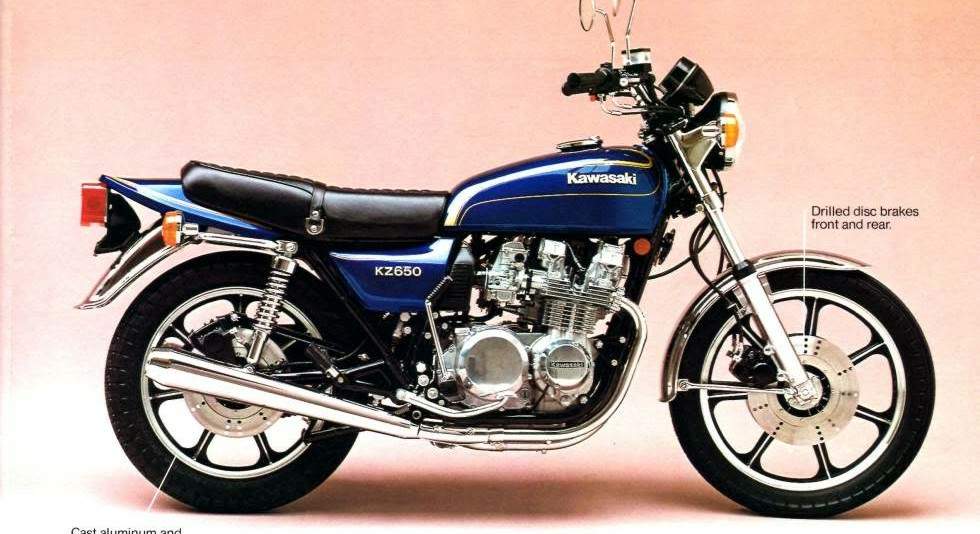
Kawasaki Z 650
The Kawasaki Z650 was a motorcycle made by Kawasaki from 1976 through 1983. It had an engine displacement of 652 cc featuring a double overhead camshaft with two valves per cylinder. The gearbox was a five speed. The Z650 was introduced to the trade in 1976 as a 1977 model and was very popular. 64 bhp (48 kW) was claimed with a dry weight of only 465 lb (211 kg), making a top speed of nearly 120 mph (190 km/h) possible. But more importantly, this new model handled like no other Kawasaki. For once all the available power could be used in relative safety. The Z650 was considered the 'Son of Z1' having been designed by the Grand Master himself, Ben 'Mr Z1' Inamura. The Z650 had the agility of a 500 with the performance of a 750, and was considered by many to be the best Kawasaki so far.The Z650 marketed in North America as the KZ650. Model History 1976/1977 Z650-B1 This four-stroke four-cylinder motorcycle boasted double overhead camshafts just
like the bigger Z1 and Kawasaki claimed 64 bhp (48 kW) from the 652 cc motor.
Unlike the Z1, the 650 used a plain bearing crankshaft with a HyVo multiplate
chain primary drive instead of a gear drive. This system necessitated the
installation of a third (intermediate) shaft in the transmission to drive the
input side of the clutch. Another departure from the Z1 engine design was the use of a shim-under-bucket method of setting valve clearances. The Z1 engine employed a shim-over-bucket design for this purpose and there had been reports of the camshafts actually forcing the shims in the Z1 engine out of position with consequent damage. Project leader Inamura made sure this would not be a problem with the 650 engine. A single 245 mm disc was used up front with a 250 mm drum on the rear, more than enough to handle this relatively lightweight bike. Both front and rear fenders were chrome. 1977 KZ650-C1 This model was offered only in North America (and possibly Japan). It was named the Z650 Custom and was introduced in early 1977, somewhat later than the B1. The C1 model differed from the B1 model in the following areas: it had cast alloy seven spoke wheels instead of conventional spoked items like the B1; disc brakes both front and rear with dual discs at the front having the calipers mounted behind the fork legs. It had different fork bottoms to cater for the rear mounted calipers. The C1 also sported four-way hazard flashers, which were not fitted to the B1. 1978 Z650-B2/B2A Very few differences were made to the B2. The front brake caliper was reversed to the back of the fork leg and the front master cylinder reservoir was changed from a round item to a trapezoidal one. The charging system was changed from a three-phase system to a two phase and the regulator and rectifier were now combined in a single unit. A hazard switch was added to the left-hand switchgear. Needle roller bearings were now used in the swingarm instead of the previous model's plain bushings and slight modifications were made to the carbs to improve low speed operation. The manual operation fuel tap was replaced with an "automatic" diaphragm type unit. There were also some slight detail changes to the outer engine cases to incorporate the new lower case Kawasaki logo. The front forks were slightly modified. The B2A was a US-only model with 22mm carburators, as opposed to the 24mm items fitted to units sold elsewhere. Power output was reduced to 60 hp (SAE net at the crankshaft) at 8,000 . This change was probably due to emission requirements in the US market. All other aspects and equipment of the B2A construction were identical to the B2 models sold outside the US. Both the B2 and B2A received the four way hazard flashers that had been previously installed only on the C1.
1978 Z650-C2 KZ650C2 All stock and original except for tires, engine guards and turn signals. See C1 above for details. The motor was, again, a standard B2 unit but the C2 carried on with mechanicals the same as were found on the C1: seven spoke alloy wheels with twin discs up front and a disc at the rear. The revised graphics (compared to the C1) made this model stand out from the crowd and the C2 was a very good seller. The first batch of bikes in the UK came with a free colour matched helmet. This model was only offered in certain markets so may not have been available in your particular country. 1978 KZ650-D1/D1A This was actually the first "SR" model released. The D1 may have been sold only in Japan but this is unknown. It featured a lot of the equipment from the C model but with a different frame, the substitution of a 16-inch rear wheel, deletion of the tailpiece (which was such a trademark of the B/C models) and an entirely different seat with a "tuck and roll" appearance to give it the full-on "chopper" look. As well, the fuel tank shape was completely different from the B/C models and more in keeping with the "chopper" look. As well, the D model featured rubber mounted two bolt style footpegs. All other models used a single bolt rigid style peg setup until the 1979 models. All D models also included a "Low Fuel" warning light incorporated into the tachometer faceplate. The D1A was a US-only model with 22 mm carburetors, as opposed to the 24 mm items fitted to units sold elsewhere. Power output was reduced to 58HP (SAE net at the crankshaft) at 8,000 RPM . This change was probably due to emission requirements in the US market. All other aspects and equipment of the D1A construction were identical to the D1 models sold outside the US. 1979 Z650-B3 The only difference over the B2 model was a change of graphics. Sales once again picked up. The new lower case tank badges were also used. The frame covers were revised to eliminate the recessed badges so that the outer surface of the cover was now totally flat. The B3 now got the same type of rubber mounted front footrests that were originally introduced on the D1/D1A to combat vibration. One mechanical change on this and subsequent models was the introduction of an "automatic" cam chain tensioner and associated bits. Until this time, the cam chain tensioner had been a manual type requiring attention from the owner on a regular basis. This first attempt at an automatic tensioner, however, was a dismal failure and was eventually changed out for the Mark II version (automatic cross wedge type) on the 1981 models. The Mark II design was somewhat better but still not a proper solution. As well, the US-only models got an air injection system for emissions reduction. This system was dubbed by the factory as the "Kawasaki Clean Air System". These variants are immediately recognizable by the two reed-valve housings and associated plumbing on top of the valve cover on the forward (exhaust) side of the engine. There is also an air diverter valve assembly (with associated hoses) bolted to the main frame tube just under the gas tank. The US-only models kept this same setup through to the end of production with the 1983 model year. 1979 Z650-C3 The C3 was the first Kawasaki model to use the new all weather sintered disc pads and drilled brake discs so that braking in the wet was much improved. The C3 also got the new "automatic" cam chain tensioner and the rubber mounted footrests mentioned in the B3 writeup. The speedometer now incorporated km/h markings as well as MPH (UK only) and the rear caliper was changed to accept the new square sintered pads. The side panel badges were also changed as per the B3 writeup above. Many considered the C3 to be the best of the range. This was the last of the C range in the UK although there was a C4 elsewhere. 1979 Z650-D2 (SR) Rumour was that the SR stood for 'Stateside Replica' and this was what Kawasaki thought a replica should be! It was basically a C3 with slightly 'chopper' styling. Chrome plating was used on the headlamp shell, clock lowers and chain guard. The rear tailpiece was dropped in place of a painted rear fender. The front exhaust downpipes were crossed over and the mufflers were made a bit shorter. The rear wheel was now a small but fat 16-inch item for that all-important custom look. In America there was also a D1A model in 1978 and an E model in 1980, which were very similar but did not have as much equipment. The D2 also got the drilled brake discs and sintered pads from the C3 model of this year as well as the new "automatic" cam chain tensioner mentioned in the B3 write-up. 1980 Z650-B4 This was a UK and Euro model only. This model did not receive the new HyVo multiplate style cam chain and associated parts referenced in other models shown for this model year. 1980 Z650-C4 A UK and Europe model only. 1980 Z650-D3 The only difference for body trim over the D2 was a change in colour and graphics. This model was offered only in the UK and Europe. The North American market received the newly introduced E1 model in its place. This is the first model to receive the new multilink HyVo type timing chain and associated pieces in place of the conventional roller chain used in all models up until this time. This was a decision by the manufacturer to have commonality of parts between the 650 and its larger brother, the Z750, which was introduced for the 1980 model year. 1980 Z650-E1 This was the first "LTD" model offered. It continued on in the tradition of the "SR" model with much the same styling cues but offered only a single disc brake on the front and a drum brake on the rear. The rest of the bike was pure D model in nature. For the U. S. and Canada, this model did not receive the new HyVo multiplate style cam chain and associated parts referenced in other models shown for this model year. Other markets, if any, did receive the HyVo chain. 1980 Z650-F1 The F1 was basically a cross between a C and a B model. It had alloy wheels but used a drum brake on the rear with a single disc on the front. For the UK market only, machines were fitted with dual discs on the front and a single disc on the rear. For the U. S. and Canada, this model did not receive the new HyVo multiplate style cam chain and associated parts referenced in the D3 model shown for this model year. Other markets, if any, did receive the HyVo chain. 1981 Z650-D4 This model was never sold in the UK. It was basically an SR version of the F2 model. 1981 Z650-F2 The F2 was much modified over the F1 model. It incorporated many of the larger Z750E parts. The motor used CDI ignition instead of points. The front end from the 750E was grafted on meaning a change to the brakes, front wheel and clocks, also the drive chain was changed to a 630 pitch 84 link chain, as opposed to the 530 pitch chain fitted to previous models. The kick-starter pedal and shaft was removed from the engine just like the Z750E. A passenger grab rail was also fitted. 1981-82 Z650-F3 There was one major change for 1981/82 F3 model, 32mm Mikuni CV carbs were fitted. These larger carbs allowed the redline to be lifted from 9,000 to 9,500 rpm. The larger 32 mm carbs also needed the accelerator cable and air box assembly from the Z750E/L models. The front fender was now also painted to match the rest of the bodywork. The drive chain was the bigger 630 chain as fitted to the Z650 F2 onwards & 13/34 front & rear sprockets . The indicators were changed from round to rectangular. Approximately 1,900 units were produced worldwide for this model. 1981-1983 KZ650 H1 H2 H3 (CSR) The CSR, the new generation of Kawasaki cruisers. More based on the KZ750LTD/CSR than the KZ650SR. Like the earlier B-models they had wire-spoke wheels, single front disc brake and a drum brake at the rear wheel. The Front fork was leading axel with the front wheel in front of, not under the fork. This Model also had the North America only "Chopper Styling" which was the raised and swept back (Chopper) handlebars, the fuel tank had a rounder shape and the saddle much more sculptured. 1981 KZ650-H1 This was the first "CSR" model. Similar to the '79 SR650-D2 but used wire spoke wheels and a single front disc brake. It had conventional carburetors and electronic ignition. The engine was based upon the E1/F1 model and it produced 60 hp. The tail light lens is round on the bottom. 1982 KZ650-H2 Then in 1982 the KZ650CSR -H2 arrived: From now on the CSR had the same engine as the F3-model and power was up at 67 htp. It got new CV carbs, a clutch upgrade (after JKAKZEH1 CA012600) The chain cover was slightly upgraded, the forks internals was updated. It got new switchgear, side and rear reflexes changed from H1. And the tail light was rectangular. The rear shocks were replaced. 1983 KZ650-H3 Last out was the KZ650CSR -H3 in 1983: The big updates here was the same engine covers as the Z650F4. And much unlike Kawasaki CSR models, the H3 had forged wheels. Actually the H3 had a lot of minor updates like modified battery/tool case, slightly updated CW carbs. Minor update to cylinder head and head cover. It got new pistons with four rings. Different in frame fittings and updated forks internal and externals, air valves at top of fork. Mid year 1983, generator details changed. Small change to starter engine. Together with the F4, this was the last KZ or Z650. 1983 Z650-F4 This was the last of the 650 models because Kawasaki was now concentrating on the GPZ range and there was no place for this previous best seller. The outer engine cases were similar to the Z750L model. Source Wikipedia
|
|
|
Any corrections or more information on these motorcycles will be kindly appreciated. |