|
|

|
|
|
|
Classic Bikes
Custom Bikes
Individual
Racing Bikes AJP
AJS
Aprilia
Ariel
Avinton / Wakan
Bajaj
Benelli
Beta
Bimota
BMW
Brough Superior
BRP Cam-Am
BSA
Buell / EBR
Bultaco
Cagiva
Campagna
CCM
CF Moto
Combat Motors
Derbi
Deus
Ducati
Excelsior
GASGAS
Ghezzi Brian
Gilera
GIMA
Harley Davidson
Hero
Highland
Honda
Horex
Husaberg
Husqvarna
Hyosung
Indian
Jawa
Kawasaki
KTM
KYMCO
Laverda
Lazareth
Magni
Maico
Mash
Matchless
Mondial
Moto Guzzi
Moto Morini
MV Agusta
MZ / MuZ
NCR
Norton
NSU
Paton
Peugeot
Piaggio
Revival Cycles
Roland Sands
Royal Enfield
Sachs
Sherco
Sunbeam
Suzuki
SWM
SYM
Triumph
TVS
Ural
Velocette
Vespa
Victory
Vincent
VOR
Voxan
Vyrus
Walt Siegl
Walz
Wrenchmonkees
Wunderlich
XTR / Radical
Yamaha
Zero
Video
Technical
Complete Manufacturer List
|
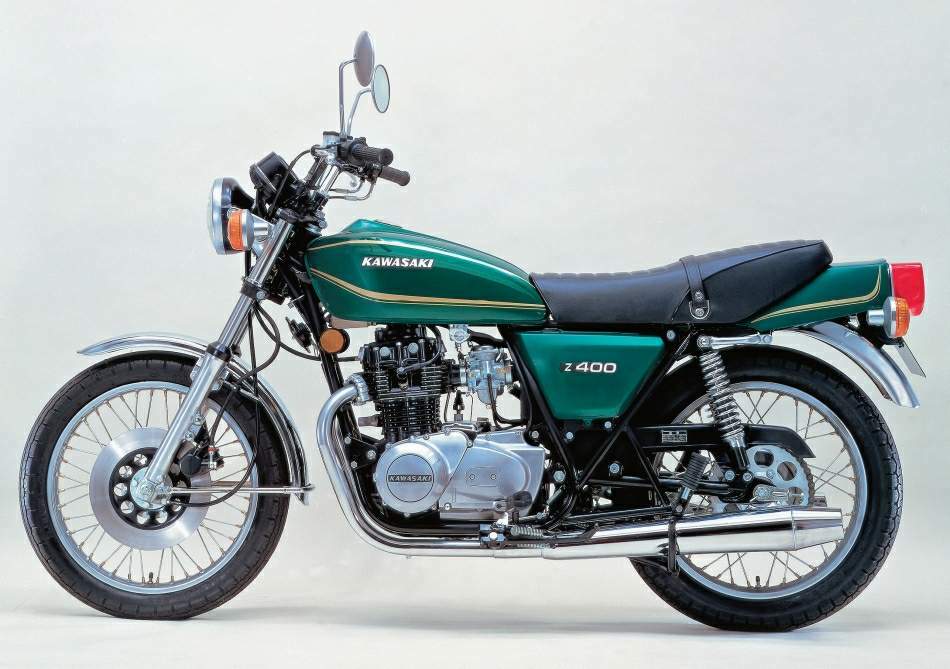
Kawasaki Z 400
Five years ago, when Kawasaki introduced the KZ400, the Honda 350 was the hottest selling motorcycle in America. It shows. Kawasaki paid Honda the ultimate compliment. The KZ400 was designed as a bigger and better CB350. Since that time Honda has developed its own bigger and better 350, a trio of 400s called Hawks. The other Japanese motorcycle manufacturers have also come out with their own 400cc Twins. High school parking lots are filled with them. So are showrooms. Kawasaki was the first Japanese manufacturer to produce a 400cc street bike, a size all the companies have now settled on. That makes the KZ400 the oldest design. It's a conventional design in 1978: Single overhead cam parallel Twin with chain driven counterbalancers. Both 64mm pistons move up and down together because of the 360-degree crank. That spaces firing intervals evenly apart hut also causes vibration. And that's why the counterbalancers. Two small counter-balancers, both running opposite the direction of the crank, are placed down near the crank, one in front and one behind. The chain which turns the counterbalancers is driven from the center of the crank, off a sprocket immediately adjacent to the cam chain drive sprocket. There is a chain guide on the balancer chain hut no adjustment for tension. The cam chain, however, has a tensioner adjustable from the front of the engine. For 1978 the KZ400 engine has been changed slightly. It's nice to report that all the changes are improvements. The original 400 Kawasaki was prone to leak oil both from the head gasket and the rocker arm covers. To eliminate the head gasket leak, an external oil line now replaces the internal oil passage. The oil line connects to the block at the oil pressure light sender and runs up to the head, which has been changed in several important ways. No longer are valves adjusted by moving the rocker shafts. Now the rocker arms have conventional threaded adjusters on the valve end and screw-in caps for access to the adjusters. The caps and external oil line look just like what Triumphs have had for forty years. They work too. No leaks or seepage was noticed during the test. Other changes were made to the trans- mission where a sixth gear was added. Instead of gearing the bike either higher or lower, the additional gear is used to make each step smaller. As a result, the new gearbox is a closer ratio unit, particularly in the higher gears where it's needed most. A number of cosmetic changes have been made to the Kawasaki: new shape mufflers, seat, taillight housing, side covers and gas tank. More important are the new front brake and side stand return mechanism. Kawasaki has moved the front brake caliper behind the left fork leg on the '78 Models and increased the swept area. The stand return linkage on the 400 has also been used on the KZ200 and will he used on all Kawasaki street bikes in 1979. It works. Good thing. All those chances are something more than an annual model change. It probably means the 400 will be around for some time to come. While the changes improved the motorcycle, none could be called major. They aren't the kind of changes which a rider will even notice right away. Sure, six speeds are nice (especially on a 400), but the change has been made more to satisfy the marketing people than the engineering people. What's important is how the changes and the unchanged work. The six-speed transmission may not he necessary and may not make the bike any quicker but because the ratios are spaced closer together from 4th to 6th, dropping down a gear for hills and headwinds doesn't hurt as much. The ratios are nicely chosen and the transmission works well. No false neutrals, gentle lever action and no missed shifts can he expected. What seemed to be a gimmick at first has become more and more appreciated by test riders: the side stand return. The reason for it being there is a West German requirement that side stands return automatically. That explains BMW's spring loaded stand, too. As long as Kawasaki developed a return linkage, driven off the sprocket, it was mounted on models for other markets. Unlike the treacherous BMW stand, the Kawasaki side stand is easy to use. When kicked down, the stand stays down. Only when the motorcycle is moved will the linkage lift the stand. On a commuter bike such as the 400 it is a real convenience for the absent minded. The one test rider who most often leaves side stands down was most appreciative.
Besides curing the oil leaks common to KZ400s, the changes to the Kawasaki's head for 1978 involve some internal changes. Compression ratio has crept up, from 9.4:1 to 9.5:1. Not a major change hut when combined with revised carburetion the result is a motorcycle which runs well on unleaded gas. The 400 lived on a steady diet of unleaded during its test and never protested. Engine performance, when evaluated as a commuter bike, was exemplary. Just turn on the choke, ignition and hit the starter button and the bike was running. Fifteen seconds later the choke could be turned off and the engine idled at a steady 1000 rpm. No choke was needed when the engine was warm. The bike could be ridden away from a stop at idle. There were no flat spots, no hesitation, nothing to mar the pleasure of commuting. There was also no big surge of power at any engine speed. Except for the Hawk automatic, this is the slowest of all the Japanese 400cc motorcycles. Its quarter-mile time is a full second behind the Hawk Type II and even farther behind the Yamaha RD400. Competing in box stock 400cc class racing is not what the Kawasaki does best. It is a commuter bike. Commuter bikes don't need speed, they need convenience. The 400's engine provides plenty of convenience and adequate speed. It will climb any freeway grade at the speed limit, out-accelerate 95 percent of the automobiles made in America and still go farther on a gallon of gas than anything on four wheels. The Kawasaki also places last in class as far as suspension is concerned. Bumps are transmitted through forks and shocks and through the small, hard seat to the rider. After hitting the bump the forks will rebound with a clank. Suspension at both ends could be improved. Suspension compliance is a limiting factor in cornering on rough pavement. With a smooth enough surface the extended side stand will scrape on the left and the brake lever will scrape on the right. But a rider must work at it to scrape either side. Normal commuting or even reasonable attempts at sport riding won't cause any scraping. Generally the placid nature of the commuter bike doesn't lend itself to berserko road racing. In normal fast riding there are no surprises, no wobbles; the bike goes where it is pointed with a minimum of effort. Occasional two-up riding causes no problem. There is adequate power, the shocks don't bottom on most bumps and handling is not significantly bothered. Only the seat discourages more frequent two-up use, particularly for the passenger. Braking is a mixed bag. The numbers aren't too bad: 33 ft. from 30 mph and 139 ft. from 60. But under hard braking the rear of the bike hops easily when the brake locks, making control difficult. The front brake provides good control but it is not powerful for a disc. In wet weather only the rear brake slows the bike, the front washing out completely and being slow to recover.
For the commuter, the 400 offers some special attributes. In the CYCLE WORLD gas mileage test loop the KZ400 ran 62.5 mpg. The mileage loop is a mixture of town and highway driving. Controls on the bike, particularly the clutch, are easy to use. Even a beginning rider who has difficulty with most motorcycle clutches found the 400 clutch pull gentle and clutch action smooth. The electric starter on the KZ is particularly valuable as the kick starter is not a primary kick. This is the first Kawasaki street bike tested which hasn't had a light switch. The headlight and taillight are on at all times on this bike, like most of the Japanese motorcycles. Servicing is another strong point of the Kawasaki. Valves can be adjusted by anyone with a feeler gauge, wrench and screwdriver. The gas tank doesn't have to be removed. The oil filter can be removed by taking out one bolt. Cam chain adjustment, air cleaner servicing and other maintenance items are all simple and all can he performed with the tools in the tool kit. Kawasaki has improved the KZ400. Problems have been eliminated. Convenience has been added. There is still a way to go. Even commuters deserve better suspension. A more comfortable seat would be nice. The power is adequate for a commuter bike. On the Kawasaki's side is convenience. It is an easy to use motorcycle which would seem to be just what commuters have been asking for. If the cost of gasoline doubles, Kawasaki will sell a bundle. Source Cycle Guide 1979
|
|
|
Any corrections or more information on these motorcycles will be kindly appreciated. |