|
|

|
|
|
|
Classic Bikes
Custom Bikes
Individual
Racing Bikes AJP
AJS
Aprilia
Ariel
Avinton / Wakan
Bajaj
Benelli
Beta
Bimota
BMW
Brough Superior
BRP Cam-Am
BSA
Buell / EBR
Bultaco
Cagiva
Campagna
CCM
CF Moto
Combat Motors
Derbi
Deus
Ducati
Excelsior
GASGAS
Ghezzi Brian
Gilera
GIMA
Harley Davidson
Hero
Highland
Honda
Horex
Husaberg
Husqvarna
Hyosung
Indian
Jawa
Kawasaki
KTM
KYMCO
Laverda
Lazareth
Magni
Maico
Mash
Matchless
Mondial
Moto Guzzi
Moto Morini
MV Agusta
MZ / MuZ
NCR
Norton
NSU
Paton
Peugeot
Piaggio
Revival Cycles
Roland Sands
Royal Enfield
Sachs
Sherco
Sunbeam
Suzuki
SWM
SYM
Triumph
TVS
Ural
Velocette
Vespa
Victory
Vincent
VOR
Voxan
Vyrus
Walt Siegl
Walz
Wrenchmonkees
Wunderlich
XTR / Radical
Yamaha
Zero
Video
Technical
Complete Manufacturer List
|
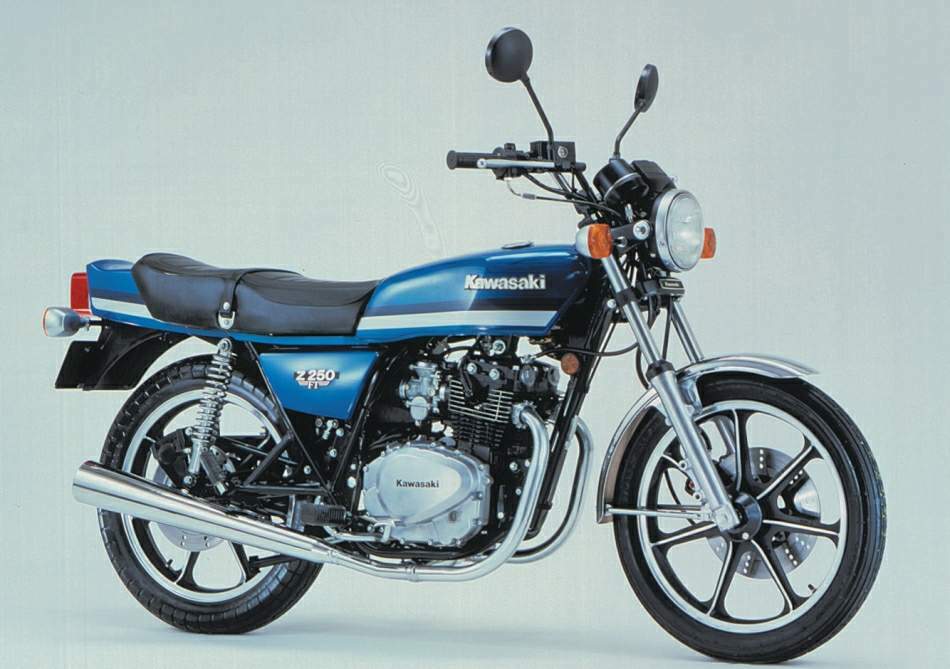
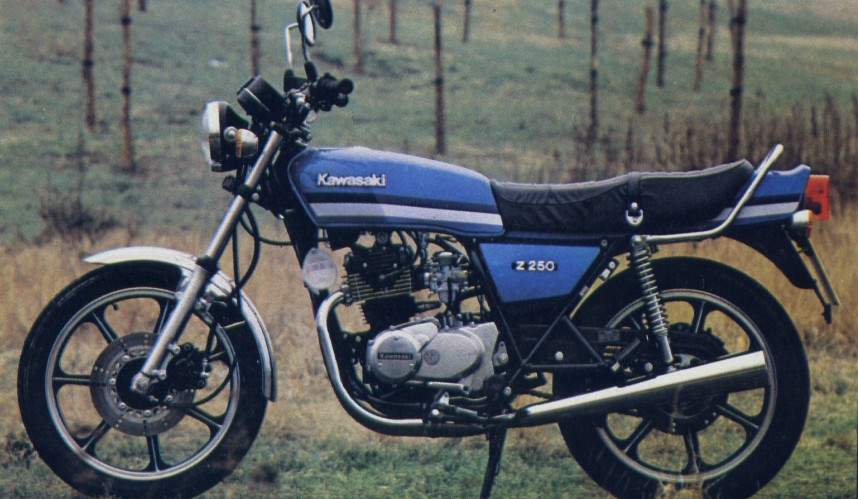
Kawasaki Z 250FT
A quick glance at the Which Bike?'% 'New Bike Buyers Guide' may lead you to conclude that there are enough 250s on the market to satisfy everybody's taste. Yamaha's RD250LC figurehead has taken the two-stroke field by storm, while in the four-stroke stakes Honda's Super Dream has taken pride of place on the sales figures table for quite some time. Though Kawasaki has a good choice of models, it hasn't been quite so prominent. However, the importers at Slough are hoping to take a bigger slice of the cake through heavy promotion of the Scorpion, or Z250A3, which in our experience is the best of the bunch when it comes to function. It may not have the big H on the tank, but it is light, smooth and fast and for 1981 comes with a host of improvements. The new 250 uses the same single overhead camshaft engine as its predecessor, producing a healthy 27bhp at 10,000rpm, so it's as snappy off the line or as quick at the top end as any of its four-stroke competitors. The beauty of the engine is that it can be revved past its 9,500rpm red line without any signs of discomfort to either the motor or the rider. The smoothness is as much due to the four rubber mounts supporting the engine. Along with a similarly rubber mounted handlebar you can not only comfortably maintain a more brisk pace than the bike's competitors but do so with greater peace of mind, thanks to the better rear-view mirror clarity. The willingness of the motor to rev is helped by its roller-bearing supported 180-degree crankshaft which, like the GSX250E Suzuki, gives a distinctive off-beat exhaust note. Since there is none of the complexity of balance shafts and the like on the Scorpion, it never seems like it's lugging too much weight. The motor is housed in a duplex
frame of classic dimensions with a wheelbase of 53in. If the 33in seat
height seems excessive it's because there's more padding in the seat. The Japanese Dunlop tyres give good road-holding, too, and you can take advantage of the cornering clearance enough to prevent scraping of the undercarriage. Riding position was excellent and the slim lines of the Kawa made for an easy-to-handle mount in all traffic conditions, though the slightly long stretch when sitting up to the flat bars did slightly favour the taller riders. Though the fashion in rear brakes is back to drums, the Z250A3 still uses a disc. That's because it's rightfully smaller than the front 9in unit and likewise has metallic pads and perforations for good feel and power when wet or dry. As on many of the later Kawasakis the front disc and wheel assembly is lighter because there's now no carrier for the disc rotor.
Switchgear, controls and general instrumentation held no surprises when compared with the other Kawasakis recently tested. All controls were within easy reach and throttle control was light and responsive, as was the clutch and brake action. There are several other subtle changes, though the most obvious improvement is in the new colour scheme of royal blue with a contrasting silver flash on the tank and tail. Weight saved by the front disc is made up by the substantial chrome-plated grab rail. Like the 440 we tested last year, the Scorpion has been wisely fitted with a self retracting side stand, the deed being achieved by trip lever on the final drive sprocket. The carburattors are operated by a single cable and in the engine, the new Hy-vo type camshaft chain has an automatic tensioner. The six-speed gearbox also has a positive neutral selector from bottom gear as on the bigger fours. The performance of the Kawasaki was much the same as its predecessors'. The free-rewing motor took the A3 to an indicated top speed of 87mph with a 13st rider clad in an oversuit on board. Unlike on buzzing two-stroke 250s, there's no need to keep the kettle constantly on the boil when flitting through traffic on four-stroke 250. Should you find yourself in the wrong ratio on the Z250A3, there's no need to hit the panic button; any one of three gears can be selected, as they're quite close together. On the open road it cruised quite happily at the legal limit with enough in reserve to make passing manoeuvres with relative ease. Fuel consumption figures are something that many first-time buyers look at very closely - the 250 we had for test was still running-in, with a meagre 352 miles on the clock when collected and a slightly tight motor — but as we've already said, it revved right to the end and returned a mean 61mpg. Kawasaki is committed to capturing a larger share of the market in 1981. Last year its marketing boys decided that, in our impoverished times with sales leveling off, what was required to stimulate the market was a cheaply-priced machine that was inexpensive to run and would perform well both in town and on the open road. Hence of the crop of sub-£800 250s from the big four, Kawasaki is currently offering three. In 1981 Kawasaki hopes to push the Super Dream from its pedestal as the top seller and, in the A3, it may well have the answer. The Scorpion has great handling, good looks and, at £899, it's no more expensive than the rest. Though time will tell, we think it deserves to succeed. Source Witch Bike
|
|
|
Any corrections or more information on these motorcycles will be kindly appreciated. |