|
|

|
|
|
|
Classic Bikes
Custom Bikes
Individual
Racing Bikes AJP
AJS
Aprilia
Ariel
Avinton / Wakan
Bajaj
Benelli
Beta
Bimota
BMW
Brough Superior
BRP Cam-Am
BSA
Buell / EBR
Bultaco
Cagiva
Campagna
CCM
CF Moto
Combat Motors
Derbi
Deus
Ducati
Excelsior
GASGAS
Ghezzi Brian
Gilera
GIMA
Harley Davidson
Hero
Highland
Honda
Horex
Husaberg
Husqvarna
Hyosung
Indian
Jawa
Kawasaki
KTM
KYMCO
Laverda
Lazareth
Magni
Maico
Mash
Matchless
Mondial
Moto Guzzi
Moto Morini
MV Agusta
MZ / MuZ
NCR
Norton
NSU
Paton
Peugeot
Piaggio
Revival Cycles
Roland Sands
Royal Enfield
Sachs
Sherco
Sunbeam
Suzuki
SWM
SYM
Triumph
TVS
Ural
Velocette
Vespa
Victory
Vincent
VOR
Voxan
Vyrus
Walt Siegl
Walz
Wrenchmonkees
Wunderlich
XTR / Radical
Yamaha
Zero
Video
Technical
Complete Manufacturer List
|
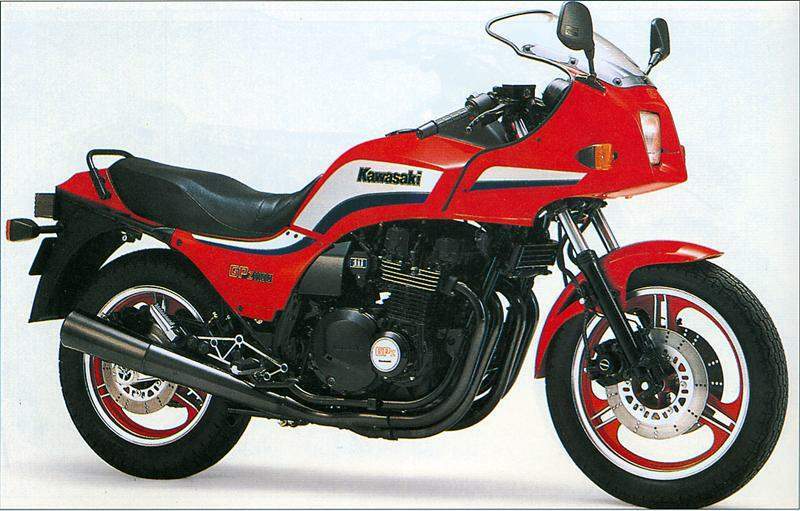
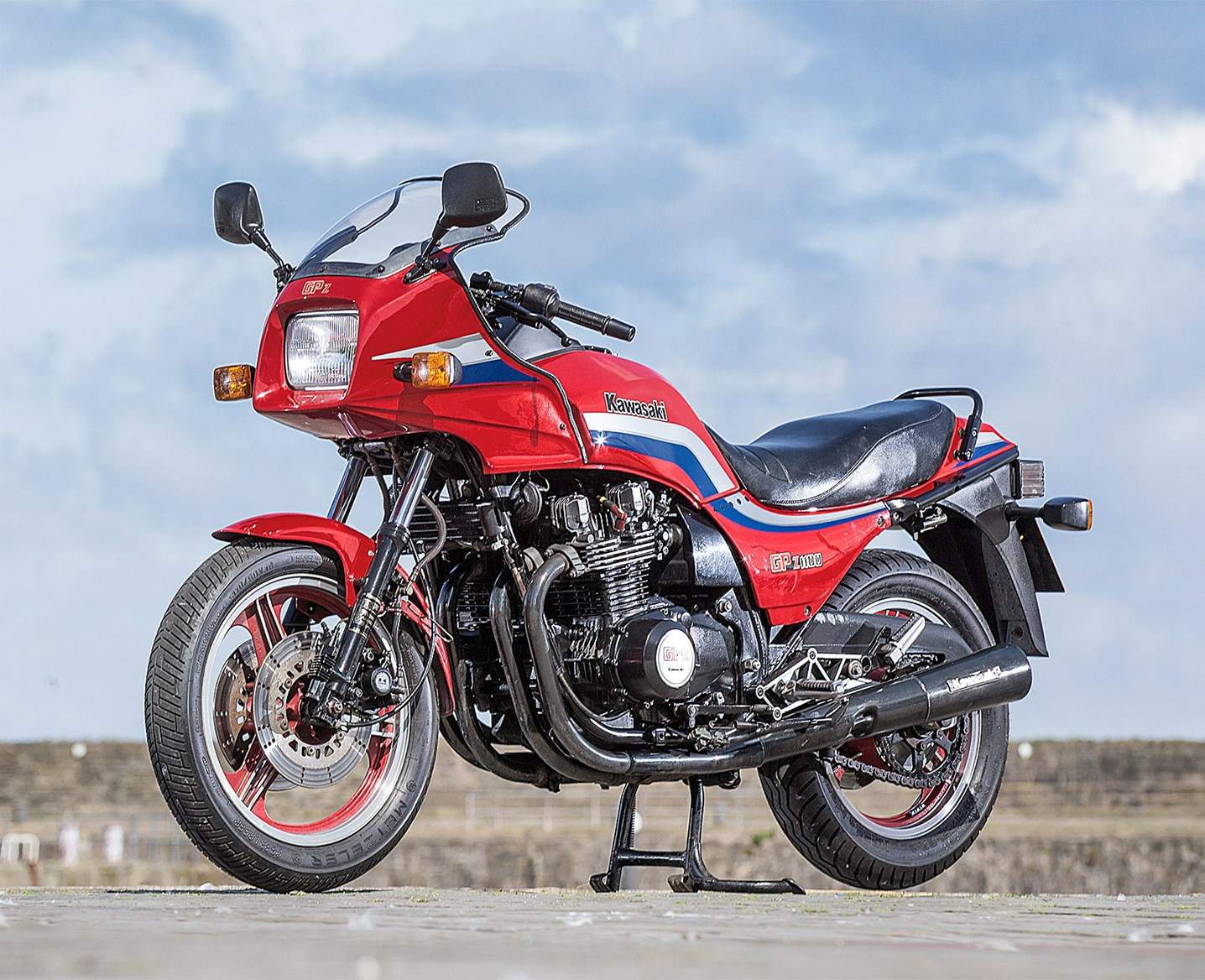
Kawasaki GPz 1100 / ZX1100 A-1
The banked circuit at MIRA is an eerie place if you've never ridden there before. Three half-mile straights connected by sweeping left-hand bends where the track suddenly tips up at an angle, gentle on the inside but steepening to become almost vertical at its outer edge. You don't make a conscious effort to lean the bike as you hit the banking, the slope does that for you. All the rider has to do is keep his machine wound on over the narrow strip of tarmac at the top of the track, between the bumpy bit half way down and the lethal car-catching fencing at the edge, as he is pushed down into the seat and the seemingly never-ending curve unfolds like a film before his eyes. To go really fast you've got to keep on the steepest bit where the bank seems almost vertical and your head about level with the wheels, while that fence (made of big posts with cable strung between them, ideal for chopping people in four) becomes a blur by your right shoulder. As the bike hardly leans in relation to the track, in theory it'd be possible to circulate the banking at quite monstrous speeds. But approaching the last banked section before the timing lights with a touch over 145mph showing on the GPzllOO's speedo, keeping the power wound on didn't seem quite so simple. Sure, the Kawasaki would undoubtedly have been stable at that speed, its suspension compressed by the g-force and with plenty of air in the freshly-fitted Michelins. But when there's only a few feet of track to play with you suddenly become distinctly aware of the frightening possibilities for disaster: a sudden gust of wind, an unseen bump, and worst of all a puncture . . . For once, self-preservation won the day. Each time round I resolved to go faster, each time I glanced at the speedo coming off the banking to find it reading well below 130mph with little space to accelerate before the lights. Once I glanced down too soon, as I was still in the curve: I looked back up to see the bike off line and the fence leaping towards me. Fortunately there were a few inches to spare, but after that there was no way I was going to force myself to go into the banking without rolling the throttle off a fraction. Not that there would have been much point in being braver — with a strong headwind against it on the next straight the CPz wouldn't even pull a genuine 130mph through the lights. Added to our feeble times on the dragstrip this was the last straw. I checked out of the proving ground and set off back home down the A5 to rekindle my enthusiasm for Kawasaki's finest and fastest. For while we've put bikes through the lights at higher speeds I have never ridden a motorcycle as consistently rapidly on the road as I did the big red GPz1100. There are two main reasons for that, the most visible of which is the frame-mounted half fairing that replaces last year's titchy handlebar job. The new fairing is good: sadly it gives no hand protection but it's great for keeping the wind off your chest and neck at velocities guaranteed to lose you your license in one hit should they be witnessed by the Law. With the excellent riding position pulling you forward to the clip-on bars it's not till an indicated 110mph or so that you become aware of any pressure at all; keeping that speed up all day is so relaxing that dedicated masochists will find it necessary to set the clock at 130mph plus before feeling any real buffeting from the breeze. For shorter riders it's probably even more comfortable at speed, though they'll have to stretch to the bars. The other factor helping reduce my licence to a blob of gibbering green jelly every time I nosed the Kawasaki out into the street was an engine built entirely in the noble traditions of the marque. Already a unit of stupendous power and strength, the GPz's traditional air-cooled, two-valves-per-pot, 1089cc motor has been further leaned on this year to give even more horsepower. That faithful old Z1-based motor has been pushed to an even higher state of tune so that it resembles in many ways a cross between a hotted-up street version of the original big Kawa lump and the engine in the real Eddie Lawson Replica — a US-only racebike called the Z1000S which Kawasaki produced last year and sold to a limited number of American privateer superbike roadracers. The combustion chamber and piston crown of the new CPz are totally different to la year's, and similar in shape to those of tl 1000S. Instead of the previous hemispheric chambers Kawasaki now use what's called polyspheric design. This divides the chambe into two sections — the inlet and exhau; valves sit in individual hemispherical pocket with a ridge between them. Pistons with high er domes, flat tops, deeper valve cutouts an< wide squish bands help push compression u[ from 8.9 to 9.5:1. Modified piston rings givt better oil control. To go with these changes the camshafts have been reprofiled to give more lift and duration. Both valves now have 0.8mm more lift, and they open six degrees earlier and close six degrees later than before. The valves are also bigger: inlet diameter goes up 1mm to 38mm and exhaust up 0.5mm to 32.5mm, with its angle steepened by one degree to allow this. Uprated springs keep the valves under control; setting clearances is more difficult than before because, with shims now beneath the buckets in the style of the old Z650, the cams must be removed to change them. Other mods of note are hand porting of the inlet tract to smooth out the flow, beefier conrods and an ignition which is now advanced electronically instead of mechanically. What all this adds up to is a motor in a pretty high state of tune for a big road bike — a motor producing phenomenal peak horsepower at the expense, it must be said, of some low and mid-range grunt. There's precious little doing below six grand, so it's no use pootling along behind a line of cars at about 60mph in top and expecting them to open the throttle and scream past them. Trying just that results in a bronchial slow-progress situation and, if you were expecting instant full-bore acceleration, a terminal head-to-head confrontation with any traffic that might be approaching from the opposite direction. In other words of one syllable, it don't want to know, John. The revs rise pretty slowly to the magic 6000rpm figure, at which point the various gasses start going where they're supposed to and the GPz shoots forward (you're already doing about a ton at this point, of course) like the street racer it is. And no sooner are you starting to enjoy this sensation than the tacho hits eight grand, the motor breathes even deeper and the speedo rockets on from 120mph to 130, 135 ... and more if you've got the road and the balls to spare. Of the big bikes I've ridden the GPz is decidedly the peakiest, and without doubt one of the most exhilarating once it comes on the cam. Those power characteristics make the rider work harder than do, say, the big GSX Suzuki engines with their extra midrange power but, oh boy, is the Kawa fast when it gets going. Really quick riding on crowded or twisty roads means lots of revs and frequent use of the gearbox but the partially rubber-mounted motor is so smooth and the box so light and positive that this intractibility rarely loses you time. Whether you consider it a disadvantage is largely a matter of taste — personally I was glad of the excuse to use maximum revs at virtually all times, though some would find it wearisome and too expensive. Fuel consumption averaged 32mpg with a worst of 29mpg; more gentle use would give low-40s figures but this motorcycle was not built to be used gently. Talk of performance figures brings us back to good old MIRA and the Great Debate (perhaps that should be Mass debate) concerning precisely how fast the GPz1100 is. The story starts with the American magazine Cycle who, after one day's testing produced quarter-mile times in the low 11-second bracket and their dyno testing subsequently gave an astonishing 104.4bhp at the rear wheel, nearly 10bhp up on anything else they'd dyno'd, returned to the strip with a professional drag racer. This superlight jockey fiddled with suspension and tyre pressures before climbing onto the saddle and blasting the GPz to an earth-shattering time of 10.88 seconds. Cycle's own drag artist couldn't match that but recorded a 10.912 sec/124.65mph pass to crack the 11-second barrier for the first time in the magazine's history. Other American mags also had the GPz fastest ever street bike, though none quite broke into the tens. We couldn't get near that when it came to standing quarters. Running normal shock and tyre pressures and with my large-economy-sized bod to cart about nobody was expecting 10-second times. All the same we'd have liked a few low to mid 11s but I found the Kawa extremely tricky to get off the line cleanly: too many revs and the wheel span violently without getting enough traction for a fast getaway, too few and the engine bogged uselessly. Even when I did start off okay the times were unimpressive — not much under 12 seconds, well down on last year's GPz although this bike's reckoned to be ten per cent more powerful. Feeble must be doing something wrong, I thought. So Peter Watson, columnist and quarter miler of some notoriety, was summoned from the safety of the timing hut to show how it should be done. But Pete's times were no better and after I'd recorded three consecutive runs within four hundredths of a second and 14 hundredths of an mph of each other we decided we weren't going to get much quicker than 11.83secs @ 114.8mph. Not for the first time we came away from MIRA with slower figures than we'd been hoping for, puzzled as to why and without time to go back and try again. Never mind, for those who lose sleep about such things a more realistic figure is probably something around 11.4 seconds. You can discount MCN's figures, of course. I seem to recall that they claimed a 10.88 second quarter, which by coincidence is identical to the best time Cycle's professional drag racer put up and was presumably achieved by starting a few yards back from the line. Very imaginative chaps; we've had a quick whip-round in the office and if a GPz-mounted MCN staffer can crack 11 seconds with one of us present there'll be £100 waiting for him at the other end of the strip. Fail and you pay us, of course. How about it?
On to more serious matters and, as you've possibly been thinking for the past few paragraphs, it's all very well knowing that you can accelerate from a standstill into the back of a panic-braking artic quicker than anyone else around but it's how the machine corners, stops and covers big distances that determine whether or not it's worth pawning the TV and starving the dog to buy one. In this case you can go right ahead because the kWacker scores high marks in each department. The GPz's frame is new — its top tube is of bigger diameter and thinner wall than before and a couple of cross-braces have disappeared — and interesting things dangle from its rear. The swing arm is a big wide aluminium box section, four pounds lighter than the '82 version despite a ball race added on outboard of the standard right-hand needle bearings to give extra rigidity. Drive chain tension is set by eccentric cams which being rigidly connected to the spindle ensure equal adjustment. Rear suspension is by Uni-Trak; not the hardware seen before on the CPz550 but a variation on Kawasaki's single-shock design which uses a lever system located beneath the unit to bump up spring and damping rates as shock travel is used. This makes for a lighter, lower unit than the original Uni-Trak design (which uses a bell-crank above the shock) and gives room for a big airbox and a low seat, though the linkage is ideally placed to catch road crud. A more serious failing becomes obvious when you go to adjust the shock. It's air-assisted and has a choice of four damping positions but the right-hand side panel must be unscrewed before any changes can be made, a time-consuming process which is made all the more annoying when you find the Schraeder valve too short for your air line to seat properly. Greater accessibility might lead to tampering from small boys but would save much hassle. Fortunately owners won't need to fiddle with the suspension very often. Once you've settled on an optimum setting it's hardly necessary to change it and although the rising rate effect is limited it's unlikely you'll need to pump the shock up before carrying a passenger (J Ryder and a certain Liberal politician notwithstanding). Around 20psi with shock damping on position three gave a good ride in conjunction with 8psi in the linked front forks; for serious street racery another 10psi in the shock and max damping helped stiffen things up. Set up like that the handling was very good. The bike is no lightweight — with its weight (537lb dry), high centre of gravity and long wheelbase the Kawa takes a fair bit of effort to hustle around but it stays stable at pretty well all speeds and angles. There's a distinctly top heavy feeling in ultra-slow bends and a couple of times the back end pogoed for a few yards after hitting a big bump mid-corner more shock damping might have helped — but it never got out of line or threatened to develop into anything nasty, at least while there was meat on the rear tyre. Front suspension is adjustable for preload via an air valve on the lower yoke and is aided for the first time by anti-dive; the hydraulic units on each fork leg give a choice of three positions. Even the softest of these made a noticeable difference if fork air pressures were kept low while adding air to the forks gave marginally more stability under braking but was not really necessary if the anti-dive was turned up instead. If maximum anti-dive was used, six psi or less was sufficient to keep the front end under control in anything but the heaviest of braking manoeuvres.
Such heavy-handed hooliganism is possible and great fun because the CPz is equipped with stoppers that are about as good as they come. Crabbing a fistful of front disc at speed brings the kWacker howling to a standstill in near-record time: there's heaps of power, plenty of feel in the lever and the pads are unaffected by water. Repeated lunatic braking under racing conditions can apparently get the lever coming back to the bar but there's no way this is a problem in road use. My only criticism is that the rear disc is perhaps a bit sharp; on one occasion I locked the back wheel momentarily when a car looked like pulling out and after that I was careful to use only the lightest pressure on the pedal except when two-up. With a healthy excess of power available for acceleration and deceleration it's not hard to get either tyre to the limits of traction. That doesn't mean the rubber's not good: the 18in front and 17in rear tubeless Bridgestones (wheels are both an inch smaller than last year's) are suitably fat and sticky. Both tyres are reassuring in the wet and well up to using all the GPz's generous ground clearance in the dry folding footrests touch down first both sides, with an exhaust heat shield joining in on the right and very silly cornering speeds needed to deck anything solid on the left. The problem with soft tyres on big bikes is of course that they disappear at a ridiculous rate. Not long after we picked up the bike its rear Bridgestone became worn enough to induce a definite weave, so we returned to get the CPz shod with a pair of green-triangle Michelins, recommended by Kawasaki for aftermarket fitment. These too were good tyres, though after not much more than a further 1000 miles (including speed testing) their tread depth was becoming decidedly marginal. The price of riding 100 horsepower is high indeed. If the CPz is undeniably expensive to run then at least it looks expensive too. The red paintwork is bright, thick and set off nicely by the black of the fork sliders, engine and pipes (the badges of which worked loose on their rivets). As well as looking the part and keeping the wind off the rider a tall passenger suffers on the higher pillion seat though the fairing carries the fine headlamp and the mirrors, which could do with being an inch wider. The other styling feature is not clever at all: a three-tiered instrument layout which puts clocks at the top, warning lights below them on the bars and a second panel for emergency lights in a console on the petrol tank. A number of problems here. The speedo is fine but for some reason the tacho (which also acts as a voltmeter) is much smaller and hard to read at a glance. The top warning panel is okay — lights for indicators, neutral, high beam and something wrong but when that last light starts flashing you have to look right down at the tank to see what the problem is. As well as carrying an LCD fuel gauge the tank-top console warns of sidestand down, low oil or battery fluid levels and of malfunction in the fuel injection system; a flashing light usually just means you're getting low on gas but you've got to slow right down to check or risk becoming an unwelcome passenger in the car in front. The problem does however become less serious when a tank bag is fitted then you can't see any lights at all. Other ergonomic flops are the indicators which don't cancel automatically and aren't even easy to stop with your thumb, and the cold-start lever which is mounted on the DFI unit instead of up on the bars. That fuel injection system is a three-way improvement on last year's version. Its various sensors — for throttle opening, temperatures, pressure and so on are now monitored; if one fails a flashing light on the tail-mounted computer box saves time by revealing which is to blame. There's also an over-ride system to get you home at reduced speed if something does go wrong (you'd have had to push the old model) and a revlimiter now saves the engine from possible destruction by cutting off the fuel supply at 11,000rpm. All very clever, though the DFI is probably partly to blame for the GPz's reluctance to warm up it splutters for a while even on mild days and perhaps has something to do with the motor's wooliness below 4000rpm. It says a lot for the GPz1100 that faults like these fade almost to insignificance when you consider the bike as a whole. My memories of the big Kawasaki are not of annoying warning lights and fiddly cold starts, oh no. They're of blasting down empty A-roads in the late-evening sunlight, sweeping through curves with the bike staying immaculately on line then winding back the throttle coming out at seven grand, watching the world being sucked backWards and waiting for that magical, pulse-quickening surge into hyperdrive when the tacho touches eight. Powerbiking at its purest the thrill of the quickest kWacker. Yes, the price is high, but the GPz1100 takes you higher by far. Source Bike Magazine 1983
|
|
|
Any corrections or more information on these motorcycles will be kindly appreciated. |