|
Kawasaki Z 1000 MKII

|
Make Model |
Kawasaki Z 1000 MKII |
|
Year |
1979-80 |
|
Engine |
Air cooled, four stroke, transverse four
cylinder, DOHC, 2 valve per cylinder. |
|
Capacity |
1015 |
|
Bore x Stroke |
69.4 х 66 mm |
|
Compression Ratio |
8.7:1 |
|
Induction |
4x 28mm Mikuni carb |
|
Ignition /
Starting |
- / electric |
|
Max Power |
93 hp @ 8000 rpm |
|
Max Torque |
8.1 kg-m @ 6500 rpm |
|
Transmission /
Drive |
5 Speed / chain |
|
Front Suspension |
Oil telescopic forks |
|
Rear Suspension |
Swinging arm oil damper 5-way spring preload |
|
Front Brakes |
2x 240mm discs 1 piston caliper |
|
Rear Brakes |
Single 250mm disc 2 piston caliper |
|
Front Tyre |
3.25-19 |
|
Rear Tyre |
4.00-18 |
|
Dry-Weight |
245 kg |
|
Fuel Capacity |
14.8 Litres |
|
Consumption average |
47.5 mp/g |
|
Braking 60 - 0 / 100 - 0 |
- / 45.7 m |
|
Standing
Ό
Mile |
12.1 sec |
|
Top Speed |
130 mp/h |
By 1979 the one-time 903 Kawasaki was into its
second year of Z1000 life, at 1,015cc, and displayed more than a few changes
sufficient, anyway, to justify Kawasaki calling it MKII.
In the engine the alterations were designed to
boost power by 10bhp, to a peak of 93bhp at 8,000 rpm. Carburetor size had
gone up 2mm to 28mm, the air-filter box had been modified, the silencers
tuned; the crankshaft was rebalanced, with bigger journals, and the cams
were made a little more fierce.
To deal with the extra power the chassis was
strengthened around the headstock, and the steering geometry altered by a
degree or two. Suspension remained entirely conventional, without
multi-adjustment or air-assistance. In
the event that is, on the road the big four was beginning to show its
years when compared with contemporary designs from Suzuki and Honda.
Kawasaki's reputation in the 'superbike' field was slipping. It was only
fully restored with the advent of the fuel-injection GPz 1100 in 1981.

Road Test
WITH THE arrival of Kawasaki's six-cylinder
behemoth, the role of company flagship is no longer a burden for the
factory's one litre fours. But the Big K has not allowed its long serving
thousands to languish outside the limelight without proper development just
as well considering the classy con tenders other manufacturers are fieldir\g
in the 100 cm3 arena.
Two versions are now available of what, last year, was Kawasaki's "cooking"
1000 a shaft-driven model to appeal to touring freaks and a chain driven
variant with a strengthened frame to satisfy boy racer types.
Both models have numerous detail improvements and our Mark Two test machine
(the chain drive job) makes a better all rounder than either last year's
Z1000 or Z1 R (an up-dated Z1-R is in the pipeline, by the way).
The bike
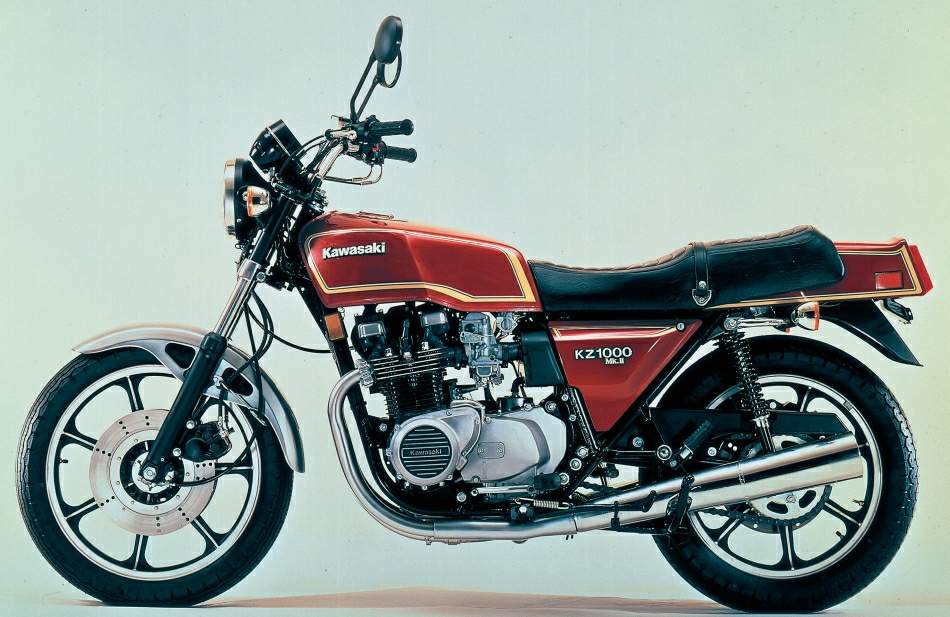
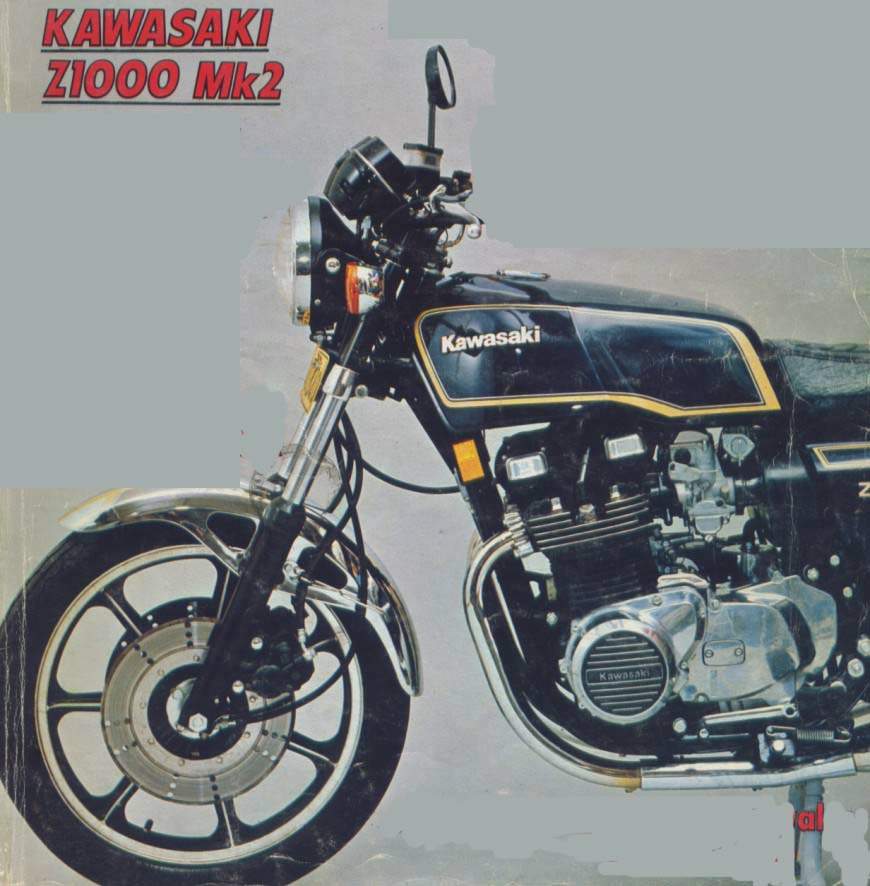
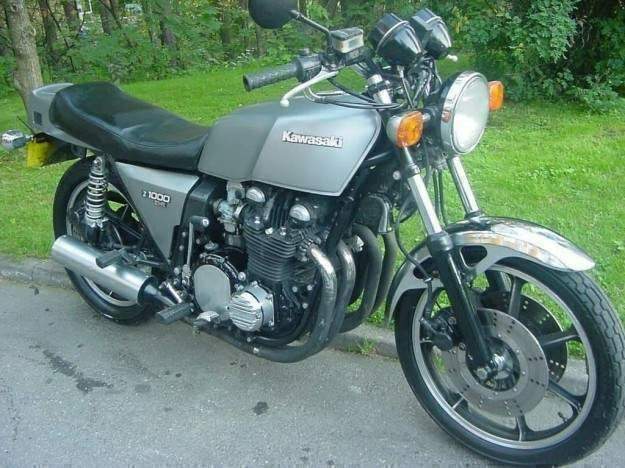
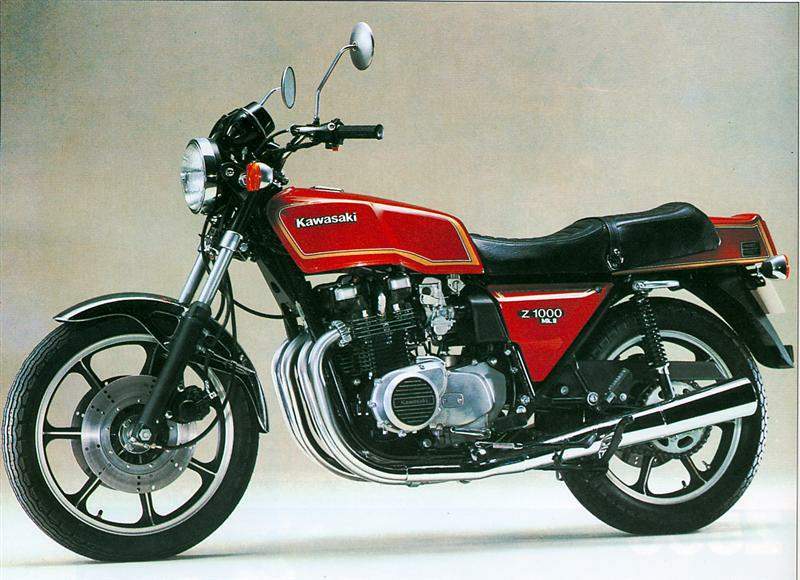
The most obvious change to the Z1000 for the Mark Two model is its
appearance the new bike sports Kawasaki's new, angular corporate styling.
Cast alloy wheels, triangular sidecovers, plastic tailpiece and matt black
engine give the Mark Two a very Z1 R ish look (without the fairing of
course).
The discs are drilled in a radial pattern to reduce
brake squeals and sintered metal pads, said to give a much better wet weather
performance, do the hard work inside the calipers.
The Mark Two is also considerably changed in the engine from its immediate
predecessor. It's also slightly tweaked; Kawasaki claims a marginal power
increase (two percent) over the Zl-R for an output of 69.4 kW (93 bhp). They're
lazy horses though
they slow the bike up fractionally! The engine also now has electronic ignition
(a good move) and an emission control system which allows fresh air to be added
to the hot exhaust gases just before they leave the head. No air pump is used,
the velocity of the spent exhaust gases past the orifices sucks the air in
through small one-way valves, so the power loss should be small, if any.
The frame, too, has received attention.
Mark Twos come with double-walled sectioi for the front downtubes from the
steerii head (to improve rigidity in this area) ai four needle roller bearings
support tl swingarm, as on the Zl-R. Damping in tl rear shocks is heavier this
year and tl front fork springs are a shade softer (bo steps in the right
direction). New silence and a more stepped seat round out t package.
One or two items which were showii their age also made the transition from c to
new, the result is that the Mark T\ soliders on with instruments which we modern
eight years ago (this applies to t vertical bank of idiot lights too), a tungst
headlight and a very mediocre horn. But you want to warn wayward pedestrians y
can always turn the blinkers on and achie your aim with motorcycling's first
quad phonic, 100 watts per channel blink buzzer. Guaranteed to put grandmothers
their graves 10 years early, this sadistic I tie device emits more noise from
its ti central (just under the speedometer) < than most 747s can pump out on
take-c Even the patented TWO WHEELS blinl buzzer muffler (a Bandaid stuck over I
hole) scarcely muted the sound output of
this
little baby which, unlike the Honda system, can't be easily turned off. Really
Kawasaki, 180 decibels would have been quite enough!
In most other ways, the Z1000 Mark Two follows closely the well-known pattern
set by the big K's heavyweight tourers over the past five years or so, which is
to say it offers honest overall value without necessarily being brilliant in
specific areas. We expect the Mark Two will prove every bit as dependable as its
rock-solid forerunners.
Engine
In terms of fundamentals the engine has changed little from last year's model
the across the frame four still displaces 1015 cm1, uses a roller bearing crank,
gear primary drive, wet sump lubrication and a dohc head which breathes through
four Mikuni slide carburettors and exhausts into a four-into-two-system with a
balancer pipe. The carbs this year have 28 mm chokes (26 mm on last year's
Z1000) but remain without an accelerator pump.
Thankfully, Kawasaki has at last given the big A to ignition points (the Mark
Two comes with a fully transistorised, electronic triggering circuit) leaving
Suzuki as the only Japanese manufacturer still fitting fiddly, mechanical
ignition triggers to its big road-burners. Also debuting on the Mark Two is the
emission control system we described earlier. We fervently hope this device
isn't a forerunner of more power-sapping and fuel-wasting, clean-air additions
to future motorcycle engines: Surely motorcyclists do enough for the environment
by leaving their cars at home!
The motor's crankcases, cylinder block and head are finished in what Kawasaki
terms a "matt black" (although it's glossy) and highly polished or chromed
bolt-on covers (for alternator, ignition sensors, cambox ends etc) are used to
set off the predominantly black powerplant. Only the centre section of the
clutch cover is polished, the remainder being left black to help the monstrous
cover look less of an eyeful on one side of the engine. Well-chromed headers
(which kept their right color all through the test) do their bit too in
emphasising the engine's handsome lines, but we reckon the front mudguard should
be painted in the color of the bike (like the Zl-R's) rather than chromed.
Starting the one-litre four (even using the funny foot crank still fitted)
presented no troubles although guessing the right amount of choke needed for a
sensible fast idle did. Kawasaki has still not corrected the oversensitive
fast-idle linkage on the carburettor bank. Neither has it fitted a neutral
override to the starter motor lockout: You get a big fat nothing when the button
is pushed unless the clutch lever is pulled in at the same time. The safety
principle is all very commendable but our Mark Two had enough in-gear clutch
drag (before the plates were freed) on cold mornings for the starter to pull the
bike off the sidestand irrespective of the lever being in.
While we're on starting, the Mark Two comes with an excellent owner's manual (97
pages all in English!) which has a good explanation of the reasons why
four-stroke bike engines should be warmed up slowly and ridden gently until they
reach normal operating temperature. Many riders would
extend
their engine's lives considerably if they digested these paragraphs, which are
of course equally valid for brands other than Kawasaki.
Once running, the Mark Two's engine warmed fairly quickly (unlike Yamaha's XS11)
to normal running, and, like all modern Japanese engines, never showed any signs
of becoming overly hot no matter how hard it worked. The bike proved
particularly smooth at higher speeds (over 160 km/h in top) though elsewhere in
the rev range it vibrated typically (but not intrusively). The irritating rattle
of the mirrors in their plastic cowls at particular engine speeds remains, and
our pillion passengers complained of footpeg tingles when the engine was working
around its redline.

Compared with its other Japanese rivals the Mark Two's engine is not quite as
quick to follow throttle commands (particularly when the throttle is backed off)
as it might be. We don't think the emission control gear has any part in this
characteristic; last year's Zl-R (we've ridden two) displayed the same trait.
One area of engine performance which has changed significantly (worsened we're
sad to say) is fuel consumption. Last year's Zl-R and Z1000 had fairly meagre
thirsts for their performances our road test Zl-R averaged 14.8 km/1 (42.1
mpg) but the Mark Two 1979 model has no hope of returning figures like these.
Our test bike averaged 12.6 km A (35.8 mpg) with a
touring best of 13.9 km/1 (39.5 mpg) and a hard riding worst of 10.7 km/1 (30.4
mpg). These results make the Mark Two a shade thirstier than most 1000-1100 cm3
bikes and even the CBX is only a little heavier on fuel. We wonder if the
economy premium was part of the price for the claimed extra three horsepower.
Unusually for a Kawasaki, our Mark Two also used a pint of oil during the test.
Dragstrip running or full-throttle, high-rev work on the street would produce a
blue haze from the left hand silencer in spite of the 3000-odd km the bike had
covered. Our testbike had been an evaluation bike for the NSW Police and we
wonder how carefully it was run in. It wasn't as strong as our test Zl-R on the
dyno (we found that curious in view of the factory's higher claimed output) and
dragstrip times verified the dyno figures for the machine. A few drops of oil
also weeped past the camcover gasket.
Performance
Like all of its predecessors, the Mark Two had no trouble coping with dragstrip
demands and was easy to control to boot. Fitted with the new Pirelli Phantom
tyres (which Kawasaki put on half way through the test to replace a pair of worn
Metzelers) we managed a best 400 m time of 12.1 seconds, 0.1 sees slower than
the Zl-R and XS1100 and 0.3 sees slower than Suzuki's GS1000. Out of eight runs
we only achieved 12.1 seconds once (the fifth pass) but 12.2 times were readily
obtainable once familiar with the bike.
As with the Zl-R, gearchanges were at just under 9000 rpm. Top speed was 217
km/h at 8400 rpm, just a whisker below peak power revs.
On the Stewart Car Company dynamometer the engine produced power curves very
similar in shape to last year's test Zl-R, the same smooth power build-up being
evident although it tailed off rather faster past 8500 rpm. Peak power, 52.6 kW
at 8500 rpm, was 1.8 kW down on the Zl-R (and 2.1 kW down on the GS1000) and
generally the Mark Two's readings were 0.5 to 1.2 kW below the Zl-R's. The
torque curve shows a drop in the 2000-3000 rev area compared to the Zl-R, due,
in part, to a slight miss that crept in around 2500 rpm and took the edge off
the Mark Two's low-speed running on the dyno.
The Z1000 Mark Two is a lusty performer regardless, lacking none of the feel of
the grunty mid-range performance expected from a big roadster four it's just
that other Japanese one-litre bikes can do fractionally better even if it's
impossible to pick in a seat-of-the-pants evaluation.
Transmission and clutch
Overall gearing has been lowered slightly (six percent) from the Zl-R's by
changing the final drive ratios, and first gear, while still good for 95 km/h at
9000 rpm, is now perfect for effortlessly fast street take-offs without the mass
of clutch slipping that marked a spirited getaway on a Zl-R (especially up a
hill or when two-up).
In our Zl-R test we found little to complain of in the transmission area except
that we thought the gearing was a trifle too tall. That has now been remedied
and the transmission, clutch, internal ratios and overall gearing are now
entirely satisfactory.
Superbike "clunk" is still present the first time one engages first gear after a
cold night and Kawasaki's worthwhile device to allow positive selection of
neutral (you can't shift from first to second while the bike is stationary) is
retained. Strangely, it has been dropped for the Z1300 six. The clutch on our
testbike behaved perfectly and excessive drivetrain freeplay was never a
problem.
Handling and suspension
It is unfortunate the Z1000 Mark Two has to be compared with the Suzuki GS1000
for no tougher opponent in the arts of handling, steering and suspension exists.
Kawasaki has improved the ZI000's steering and suspension (which we preferred to
the Zl-R's) and the Zl-R's handling (better than the ZI000's) and the whole
package is present on the Z1000 Mark Two.
The double-walled frame tubes around the steering head have eradicated the last
remnants of the uncertainty of earlier models, and the return to a 19 inch front
wheel has put a stop to the Zl-R's tendency to follow longitudinal road
irregularities and to stand up when braked mid-corner. Also, the adoption of
four needle-roller bearings for swing-arm support defeats any thoughts this
member may have had about becoming less than totally rigid (Gosh!).
Although both front and rear suspensions are modified for 1979, neither the
forks nor the rear units can provide the well-controlled compliance of Suzuki's
air forks and shocks.
The forks have a little too much internal friction
and not enough travel and the rear units remain slightly oversprung. The end
result is that the Mark Two transmits a little too much road shock to the rider
and the bike itself can become unsettled (especially at the back) on tricky road
surfaces like truck-braking corrugations. However, the bike is significantly
better than its two predecessors and nearly as good as Yamaha's XS1100. It only
really seems wanting when matched against the GS1000. The same applies to the
Mark Two's steering (which is quite good really and better than the XSllOO's)
it just can't equal the precision and finesse of the big Suzuki's steering.
Despite weighing in only one kilogram lighter than the Zl-R, the Z1000 Mark Two
feels lighter to ride and tossing the bike about in S-bends is quite easy.
Two-up riding on the Mark Two was secure and fairly comfortable (given the
suspension) but the pillion's part of the seat slopes forward too much. This,
combined with the fairly slippery seat covering, meant our test passenger had to
do a fair bit of pushing herself back up the seat every time the bike braked.
The Kawasaki prompts close rider/pillion relationship but the strain of having
to brace against braking is bad news for the passenger.
Pillions also noticed the pegs (which are well-located) vibrating too much when
we were in a hurry. The rider himself fares better and we have no complaints
about that seat (or riding position) although we think the earlier non-stepped
Z1000 saddles are better overall. Ground clearance, one or two
up is quite good, even though some competitors provide more.
Braking
We found the brakes on the Mark Two very much to our liking (having ridden some
rather spongily-braked Hondas lately), the three discs with all-hydraulic
operation (and lacking the Zl-R's cable/hydraulic front units) provided very
controllable, powerful stopping. Feel at the controls was excellent on our
testbike.
A major aspect of the Mark Two's good brakes are the new all-metal disc pads
which provide the model with far better wet weather stopping than any bike out
of Japan since disc fever hit us. Heavy rain during the test provided ample
opportunity to assess the components. There is still a slight delay when the
brakes are applied initially, but it's a fraction of the usual one. At the strip
the Mark Two managed very respectable crash stops and we had no problems with
fade.
General
If there's one concession Australia needs which is yet to be heeded by Kawasaki
it's the matter of tank capacity. The overly small reserve fuel supply 1.9
litres is inadequate for a moderately thirsty bike in Australia. And the tank
holds only 17.8 litres anyway, which doesn't give a very good touring range
although it's much better than the Zl-R's. Three and a half litres would be the
minimum sensible reserve
capacity. On one occasion (during a petrol shortage, naturally) we ran the bike
completely dry in only 185 km by underestimating the tank's reserve capacity. Be
warned about the range and the frustration!
We think also that the steering lock should be combined with the ignition
switch. It's primitive in this age to have to go hunting for it elsewhere.
Just about everything else on the bike is okay. Switches are standard Kawasaki
and posed no problems, the hazard lights are a worthwhile fitting (they have
their own separate relay to handle the extra load) and the finish of the bike is
very good. New blinkers are used but the tungsten headlight lingers on. That's
also a strange one the Zl-R's QI unit would've been nice. And the engine's
polished alloy covers still tarnish a little too readily for our liking. Maybe
on the Mark Three . . .
Conclusion
The Z1000 Mark Two is a very good-looking motorcycle, considerably improved over
either the Zl-R or the Z1000, which also happens to come with probably the most
durable engine in motorcycling. Its suspension can't quite match that of its
chief rivals, but its brakes certainly can in the wet. The Mark Two promises a
long life and gives reasonable value for the dollars invested, in spite of its
diminished fuel economy.
It's not state-of-the-art it is strong run-of-the-mill.
Source Two Wheals Magazine 1979
 |