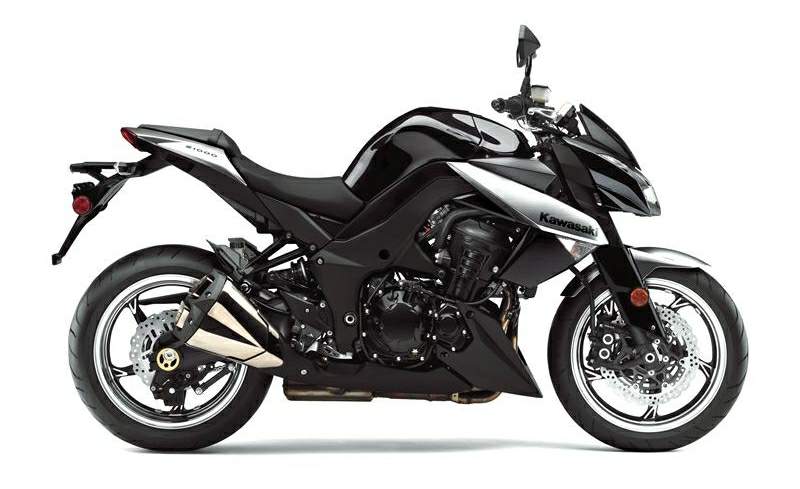
Liquid cooled, four
stroke, transverse four cylinder, DOHC, 4 valve per cylinder.
Capacity
1043
Bore x Stroke
77.0 x 56.0mm
Compression Ratio
8.0:1
Induction
DFI® with four 38mm Keihin throttle bodies, oval
sub-throttles
Ignition /
Starting
TCBI with digital advance
/ electric
Max Power
Max Torque
Transmission /
Drive
6 Speed / chain
Frame
Type: Aluminum Backbone
Rake/Trail
24.5 degrees / 4.1 in.
Front Suspension
41mm inverted cartridge fork with stepless compression
and rebound damping, adjustable spring preload / 4.7 in wheel travel
Rear Suspension
Horizontal monoshock with stepless rebound damping,
adjustable spring preload / 5.4 in wheel travel.
Front Brakes
2x 300mm discs 2 piston caliper
Rear Brakes
Single 250mm disc 1 piston caliper
Front Tyre
120/70 -R17
Rear Tyre
190/50 ZR17
Seat Height
815.3 mm /
32.1 in.
Dry-Weight
Fuel Capacity
15.5 Litres / 4.1 lb
Kawasaki Z: Bringing You the World’s Coolest Streetbikes Since 1973 With
this latest in a long line of naked Kawasaki streetbikes, we threw out the old
rules and started with a clean sheet, drawing upon more than 35 years of
experience in giving the people what they want. If the new Z1000 knocks your
eyeballs out, that’s exactly what we had in mind. Even more important, though,
is the feeling this one provides every time you twist the throttle.
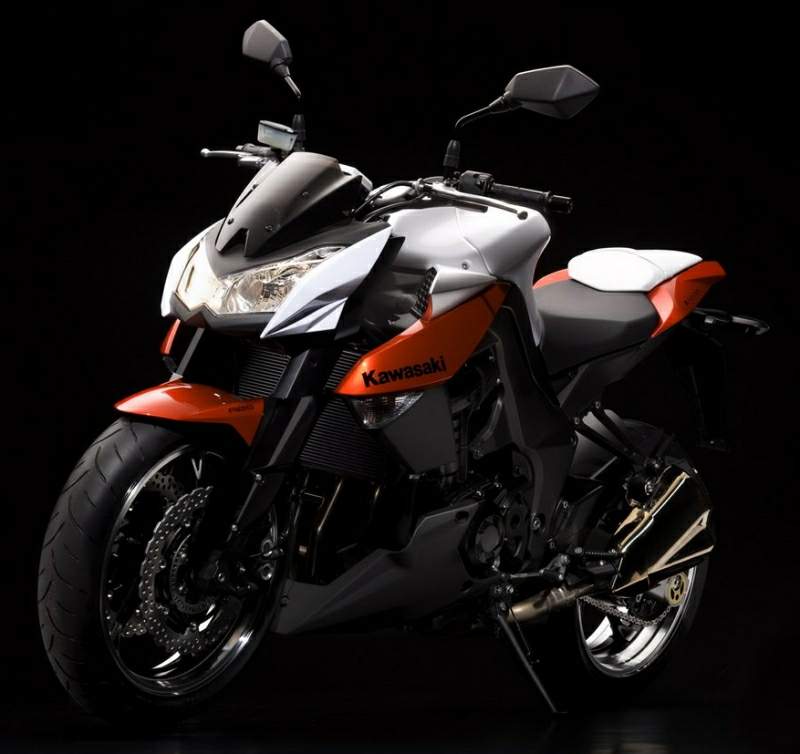
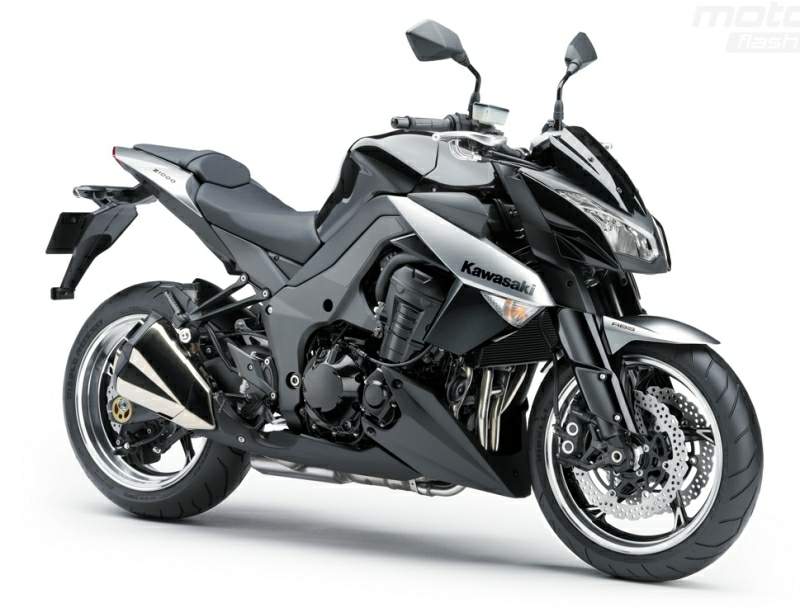
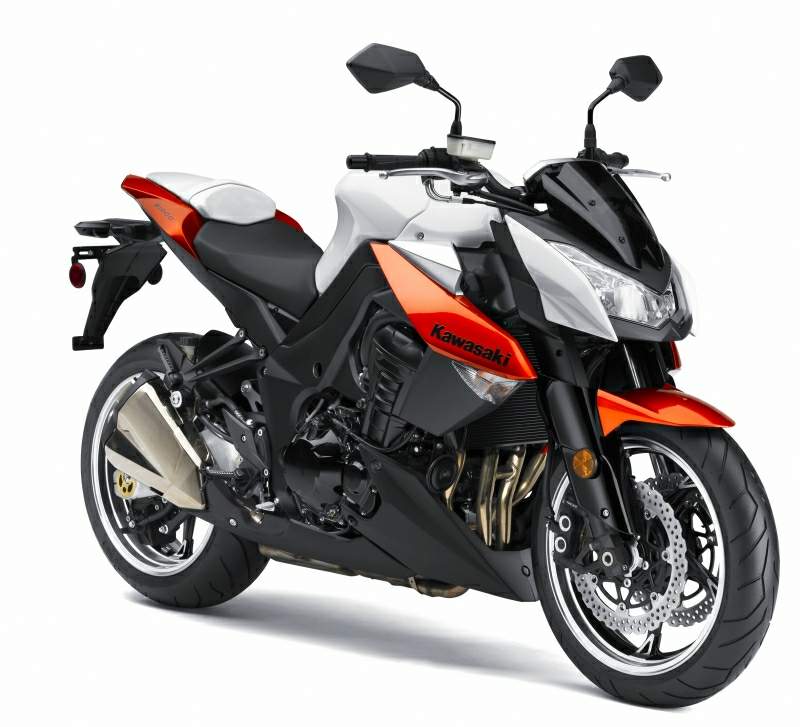
A sharp new front cowl sloped back at an acute angle highlights the Z1000’s new
nose, followed by a tilting instrument panel, visible through an orange lens,
that can be angled to suit rider preference. Just below that a long, narrow
headlight represents Kawasaki’s first use of a line-beam unit. Following the
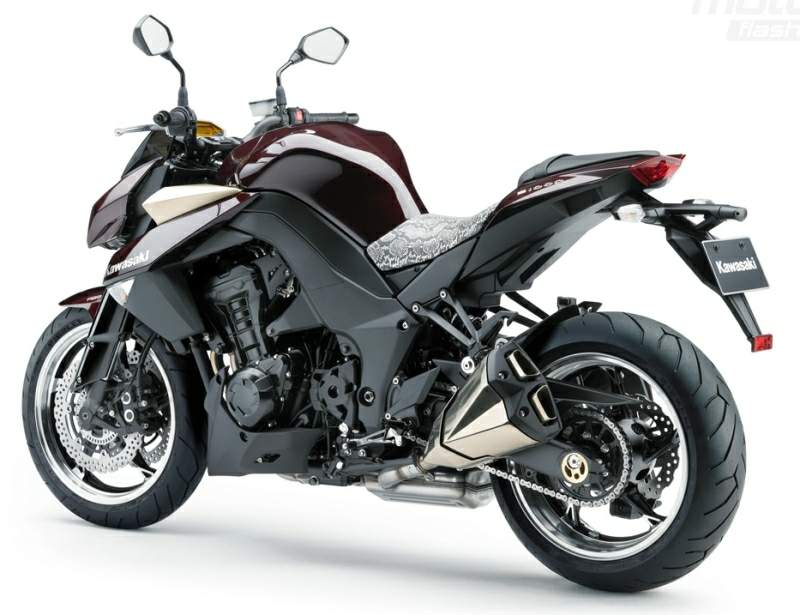
lines rearward, the eyes will next encounter a dynamically designed steel gas
tank, flared on the sides to let you grab it with your knees, and trim at the
rear for a snug fit. The seat’s low and narrow at the front to make ground
contact easy, and it flows beautifully rearward to end in a futuristically retro
LED taillight behind a red lens.
Previous Z1000s used a steel frame, but this one gets its own all-new aluminum
one. Similar in concept to the frame of the Ninja® ZX™-10R sportbike, the frame
beams curve over the engine, resulting in a narrow bike that’s easy to grip with
the knees. The engine bolts in solidly, stressed-member style, at three places,
and in a rubber mount at the upper rear of the crankcase for great torsional
rigidity and solid handling. Wherever possible, welds were eliminated for a
smooth, organic appearance. The main frame and swingarm pivot areas, for
example, are cast as a single unit. The rear subframe is a three-piece aluminum
die-casting, light, smooth and beautiful.
At the heart of every naked bike is its engine. We didn’t just bolt it into that
frame for solid handling, we did it so you won’t forget what you’re riding:
You’ll definitely feel those 1,043 cubic centimeters of fuel-injected Kawasaki
four-cylinder every time you twist the throttle. A secondary balance shaft
eliminates excess vibes, but on this bike, a little bit of character is designed
in. In the same spirit, the bike’s cool air system uses ducts just ahead of the
fuel tank to usher air into the airbox, a placement that lets the rider savor
the bold sound of screaming air being sucked into the engine’s downdraft
intakes.
The Z1000’s four-cylinder uses a longish stroke—56mm—to make the most impact in
the rpm range most used by naked bike riders. Long-stroke engines keep intake
air velocity up for maximum midrange power whatever the displacement. From
nearly any rpm, rolling the Z1000’s throttle open provides the kind of instant
gratification most sportbikes just can’t quite muster. Having said that, this
engine also spins up noticeably faster from about 7000 rpm upwards, with a silky
smooth, highly intoxicating response.
What more do you need? Not much. How about new five-spoke wheels, with spokes
machined near the rims for a custom-wheel look. We carried forward the quad-pipe
theme from the last Z1000 (and the first Z1), but an under-engine pre chamber
let the engineers use shorter mufflers for great looks, better mass
centralization and light, quick handling. A solid-mount handlebar and aluminum
footpegs lifted from the Ninja ZX-10R complete with machined edges contribute to
the Z1000’s direct feel.
Nobody scrimped on the suspension and running gear, either: A radial-pump master
cylinder provides the latest in braking feel and feedback. Adding compression
damping adjustability to the 41mm inverted fork gives it all-way tunability, and
a completely new, horizontal placement of the rear shock provides typically
UNI-TRAK®-like performance.
The next time somebody complains to you that modern motorcycles have no soul,
take them for a ride on a new Z1000. Everything about it is up-to-the-minute
modern. But you can feel its roots every time you hit the starter. This one’s
classic Kawasaki all the way.
Development of the new 2010 Z1000 started from scratch, with the specific goals
of creating a distinctive visual impact and superior on-road performance. The
end result is essentially a custom-made super streetfighter.
A unique blend of Japanese art and technology, the 2010 Z1000’s styling takes a
dramatic leap forward with the distinct look of an apex predator. Hunched-down
and ready to pounce, its visual impact is much stronger than that of a naked
sportbike, or a derivative copy of some Euro trend.
The Z1000 clearly surpasses the dynamic performance of its predecessors, thanks
to a new quick-revving 1,043cc inline-four cylinder engine, and an all-new
quick-steering aluminium chassis connected to an all-new horizontal rear
suspension design. Though it offers true sportbike handling; the Z1000’s
comfortable, upright riding position mean it remains a practical transportation
tool, even as the dramatic howl from its new cold-air intake raises hairs on the
back of its rider’s neck.
Authentic Kawasaki Accessories are available through Kawasaki dealers.
Features and Benefits:
All-new Engine
- Liquid-cooled, DOHC, 16-valve 1,043cc inline-four offers greater torque and a
stronger top-end rush than previous Z1000 models
- Bore and stroke of 77.0 x 56.0 mm were chosen to achieve the desired engine
character -strong in the everyday rpm range most used by naked super bikes
- 38mm downdraft throttle bodies allow intake air to travel to the engine in the
shortest possible distance
- Oval sub-throttles help keep the engine slim - a good thing since the throttle
bodies are positioned between the rider's knees
- Soft rev limiter provides good overrev; power doesn't drop off suddenly at
high rpm
- Crankshaft and transmission shafts are arranged in a straight line instead of
a triangular layout, to maintain the design from the previous Z1000 - a design
that offers the best look for a naked model
- The crankshaft was lowered to allow for a longer stroke without adding engine
height
- A secondary balancer, driven off a gear on the sixth web of the crankshaft,
eliminates excess vibration
Cool Air System
- The intake system routes cool air to the airbox from ducts above the radiator
shrouds, minimizing performance loss due to heated intake air
- Positioning the ducts close to the rider allows the intake sound to be enjoyed
by the rider
- A resonator inside the airbox reduces noise at low rpm, and enhances intake
sound at high rpm
Exhaust System
- The exhaust system features a 4-into-2-pre-chamber-into-2 layout. Silencer
end-caps maintain the quad-style image
- Main and pre-catalyzers ensure emissions are clean
- Thanks to the under-engine pre-chamber, silencer volume could be reduced. The
silencers are also lighter. Overall exhaust system weight is about the same, but
the new system offers much better mass centralization and contributes to a lower
center of gravity
Fuel Pump
- Slim-type fuel pump features an integral fuel gauge
- With revised fuel tank design and the slim-type fuel pump, dead volume inside
the tank is minimized; fuel capacity is 4.1 gallons
All-New Aluminum Backbone Frame
- An aluminum backbone frame designed specifically for the Z1000, and similar in
concept to the frame of the Ninja ZX-10R, allows a narrow construction that is
easy to grip with the knees
- Lightweight and highly rigid, the frame uses the engine as a stressed member,
for a firm, planted feeling and enhanced stability
- Frame is tuned to transmit the ideal level of engine feedback directly to the
rider
- The frame's five-piece construction consists of steering stem, left and right
main frames, and two cross pieces. The two main frame components have open
C-shaped cross sections
- As much as possible, welds were eliminated for simplicity and appearance. The
frame beams and swingarm brackets are now single die-cast pieces
- The new frame uses four engine mounts; three mounts are rigid, the upper rear
crankcase mount is rubber
- The rear sub-frame is a three-piece aluminum die-casting construction, light,
strong and good for mass centralization
- The sub-frame is an example of form and function combined, negating the need
for side covers and allowing underseat narrowness for a shorter reach to the
ground
All-New Horizontal Rear Monoshock
- New rear suspension positions the shock unit and linkage above the swingarm
where it's less exposed to exhaust heat and contributes to mass centralization
- Visible from the outside, the horizontal monoshock contributes to the
aggressive appearance of the new Z1000
- Linkage characteristics are the same as those of a standard UNI-TRAK rear
suspension: Wheel movement versus shock stroke is the same ratio
- The shock features rebound damping and spring preload adjustability
Fully Adjustable Front Fork
- The Z1000's 41mm inverted fork is adjustable for compression damping, rebound
damping and spring preload - and it's protected from harm by a cool-looking
shroud
- Settings are designed for both sporty back road performance and excellent
comfort on the street
Handlebar, Grips and Footpegs
- The tubular handlebar is rigid-mounted, contributing to sharp, direct handling
- A wide, flat bend handlebar offers a design similar to those on off-road
bikes, for excellent control
- Tapered-type grips, like those used on supersport models, offer more direct
feel
- Ninja ZX-10R-style footpegs with knurling offer good grip, direct feel and
control and no-nonsense looks
- The passenger footpeg brackets incorporate convenient luggage hooks
Brakes
- The Z1000's 300mm front petal brake discs are gripped by opposed four-piston
radial-mount calipers. (Caliper piston size is 4x30 mm)
- A radial-pump front brake master cylinder contributes to the superb control
and feel offered by the new calipers
- The rear brake is a single piston, pin-slide caliper gripping a 250mm petal
disc. The caliper is mounted below the swingarm, and located by a torque rod
Instrumentation
- A distinctive tilting instrument panel with multifunction LCD display behind
an orange lens covers all systems
2010 Kawasaki Z1000 Technology
Overview
TAILOR-MADE SUPER NAKED
In order to deliver an "excitement" never before experienced with Super Naked
models,development of the new Z1000 started from scratch - essentially resulting
in a Tailor-made Super Naked.
1. VISUAL IMPACT
Unlike the "mono-form" design of supersport models (where the ensemble is
designed as a single piece), Kawasaki naked model designs are collections of
parts - each meticulously crafted as both stand-alone components, and as parts
of a whole. While contemporary Super Naked models are often no more than
supersport models with the fairings removed, the new Z1000 realises a stunning
VISUAL IMPACT by being conceived in complete design freedom.
Conceived in complete design freedom for a completely unique appearance.
Each part of the new Z1000 was meticulously designed with a dual role in mind:
Individual functionality, and realization of a condensed, mass-forward image.
While the 2007 Z1000 took the avant-garde design of its predecessor and made it
sharper and more aggressive, both models can still be said to have conventional
designs. In addition to individual functionality, each part of the 2010 Z1000
was designed to draw volume (and mass) away from extremities and toward the
centre. The resultant condensed, mass-forward image gives the new Z1000 a more
powerful, dynamic design.
2. RIDING IMPACT
Supersport-based engines and chassis offer high performance, but the number of
riders who are able to enjoy this performance on the street is limited.
Rather than pursuing "speed" and performance figures, Z1000 development focused
on the "excitement" derived from riding a sport bike on the street, thereby
achieving a high RIDING IMPACT.
Ride with "IMPACT" at any time, in any situation
New engine: designed to offer increased feeling of "acceleration"
1,043 cc 16-valve DOHC In-line Four
Completely new engine.
Bore and Stroke chosen to achieve desired engine character.
Development Goals:
WILD engine character
Sharp throttle response
High-rpm Power and Sound of an In-line Four
Intoxicating intake howl care of new Cool Air system
Cool Air System
New system uses ducts to direct fresh (cool) air into the air cleaner.
Positioning the ducts close to the rider allows the intake sound when
accelerating to be enjoyed.
New chassis: designed to maximize enjoyment of sport riding on the street
Highly rigid aluminum frame delivers very direct feel
Rigidity of the main frame was increased; engine mounts increased from 3 to 4.
Using the engine as a stressed member contributes to direct handling.
Using lightweight aluminum for the frame (previously steel) contributes to sharp
handling.
Slim, compact twin-tube frame design contributes to ergonomics.
Slim, compact backbone twin-tube frame design contributes to ergonomics
Uniting the main frame and swingarm pivot area contributes to high-quality
finish. (welds eliminated)
Features for high level of control
Handlebar
- Wider and moved slightly further and higher. New position contributes to the
rider's freedom of movement.
- Fat-type handlebar contributes to tough appearance.
Seat height
- Lowered approximately 5 mm. Slightly narrower thanks to the new frame; this
contributes to the rider's freedom of movement.
Footpegs
- Aluminum footpegs from the Ninja ZX-10R with machined edges contribute to the
direct feel.
Front brakes
- Radial-mount calipers and a radial-pump master cylinder deliver superb braking
performance and precise brake control.
Front suspension with compression adjustability
- Compression damping adjustability added. Settings chosen to deliver light
handling.
Thorough mass centralization contribute to light, sharp handling
VISUAL IMPACT
The new Z1000 takes the aggressive styling of its predecessor a step forward.
From the sharply sloped front cowl design made possible with the slim new
line-beam headlamp, to the minimalist tail section, the new Z1000 presents a
very condensed, mass-forward image. This dynamic design is reinforced by the
front fork covers and wide shrouds adorned with intakes for the new Cool Air
system. Where its predecessor formed the image of an athlete poised to explode
out of the blocks, the new Z1000 gives the appearance of a dangerous predator
feigning sleep - though no less ready to leap forward without a moment's
hesitation.
Condensed, Mass-forward Image for Dynamic Design
Sharp front cowl slopes back at an acute angle, contributing to the aggressive
design and the image of a low, forward-located centre of gravity.
In addition to protecting the inverted fork's inner tubes, fork covers reinforce
the low, mass-forward image.
Slim, compact line-beam type headlamp (first use on a Kawasaki) allowed the
design freedom to make the front cowl smaller. Locating the bulbs slightly
higher in the headlamp unit gives the Z1000 a fierce look when viewed from the
front.
Ignition key cylinder was relocated to the front of the tank (previously forward
of the handlebar), allowing the instrument panel to be positioned closer to the
rider for enhanced visibility. Relocating the key cylinder away from the
instrument panel also helped make possible the compact front cowl. Moving the
key cylinder closer to the rider also contributes to mass centralization.
Dynamic fuel tank design features supersport-style flared edges with a trim
shape at the rear, a shape that is easy to grip with the knees. Concentrating
the tank's volume toward the rear helped make room for the repositioned key
cylinder. Steel construction facilitates the use of magnetic tank bags.
Voluminous shrouds with integrated turn signals contribute to the new Z1000's
concentrated, massforward design.
Sharp under-cowl adds to the image of a low centre of gravity and reinforces the
mass-forward design.
Minimalist tail cowl is slimmer and more compact, moving mass both physically
and visually away from the rear and toward the front.
LED taillight design, reminiscent of the original Z1000's, features red LED
bulbs and a transparent lens.
The silencers are also lighter (5,100 g >> 3,500 g each). While overall exhaust
system weight is about the same when the prechamber is included, the new system
offers much better mass centralization and contributes to a lower centre of
gravity.
Quad-style muffler maintains a key design element from previous models. The
silencers are also lighter (5,100 g >> 3,500 g each). While overall exhaust
system weight is about the same when the prechamber is included, the new system
offers much better mass centralization and contributes to a lower centre of
gravity.
Tilting Instrument Panel
Fully digital instrument panel features an eye-catching orange lens .
The instrument panel can be angled to suit rider preference. Riders can choose
from three positions. Angle can easily be changed without tools using an
adjuster knob on the left side.
Meter functions include digital speedometer, bar-style digital tachometer,
odometer, two trip meters, fuel gauge, and clock.
Details
Swingarm features eccentric axle adjusters, contributing to the Z1000's Kawasaki
identity.
Unnecessary material trimmed from the rear flap to give it a light look.
RIDING IMPACT: CHASSIS
To deliver a high riding impact, Kawasaki engineers wanted a quick-steering and
lighthandling package. An all-new aluminum frame with 30% more rigidity,
increased mass centralization, using the engine as a stressed member, and a new
rigid-mount handlebar all contribute to sharper, firmer handling. A new tank and
sub-frame offer a slim riding position, and a number of other changes offer
increased control.
All-new Aluminum Twin-tube Frame
Highly rigid aluminum frame delivers very direct feel Similar in concept to the
frame of the Ninja ZX-10R, the frame beams go over the engine (on a supersport
model the frame beams would be much stiffer), allowing a narrow construction
that is easy to grip with the knees.
Lightweight and highly rigid, the frame uses the engine as a stressed member.
Torsional rigidity is up about 30%; lateral stiffness is about the same. The
frame itself is approximately 3-4 kg lighter.
Handling is improved, offering a firmer, more planted feeling, and stability is
enhanced. The new frame offers firmer handling and enhanced stability.
The frame beams and swingarm brackets are now single die-cast pieces. The new
frame is a 5-piece construction, consisting of steering stem, left and right
main frames, and two cross pieces. The two main frame components have open
C-shaped cross sections.
As much as possible welds were eliminated, offering an improved appearance.
The new frame uses 4 (instead of 3) engine mounts. All engine mounts are rigid
except the upper rear crankcase mount, which is rubber. The increased rigidity
(also due to using the engine as a stressed member) contributes to lighter,
firmer handling while maintaining stability.
Feeling from the engine is also transmitted more directly to the rider.
The rear sub-frame, previously two steel pieces (left/right) welded to the
frame, is now a 3-piece aluminium die-cast construction. The new sub-frame
weighs less, contributing to mass centralization.
The sub-frame is an example of form and function combined, allowing the side
covers to be eliminated. This also allows the width under the seat to be
narrower, offering riders a shorter reach to the ground.
Mass Centralization
The new exhaust system (with shorter silencers and pre-chamber), Horizontal
Back-link rear suspension and the use of downdraft throttle bodies are the
greatest contributors to mass centralization.
The new aluminum sub-frame and repositioned key cylinder also contribute. The
result is lighter, sharper handling. Turn-in is light. Steering is neutral after
the bike has been leaned over. The bike is stable mid-corner. And the bike goes
where you want it to.
Fully Adjustable Front Fork
With the addition of compression damping adjustability, the Z1000's 41 mm
inverted front fork is now fully adjustable.
Settings offer both sporty performance (contributing to light handling on the
street and in the hills) and comfort.
Fat-type Handlebar, Grips & Pegs
New handlebar is rigid-mount, contributing to the sharper handling.
The handlebar is thicker at the centre (28.6 mm), tapering to 22.2 mm at the
grips.
Revised position is slightly wider (23 mm), slightly further (14 mm) and
slightly higher (7 mm). The revised position and a flatter bend offer a design
similar to handlebars of off-road bikes, facilitating control.
The new handlebar also looks tough, contributing a touch of badboy image to the
Z1000's appearance.
Tapered-type handle grips (like those used on supersport models) offer more
direct feel.
Ninja ZX-10R-style footpegs with knurling offer good grip, more direct feel and
control, and also contribute to the sporty look.
Tandem footpeg-stays incorporate convenient luggage hook.
Front and Rear Seats
Seat height is approximately 5 mm lower, and the seat could be made slimmer
thanks to the new subframe. The result is an easier reach to the ground.
Compact passenger seat matches the design of the Z1000's tail section.
Engine
RIDING IMPACT: ENGINE
To maximize impact, the engine needed to deliver more than just performance
figures. Riding impact is about the sensation the rider feels. Engineers wanted
to offer superb throttle response, power delivery with a hit in mid-range, and a
seductive intake howl with just the right amount of engine vibration to make
accelerating an exhilarating experience.
All-new Engine
Liquid-cooled, DOHC, 16-valve 1,043 cc In-line Four offers a greater power
output (138 PS) and stronger torque than that of the previous Z1000. The new
displacement was chosen with the desire to maintain the Z1000 name.
Bore and stroke of 77.0 x 56.0 mm were chosen to achieve the desired engine
character. Compare this to the bore and stroke of the 2008 Z1000 and 2009 Ninja
ZX-10R:
2008 Z1000 - 77.2 x 50.9 mm
2009 Ninja ZX-10R - 76.0 x 55.0 mm
1,043 cc 16-valve DOHC In-line Four
Downdraft throttle bodies allow intake air to travel to the engine in the
shortest possible distance, offering improved performance. While downdraft
throttle bodies often use short intake funnels to maximize high-rpm performance,
the Z1000's are longer to offer the best Super Naked power characteristics.
Throttle bore is ø38 mm (2008 Z1000 was ø36 mm), chosen to offer the ideal
low-mid range response.
Oval sub-throttles help keep the engine slim - this is important since the
throttle bodies are now positioned between the rider's knees.
Good over-rev characteristics mean that power does not drop off suddenly at high
rpm.
Engine tuning is focused on the feeling the rider gets when opening the
throttle. There is a much greater feeling of torque (set at the maximum level
before the rear wheel starts spinning). Get on the gas at any rpm and the engine
pulls strongly - although the feeling is more like being propelled forward.
Power delivery is quite linear, but the engine spins up noticeably faster from
about 7,000 rpm onwards. Silky smooth response from mid-high rpm ensures
excellent driveability.
Crankshaft and transmission shafts are arranged in a straight line (compared to
the Ninja ZX-10R, which uses a triangular layout). This maintains the design
from the 2008 Z1000, an engine design we felt offers the best look for a Super
Naked model.
Crankshaft was lowered to allow for the longer stroke without adding engine
height. The shaft line, which was horizontal on the 2008 Z1000, is angled 5o
down. Thus, engine size is about the same despite the 90 cc displacement
increase.
A secondary balancer, driven off a gear on the 6th web of the crankshaft,
eliminates excess vibration. Of course, a certain amount of engine vibration was
desired as part of the bike's character (vibration contributes to the feeling of
acceleration, increasing linearly with rpm), so vibration was not totally
eliminated. However, adding the secondary balancer enabled the changes to the
chassis for improved handling (With the chassis changes, the vibration
transmitted to the rider is about the same as the 2008 Z1000)
Cool Air System
With the airbox nestled between the frame rails, intake air is more affected by
engine heat.
The Cool Air system routes cool air to the airbox from ducts above the shrouds,
minimizing performance loss due to heated intake air. This should not be
confused with Ram Air, where force-fed air becomes pressurized in the airbox.
Positioning the ducts close to the rider allows the intake sound to be enjoyed
by the rider.
A resonator inside the airbox reduces noise at low rpm, and enhances intake
sound at high rpm.
Exhaust System
The exhaust system features a 4-into- 2-pre-chamber-into-2 layout. Silencer
end-caps maintain the quadstyle image
Main and pre-catalysers ensure emissions are clean.
An exhaust device is located upstream of the right-side silencer.
Thanks to the under-engine prechamber, silencer volume was reduced from 4.5
litres to 3 litres each. The silencers are also lighter (5,100 g >> 3,500 g
each). While overall exhaust system weight is about the same when the prechamber
is included, the new system offers much better mass centralization and
contributes to a lower centre of gravity.
Fuel Pump
Slim-type fuel pump features a unitised fuel gauge.
With the revised fuel tank design and the slim-type fuel pump, dead volume
inside the tank is minimized.
This locates the suspension far enough from the exhaust that operation will not
be affected by heat.
The new arrangement contributes to mass centralization.
Visible from the outside, the backlink Horizontal Back-link contributes to the
appearance of the new Z1000.
The new rear suspension eliminates the external reservoir tank, however
performance is the same or better than that of the 2008 Z1000.
Linkage characteristics are the same as those of a standard Uni-Trak rear
suspension: linkage ratios were set such that rear wheel movement vs shock
stroke is the same as would be with Uni-Trak rear suspension.
As before, the rear shock features rebound and preload adjustability.
Brakes & Tires
Brakes
At the front, the Z1000's 300 mm petal brake discs are gripped by opposed
4-piston radial-mount calipers. Caliper piston size is 30 mm.
Radial-pump front brake master cylinder also contributes to the superb control
and feel offered by the new calipers.
Swingarm features eccentric axle adjusters, contributing to the Z1000's Kawasaki
identity.
The caliper is mounted below the swingarm and features a torque rod. The
arrangement adds a racy image.
Tires
New tires contribute to Z1000's nimble handling.
ZR1000D: Dunlop D210
Tire sizes are unchanged from its predecessor.
F: 120/70ZR17M/C (58W)
R: 190/50ZR17M/C (73W)
NOTE:
Some of the photos on Motorcycle Specs are owned by somebody. If you see any of
your photos, you can let me know so that I can acknowledge it, or if you
object to it, I can remove it altogether. If any copyright holder objects
to their articles being placed on Motorcycle Specs, it will be removed upon
request. Any correction or more info on these bikes will kindly be
appreciated.
Contact MePrivacy
Policy Website
Stats