|
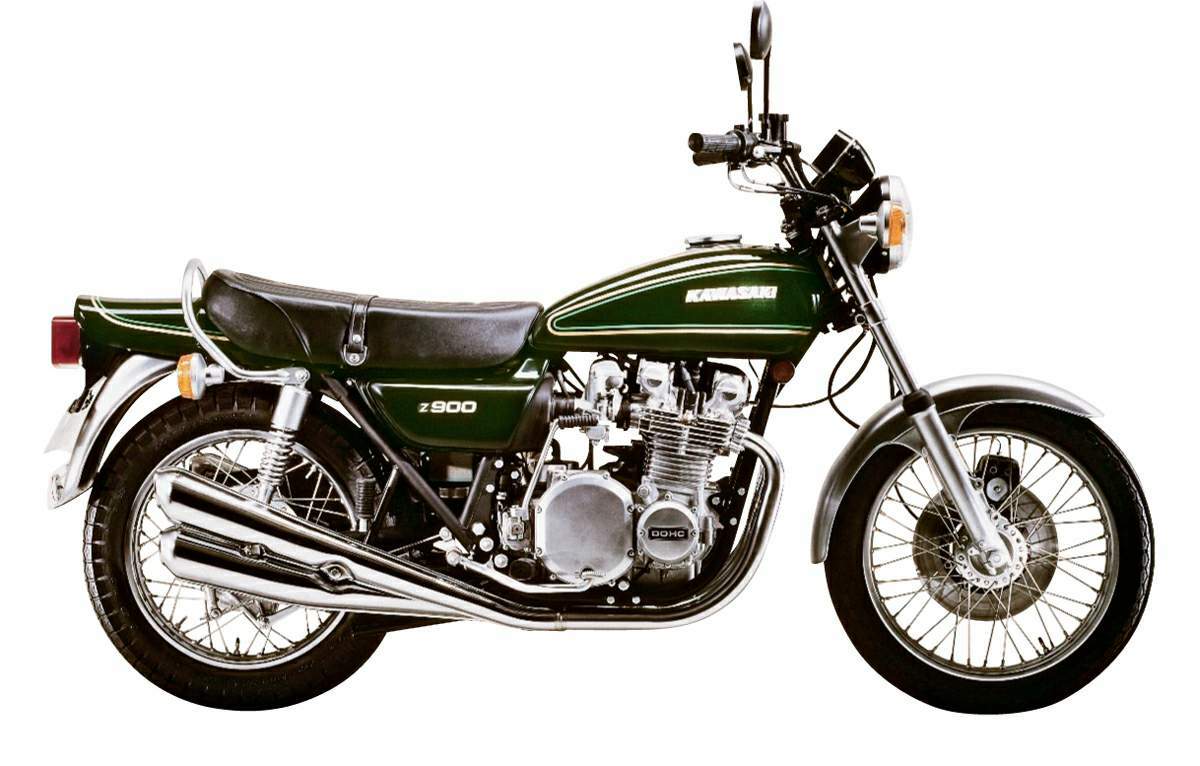
Kawasaki Z1 900

|
Make Model |
Kawasaki Z1 900 |
|
Year |
1972-73 |
|
Engine |
Air cooled, four stroke, transverse four
cylinder, DOHC, 2 valve per cylinder. |
|
Capacity |
903 |
|
Bore x Stroke |
66 x 66 mm |
|
Compression Ratio |
8.5:1 |
|
Induction |
4x 28mm Mikuni carbs |
|
Ignition /
Starting |
- / electric & kick |
|
Max Power |
82 hp 59.8 kW @ 8500 rpm |
|
Max Torque |
73.5 Nm @ 7000 rpm |
|
Transmission /
Drive |
5 Speed / chain |
|
Frame |
Double tubular steel cradle
|
|
Front Suspension |
36mm Telescopic forks |
|
Rear Suspension |
Dual shock, 5-way preload adjustment |
|
Front Brakes |
Single 296mm disc 2 piston caliper |
|
Rear Brakes |
200mm drum |
|
Front Tyre |
3.25 H19 |
|
Rear Tyre |
4.00 S18 |
|
Dry-Weight |
230 kg |
|
Fuel Capacity |
18 Litres |
|
Consumption average |
48 mp/g |
|
Standing
¼ Mile |
12.3 sec / 112 mp/h |
|
Top Speed |
135 mp/h |

If one machine summed up the spirit of Seventies super
biking, it was Kawasaki's Z1, which burst on to the scene in 1973 and
dominated the decade with a performance that put it streets ahead-often
literally-of the opposition. The first big 'Zed' was a landmark motorcycle,
raising the speed stakes to new heights and establishing a reputation for
brute power and reliability that Kawasaki has retained to this day.
The Z1 early story is one of triumph over near disaster. In the fall of
1968, Kawasaki's engineers were dismayed when, with their own plans for a
radical four-cylinder 750 well advanced, they were suddenly confronted by
Honda's CB750. Kawasaki considered scrapping their project, code-named 'New
York Steak' - but, instead, they learnt all they could from the Honda,
enlarged their own twin-camshaft engine to 903cc, and returned four years
later with the Z1.
The wait and the extra work were worthwhile,
because the Kawasaki was a better bike in almost ever)' way. Its big motor
put out 82bhp - 15bhp more than the single-cam Honda, and enough to give a
top speed of 130mph. It was smooth, it was tractable and it was almost unburstable.
Tuners and racers adopted it in droves, and Z1-based bikes were soon competing
successfully at ever)' level from club-racing to the international endurance
events. But there was much more to the Z1 than simply an engine. The
bike's rounded styling was striking, its handling was reasonable (though when
pushed hard the Kawa could get seriously out of shape), and it was even fairly
comfortable despite the high handlebars. The inescapable conclusion when
comparing CB750 with Z1 was:
'The King is dead. Long live the King.'
Such was the performance of the Kawasaki Right: Handling was respectable by
early-Seventies standards, but the Z1's chassis combination of simple frame,
skinny forks and single disc ensured that a rider had to be brave. that it
needed virtually no changes to remain on top when it became the Z900 in 1976; it
merely gained a second front disc brake and slightly firmer suspension. A year
later came the Z1000, its motor bored out to 1015cc to give even more low-rev
smoothness and punch. The following years saw the big 'Zed' in a variety
of guises: Café-racer Z1-R, shaft-drive Z1000ST tourer, and later the fiery red
GPz1100 sportster. All were good bikes.
Source of review: Roland Brown

Road Test But
it doesn't stop there, since we can also find beauty in performance. And the Z-1
is probably the most performing production motorcycle on planet Earth. It has
enough top speed, acceleration, and braking power to satisfy the most gutsy of
heroes. Too, it can handle the tough twisties without a shake, shudder, or
snarl.
On top of everything else, Lady Z shows just how
foxy she really is when ifs time for manners; in heavy town traffic, touring on
the open road, or just firing up in your driveway without disturbing the
neighbors late at night It is hush, hush quiet, but the sound evokes attentive
respect for the power that surely lurks within.
Development on the project, dubbed, "New York
Streak, "started some time back around 1968. Kawasaki was taken by surprise by
Honda's intro of their 750, and did a bit of re-evaluating; the result being a
late 1972 introduction of the 1973 900 Z-1. While the new "Z" will often find
itself compared with Honda's enormously successful 750 Four, there is more of a
difference than one would imagine.
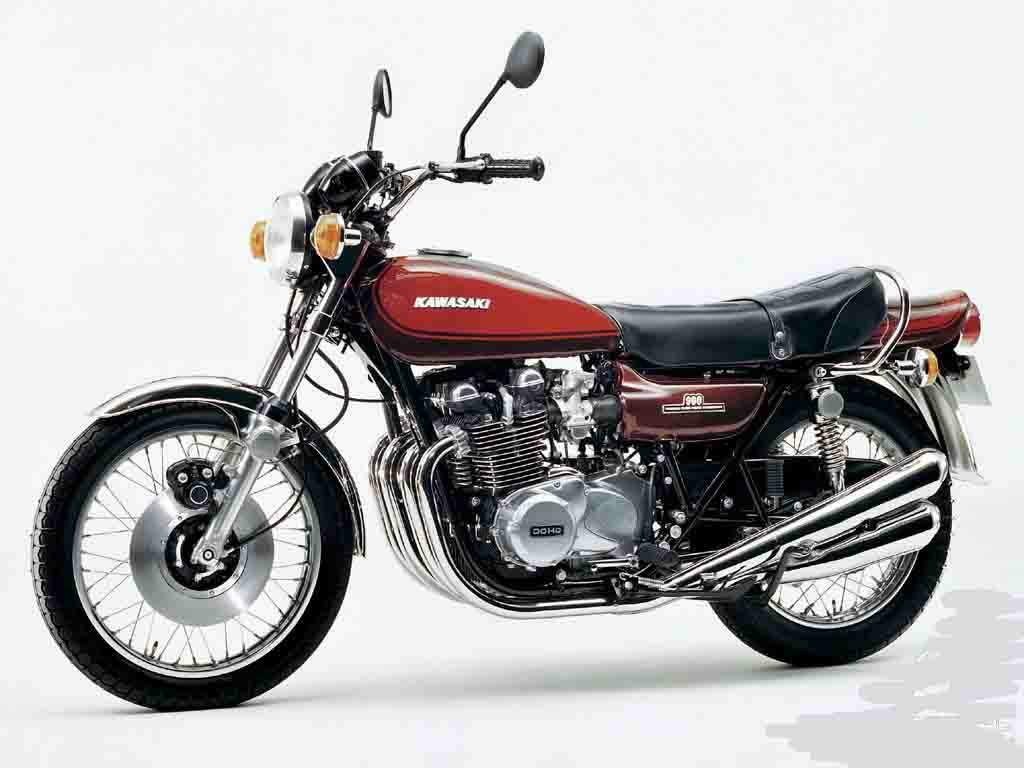
The only real similarities in styling (the ones
that might make you think it's a Honda at first glance) are the four exhaust
pipes and the large size of the overall motorcycle. Otherwise, the Z-1 has a
look all its own.
At the front the big Kawasaki is blessed with a
new design high speed tire, the Dunlop K 103. The three center ribs are designed
to aid stability at the speeds the 903 is capable of. The fender is chrome and
has no rods or braces to support it; very clean looking.
Lower fork legs are aluminum and have cast in
recesses for the amber side reflectors, a design that will make it rough to
remove the lenses. After all, the recesses will still be there. Though the left
leg carries the big disc brake and caliper assembly, the right one also has cast
on lugs to fit another complete stopping unit. The disc assembly looks to be the
only component borrowed from another Kawasaki, the 750 H2.
By not fitting rubber boots to the sliding
portion of the forks, Kawasaki has kept the front end very stylish and light
looking. So often these rubber boots give a bulky look to many different
motorcycles. To keep dirt from ruining the oil seals, rubber wipers snap on the
tops of the lower fork legs and maintain a good seal from the elements.
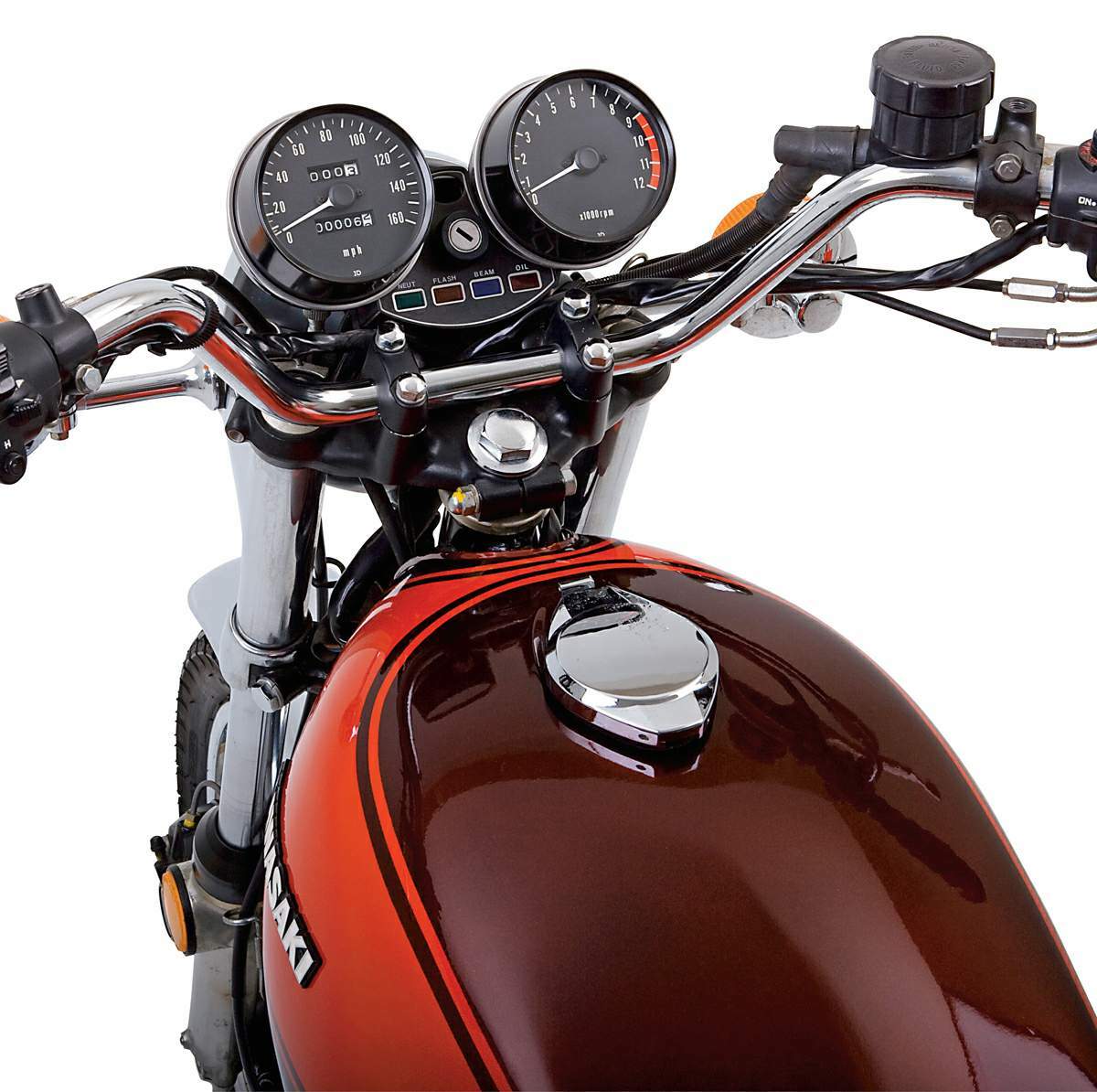
The headlight is a conventionally styled item and
its ears contain the front turn indicators. Just above the sealed beam are the
instruments, the nicest ones we've seen on any motorcycle. They're streamlined;
that is, swept back and shrouded in an extremely pleasing manner, with the
speedo on the left and the tach on the right. In between, facing the rider, are
the now fairly common warning lights. More important though, is the placement of
the ignition switch . . . right in the middle of the instruments where it is
easy to reach. The 750 Honda, you'll remember, still has its keyswitch down
under the tank a la 1960.
Lighting controls are all at your fingertips near
the handgrips. The 900 has its high beam and on/off headlight controls
independent of each other, so when you switch to low beam you don't mistakenly
turn off the lights; a common occurrence on the 750 Honda.The starter button is
just by your right thumb; the kill button just above that.
For as big as the fuel tank is, it doesn't look
bulbous or out of place. Its shape, as well as the paint treatment, combine to
make the 4.76 gallon unit a thing of beauty. The cap is the flip up type, and
requires two hands to pop it open. That might seem a bit of trouble at first,
but the first time you see one of the local four year old house apes try it,
you'll see why they made it that way. The chances of a kid getting it open and
filling your tank with goldfish are slim indeed.
We don't often find a motorcycle seat that not
only looks good, but offers the ultimate in riding comfort for both the rider
AND passenger. Well, we found one on the Z-1. It's as comfortable as the one
found on the BMW machines, but it looks a lot better. And a nice, solid hand
hold is awaiting the passenger's grip in the form of a hefty, chromed bar just
behind the seat.
Of course a seat so well designed surely must
flip up to reveal items that the owner must occasionally get to and, it does.
The battery is there, the tool kit, the pop out air filter element, even a
little slide out tray that fits in the tail section and holds your owners manual
and registration.
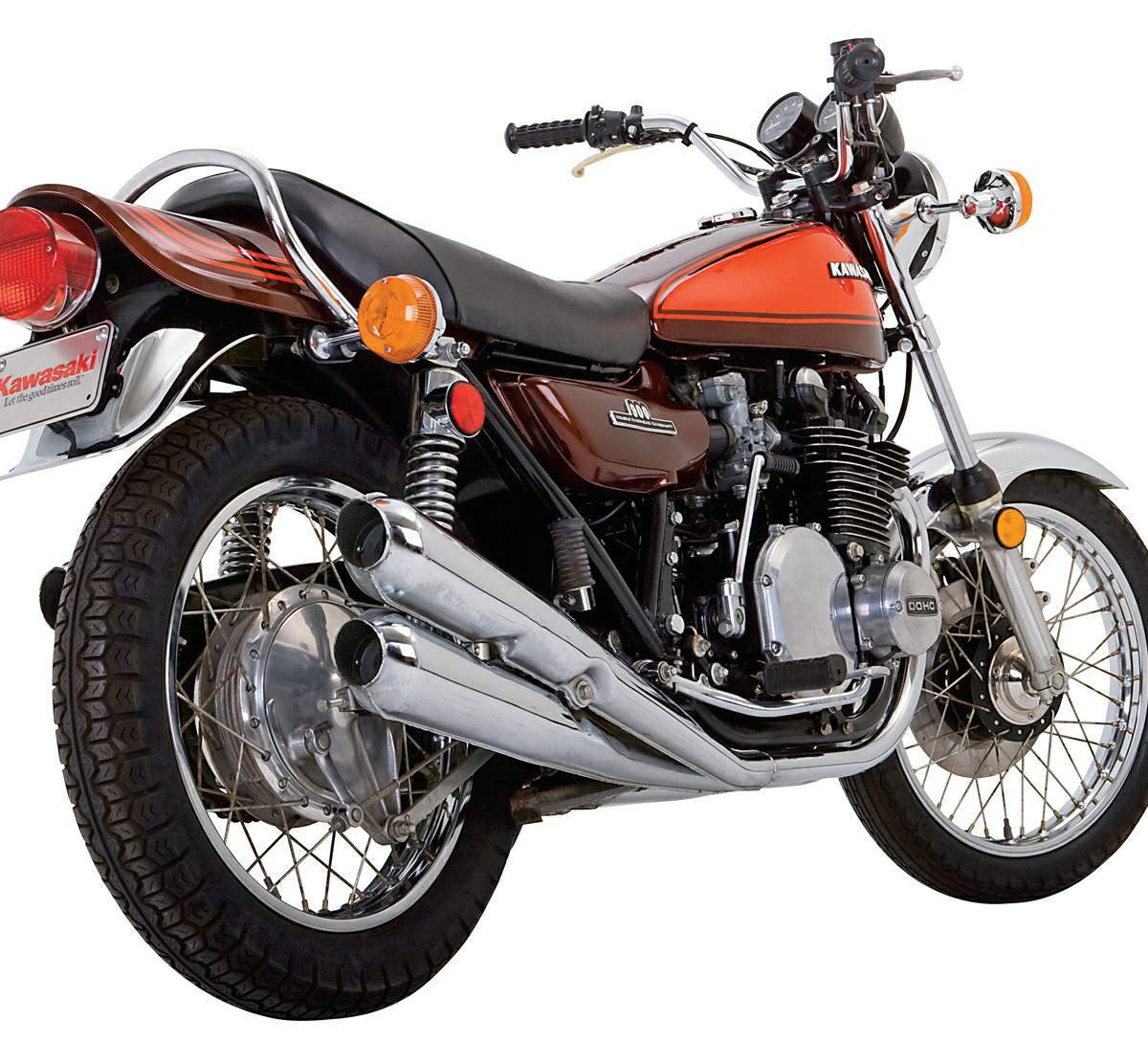
Flexible type plastic is used in the snap-on side
covers and the upper portion of the rear tail section. Paint on the machine is a
metallic brown and orange and, very pleasing.
Since most of the braking force is needed at the
front wheel, .a standard drum brake is fitted to the rear. Dunlop makes the
4.00x18 K87 mk 11 tire, fitted to the back wheel.
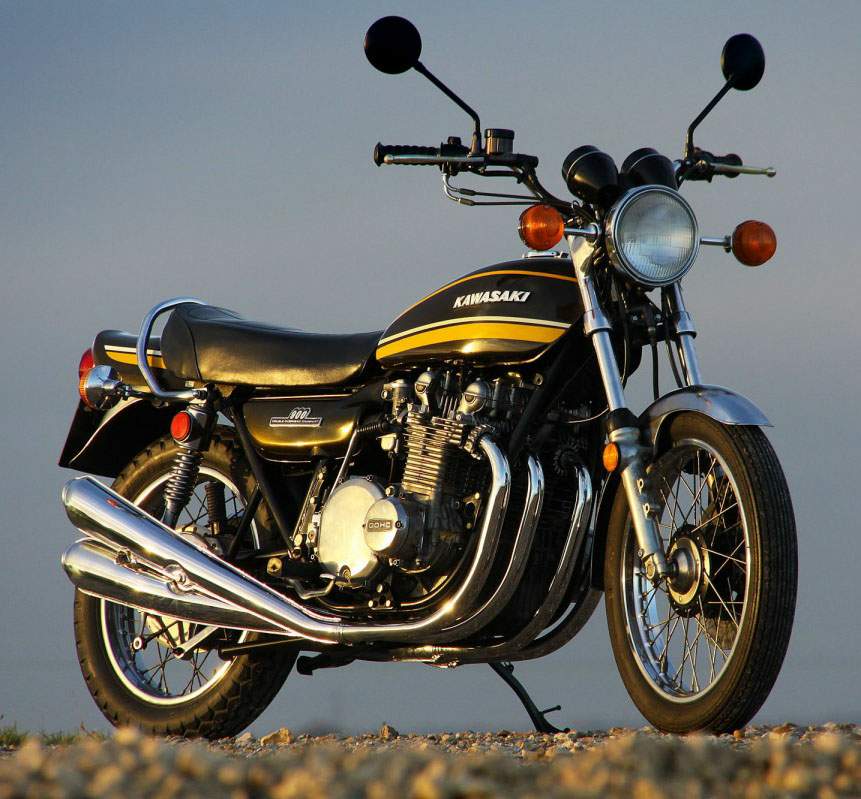
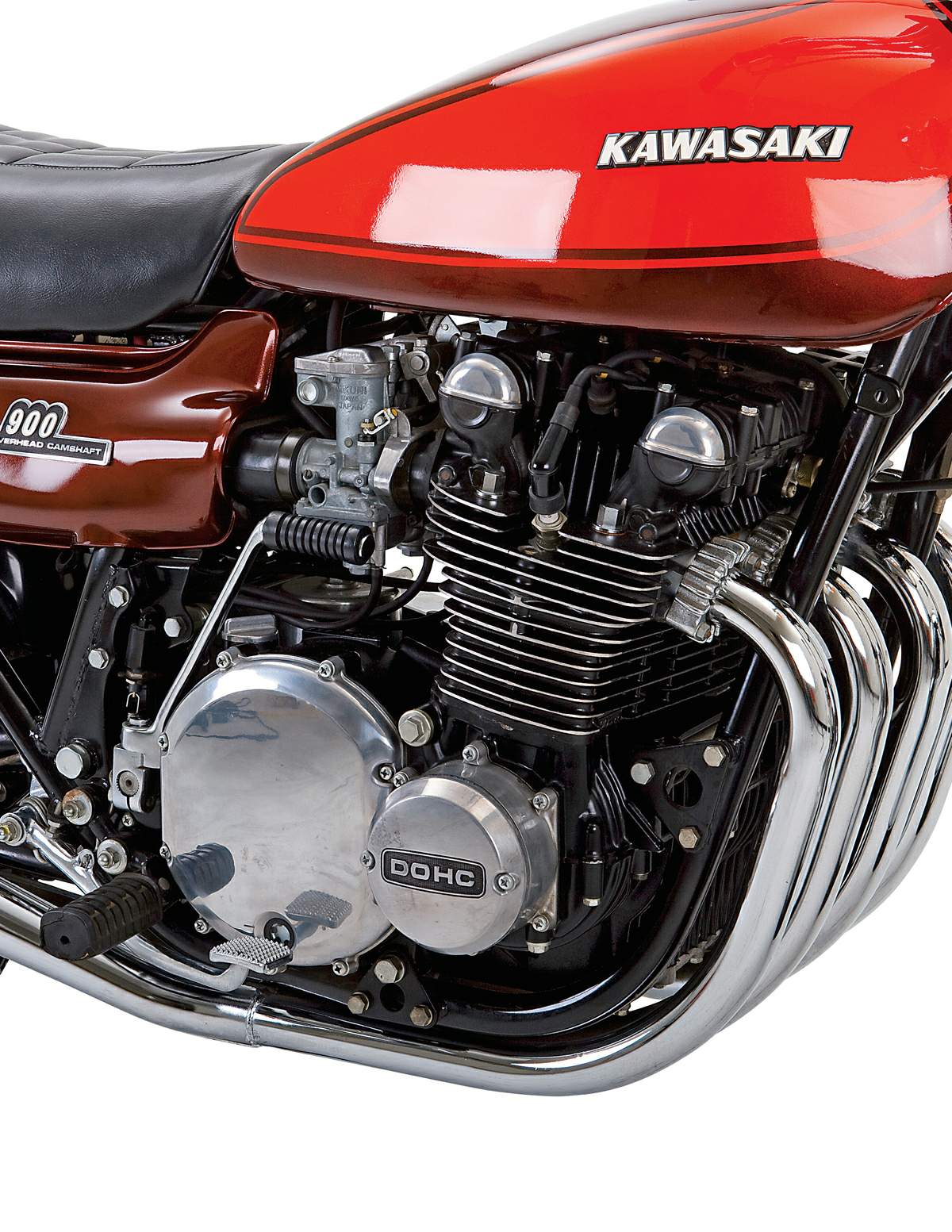
When you talk about the styling of the Z-1, you
can't leave out the engine. Where is class with a capitol "C". Kawasaki has
painted the thing black and adorned it with chrome and polished embellishments.
The most far-out looking engine ever fitted in a production motorcycle.
Fifty-five cubic inches, double overhead cams, and 82 horsepower. Lots of work
and research went into this four, and that much more testing.

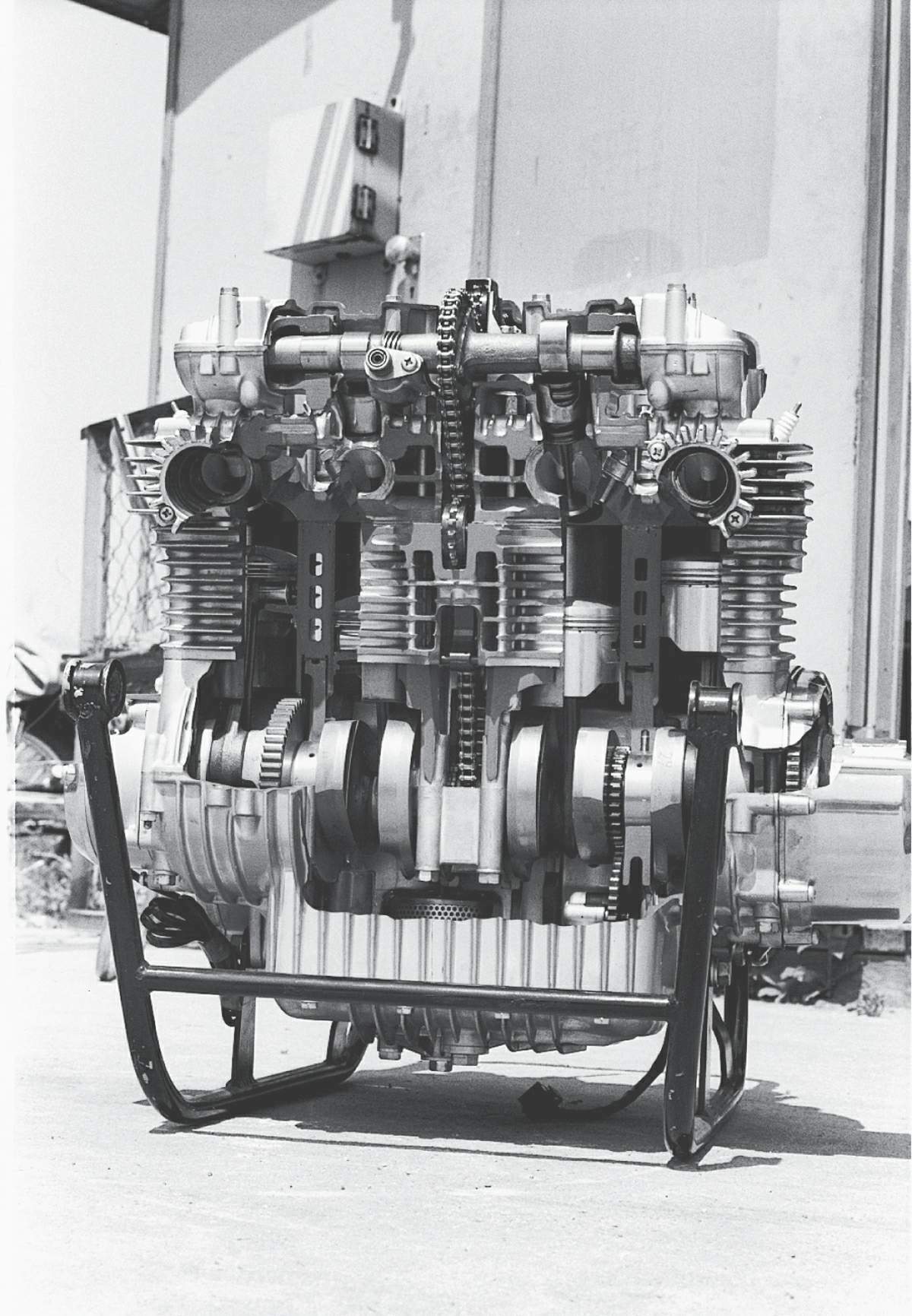
For the displacement of this engine, it is still
fairly narrow. The designers undoubtedly wanted to keep the crank as short as
possible for this reason. Though it is short, it is actually nine pieces that
are pressed together, and naturally, very strong. And unlike many engines of
this size, the crankshaft rides in needle, rather than roller bearings.
In order to eliminate drive train snatch, the
engineers came up with a direct primary drive system. The gear teeth for the
drive are cut directly on the number four crankshaft counterweight, which
eliminates any need for chains or idler gears. And it works.
Compared to the Honda Four, little grab or snatch
is present. And, since the big 900 drops or picks up rpms slower than the Honda,
it can be ridden more smoothly in traffic.
The two overhead camshafts, an unusual feature on
a production type engine, are driven off the center of the crank, by a chain.
The chain is a single row type, with no master link, and features an external
adjustment for the tension. Another gear on the crankshaft drives the engine oil
pump.
When you're ready to push the electric starter,
there's no need to find neutral. The starter drives directly to the crank, but
not so the kick starter. This one connects up to the clutch, so neutral must be
located first. The kick starter will probably only be used when the battery is
low or the weather exceptionally cold.
As far as gearboxes go, the one in the new 900 is
high on the rating scale. It is a five speed unit, with low gear being down, and
the remaining four up, in the pattern. It seems to work faultlessly, and no
doubt the strong, eight plate clutch has much to do with it.
Honda's initial problems with their drive chain
drew plenty of adverse publicity and forced a recall on thousands of machines.
Kawasaki researched this problem carefully, and tried to come up with a chain
that not only wouldn't break, but one that would last as long as possible. Drive
chain wear on a big, high powered machine is critical.
The final result was what is probably the largest
chain ever put on a motorcycle; a 3/4" pitch monster, bigger even than the one
that graces the sprockets on the Harley-Davidson Electra Glide. Like the Honda,
there is no master link. If you need to change the tire, provisions have been
made to make the job possible without too much hassle.
To keep the links moist with lube, a gear driven
pump meters the oil of your choice from a small tank under the left side cover.
The oil is delivered at the rate of 5cc an hour at an output shaft speed of 1500
rpm. Even with the pump, however, Kawasaki recommends that you lube the chain by
hand every three hundred miles, for the longest chain life possible. But, don't
expect more than about 5,000 miles per chain with the "Z. " The rear tire will
last about the same length of time.
Though economy isn't possible with tires or
chains, the big bruiser gets thrifty in the fuel department. 40 miles per gallon
can be expected on a normal ride, and the fuel you put in that tank is regular —
that's what Kawasaki advises you use.
The 903 even has a smog system, so to speak, the
first bike ever to use such a device. Crankcase fumes are shuffled through a
canister and eventually back to the carburetors to be reburned. No doubt future
legislation will require such devices, and Kawasaki is just that much ahead of
the game.
You will find that the 900 is extremely cold
blooded, and requires about five minutes of warm up before it will accept
throttle turning. Also, it needs a good thousand miles of break in before hard
running is done. The Kawasaki people were very definite about this point. So
much in fact, that they do not release any test machines to the press unless
they have at least 1000 miles on the odometer.
The Z-1 will cruise comfortably at any speed the
rider feels he can get away with. At 80, for example, the engine is literally
loafing at 5000 rpm. Top speed is much faster than most riders will ever want to
go, or even try once. Acceleration is phenomenal, but you don't realize just HOW
fast you are going until you look at the speedometer. Then, your heart THUMPS!
It likes to go around corners, though it never
lets you forget that it is a big machine, about 540 pounds all fueled up and
ready to ride. If you get into trouble, it will be your fault, because the 900
doesn't play tricks like the 750 Triple.
It is everything you've wanted in a big street
motorcycle, and once you sample its cadence, you'll see what we mean.

|