|
|

|
|
|
|
Classic Bikes
Custom Bikes
Individual
Racing Bikes AJP
AJS
Aprilia
Ariel
Avinton / Wakan
Bajaj
Benelli
Beta
Bimota
BMW
Brough Superior
BRP Cam-Am
BSA
Buell / EBR
Bultaco
Cagiva
Campagna
CCM
CF Moto
Combat Motors
Derbi
Deus
Ducati
Excelsior
GASGAS
Ghezzi Brian
Gilera
GIMA
Harley Davidson
Hero
Highland
Honda
Horex
Husaberg
Husqvarna
Hyosung
Indian
Jawa
Kawasaki
KTM
KYMCO
Laverda
Lazareth
Magni
Maico
Mash
Matchless
Mondial
Moto Guzzi
Moto Morini
MV Agusta
MZ / MuZ
NCR
Norton
NSU
Paton
Peugeot
Piaggio
Revival Cycles
Roland Sands
Royal Enfield
Sachs
Sherco
Sunbeam
Suzuki
SWM
SYM
Triumph
TVS
Ural
Velocette
Vespa
Victory
Vincent
VOR
Voxan
Vyrus
Walt Siegl
Walz
Wrenchmonkees
Wunderlich
XTR / Radical
Yamaha
Zero
Video
Technical
Complete Manufacturer List
|
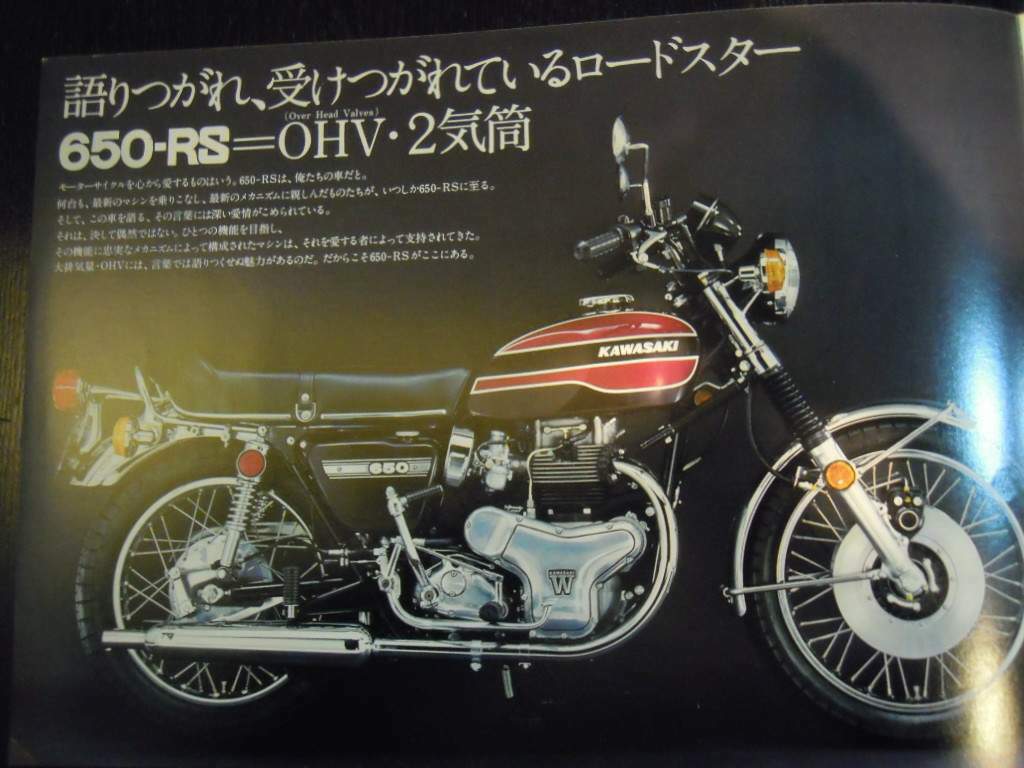
Kawasaki W3 650
The history of the W1 can be traced back to 1960 and the early K1, a motorcycle developed by the Japanese motorcycle meguro. Meguro had first started producing motorcycles back in 1909 and had modeled the K1 on the English BSA A7 as a replacement for their single cylinder Meguro Z7. It was early days, and most Japanese motorcycle manufacturers at the time were basically building bikes copied from American and European models, particularly in the large displacement categories. For its day, the K1 was an advanced design and showcased modern-day manufacturing techniques with its Air-Cooled , 4-stroke, Twin OHV 496cc engine mounted in a double-cradle frame.
In 1960, Meguro Works entered into a business relationship with Kawasaki Aircraft Co.,Ltd., leading to a full merger in 1963. Therefore, although the K1 was developed and produced by Meguro, selling it was left to Kawasaki Motor Sales Co., the forerunner of Kawasaki Motorcycle Co.,Ltd. At the time, the Kawasaki engineers were so deeply engaged in the development of a 4-stroke engine for small cars that they had no time to develop anew motorcycle engine. But by the end of 1962 the four-wheel project had ended and some of these car engineers transferred to Meguro and tool over the project. There were two projects that the developers had to tackle: the SG(a single-cylinder 250cc OHV) and the K1. For both projects, ex-Meguro engineers kept working on the task of chassis development, while the SG and K1 engines were developed by the ex-Kawasaki engineers. Since the K models were still in the transition stage from Meguro to Kawasaki, there were many problems associated with technology transfers and maintenance. However, work proceeded at the same time on development of a successor to the K1�\ the new W1. At the time, sales objectives were concentrated on receiving orders for police patrol motorcycles intended for guard duties during the 1964 Tokyo Olympics. Since there was no time to develop a new engine, or even to remodel an existing one, there was no choice but to use the K1 model as it was. However, the engineers still wanted to overcome some basic design flaws in the K1 engine. Because the sales side wanted to maintain the impressive appearance and dignified look of the K1, it was decided to remodel the engine only, and in 1965 the remodel the engine only, and in 1965 the remodeled K1 was introduced as the K2. (The changes included increased oil pump capacity, improved crankshaft bearings, etc. The Y-shape cover, the distinctive feature of the W models, was adopted at this stage.)
However, both the K1 and K2still shared the basic weak points of the BSA A7. The K2 was exported to the US for a test in response to the expanding American market for 4-stroke motorcycles. Unfortunately, it was rejected for a lack of power. The answer was the W1 which was developed as a large, high-performance, 4-stroke based on the K2. With this new model, the basic problems found in the lubrication system (already improved in the K2)and the weakness in the crank's big end durability was solved by going to a built-up crank. But their was insufficient time to implement the intended changes in the valve train (making it an O.H.C.).As far as the frame concerned, the conventional tubular frame from the BSA A7 was used unchanged. The frame building technology that Kawasaki inherited from Meguro was the quite advanced for its time, and most f the models following the K1 adopted tube frames because they were comparatively easy to make. Even though Kawasaki had developed a 4 stroke engine much earlier, the K1,K2 and W1 were typical 4-stroke motorcycle models for their day and were, so to speak, textbook models reflecting the then-current design and production technologies. The W series entry into the US market was rather unsuccessful because it was too similar to the K models in basic structure and lacked a feeling or impression of being "new". The W models also mimicked too much the look of the BSA A7 for an American tastes, even though internally the engine was much improved from the BSA. The W1 engine featured the larger bore of the K models and included a separate primary drive and transmission. The frame welding techniques came directly from the K models. Prior to the W1 Kawasaki only sold 2-strokes on the US market, but with the debut of the W1 it joined Honda in becoming one of the first Japanese motorcycle manufacturers to produce 4-strokes. While Honda had produced only 4-strokes from the beginning, Kawasaki's entry into the US the market was based on predictions of increased sales for large displacement 4-strokes in the near future. The 624cc engine of the W1 was one of the first large-displacement Japanese motorcycles. However, the way motorcycles were used in America was quite different than expected and the W1 was found "unsuitable" for the American market. On the other hand, in Japan it was well received and became famous for its unique OHV vertical twin sound and individual style. Source khi.co.jp
|
|
|
Any corrections or more information on these motorcycles will be kindly appreciated. |