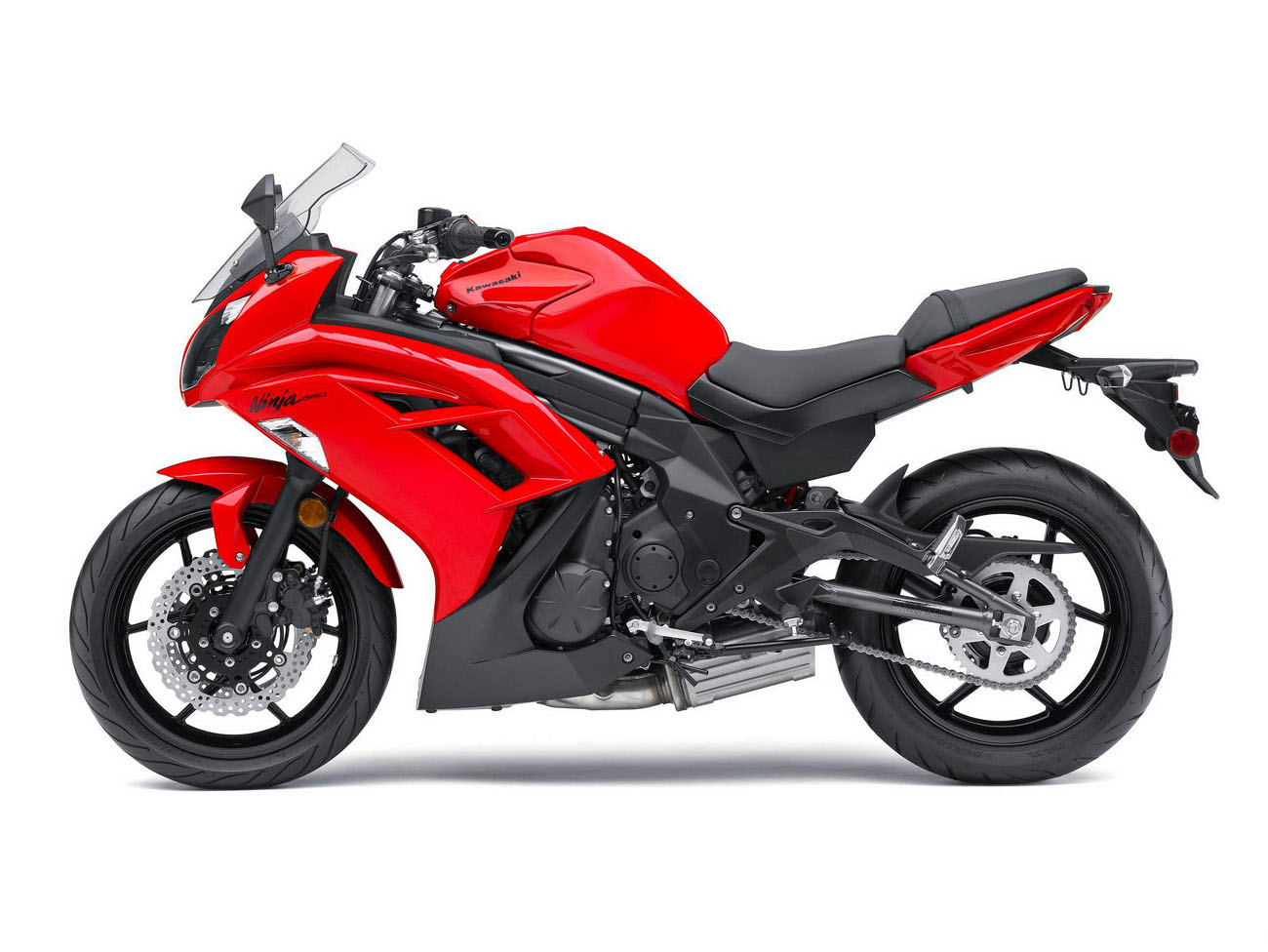
41mm hydraulic telescopic fork 120mm 4.9 in wheel
travel.
Rear Suspension
Single offset laydown shock with adjustable
spring preload, 130 mm 5.1 in wheel travel.
Front Brakes
2x 300mm discs 2 piston calipers
Rear Brakes
Single 220mm disc 1 piston caliper
Front Tyre
120/70 -ZR17
Rear Tyre
160/50 -ZR17
Seat Height
805 mm / 31.7 in
Wet
Weight
208 kg / 460.8 lb
Fuel Capacity
16 Litres / 3.5 gal.
They’re known as “sweet spot” motorcycles:
streetbikes so balanced, user-friendly and all-around capable that they stand
well above their two-wheeled counterparts, forging lasting reputations as
exciting, practical and stylish machines.
There aren’t many such overachievers in today’s narrowly focused two-wheeled
world. Since its debut back in 2006, the multi-talented Ninja® 650R has been a
bona fide member of this elite group, winning accolades from owners and media
alike. But for 2012, the massively reworked Ninja 650 is better than ever.
This practical sportbike features a raft of new technology and design elements,
including a totally new perimeter-style frame, revised suspension, more angular
bodywork, new instrumentation, improved engine performance, a more comfortable
saddle, lower seat height and much more. The new-and-massively-improved version
promises even more of the all-around capability that suits beginners and
veterans alike.
It all starts in the engine bay, where an advanced, highly compact,
liquid-cooled 649cc vertical twin works its magic with help from a digital fuel
injection system featuring 38mm throttle bodies and sub-throttle assemblies for
optimum response and precise fueling. The ultra-narrow engine produces
substantial power with plenty of character – especially down low and in the
mid-range – from an impressive array of technology, including double overhead
camshafts acting on eight lightweight valves. Lightweight pistons run in plated,
linerless cylinders, while a 180-degree crank assembly – coupled with a balancer
shaft – maintains a surprising level of engine smoothness.
This has always been a brilliant streetbike engine – torquey, smooth, and
blessed with impressive top end performance, yet enough satisfying low- and
mid-range oomph to please novices and experts alike. But this year it’s even
better thanks to key exhaust system changes, including a header-section
connector pipe and a three-chamber muffler design. The high-rpm rush remains,
but Kawasaki engineers have pushed additional power down into the mid-range
zone, which results in even more all-around usability and in-town
responsiveness. Figure in the Ninja 650 engine’s estimated 50-mpg* fuel economy,
precise fuel injection and its pleasing twin-cylinder throb, and you’re looking
at what just might be the most flexible and satisfying streetbike engine on the
planet.
Wrapping around that wonderfully usable engine is an all-new twin-pipe perimeter
frame that offers increased rigidity vs. the old Ninja’s trellis layout, yet
retains the narrow-waisted design that results in a comfortable reach to the
ground. The new frame is slim, light, compact and aesthetically pleasing, while
a swingarm with forged axle holders lets the rear wheel arc through its
suspension travel in style. The new backbone-type subframe also offers a 10
percent increase in maximum carrying capacity. Combined with revised suspension
settings front and rear, (there’s more ride comfort for 2012 from the 41mm fork
and single-shock rear end) the overall chassis setup – which includes Dunlop’s
new Roadsmart II tires – amplifies the “sporty-yet-comfortable” ethos that’s won
the Ninja 650 model so many fans over the years.
It’s a more comfortable machine, too, with a 20mm wider handlebar than the
previous version and a 2-piece seat assembly topped with foam that’s thicker
than before. Both the handlebar and saddle are rubber-mounted, along with the
footpegs, for even more vibration-free comfort. And while enjoying all that
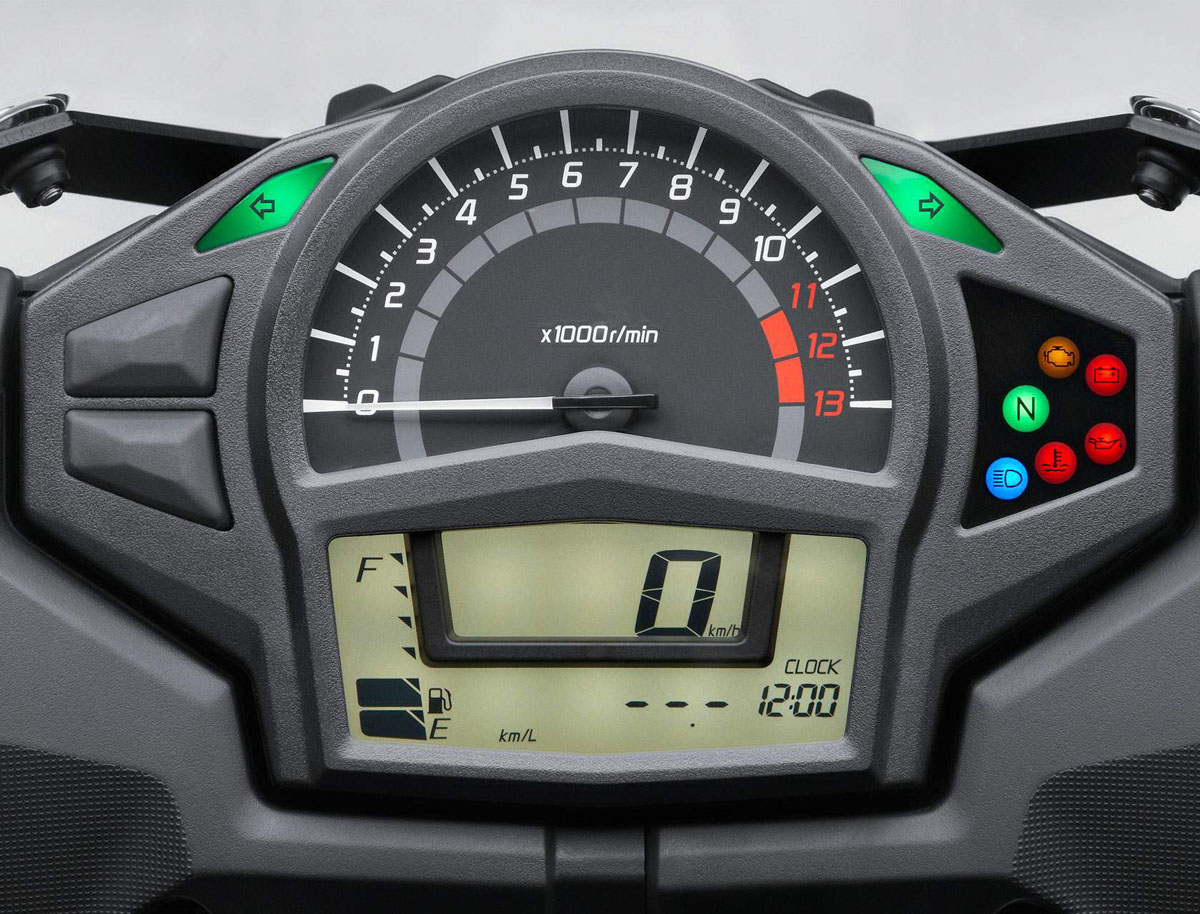
ergonomic goodness, you’ll gaze upon a new instrument panel featuring an analog
tachometer situated above an LCD info-center showing speed, trip meters, fuel
consumption, remaining range, etc., with a swath of info-lights to the right.
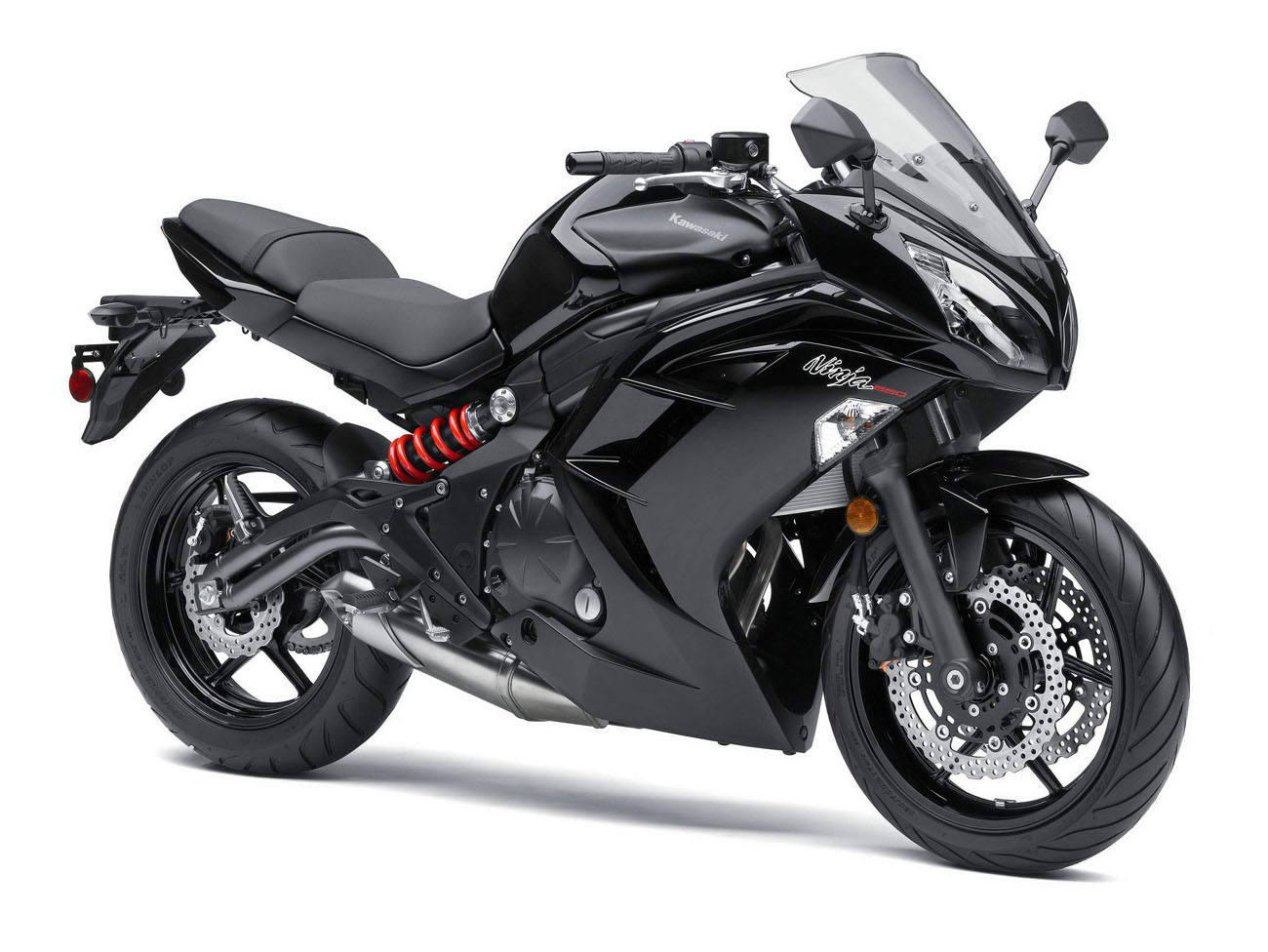
Folks watching you ride by will see a sleeker and more aggressively styled
motorcycle, as well. The all-new bodywork is more sharply defined and more like
our race-winning supersport machines, with flowing lines and a tapered brow that
blends nicely with the rest of the bike. The new body parts make the 2012 Ninja
650 more slippery from an aerodynamic standpoint, while an adjustable,
3-position windscreen allows riders to tailor the cockpit’s still-air cocoon for
maximum riding comfort. Engine heat is routed rearward more effectively than
before, as well, further adding to the comfort level.
It all adds up to one sweet mid-sized sportbike, one that works superbly for
novices and vets – not an easy feat. Pull away from a light and the 650’s
torquey engine, light-pull clutch and perfect throttle response make quick work
of the job. Crisp, linear brakes make slowing down a simple affair, while the
low seat height gives riders max confidence once stopped. And light steering and
maneuverability keep novices grinning all day long. Experts will love the new
Ninja’s powerful yet flexible engine, modern suspension, disc brakes and nimble
handling. And the new more aggressive styling looks like it’s going 100 mph,
even when sitting still.
The 2012 Ninja 650 really can do it all – whether it’s commuting, cruising,
touring or apex-strafing. Just like we said at the beginning: Sweet.
Kawasaki Ninja 650 ABS
Great Ninja styling, fun to ride and user-friendly
The Ninja 650R ABS offers a package that is both fun and easy to ride and
matches its street performance with aggressive Ninja Supersport styling. The
most apparent change for 2010 is the addition of ABS while sharp, aggressive
styling gives the bike the look of a modern supersport machine.
The 649cc fuel injected liquid cooled Parallel Twin is by far and away the most
compact in its category. The torquey engine revs quickly, adding to rider
excitement, and response is silky smooth, especially at low-mid rpm.
Sporty, easy to handle and wrapped in seductive Ninja supersport styling, the
new Ninja 650R ABS enables riders to experience the fundamental joy of
motorcycling.
Kawasaki Ninja 650 Features and Benefits
• Redesigned twin-pipe perimeter frame offers proper rigidity, stable handling,
a low seat height and improved aesthetics
• Twin-pipe swingarm assembly offers improved rigidity and maximum style
• Redesigned exhaust system features a new connector pipe, a higher-volume
3-chamber muffler assembly for improved mid-range while maintaining peak top-end
power, and a higher quality finish
• Redesigned bodywork features better aerodynamics, improved engine-heat
dissipation and sharper looks that identify with the flagship ZX™-14R
• Easier-pull clutch cable design for reduced fatigue and enhanced control
• Revised suspension settings and increased wheel travel front and rear offer
improved ride comfort while offering excellent compliance in varying situations
• Improved brake pads offer better braking performance and control
• New instrument cluster assembly features an analog tachometer and a digital
readout module for at-a-glance information transfer to the rider
• 20mm wider handlebar offers improved rider comfort and control
• Redesigned 2-piece seat assembly features thicker and wider foam for improved
comfort for rider and passenger
• Dunlop’s grippy yet durable Roadsmart II tires are standard
• Increased fuel capacity and more compact battery
• Liquid-cooled, DOHC, eight-valve fuel-injected twin cylinder engine delivers
smooth, responsive performance, especially in the low
• to medium-rpm range
• Additional mid-range power for 2012, produces exceptional roll-on response and
impressive passing performance, to help make even commuter traffic enjoyable
• Minimal vibration via a 180-degree crankshaft-driven balancer shaft, which in
turn drives the water pump
• Oil jets on the connecting rod big ends spray oil on the underside of the
pistons to aid cooling
• Lightweight plug-mounted ignition coils deliver a hot spark and save space
• High-capacity radiator for increased cooling efficiency
• Engine coolant travels directly to the engine cases, then follows internal
passages to the cylinder and head for minimum external plumbing and a simplified
cooling system
Digital Fuel Injection
• Fuel injection settings boost the engine’s bottom-end power while letting it
rev more quickly
• Sub-throttle valve equipped 38mm Keihin throttle bodies offer optimum
performance and rideability
• Located behind the main throttle valves, the sub-throttles are controlled by
the DFI® system’s ECU for a precise throttle response, similar to a constant
velocity carburetor
• Auto fast-idle system simplifies starting and helps ensure that the catalyzer
reaches optimum temperature quickly
• Lightweight fuel pump is mounted inside the fuel tank
Compact Engine Design
• Powerful twin-cylinder engine is the most compact in its category, which helps
reduce the dimensions of the entire motorcycle and allows use of a slim (and
all-new) twin-pipe perimeter frame
• Triangular setup of the crankshaft and transmission shafts makes the engine
dimensionally short front-to-back
• Transmission input shaft, output shaft and gear-change drum are contained in a
cassette-style package that allows a compact layout and eases transmission
maintenance
• Semi-dry sump design reduces engine height
• Plated, linerless aluminum cylinders with a narrow cylinder pitch keep the
engine light and slim
Low Emissions
• Efficient fuel injection and a three-way catalyzer inside the exhaust produce
very low emissions, able to pass stringent Euro III emissions regulations
• 300-cell catalyzer is compact and light
• Under-engine muffler placement aids mass centralization and yields a low
center of gravity
Vibration Control
• Rubber-mounted seat, handlebar and footpegs (rider’s and passenger’s) keep
vibration low and comfort as high as possible
Rigid Twin-pipe Perimeter Frame
• Slim, low, lightweight, rigid and compact frame design is narrow at the knees
and footpegs (50mm narrower for 2012) for optimum rider comfort and control
• The strong steel perimeter frame wraps around the engine for optimum rigidity,
rivaling that of all-aluminum designs
• Optimal frame rigidity is achieved through extensive computer analysis, which
translates to superb handling and wheel control
• The new frame and swingarm designs flow together well aesthetically, and work
with the revised suspension settings to offer maximum wheel control
• Short front-to-back dimensions of the engine allow for a longer swingarm and a
shorter wheelbase, which contributes to the new Ninja’s light and nimble
handling
• Clean frame joint weld finishes highlight the bike’s overall quality and
attention to detail
Stylish Twin-Pipe Swingarm
• New swingarm is tuned to complement the new frame’s flex and rigidity
characteristics
• Swingarm’s upper right tube has a D-shaped cross section for strength and
light weight
• Swingarm shape and design contributes to the Ninja 650’s high-quality
appearance
Suspension
• Revised settings on the 41mm conventional fork and preload-adjustable laydown
shock offer more travel for improved ride comfort and exceptional wheel control
• Fork lower ends around the axle shaft add to the bike’s performance and
enhance its high-quality image
Comfortable, Confidence-inspiring Ergonomics
• A 20mm-wider handlebar, new 2-piece seat (wider and thicker foam for 2012) and
optimal footpeg placement result in a comfortable and natural riding position
suiting a wide range of riders
• New backbone-type subframe offers a low seat height and a narrower footpeg
placement for improved control and comfort, making the reach to the ground even
easier
• The offset single-shock rear suspension layout along with a smaller battery
for 2012 allows a lower seat height as well
• This low seat height and slim overall design make it easy to plant both feet
firmly on the ground when stopped – a bonus for newer riders
Triple Disc Brakes
• Dual 300mm front petal-shaped disc brakes with twin-piston calipers and a
single 220mm rear petal-shaped disc deliver plenty of braking power, especially
with the addition of grippier brake pads for 2012
• Front brake master cylinder features a 14mm piston for smooth actuation
Sleek, Supersport-inspired Bodywork
• A dual headlight design within the new fairing’s angular snout features
multi-reflector bulb hoods and twin position lights – like its Ninja supersport
brethren
• A 3-way adjustable windscreen deflects air away from the rider, creating a
still-air envelope and reducing wind buffeting at higher speeds
• Redesigned – and larger-capacity – fuel tank meshes perfectly with the
radically shaped new fairing
• Distinctive Ninja supersport design elements enhance the new Ninja 650’s
sporty image and compact appearance
• Integrated front turn signals feature clear lenses and amber bulbs
• A sleek tail cowl featuring a thin LED taillight accentuates the new
bodywork’s radical appearance
• Inner rear fender helps keep the underside of the tail cowl clean
• Turn signals also function as flashing hazard lights
• A redesigned front fender minimizes water splash, while its shape matches the
Ninja 650’s new bodywork package
• Supersport-type mirrors – like those on Kawasaki’s ZX-10R and 6R – accentuate
the new bike’s aggressive positioning and aesthetics
6-Spoke Aluminum Wheels
• Attractive six-spoke supersport-style wheels augment the bike’s lightweight
look and reduce unsprung weight for superb suspension action
Instruments/Controls
• All-new multi-function instrumentation includes a fuel gauge, digital
speedometer, clock, odometer, dual trip meters, economical riding (ECO)
indicator, and an analog tachometer above the LCD info-pod
• Clock and trip meter can be viewed simultaneously
• Easy-to-read LCD screen offers riders quick, at-a-glance information on a
variety of systems
• Ignition switch is now located at the top of the tank assembly, which gives a
clearer view to the Ninja 650’s newly designed instruments
Review
Story by: Gabe Ets-Hokin, Feature Editor, January
2006
Today's story starts way back in 1987, when Honda introduced an unpretentious
little motorcycle with a mildly-tuned, liquid-cooled 647cc V-twin engine in a
rigid aluminum frame. Priced almost as high as its fully-faired and much more
powerful cousin, the 600 Hurricane, the Hawk GT sold about as well as Ann
Coulter t-shirts at a Phish concert. However, savvy enthusiasts quickly
recognized that with a few choice suspension and engine modifications, the Hawk
was an incredibly sweet-handling and fun bike that did double duty as a
lightweight racer. Many racing clubs had classes filled completely with Honda
Hawks, as no other manufacturer made a middleweight twin with the Hawk's
potential.
That all changed in 1998, when Suzuki introduced the SV650. With a stiff
aluminum frame and swingarm and modern suspension and wheel sizes, the SV was
virtually as good as a heavily modified Hawk right out of the showroom. The
icing on this cake was a smooth, four-valve liquid-cooled 90-degree V-twin that
made 68 hp with a stock exhaust, a power output that a Hawk could achieve only
by being a heavily breathed-on grenade. By the end of the 1999 racing season,
Hawks were winning races only in the hands of the most skilled and dedicated
riders. The popularity of the SV as a street bike ensured a steady supply of
cheap race bikes, and seven years later, club racing grids are packed with
SV650s.
Sean went out on the Suzuki first to scuff in the new tires. When he came back,
he was all smiles...
Last year, Kawasaki showed an interesting bike built for the European market.
The ER-6n is a naked standard with a steel trellis frame and a sophisticated
650cc parallel-twin motor. Power output was claimed at 69.7 hp, clearly
targeting the second-generation SV's 71.1 claimed hp. The weird styling and lack
of full fairing meant this bike probably would never come to American riders.
Imagine our surprise when we got invited to the introduction for Kawasaki's
all-new for 2006 Ninja 650R. Pete's day aboard the new bike revealed a
nice-handling little bike that was let down only by budget suspension and
braking components. We also found out that a unit would be available for a full
test in just a few weeks.
We knew our readers would want to know how this bike -- the first serious
competition for the SV available in the US -- would do against the Suzuki twin,
so we called up Suzuki and begged for an SV650 to test as well. All we had to
decide was which flavor SV to compare it to. Some of us felt the standard SV
would be a closer match, as the Kawi has tall bars that would feel very
different from the S model's clip-ons on a racetrack, where the other school of
thought held the majority of readers would feel only bikes with fairings should
be compared, as a buyer in the market for a faring-ed bike wouldn't consider a
naked, and vice-versa. In the end, the fairing people won, and Suzuki graciously
and kindly gave up a fresh-from-the-crate 2006 SV650S.
Both Publisher Sean Alexander and I are club racers and trackday junkies with
many miles on SV650s, so we wanted to see how the two bikes stacked up on the
racetrack. A few phone calls secured us a trip to the Streets of Willow
racetrack, courtesy of Hyperclub trackdays, and a call to Michelin got us two
new sets of Pilot Power street/trackday tires.
After a week of all kinds of riding, from the track to the canyons, from bumpy
LA freeways and city streets to the smooth sweepers of the Angeles Crest, we
think we have enough data to have an intelligent opinion on who makes the best
650 twin streetbike. Does the Kawi have what it takes to unseat the SV from its
middleweight-twins throne?
The Contenders
2006 Suzuki SV650S :: 71.15 hp :: $6,449 :: Friendly and Furious
Completely revamped for 2003, the SV650S is an awful lot of motorcycle for
$6,449. It uses the same basic formula that was so successful in 1999 with just
enough tweaks to keep it fresh and modern.
The heart of the SV is the liquid-cooled, four-valve per cylinder V-twin motor.
It uses an 81 mm bore and 62.6 mm stroke and precise electronic fuel injection
to pump out 71.15 hp at 9,000 rpm; an unheard of number from a stock 650 twin
not so long ago. The Vincent Black Shadow -- one of the most feared bikes ever--
made less than that. Do you still dismiss this as a "beginner" bike?
If only a Vincent had such a good chassis. The SV's "truss"-style frame was
all-new for 2003, with a boxier, more creased appearance than the old one. It
retained the aluminum swingarm and linkage-type rear suspension of the old bike,
along with a 41 mm damper-rod fork. The front and rear suspensions are
adjustable for preload only. Wheels are 3-spoke aluminum jobs shod with Dunlop
D220s, a 120/60-17 in front followed 56.3" behind by a 160/60-17 rear. Braking
is handled by a trio of Tokico two-piston sliding-pin calipers and 290 mm front
discs- the rear disc is 220 mm.
Perched on top is 1980's-esque bodywork with lots more sharp edges. Our 2006 was
in a fetching shade of red, the bodywork contrasting nicely with the black frame
and wheels. There are plenty of amenities, like a metal grabrail for your
passenger and a hazard light. The LCD speedometer sits above the tachometer. As
a bonus, you can view the coolant temperature and clock at the same time. The
bike weighs in at a claimed dry weight of just 372 pounds.
Aside from the Duran Duran-esque fairing and five extra Ben Franklins, the S
differs from the standard version of the SV650 by having higher and more rearset
footpegs, low clip-on handlebars, a slightly shorter swingarm, and taller
gearing. It's a complete package that looks like something much more powerful,
expensive and sophisticated than it is, which partially explains the bike's
continuing success. What does the Ninja need to surpass it?
2006 Kawasaki EX650R :: 65.65 hp :: $6,299 :: Meet The New Kid
Lest Pete's endurance of the long tech briefing go in vain, check out his
coverage of the 650R's press introduction. If you'd rather have me give you a
quick rundown, we'll start with the motor.
Kawasaki's engineers faced a daunting task: make a motor that matches the SV's
power output without making a peaky mess that intimidates novice riders while
saving enough money to keep the price competitive. One way to do this is to use
a parallel twin powerplant. A single cylinder head saves money in many ways:
there's only one cylinder block, one cam chain, one cam chain tensioner, two cam
shafts instead of four, and so on. Additionally, it's more compact, saving mass
and making it easy to package.
To inform you cynics out there, it's not a bored-and-stroked EX500 motor. With a
very oversquare 83 mm bore and 60 mm stroke, it's a much more compact and modern
design, with a cassette-style gearbox, semi-dry oil sump and liner-less
cylinders to make it smaller than the 500. A 180-degree crank and balance shaft
keep it smooth, and 38 mm injectors directed by a microprocessor-controlled
engine management system keep it precisely fueled.
The motor nests in a slick red-painted steel trellis-style tube frame that's
designed to be narrow, light and compact. The most remarkable feature of the
frame is the "laydown"-style rear shock adjustable only for preload (but
incredibly easy to adjust- you don't even have to bend over). The 41 mm
damper-rod fork is non-adjustable.
Brakes and wheels are nothing fancy. The six-spoke wheels sit just 55.3" apart
and carry Bridgestone BT-020s, a 120/70-17 in front and a 160/60-17 on the back
hoop. The brake calipers look just like the two-piston units on the SV, but with
the fashionable "petal"-style 300 mm rotors like those found on the ZX-6R and
ZX-10R.
It's wrapped up in a muted, sophisticated fairing with a chest-height windscreen
and integrated turn signals. Large integrated footpeg brackets carry the rider
and passenger pegs on one immense unit, which will be challenging for racers to
modify. The seat is carefully styled to blend in with the bike's lines and is
very narrow and low at the front, but thickly padded and wider at the rear. The
handlebars are high and pulled back, but not too wide.
...For $6,299, this is a nicely-finished, good-looking bike.
Instrumentation is a bit spare, with no temperature gauge to distract the rider.
There is a clock, dual tripmeters, and hazard lights as well. The build quality
is just OK; the unit appears nicely designed, but the plastic is thin and some
plastic panels have unsightly gaps and seams. Still, for $6,299, this is a
nicely-finished, good-looking bike.
NOTE: Some of the photos on
Motorcycle Specs are owned by somebody. If you see any of your
photos, you can let me know so that I can acknowledge it, or if
you object to it, I can remove it altogether. If any copyright
holder objects to their articles being placed on Motorcycle
Specs, it will be removed upon request. Any correction or more
info on these bikes will kindly beappreciated
Contact MePrivacy
Policy
Website Stats