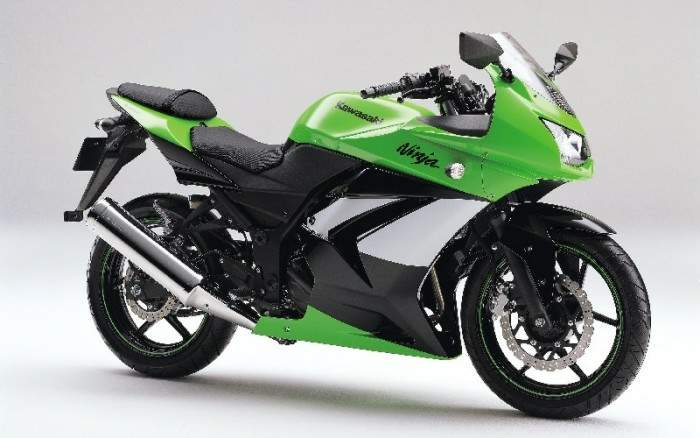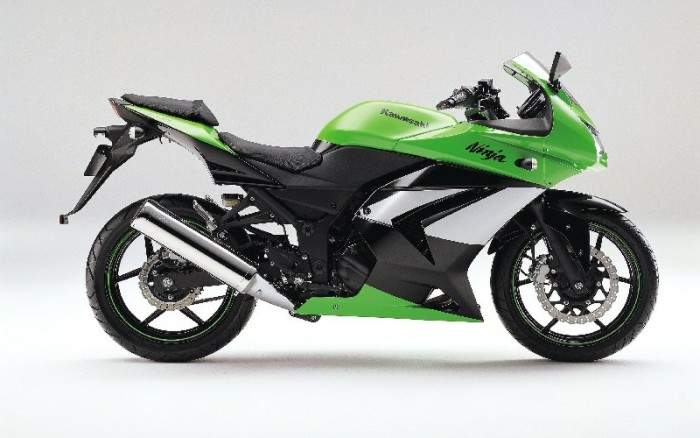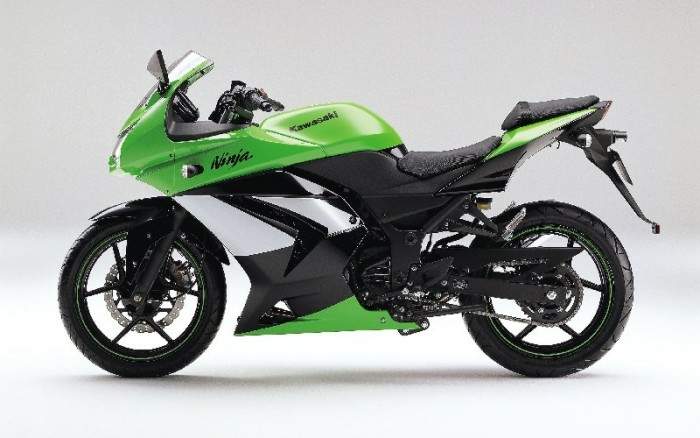
Kawasaki has introduced a limited edition Ninja
250R in Japan.
It has a great paint scheme with black side panels echoes the MotoGP ZX-RR.
Kawasaki has significantly re-engineered and
redesigned the venerable Ninja 250R for 2008.
Engine and chassis changes, new bodywork and a larger, more powerful front brake
are part of the new package. Here is the information from Kawasaki.
One look at the new Ninja 250R tells everyone that this bike is the genuine
article. With a new full-fairing similar to the Ninja ZX-6R and -10R supersport
bikes, a single kicked-up muffler, UNI-TRAK® rear suspension, high-performance
petal disc brakes and a dual seat, this is the most stylish performer in its
category.
Compact size, exceptional personality and a low price tag highlight Kawasaki’s
new Ninja® 250R quarter-liter performer. Considering how much fun it is to ride
and the fact that it’s the only 250cc sportbike sold in the U.S., it’s no wonder
the Ninja 250R has been a strong seller for over a decade. Its successful blend
of a rider-friendly engine, easy-to-operate chassis and supersport styling
worthy of its Ninja moniker, this model was developed to offer real world
performance to riders of all skill levels and goes to show that good things do
come in small packages.
At the core of the lightweight Ninja 250R is an engine that thrives on high-rpm
excitement. The gutsy 249cc parallel twin has been retuned to spice up its
smooth and predictable power delivery. It now offers more low- and mid-range
torque thanks to revisions to its dual overhead camshafts and a new 2-into-1
exhaust system. A silky smooth six-speed transmission tops off the sportbike
equipment list, enabling the 250R to exploit a powerband that’s sure to please
riders with its beginner friendly low-end grunt and a lively top-end rush
that’ll keep seasoned veterans satisfied. The coup de’ grace, is its ability to
deliver excellent fuel economy.
The 250R’s new fairing and windscreen not only look great, they deliver improved
wind protection for a wide range of riding situations. This lightweight
sportbike is loaded with even more rider-friendly features such as an
easy-to-read instrument panel and positive neutral finder.
A natural riding position and comfortable ergonomics combined with its
lightweight handling, easy controllability and improved throttle response make
the 250R a pleasure to ride on city streets. Also new for 2008 are larger
17-inch wheels that offer great handling and improved stability. A larger 290mm
front brake rotor is gripped by a powerful 2-piston caliper to provide a healthy
dose of stopping power with a responsive feel at the lever. Like Kawasaki’s
other sport models, the Ninja 250R is fitted with petal discs for efficient heat
dissipation.
The simple formula of providing easy-handling agility, lightweight
responsiveness, and low ownership costs make the Ninja 250R a force to be
reckoned with in the entry-level sportbike category.
Review
Quick. Name the best-selling
Kawasaki motorcycle in the United States in 2007.
The ever-popular and recently redesigned KLR650? The flagship Ninja ZX-10R
sportbike? Maybe the Vulcan 900 Classic, an affordable cruiser?
No. While all those bikes rank in the top 10, Kawasaki's best selling model last
year was the Ninja 250. And just as Kawasaki waited 20 years to redesign its
popular KLR650 dual-sport, it let the smallest Ninja languish virtually
unchanged from 1988 to 2007.
Can you blame them? Why mess with success?
Well, one reason to mess with success is to make it even better, and
fortunately, that's what Kawasaki has done with the 2008 Ninja 250R.
While the changes for 2008 run through every part of the motorcycle, the
exterior facelift demands immediate attention. The Ninja 250 was right in the
mainstream of sportbike styling when it first came out in the 1980s, but trends
moved on as the 250 stayed put, and nostalgia doesn't play in the sporting world
the way it does in the cruiser world.
For 2008, the Ninja 250R gets sleeker bodywork, a two-piece seat (the rear seat
cowl shown in some of the photos is a $99.95 option) and a single exhaust
canister, all of which bring the look smartly up to date. In fact, with bodywork
determined more by styling than by the aerodynamic concerns dictated by racing,
the smallest Ninja will actually be more attractive to many eyes than its more
rounded 600cc and 1,000cc siblings.
As soon as you settle into the 250R's seat, you notice a couple of additional
differences from its bigger brothers. For one, although the seat is slightly
higher than before, at 30.5 inches, it's narrow and still allows even shorter
riders to get both feet on the ground. With the majority of Ninja 250 buyers
being first-time riders (and 33 percent being women), user-friendly ergonomics
are important.
Which brings us to a second difference from the bigger sportbikes. The riding
position is more sport-touring than sportbike in feel. The rider leans forward
just slightly and leg room isn't cramped for anyone under six feet in height.
Ninja 250 riders told Kawasaki they use their bikes mostly for riding around
town, backroads excursions, commuting and shorter weekend trips, and this riding
position matches that mission, especially for urban use, better than a
racetrack-oriented sportbike crouch would.
Past Ninja 250 owners said they wanted a fuel gauge, so Kawasaki gave them a big
one. It's as prominent as the tachometer, which makes the gauge cluster a little
unusual in the sportbike world. The small tachometer is still easy enough to
read, however.
And you will want to keep an eye on it. You just don't have to monitor the tach
as closely as before.
That's because much of Kawasaki's work in redesigning the engine was aimed at
providing more low-end and midrange torque. Revving the old Ninja 250 was fun,
but also essential for forward progress.
Kawasaki updated the head of the engine with reshaped intake and exhaust ports,
a newly shaped combustion chamber and thinner valves. Cam timing was also
revised.
The 250R uses two Keihin carburetors, with the jetting revised for the new
engine. Informed readers will wonder why the U.S. version doesn't come with the
fuel injection system found on the 250R in Europe. The answer is on the price
tag.
When Kawasaki asked Ninja 250 buyers to rank the level of importance of
different aspects of the bike, they placed "price" number one. That's not the
case for any other motorcycle Kawasaki sells in the U.S. market.
"We had a choice," said Kawasaki's Karl Edmonson. "We could have carbureted or
fuel injected. To keep the cost down, we went with carbureted."
Meanwhile, the company's European division felt it needed fuel injection to be
able to sell the 250R in Europe. Either way, emissions is not a problem and the
250R is 50-state legal. Its new exhaust system includes two catalyzers.
Along with the additional power from the engine redesign, the 250R got more
stopping power with a slightly larger single disc up front and petal discs front
and rear. The Kayaba rear shock is now adjustable for preload.
Oh, and one more change that will bring cheers from knowledgeable riders. The
Ninja 250R gets 17-inch wheels in place of the old 16-inchers. In addition to
better stability, the modern-size, six-spoke wheels allow a greater choice of
tires.
"This is probably the thing that has had the biggest impact on making this feel
like a different motorcycle," Edmondson said of the switch to 17-inch wheels.
While I personally haven't had much experience with the former Ninja 250, test
riders who owned the old version and sampled the 2008 model at the press intro
in San Diego were quick to confirm Edmondson's assertion that the 250R feels
like a different motorcycle.
We rode the bike the way Ninja 250 buyers say they ride: On city streets,
jumping onto the freeway to get out of town, looping some tasty backroads --
everything except riding to work (luckily for us).
Pulling onto a southern California freeway on a 250cc motorcycle, there's reason
to wonder about the bike's ability to keep up with traffic. No problem, as it
turns out. About 8,000 rpm in sixth gear will have you speeding on any highway
in the country, and the Ninja pulls to its 13,000 rpm redline. The additional
power is crucial on the highway, and makes the 250R a far more versatile bike.
You still have to plan passes in advance with a downshift or two, but really,
you can ride this bike anywhere there's pavement.
Venturing onto curvier roads, the Ninja's light weight pays off. There's nothing
exotic here. Non-adjustable (except for rear pre-load) suspension, a single
brake disc at both ends and bias-ply tires. But you don't need much exotica when
you have well under 400 pounds of motorcycle to accelerate, turn and stop and a
modest 16.2 foot-pounds of torque twisting the rear wheel.
The wide-spaced hand grips and narrow tires add to the nimbleness and the disc
brakes provide plenty of stopping power. The footpegs are high enough that
you're unlikely ever to scrape pavement. And while you need to keep the revs up
above 8,000 rpm if you want to keep forward momentum going at a brisk pace,
that's not a bad thing. I predict that new riders will actually hone their
skills faster on a small bike like the 250R than they would on a bigger machine.
If you're in the wrong gear, you can't just twist the throttle harder to get out
of the hole you dug for yourself.
Fortunately, the six-speed transmission shifts easily and I never had trouble
finding neutral at a stop.
If I could suggest any areas for improvement, I'd look at the seat and the
clutch. The seat is narrow, to help shorter riders get two feet firmly on the
ground, and it starts to feel a little hard on longer rides.
More importantly, the clutch lever's engagement point is pretty close to the end
of its travel, the reach is typical of most motorcycles and the pull effort is
heavier than I'd expect for a small bike. A shorter reach would be helpful to
many of the women riders buying the Ninja 250, and a lighter pull and broader
range of engagement would help new riders learn clutch-throttle coordination.
Some riders said a little adjustment improved the clutch. It might be a good
idea for new riders to make sure the dealership pays extra attention to getting
the clutch adjusted just right before the bike leaves the showroom.
The bottom line is that the improvements for 2008 make the Ninja 250R a more
broadly usable bike than ever before, one that's aimed at exactly the types of
riding that past buyers say they use their motorcycle for: around-town
transportation, commuting, weekend sorties in search of fun. For an MSRP of
$3,499, less than the price of similar-size scooters, buyers can get a real
motorcycle that's cheap to buy, cheap to insure, cheap to keep filled with gas
and will take you wherever the road leads.
The Ninja 250 has introduced thousands of newcomers to the joys of riding. Many
of them moved on to bigger bikes. New riders will still get their first taste of
street riding on the Ninja 250R. But now, more than ever, the Ninja 250R is all
the motorcycle some riders will need.
NOTE: Some of the photos on
Motorcycle Specs are owned by somebody. If you see any of your
photos, you can let me know so that I can acknowledge it, or if
you object to it, I can remove it altogether. If any copyright
holder objects to their articles being placed on Motorcycle
Specs, it will be removed upon request. Any correction or more
info on these bikes will kindly beappreciated
Contact MePrivacy
Policy
Website Stats